• About Us
    • What Is Street Harassment?
    • Why Stopping Street Harassment Matters
    • Meet the Team
      • Board of Directors
      • Past Board Members
    • In The Media
  • Our Work
    • National Street Harassment Hotline
    • International Anti-Street Harassment Week
    • Blog Correspondents
      • Past SSH Correspondents
    • Safe Public Spaces Mentoring Program
    • Publications
    • National Studies
    • Campaigns against Companies
    • Washington, D.C. Activism
  • Our Books
  • Donate
  • Store

Stop Street Harassment

Making Public Spaces Safe and Welcoming

  • Facebook
  • Instagram
  • Pinterest
  • Tumblr
  • Twitter
  • YouTube
  • Home
  • Blog
    • Harassment Stories
    • Blog Correspondents
    • Street Respect Stories
  • Help & Advice
    • National Street Harassment Hotline
    • Dealing With Harassers
      • Assertive Responses
      • Reporting Harassers
      • Bystander Responses
      • Creative Responses
    • What to Do Before or After Harassment
    • Street Harassment and the Law
  • Resources
    • Definitions
    • Statistics
    • Articles & Books
    • Anti-Harassment Groups & Campaigns
    • Male Allies
      • Educating Boys & Men
      • How to Talk to Women
      • Bystander Tips
    • Video Clips
    • Images & Flyers
  • Take Community Action
  • Contact

France: New Anti-Harassment Transit Campaign

November 9, 2015 By HKearl

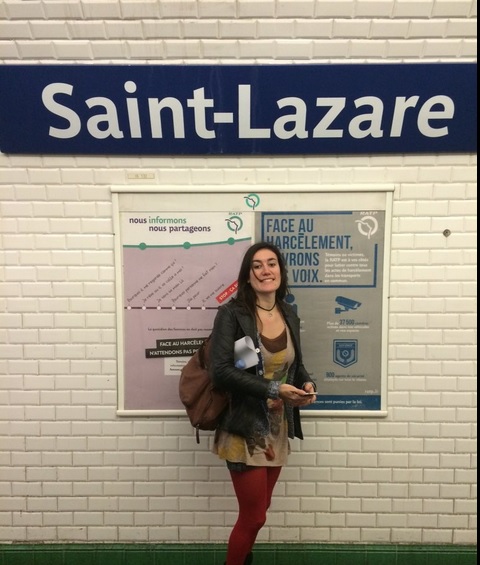
A member of Stop Harcèlement de Rue - by the new French anti-harassment transit campaign
A member of Stop Harcèlement de Rue – by the new French anti-harassment transit campaign

France just rolled out a nationwide anti-harassment transit campaign!

Info via The Local FR:

“Stop – That’s Enough!”

This is the tagline used by the French government in an active push to stop sexual harassment on public transport.

The government launched the awareness campaign on Monday together with rail operator SNCF and Paris transport chiefs RATP.

It will see flyers handed out and a set of posters put up in key places around the capital, encouraging victims and witnesses to speak out with confidence about sexual harassment.

The campaign also aims to remind the culprits that sexual harassment is punishable by law and groping can lead to five years in prison….

Outspoken French feminist group Osez le Féminisme! was one of the organizations behind the push to get authorities to take notice, and welcomed the move on Monday.

“I’ve seen the posters everywhere in the subway now, it’s great that the public service takes this point so seriously,” one of the group’s members, named Aurelia Speziale, told The Local on Monday…

The campaign has taken to several channels to push the message, including encouraging women to share their experiences on social media with the hashtag #HarcèlementAgissons (“Act now against harassment”). The topic was trending on Twitter in Paris on Monday morning.

Other measures saw the implementation of the emergency number 3117, which can be used to report cases of harassment, and to trigger the intervention of security staff. It will soon work via text message too for situations when women aren’t able to speak on the phone.
Night buses in western France’s Nantes have also introduced “on demand” bus stops, meaning people can get off the vehicle as close to their home as possible rather than at the bus stop with everyone else….

When its survey of 600 women in Seine-Saint-Denis and Essonne, two areas in the outer suburbs of Paris, revealed shocking responses. It found that 100 percent of the women said they had experienced at least some form of gender-based sexual harassment in their life while riding the train.”

In Lille in northern France, Ville Sans Relou released a video showing some of the comments that people have been subjected to while out and about in Lille. The video, with English subtitles below, sees one woman recount how someone asked her “Hi, can I rape you please?”…

 

Share

Filed Under: News stories, public harassment Tagged With: france, transit campaign

Egypt: Comic Stories Against Harassment

October 29, 2015 By HKearl

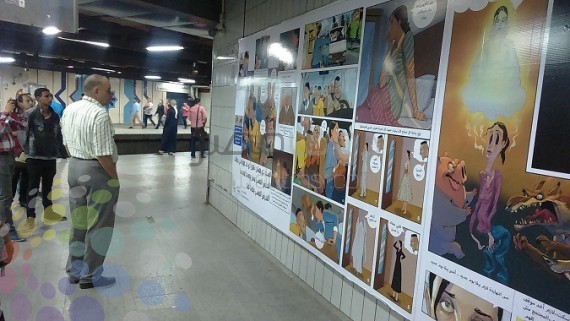
Imprint Movement's new campaign. October 2015

Our friends at Imprint Movement, in collaboration with Al-Moltqa for Consulting and Training, launched a new anti-harassment campaign in Cario’s subways yesterday.

Their press release says:

“The campaign aims aims to communicate to subway passengers and security personnel how sexual harassment affects the entire Egyptian society and not only the girl or the woman who gets sexually harassed.

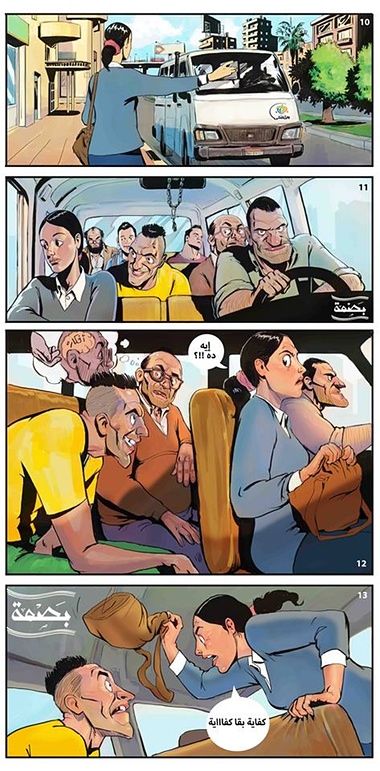
Imprint has chosen a new approach to draw attention, “Comic Stories”. The comic stories address the challenges that women face created by sexual harassment, the victim blaming culture, to what extend do women and girls feel safe in public space, reactions of the public, its reflection on her personal and professional life and how that effects the entire society. Many posters will be put up to show how the crime of sexual harassment increases when the public don’t interfere to support the girl/woman who get sexually harassed.
The comic story will be circulating around the Cairo subway, It’s Now at Al-Shohadaa, Then it will take place at Mohamed Naguib then Al-Sadat and finally Al-Attaba  metro stations. Twelve posters will be put up at Helwan University station, Manshyet Al Sadr Station and Cairo university station as these station are considered to have the most activity and gets huge amount of people daily.

The launching of “What will you do?” campaign is 24th of October, 2015 and ends on the 15th of February 2016.”

Congratulations to them on this innovative campaign!

Learn more about the campaign and see photos here.

Via the Guardian: An illustration depicting a young woman’s experience on a minibus. Illustration: Ahmed Nahby/Mada Masr/Imprint

UPDATE: The Guardian has a great feature article about their campaign. Here is an excerpt:

“Imprint, the organisation behind the campaign, has been raising awareness of sexual harassment through events ranging from one-on-one conversations to workshops, co-founder Abdel Fattah al-Sharkawy explained.

He said participants – both male and female – often found they weren’t aware of what constitutes sexual harassment, and rarely related the term to their own day-to-day experiences.

‘We wanted to make that link’ through the comic campaign, he said.

The group decided to work with comics because ‘they’re catchy and colourful’, drawing people of all ages in to explore the stories they tell, Sharkawy added.

Another image from the series shows male passengers on a minibus reacting to the young woman.

‘This woman can be an influential person in your life,’ the illustration reads. ‘Sexual harassment doesn’t harm her alone, it harms us all.’

They differ from typical public service announcements because they rely on storytelling instead of propagandistic slogans, so they ‘make you think and form an opinion,’ he said.”

Share

Filed Under: News stories, Resources, street harassment Tagged With: Egypt, imprint movement, transit campaign

Costa Rica: A Protest, a Law, and a Campaign Targeting Men

October 26, 2015 By HKearl

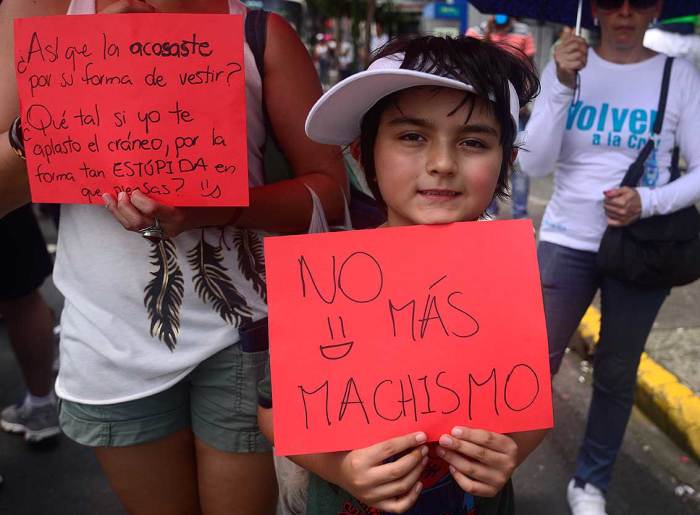
A boy holds a sign reading “no more machismo” during the “Gracias a Gerardo” march in downtown San José. Lindsay Fendt/The Tico Times

This has been a busy month in Costa Rica.

Last week there was a march against street harassment.

Via the Tico Times:

“More than 100 people wearing white and carrying signs marched in the Costa Rican capital San José on Sunday morning to protest against sexual harassment in public places, or street harassment. They also marched in solidarity with the family of Gerardo Cruz, a young man who was stabbed shortly after publicly shaming another man for lewd behavior in the street…

Marchers said they came out for several reasons, ranging from support for the Cruz family to making a stand against sexual harassment and machista culture.

“I came because I’m a mother and I want to support a better world for my daughter and show respect for all the women in the country,” said María Gutiérrez, a 33-year-old judicial branch worker who pushed a stroller with her baby.

Rebeca Pérez, a 33-year-old makeup artist, was there wearing white with her son, Aaron. “I’m here because I want to show my son that we [women] deserve respect, and to set a good example for him, not the negative ones we see every day.”

Pérez said the first time she got harassed in the street was in front of her home when she was 9 years old. A man approached her and started asking her questions about sexual development, she said.

“I hope there’s a change,” she said, carrying a sign that read, “If we teach our children, street harassment will end.”

This month, the women’s rights group Colectivo Acción Respeto Costa Rica and other organizations launched an initiative to draft and submit a bill for criminalizing catcalls and other forms of sexual harassment in public spaces.

Via the Tico Times:

“The groups announced their proposal during a press conference at the Legislative Assembly where lawmakers from the ruling Citizen Action Party (PAC), National Liberation Party (PLN) and Broad Front Party (FA) offered support to promote the adoption of the draft. Among its main goals the initiative asks for the inclusion of street harassment as an offense in the country’s Penal Code.

Alejandra Arburola Cabrera, a spokeswoman with the Colectivo, told The Tico Times that they started working on the initiative months ago, however the recent stabbing of Gerardo Cruz prompted them to speed up the discussion and include lawmakers and citizens.

Cruz was stabbed twice one day after he posted on his Facebook profile a video he shot of another man recording video with his cellphone up the skirt of a female pedestrian in downtown San José. Cruz has since undergone three surgeries and currently remains at Calderón Guardia hospital.

Arburola said Cruz’s case is a reflection of the reality that haunts women from the moment they leave their houses everyday. “We are seen as objects, with no rights and submitted to constant violence. This needs to stop as soon as possible,” she said.

Tuesday’s meeting also allowed the groups’ leaders to call on all citizens to participate in the drafting of the bill, following a number of priorities identified by the group in recent months.

Among them, they believe the bill should clearly define street harassment based on gender or sexual orientation as a criminal offense punishable with prison sentences…

This isn’t the first time Costa Rica considers penalizing street harassment. In 2005, then-Costa Rica legislator Gloria Valerín Rodríguez (Social Christian Unity Party) introduced a bill that would have added street harassment against women to Costa Rica’s penal code.

Valerín proposed a fine of 30 to 50 days minimum wage for perpetrators. The bill was unsuccessful.”

There is also a new social media campaign in Costa Rico to engage men in the issue. The Ombudsman’s office, the National Institute for Women and NGO “El acoso callejero no es cosa de hombre” (Street sexual harrasement is not a man’s thing) launched “videos and messages from artists, athletes, journalists and other personalities saying that real men don’t catcall, make obscene gestures, take pictures or videos on the street.”

Here is one of them.

Share

Filed Under: male perspective, News stories, street harassment

Croatia: Breastfeeding in Public is a Street Harassment Issue

October 25, 2015 By Correspondent

Marinella Matejcic, Croatia, SSH Blog Correspondent

Woman breastfeeding. Image via the Huffington Post

You know how, when we talk about street harassment, most people just assume that it involves a woman, a man and physical or verbal violence? Maybe you’ll react on the sentence you just read and say: but it can involve a trans* person, as well! You would be completely right, but that’s not the issue here.

I want to talk about another form of street harassment, the one that we’re not “ranting” about enough. It incorporates patriarchy, body shaming and street violence as we know it: breastfeeding in public. Everyday Feminism and HuffingtonPost have covered the topic, but are we paying enough attention?

Sometimes, it is amiss, depending on your location and whereabouts, as well as your feminism postulates, to talk about the relation of feminism and childbearing/caring. But if we talk biology, kids are something some women have, which is perfectly fine. The broader feminist community has to incorporate mothers into their stories and keep the whole “women, sisters” agenda as far as possible from crossing a woman because of her reproductive choices. We tend to talk about sexual and reproductive health and rights, but, from time to time, ignore actual women who decided to procreate.

Saying: “I’m fine with breastfeeding, but…” doesn’t portray you as an open-minded individual – that but is what distinguishes a valid opinion from discrimination.

Some people say that it’s a disgusting site to see. Breastfeeding is disgusting because a woman’s boob is out and the baby is, ugh, eating from it? How awful is that? I really don’t even want to get into that double-standards-patriarchy talk. There is no doubt that the patriarchy itself is the core problem of why do people consider that they are entitled to judge, give advice to or obstruct any women’s actions. But I don’t think that we should discuss this topic related to general hyper-sexualisation and acceptance of women’s breasts in the media and marketing industry. That is a waste of time and emphasizes the wrong notion that woman has to do something specific with her body in order to please the general audience and expectations. Forcing a person to somehow feel ashamed because of a personal process that isn’t hurting anybody is a form of oppression, you know?

Let’s sum it up: I’m talking oppression, feminism and sexualisation. What does nurture have to do with that and how can I justify this blog post on a site street harassment, when it is clearly about breastfeeding? It’s really simple: street harassment can be broadly defined but in every definition, it includes some force of violence in public space – and banning a mother from feeding her child is violence. Sexualisation of that act is violence. There was a great article on this on Everyday Feminism, called 8 Reasons Why the Policing of Parents Who Nurse in Public Is Street Harassment. It is a good read.

Somehow I just can’t get rid of the notion that by shaming a nursing woman, we’re sending signals that a woman’s body is here just for being tangled by society’s ideas on a woman’s position. It’s fact that basically, a woman produces food and feeds her baby in a most natural way, but is seen as daring to provoke the general public by claiming her own body! What nerve, huh? Again, oppression through shaming. Sound familiar?

At one point in my life, I was a breastfeeding mom as well and had to cope with comments like, “Why don’t you just breastfeed her in the toilet, it’s not a nice sight!” or “Are you sure, somebody might see you?” or even “But that’s a private thing, don’t publicize it,” on, I guess, a weekly basis.

By opting-in for the shaming of breastfeeding mothers in the street or in some shopping place (for instance, these security officers that harassed a bunch of breastfeeding moms at a mall, because they were such a threat to public moral and everything) you are perpetuating the culture of violence and street harassment. Maybe, if you find it edgy to think about it in those terms, just try to put yourself in those shoes, while doing some dull everyday task. Imagine people telling you “don’t do that HERE”, “you’re OBSCENE”, “hush, hide!”

What would be your feelings if a complete stranger came up to you and told you to put that food of yours away because that’s not what a nice person is supposed to do outdoors and among other people?

So, what should one do when one meets a woman that nurtures her child in public? Nothing. Live and let live.

What if you breastfeed and somebody harasses you? Best for Babes has some good advice.

Views on breastfeeding in general and views about it specifically in public are so different across the globe, and we have to keep that in mind. Feeding a child in public is a choice that a woman has to have. After all, a baby has to eat.

Marinella is a freelance journalist/writer, feminist activist, and soon-to-be administrative law student. She writes for Croatian portal on gender, sex and democracy called Libela.org and covers CEE stories for globalvoicesonline.org. Follow her on Twitter @mmatejci.

Share

Filed Under: correspondents, News stories, street harassment Tagged With: breast feeding, street harassment, women's bodies

Ireland: A Letter Challenging Verbal Abuse

October 25, 2015 By HKearl

Jenny Stanley. Image via The Independent

Last week, Jenny Stanley wrote a powerful open letter about street harassment for The Irish Times. In it she describes the many times she faced street harassment as she simply commuted home from work at night. Her closing is heartbreaking:

“I walked home. I opened the door and sat in my kitchen. I cried. I was so very, very tired. I knew then that just because I was home it did not mean it was all over. I too am exhausted, not only for myself but for those who have had and will have similar experiences, and the innumerable amount of men who do value and respect women and anyone who believes that gender should not influence a person’s right to be viewed as an equal in the eyes of another.”

Her letter has been covered by several outlets, including Cosmo, MTV, Elite Daily, Bustle, and the Huffington Post.

I joined Jenny and Tom Meagher of the White Ribbon Project on an episode of The Women’s Podcast for The Irish Times. I was asked to talk about the “right way” to respond to street harassers and shared how there is no right way. We have to do whatever we can to feel safe and get out of a frustrating, annoying, upsetting and sometimes really scary situation. And then we can do what we can to speak out and be part of the cultural shift so that street harassment is no longer acceptable or commonplace.

Tom spoke about men’s role and how to reach boys on the issue, which is so, so important.

I applaud Jenny for taking a stand — even if she didn’t feel able at the time the harassment happened, she is clearly having an impact now.


Share

Filed Under: Advice, News stories, Stories, street harassment Tagged With: Jenny stanley, speaking out

« Previous Page
Next Page »

Share Your Story

Share your street harassment story for the blog. Donate Now

From the Blog

  • #MeToo 2024 Study Released Today
  • Join International Anti-Street Harassment Week 2022
  • Giving Tuesday – Fund the Hotline
  • Thank You – International Anti-Street Harassment Week 2021
  • Share Your Story – Safecity and Catcalls Collaboration

Buy the Book

  • Contact
  • Events
  • Join Us
  • Donate
  • Facebook
  • Instagram
  • Pinterest
  • Tumblr
  • Twitter
  • YouTube

Copyright © 2026 Stop Street Harassment · Website Design by Sarah Marie Lacy