• About Us
    • What Is Street Harassment?
    • Why Stopping Street Harassment Matters
    • Meet the Team
      • Board of Directors
      • Past Board Members
    • In The Media
  • Our Work
    • National Street Harassment Hotline
    • International Anti-Street Harassment Week
    • Blog Correspondents
      • Past SSH Correspondents
    • Safe Public Spaces Mentoring Program
    • Publications
    • National Studies
    • Campaigns against Companies
    • Washington, D.C. Activism
  • Our Books
  • Donate
  • Store

Stop Street Harassment

Making Public Spaces Safe and Welcoming

  • Facebook
  • Instagram
  • Pinterest
  • Tumblr
  • Twitter
  • YouTube
  • Home
  • Blog
    • Harassment Stories
    • Blog Correspondents
    • Street Respect Stories
  • Help & Advice
    • National Street Harassment Hotline
    • Dealing With Harassers
      • Assertive Responses
      • Reporting Harassers
      • Bystander Responses
      • Creative Responses
    • What to Do Before or After Harassment
    • Street Harassment and the Law
  • Resources
    • Definitions
    • Statistics
    • Articles & Books
    • Anti-Harassment Groups & Campaigns
    • Male Allies
      • Educating Boys & Men
      • How to Talk to Women
      • Bystander Tips
    • Video Clips
    • Images & Flyers
  • Take Community Action
  • Contact

Los Angeles passengers under 18 years old face high rates of unwanted touching

August 25, 2015 By HKearl

Here is the latest study about harassment on the Los Angeles, California, transit system (via the LA Times):

“Recent survey data from the Metropolitan Transportation Authority suggests nearly one in five riders — 19% — has experienced some form of harassment this year. Seven percent have been fondled or groped, and 8% have been subject to indecent exposure.

The data, from nearly 20,000 surveys handed out on Metro buses and trains, raises question about actual and perceived safety on Los Angeles County’s ever-expanding rail network. And, experts say, it could be a stumbling block for Metro as the agency works to coax Angelenos out of their cars and onto public transit.

The numbers are also troubling for the 78% of Metro riders who have no access to a car.

Although six in 10 Metro passengers are Latino, black passengers reported the highest rates of indecent exposure, physical contact and harassment overall. Riders younger than 34 reported the highest rates of harassment of all kinds. Passengers younger than 18 reported the highest rate of unwanted touching of any age group.”

I am so glad they are collecting this information and are recognizing this as a problem that could keep people from wanting to ride the system. I think it’s also important that it shows young people and black passengers face the most harassment. Knowledge is the first step toward solutions.

And here are some of their strategies, which are all very positive steps forward:

“[A] public awareness campaign called “It’s Off Limits,” which urges passengers to report harassment by calling (888) 950-7233…

Metro has a smartphone app, Transit Watch, that helps people call sheriff’s deputies, confidentially report harassment and snap photos of an incident. But only 6 in 10 Metro riders own a smartphone….

In the last three months, Metro has begun training its 11,000 employees to handle reports of sexual assault or harassment. Someone who has just been through that experience will probably talk to the first uniformed person they see, Gonzales said, even if it’s a janitor or a ticket-taker.”

Share

Filed Under: News stories, public harassment

End of August News Round-Up

August 20, 2015 By HKearl

Here are the articles I’ve been reading over the past two weeks!

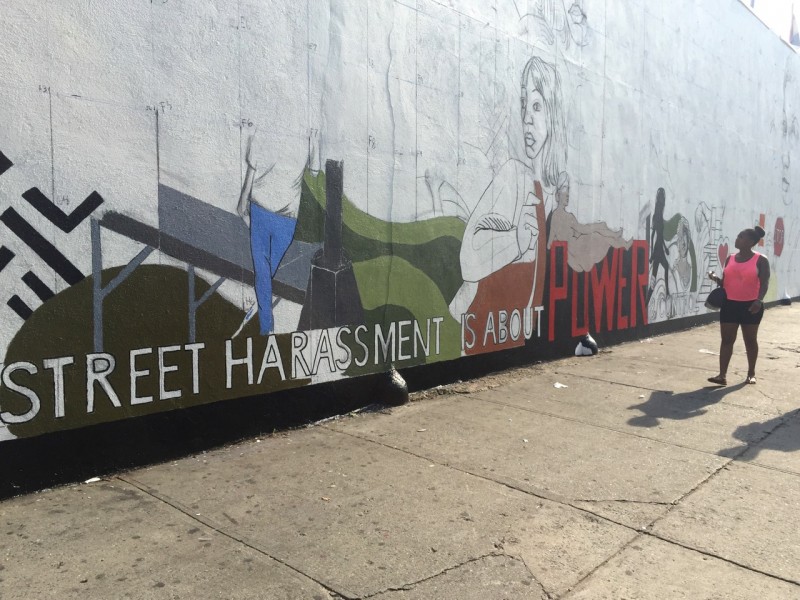
Aug2015BrooklynTeenageGirlMural

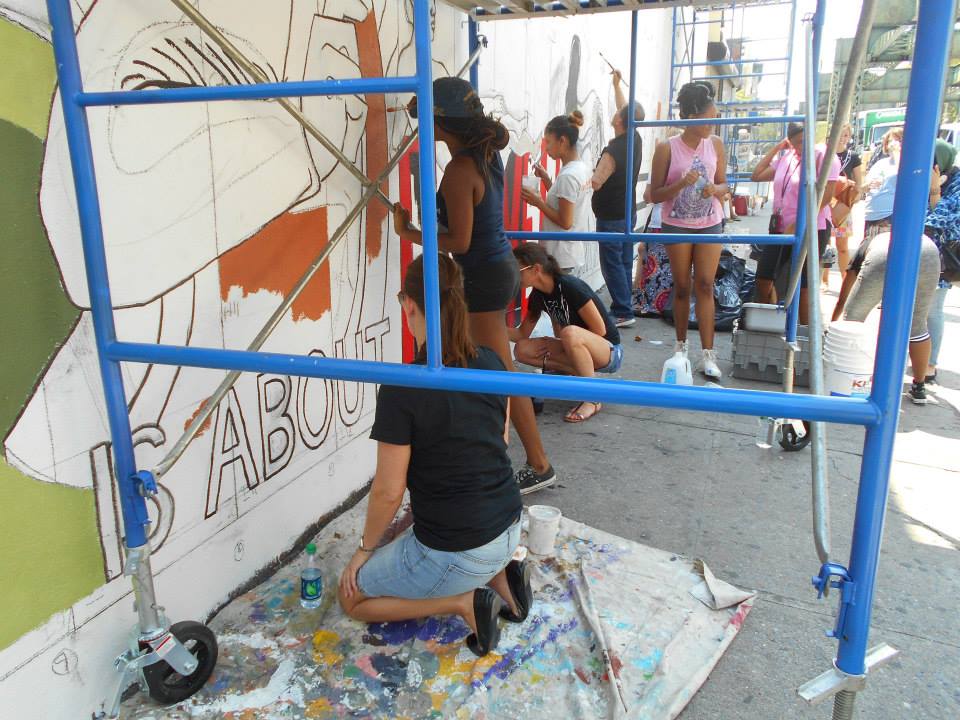
Check out the photos of teenage girls in Brooklyn as they create a mural depicting street harassers as zombies!

BK Magazine: “Catcallers Turn into Zombies in this Anti-Street Harassment Mural”

“Painted by 20 young women, ages 15 to 21, the mural depicts catcallers as drooling packs of undead, saying things like “God bless those legs” and “Hey yo, ma” and “I told you to smile.” They stagger towards frightened women–both female figures from art history and artists’ self-portraits–saying “Stop” and “I object to objectification.”

Perhaps predictably, the teenagers say they’ve been constantly getting sexually harassed while painting this mural fighting sexual harassment. “Every day we always get catcalled, or there’s always comments, people whistling at us,” Violet Ponce, a 17-year-old from Bushwick, told the Bed-Stuy Patch…

“We wanted to show that the feeling of being catcalled or when someone says something disturbing, it causes fear,” Danielle McDonald, an art teacher overseeing the project along with assistant artist Jazmin Hayes, told the Brooklyn Paper. “So that’s where the zombies came from–something scary and mindless.” They cite feminist activist graphic art as inspiration, from political posters and comic books to works by the likes of Guerrilla Girls and Jenny Holzer.”

Guardian: “I’m tired of being kind to creepy men in order to stay safe”

“We’ve all been bothered by persistent guys who pester us relentlessly, believing themselves to be entitled to our company and more. We’re under pressure to be polite and manage their expectations. Ignored men are angry men, and it’s horrible to sit silently while a man shouts at a packed carriage: “She thinks she’s too good to talk to me!”

When it comes to responding to harassers, you’re damned if you do and damned if you don’t – and sometimes it gets to the point when dealing with entitled idiots is so exhausting that you feel safer staying at home…

[We need] to create spaces where all women feel they are safe to look their harasser in the eye and say: “Leave me alone. I do not want to talk to you.” Because I’m tired of being kind to the creeps in order to stay safe. And I don’t want to stay in.”

BBC: “Struggling with Sexism in Latin America”

“Whether it is honour or so-called machismo, the end result is the same. Women become second-class citizens…

Since moving back to Latin America, I have lost count of the times I have been asked what it was like as a woman living in the Middle East. “It must have been so hard,” people say. To be honest, living in cities such as Mexico City can often feel harder.

While many of my female friends have smiled knowingly at my response, others flatly reject it. “Women here are free,” said one. “What’s wrong with being complimented in the street? They are appreciating our beauty,” said another.

If your “freedom” on the way to work is curtailed by threatening sexual comments, and you are made to feel like an object and not a human being, I question whether that is true liberty.”

Vancouver Observer: “An ‘unwanted kiss’ may seem innocent but has larger consequences”

“Early on the Friday (Aug. 7) evening of the Squamish Valley Music Festival, Megan Batchelor was reporting live — sounds like a fun assignment, right? Well, maybe for a man.

As Batchelor was talking about the threat of rain, a young man ran up behind her, planting a kiss on her cheek. She was clearly startled; one can imagine how it might feel for a strange man to come up behind you, aggressively touching or grabbing you, unannounced. Even if you can’t, Batchelor said the incident “rattled” her and she decided to file a report with the Squamish RCMP…

This kind of behaviour serves a purpose and it is to put women in their place. To say, ‘You don’t belong here and while you can play at ‘gender equality,’ we still don’t respect you.’ It intends to humiliate and demean, but even more than that: It is a threat. These public displays of misogyny and harassment send the message to all women that they aren’t safe in public places and that no matter what they do, they are always at risk of sexual assault….

There need to be real consequences and men need to be held accountable for their behaviour. If we continue to brush it off or to tell women to just ‘deal with it’ we are saying that the behaviour is okay and, in doing so, are actively working against gender equality and women’s safety.”

Vice News: “Indian Teenager Dies After Setting Herself on Fire Over Alleged Sexual Harassment”

Trigger Warning. Another life senselessly ended. May she rest in peace.

‪#‎India‬: “The girl was Dalit, from the lowest hierarchy of India’s caste system. In a statement that she gave late on Monday to a judicial magistrate, she accused four local boys of stalking and tormenting her relentlessly over recent weeks with indecent remarks and lewd conduct. She endured the mistreatment along the roughly six miles that she walked daily to school.

“I couldn’t bear the humiliation. They crossed all limits,” she reportedly told the magistrate. “They did things I can’t even share with you.”

Daily Life: “Alicia Keys says she developed tomboy style to avoid street harassment from men”

“To this day, Keys says, each morning she wonders what she can wear that won’t draw too much attention when she goes grocery shopping or to pick her son Egypt.

But, the other day, she says, she had a realisation, wondering “Why are you choosing to be that person?”

She listed all the things she no longer wants to feel ashamed to be.”

Morocco World News: “Moroccan Women Affected by Sexual Harassment Share Their Views”

“Women share their stories and views with ‪#‎streetharassment‬, including Fouzia R., a high-school student from Casablanca who says: “In my opinion, men harass women because they have some problems with their self-confidence. I once talked to my elder brother about this and he told me, ‘I would never run after a woman on the street that clearly feels uncomfortable with the situation, nor would I give compliments to a stranger. I have pride.’

So, I think that if men would think more like my brother, sexual harassment in Morocco could be lessened. Parents have to teach their sons respect and values at ayoung age… I guess a lot of parents don’t have those conversations with their sons in their early stages of puberty, in regards to sex, women and respect…”

Wicked Local: “The reality of ‘on street harassment'”

“This summer I am interning at the Center for the Study of Sport in Society at Northeastern University. In a recent project, we discussed the lagging participation and retention rates of middle and high school female athletes nationwide. Although our sports culture is slowly becoming a more inviting space for young women, there are still many barriers. Street harassment is just one of them — imagine being 14 again, still adjusting to your body as it rapidly moves through puberty, trying to train it to compete and feel healthy. While this happens, you are focusing on the road, on your breathing, on your body, when someone suddenly violates your space and concentration by screaming a comment at you, or takes it a step further by invading your physical space and running alongside you.”

DNAinfo: “Edgewater Woman Fed Up With Street Harassment Chases Attacker”

“Four years to the day after surviving a brutal attack in a Lincoln Square alley, an Edgewater woman out for her daily run said she was forcibly “kissed” on the cheek by a man who she later learned — after chasing him for several blocks — is accused of assaulting other women in the neighborhood.”

Trigger Warning: The Independent: “Teenager requires surgery after being attacked by cat-calling men for ‘wearing a bikini’”

“A teenager from Louisiana will require surgery after being attacked by a group of men who had harassed her while she was wearing a bikini.

Jessica Byrnes-Laird, 18, was sitting in her car while her boyfriend entered a store in Shreveport after the pair had spent the day swimming.

The four men started harassing her and fought with her boyfriend after he emerged from the shop.”

al Bawaba, “A viral video highlights Saudi’s sexual harassment problem — again”

“A video appeared on YouTube this week showing a woman in eastern Saudi Arabia fending off a potential sexual harasser with a broom.”

CityLab: “Talking to My Son About Street Harassment”

“My kid is a gentle soul and a generally decent young man. I trust his instincts and his heart. But that doesn’t mean I don’t feel the need to be quite direct and explicit about his responsibility to be a young man who always treats girls and women with respect—on the street and everywhere else. It’s his responsibility to be conscious and empathetic about what women deal with every day. We talk about it the way we talk about any other duty he has to be a good citizen of the world, and while he occasionally rolls his eyes when I get going on the topic (yes, he is a teenager), I feel confident that he’s listening.”

All Africa: “Zambia: Street Harassment – Women Fight Back”

“The day of the march was one of the best days of my life, partly because I felt we had achieved something against the odds, but most of all I realized just how wonderful it felt to finally speak out and stand up for myself and for what was right. It was as though with every chant I was getting back bits of dignity that had been stripped away from me, for myself and for other women.”

Daily News Egypt: “Feminist author Mona Eltawahy gives account of Cairo sexual harassment”

“Mona Eltawahy, a well-known Egyptian writer who has long-spoken out against sexism, reported a minor sexual assault online and her decision not to press charges against her harasser.”

Daily Times: “Surviving street harassment: An introductory guide”

“As a teenage girl, having been born and bred in Lahore, Pakistan, I crave a society where I can venture to Liberty Chowk without a man’s company and return in the wee hours of the morning, completely unharmed, with all my errands having been run without having faced any difficulty, except perhaps at the hands of a procrastinating darzi.”

Mic: “Men Only Care About Catcalling When It Affects Women They Know”

“A wave of new videos seeks [to force] men to witness the harassment the women in their lives face — but is this really changing their minds, or just momentarily grabbing their attention? …

In order to understand women’s issues, men are commonly encouraged to consider how gender-based discrimination ultimately effects them. Educators prompt men to imagine how they would feel if their mothers, wives, daughters or sisters were subjected to the treatment they either perpetuate or allow to persist by remaining silent. This mentality is implicitly evident in the premise of these videos, and even referenced outright….

Multiple studies capture that [empathy] gap: Women are trained to empathize with others, while men must feel motivated to do so: To truly care about the experiences of others, men may require proof that those experiences directly, negatively effect them, too. In this case, the proof is provided by actual visual documentation of women they know being harassed….

Ideally, our society would recognize that street harassment is unacceptable based on the sexist way it objectifies and demeans women. We’re not there yet, though, and that’s why these videos — flawed as they are — still have some value.

Metro UK: “‘There would be a fistfight’: Dads react to their daughters getting catcalled”

“Sure, it’s a shame that men have to relate catcalling to a relative to really get why it’s so bad, but if this video works towards making guys a tiny bit more understanding about street harassment, it can only be a good thing.”

Obvi We’re the Ladies: “I’m Always Aware, But Should I Have To Be?”

“As women, what we can do is support other women. When someone speaks up about their experience we can listen first, and act second. We can be there for women who have experienced the trauma of sexual assault, and we can be there for women who haven’t. We can share our stories, and we can help one another heal. We can refuse to be silent, and we can refuse to be ignored.”

TripIt: “How to deal with street harassment when traveling“

Share

Filed Under: News stories

UK: Harassment and Technology – Legislation Is Not Growing Fast Enough

August 19, 2015 By Correspondent

Emma Rachel Deane, UK, SSH Blog Correspondent

PAY-Gemma-NewittLast month 20-year-old Gemma Newitt was left enraged after no charges could be brought against a man who took inappropriate photos of her in a supermarket. CCTV footage from a Co-op store in St Austell, Cornwall shows Karl Leggatt holding his mobile phone inches away from Newitt’s bottom as she browsed the shelves of the store. After the incident was reported to the Store Manager the police were called and Newitt was told that no arrests could be made because Leggatt had not broken any laws.

After celebrities including Katy Perry, Paris Hilton and Lindsay Lohan fell victim to an invasive lens, the “upskirt photo” became an all too familiar phrase. Although generally used to refer to an unauthorised photograph under a woman’s skirt, the term is also used in relation to more general voyeuristic photography depicting, almost exclusively, women. Despite the relatively recent phrasing, the interest in creating such images is not a recent occurrence and references in art can be found as early as the 1700s as well as a plethora of pictures created during the pin-up era. The difference between then and now, of course, is the development of technology. Smartphones now make it possible for non-consensual images to be uploaded to the internet and viewed by millions within minutes. There are entire websites dedicated to photographs of women sitting on benches, relaxing in parks and stepping out of cars completely unaware that they are being intimately photographed and posted on an erotica site.

Screenshot 2015-08-16 at 22Last year, despite complaints, crowdfunding site Indiegogo continued raising funds for a smartphone accessory, pitching itself on the ability to take stealthy photos of a woman’s body without her knowledge. The text on the webpage advertised the accessory’s ability to “take pictures round corners” while images used in the marketing focused on discreetly photographed breasts and legs.

Australia, New Zealand and India are countries that have specific legislation in place to tackle the issue based on a reasonable expectation of privacy but the UK is yet to follow suit. The Sexual Offences Act of 2003 criminalises ‘voyeurism’ in the UK and defines it as recording someone engaging in a private act or installing surveillance equipment in private areas without the knowledge or consent of the victim. This means that because Newitt was shopping in a public place, her body was considered available for public recording. Few countries have tackled the issue head on and created specific legislation for the protection of a woman’s privacy in this modern world of ever developing technology.

The attitude that women’s bodies are publicly owned is ingrained deeply in our society. We see this exhibited in a myriad of ways which each boil down to denying women agency over their own bodies. Restriction to abortion access, slut-shaming, sexual assault and the endless barrage of judgmental appearance based media representation are all displays of entitlement to the female form which promulgate a culture in which Leggatt could think of his actions as reasonable behaviour and stand vindicated by the law.

Emma Rachel Deane is a London-based retail manager for a fast growing women’s lifestyle brand and an outspoken advocate for women’s social justice issues. She can be found blogging on Raging Hag or tweeting @emmaracheldeane.

Share

Filed Under: correspondents, News stories, public harassment

Early Aug 2015 News Roundup

August 2, 2015 By HKearl

Here are a few news stories and initiatives from the week.

Women runners, here’s a survey on street harassment!

“Brooklyn High-Schoolers Sexually Harassed While Painting Mural About Sexual Harassment”

Brooklyn mural by high school students. Via Patch.com

“Along the bottom of the mural is the phrase, “Street harassment is about power and control.”

Although some men passing by on Myrtle just yell and whistle from afar, some come up to talk to the artists.

”Guys will walk by and say, ’You ladies shouldn’t be doing this, it’s too much for you, it’s too heavy, you need help,’” says Ponce.

Sometimes this leads to a conversation about street harassment. “People aren’t aware that it’s a problem,” says Ponce. ”They say, ’It’s a compliment, just take it.’”

Although Ponce doesn’t believe the mural has changed anyone’s habits just yet, she says some of the same guys who used to harass them are more respectful now as they walk by.

“It feels like you’re making an impact,” she says.

You can scope out the mural for yourself at 1102 Myrtle Avenue, along the wall of the Food Bazaar Supermarket. The girls expect to finish by August 24.”

“Why That Viral [Cosmo] Video of Men Reacting to Street Harassment Isn’t Praise-Worthy”

“While it’s no doubt that the producers’ intentions weren’t malicious – they wanted to highlight how pervasive (and f**ked up) the everyday whistles, taunting and stalking women encounter is – was having heterosexual dudes validate our day-to-day experiences really the best way to combat this gendered violence? In other words, should we be criticizing sexism by perpetuating it in another form?

The sexual intimidation straight women meet each time they step out of their homes should not have to be substantiated by their male companions. Her voice, alone, should be enough for her partner, and the rest of society, to take her experiences and frustrations as valid.

We’re ready for a street harassment video without paternalism, where women – including bisexual, lesbian, queer and trans women, because this is far from just a straight women’s issue – don’t need men to ensure that our daily harassment is believed.

Also, it would be great to have a video that didn’t overwhelmingly depict men of color as the perpetrators, because, news flash: white dudes aren’t santos and do hiss, jeer, harass, touch and stalk women as well.”

“LISTEN gets Vic government on board in push against sexual harassment and assault in music venues and festivals”

“The LISTEN collective [in Australia], a group of musos and industry professionals who are also passionate advocates for gender equity in Oz music, are taking active steps to deal with the situation. Importantly, they’ve just persuaded the Honourable Jane Garrett, Minister for Justice, to convene a task force to implement policy addressing sexual harassment and sexual assault at music venues and festivals.”

“How to Deal With Street Harassment When Traveling”

“On the flip side, it’s important to learn how to shut down unwanted attention not just with body language but verbally as well. Oftentimes in Western cultures, women are taught to be polite even when we feel uncomfortable in a situation. If someone is pestering you for attention, for your phone number or for anything else, it’s perfectly alright to shut them down with a simple no and to walk away if they won’t take no for an answer. Don’t feel obligated to continue a conversation with anyone who makes you uncomfortable. It’s not rude—it’s perfectly appropriate.”

“Could catcalling become illegal in Austin, Texas, and elsewhere?”

“Men are the primary perpetrators of street harassment against both women and men (and it is largely men in the LGBTQ [lesbian, gay, bisexual,transgender, and queer] community who are harassed compared with their heterosexual male peers),” she adds. “We need programs educating young men on issues of respect and consent, we need social shaming of harassers, and we need men to model respectful behavior to their friends and family members.”

“Public Property”

“There is a clear difference between striking up a polite conversation with somebody whilst both inhabiting a public space and utilising that public space as a tool to enable inappropriate commentary.”

“10 ultra-regressive scenes from Bollywood movies that encourage you to be a creep

Share

Filed Under: News stories, street harassment

Austin Woman Takes on Street Harassment

July 31, 2015 By HKearl

Learn how runner Anna Aldridge in Austin, Texas, got a mechanic shop to start addressing street harassment! Now she wants to work to address the issue city-wide.

You can sign her petition: http://tinyurl.com/p9bt58a

Also you can learn more about the problem overall via this Christian Science Monitor article from today. Hopefully the city council and others will take notice and do something!

Share

Filed Under: News stories, street harassment

« Previous Page
Next Page »

Share Your Story

Share your street harassment story for the blog. Donate Now

From the Blog

  • #MeToo 2024 Study Released Today
  • Join International Anti-Street Harassment Week 2022
  • Giving Tuesday – Fund the Hotline
  • Thank You – International Anti-Street Harassment Week 2021
  • Share Your Story – Safecity and Catcalls Collaboration

Buy the Book

  • Contact
  • Events
  • Join Us
  • Donate
  • Facebook
  • Instagram
  • Pinterest
  • Tumblr
  • Twitter
  • YouTube

Copyright © 2026 Stop Street Harassment · Website Design by Sarah Marie Lacy