• About Us
    • What Is Street Harassment?
    • Why Stopping Street Harassment Matters
    • Meet the Team
      • Board of Directors
      • Past Board Members
    • In The Media
  • Our Work
    • National Street Harassment Hotline
    • International Anti-Street Harassment Week
    • Blog Correspondents
      • Past SSH Correspondents
    • Safe Public Spaces Mentoring Program
    • Publications
    • National Studies
    • Campaigns against Companies
    • Washington, D.C. Activism
  • Our Books
  • Donate
  • Store

Stop Street Harassment

Making Public Spaces Safe and Welcoming

  • Facebook
  • Instagram
  • Pinterest
  • Tumblr
  • Twitter
  • YouTube
  • Home
  • Blog
    • Harassment Stories
    • Blog Correspondents
    • Street Respect Stories
  • Help & Advice
    • National Street Harassment Hotline
    • Dealing With Harassers
      • Assertive Responses
      • Reporting Harassers
      • Bystander Responses
      • Creative Responses
    • What to Do Before or After Harassment
    • Street Harassment and the Law
  • Resources
    • Definitions
    • Statistics
    • Articles & Books
    • Anti-Harassment Groups & Campaigns
    • Male Allies
      • Educating Boys & Men
      • How to Talk to Women
      • Bystander Tips
    • Video Clips
    • Images & Flyers
  • Take Community Action
  • Contact

Late June 2015 News Roundup

June 29, 2015 By HKearl

Here are some of the stories relevant to street harassment I’ve read the last two weeks:

Canada: “OC Transpo to launch new online tool for reporting harassment”

“OC Transpo will launch a new online tool to make it easier to report harassment on its buses next week — nearly two years after promising it.

The goal of the new tool is to collect reports from passengers and witnesses, some of whom may choose to remain anonymous, about incidents of sexual harassment or other “unacceptable or illegal behaviours,” OC Transpo says in a report prepared for the transit commission.

According to OC Transpo, it will be the first transit agency in Canada to permit such anonymous reporting when the reporting tool goes live on June 17.”

Canada: “No, That Canadian Study Didn’t Simply Say Teaching Young Women Self-defence Will Stop Rape”

“This workshop can empower women to assert their boundaries and defend themselves if needed, but it’s not only about self-defense. It’s also about teaching women to recognize and respond to common dangerous situations, which more often involve people they know—not strangers in the bushes.

Known as the “red zone”, women in university are at heightened risk for sexual assault in the fall semester of their first year. A new poll by the Washington Post found 20 percent of women and five percent of men who attended college in the past four years report being sexually assaulted.

Historically, society has placed the onus on women to prevent sexual assault: Don’t walk home alone at night, don’t wear short skirts and all that. In recent years, public pressure from rape survivors and their allies has forced universities, police and politicians to look at the issue differently.

Slowly the onus has begun to shift away from women to prevent attackers from raping them and instead onto attackers to not rape women.

Consent and bystander intervention programs are also on the rise on college campuses.

It’s in this context that Senn and her co-authors researched the efficacy of a resistance program to prevent sexual assault.

The workshop they developed is one more tool in the rape-prevention toolbox. “

Egypt: “The App that wants to make Egypt’s Streets Safer for Women”

“This Ramadan, spliced into the TV soap operas that are popular during the fasting month, Egyptians will also be seeing some confrontational ads about sexual harassment. The ads launched in early June by HarassMap خريطة التحرش الجنسي, a local Egyptian organization, is part of a campaign that began last month called “Harasser = Criminal.

The public service announcements, each about a minute long, show how women are harassed in public spaces. One clip, which shows a man touching a woman on a bus, has gathered nearly 100,000 views to date.”
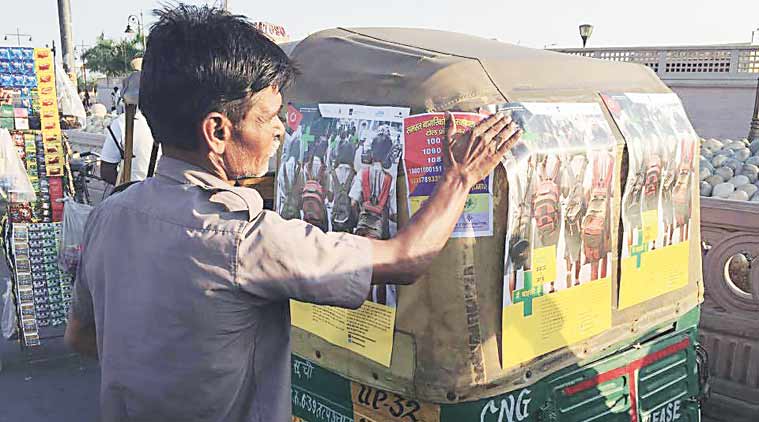
An auto rickshaw displays campaign posters, via The Indian Express

India: “She’s not #AskingForIt: A campaign to stop sexual harassment in public places”

“It is seven in the evening and a girl is standing at a bus stop. Few boys whistle at her and pass comments. But the bystanders are mute. Why? Apparently the girl was asking for it. Will she tell anyone about what happened?

These are the questions Breakthrough India, a global human rights organisation, is asking people around the country. Their campaign ‪#‎AskingForIt‬, which began in March this year, coaxes people to act, and stop sexual harassment in public places.”

Latin America: “Latin American women fight back against harassment”

“Costa Rica, Mexico and Peru have passed laws against street harassment that include, in Peru`s case, prison sentences of up to 12 years for the most extreme offenders.

Lawmakers in Argentina and Chile are considering similar bills.

In Chile, nine in 10 women have experienced some form of sexual harassment in public, and 70 percent say they have been traumatized by it, according to a 2014 study by the Observatory Against Street Harassment.

An Argentine study found similar numbers.

In a sign of the growing indignation, the Observatory has spread from Chile, where it was founded, to Colombia, Bolivia, Nicaragua and Uruguay.”

Nepal: “Police on High Alert against Human Trafficking”

“With growing incidents of children, girls, and women trafficking on various pretensions following the April 25 quake and subsequent aftershocks, Dhading police have maintained special surveillance over such possible criminal acts in the district….

Policewomen from various police cells have been deployed to inquire about the destinations of travelling children, girls, and women, reasons for travelling, their relation with the persons accompanying them, besides other information, said Area Police Office Gajuri Inspector Hemanta Bhandari Chhetri.

As many as 46 children who were rescued from Nagdhunga while being taken to Kathmandu were handed over to their parents. Police had arrested seven persons in connection with the incident.”

USA: “Catcallers to be challenged by Anti-Harassment Cyclists”

“Community organizing group Brooklyn Movement Center is launching its first “Anti-Street Harassment Bike Patrol” in Bed-Stuy and Crown Heights aimed at calling out people who hassle women on the street. Once a week, volunteers will bike in groups of four to intervene in situations sparked by unsolicited remarks….

[The] patrol aims to change the culture around street harassment instead of criminalizing the behavior, Arellano said. Organizers see the patrols as a “building tool” to educate the community….The group held its first orientation on Wednesday and will host another meeting in the coming weeks, organizers said. For more information, contact the Brooklyn Movement Center at (718) 771-7000.”

USA: “How Sexism Affects Everyday Health”

“Researchers have documented the link between concerns about physical safety and psychological harm. Consider, for example, that before puberty, boys and girls experience depression and anxiety at similar rates, but, upon puberty, when street harassment, awareness of physical vulnerability and rape begin, girls are up to six times as likely to suffer from anxiety as teenage boys.”

USA: “NY Lawmakers Set Penalty For Improper Subway Touching”

“New York lawmakers have voted to establish the crime of improper touching or other sexual contact aboard the subway or other public transportation after an increasing amount of complaints from young women…The misdemeanor also applies to public buses or trains and carries a penalty of up to one year in prison.”

USA: “The Clever Way Women Are Striking Back Against Body-Shaming Ads”

“Hey, ladies: On your way to and from work, you might want to think about dropping a few pounds—or maybe getting a boob job or butt injections. Those are just some of the messages advertisements for plastic surgery or diet products send to women who ride public transportation through signs that commonly line the interiors of buses and subway cars. It seems some feminist activists in New York City have had enough. They’re slapping stickers that proclaim “This Oppresses Women” on body-shaming promotions on the Big Apple’s mass transit systems….

“It’s hard to ignore [the advertisements] when you’re sitting on the subway and a guy is like, ‘Hey, baby, what’s up?’, and then you see these pseudo-naked women for the plastic surgery ads, and you’re like, ‘OK, this has to be connected,’ ” Munger told MTV News. “But then you realize the ads are contributing to how men treat you all the time, especially in New York, because it’s such a pervasive part of your life. You see these ads every single day in your face on the subway, on the street; it’s kind of ridiculous.”

USA: “Why Many Rape Victims Don’t Fight or Yell”

“Most victims will freeze, if only briefly. Some will fight back, effectively. Some will resist in habitual, passive ways. Some will suddenly give in and cry. Others will become paralyzed, become faint, pass out or dissociate.

Few who have experienced these responses realize that they are brain reactions to attack and terror.

They blame themselves for “failing” to resist. They feel ashamed. (Men especially may see themselves as cowards and feel like they’re not real men.) They may tell no one, even during an investigation. Sadly, many investigators and prosecutors still don’t know some or all of these brain-based responses.

None of these responses – in women or men – entails consent or cowardice.

None is evidence of resistance too insufficient to warrant our respect and compassion. They are responses we should expect from brains dominated by the circuitry of fear (just as we should expect fragmented and incomplete memories).”

USA: “Iowa City police arrest man for attacks on women”

“Sgt. Scott Gaarde said between May 27 and June 8, the police department took five reports from women who described being accosted by a man in or near Willow Creek Park. The victims reported the suspect would ride past the women on a bicycle, then approach them from behind and grab them…

Based on their investigation and cooperation from the victims, Long was charged this week with four counts of assault with intent to commit sexual abuse, an aggravated misdemeanor. He was taken into custody on Wednesday and transported to the Johnson County Jail.”

USA: “Study shows how men overcompensate when their masculinity is questioned”

“The researchers note that while women may display a similar dynamic when it comes to femininity, in general, the anxiety about not meeting gendered expectations is likely more severe among men since gender norms have expanded more for women — as the study puts it, “masculinity is more easily threatened than femininity.”

And the ways in which it may be reasserted when threatened are also way more harmful. This study joins a huge body of research on the dangers of threatened masculinity. While the overcompensation in this case is pretty benign — lying about their height, avoiding stereotypically “feminine” products — other research has hinted at how damaging it can be. In one study, men whose masculinity was threatened were more likely to hit a punching bag and, in another, to sexually harass a female interaction partner, and, in another, to blame the victim in a rape case.”

USA: “Anti-Street Harassment PSA”

“A music video inspired by Bollywood depicts a woman walking down the street. This short public service announcement makes a statement about street harassment in New York City through a re-appropriation of the lyrics of Gnarls Barkley’s “Crazy”.

Global: “Can New Laws Stop Men From Harassing Women in Public?”

“Whether the legislation provides the culture change or the culture change spurs the legislation isn’t clear. There does, however, appear to be a real link between the two, and an ability for each to lean on the other as a means of building into our social fabric some kind of awareness of the damage wrought by street harassment.”

Share

Filed Under: News stories

Charleston Shooting, Race, and Sexual Violence

June 18, 2015 By HKearl

Yesterday, a white supremacist terrorist went to a Black church in Charleston and murdered nine people, six women and three men (read about them. My thoughts go out to their loved ones). This level of premeditated violence and hate is hard to comprehend, particularly at a place that is supposed to be peaceful and safe.

Survivors report he said, “I have to do it. You rape our women and you’re taking over our country. And you have to go.”

I keep thinking about that. And how wrong he is. Black women are as valuable as white women and women of any other race. There is no “our” and “their.” White men are more likely to rape white women overall than are Black men. Black people are certainly not “taking over” the country. I know I shouldn’t try to find logic in the thought process of someone like him, but, I can’t help but also ask, why kill mostly women if that is his line of reasoning? And at a church?

His words bring up longstanding problems in our society: the perceived value of white women’s bodies over Black women’s and white men justifying their violence against Black people over (usually just lip-service instead of actual) concern for white women.

Dr. Estelle Freedman’s book Redefining Rape: Sexual Violence in the Era of Suffrage and Segregation as well as Dr. Danielle McGuire’s book At the Dark End of the Street: Black Women, Rape, and Resistance–A New History of the Civil Rights Movement from Rosa Parks to the Rise of Black Power are good resources for learning about this in the late 1800s and 1900s in the USA. They show how our country, our legal system is built on the oppression of all women and men of color.

We can see that in how laws and the justice system today protect white men (especially wealthy and heterosexual) at the expense of everyone else. That has to change.

I also want to share what Courtney E. Martin, a writer and thinker whom I greatly admire, shared today on her Facebook page:

“I’m thinking about how, yes, the shooter is probably mentally ill, but how our racist society is, too, and how we can’t pretend he is an anomaly. He is the son of white people, the son of America, the son of our education system and our culture and our history. We made him. White Americans, especially, made him. So how can we stop making him? How can we take responsibility for the history and the present? And what is my role in that unmaking and that claiming of responsibility?“

As a white person too, I think about that. What can I do to challenge racism and to make it so that public spaces, churches, schools, and workplaces are safe and equitable for all? I implore any white people reading this to think about it too (if you aren’t already). We have to help make the change.


Share

Filed Under: News stories, race

Andrea Farrington, Murdered for Reporting Sexual Harassment

June 15, 2015 By HKearl

Andrea Farrington, image via Liberals Unite

Over the weekend, I was so saddened and outraged to read that Alexander Kozak, a security guard at a mall in Iowa, point blank shot a 20-year-old young woman named Andrea Farrington because she (and other women) had reported him for sexual harassment. He finally lost his job over it, and in retaliation, he murdered her.

Liberals Unite has this on this site today, which is so true:

“The other aspect, which seems to be somewhat overlooked by articles in mainstream and social media, is that this young woman, barely out of her teens, was murdered horribly and in cold blood for reporting sexual harassment.

She reported this man again and again before he was finally let go, and then he killed her.

So the message that’s being sent out to women of all ages experiencing sexual harassment is: Don’t ruffle the feathers. Don’t report harassment. If you do, good luck getting anyone to take action. Good luck not being accused of ‘asking for it.’

If your complaint causes the job termination of someone, take cover, because that person might seek revenge and kill you.

So just quit your job quietly, and go work somewhere else. Leave the harasser, who will keep his job, to continue harassing others – that is, unless he gets arrested for tracking you down and killing you–after all, you did reject him.”

There was a vigil to honor her yesterday. Our thoughts go out to her family and friends. What a senseless and horrific loss.

You can help her family via: http://www.gofundme.com/wx2rxg

Share

Filed Under: News stories

June 9 news round-up

June 9, 2015 By HKearl

Via Huffington Post:

“There is a moment in the McKinney, Texas pool party video that’s both horrifying and absurd: when Cpl. Eric Casebolt manhandles, violently restrains, then sits on top of an unarmed, 15-year-old, bikini-clad black girl as she cries for her mother.

The absurdity, of course, lies in how unnecessary and over-the-top Casebolt’s behavior is (earlier in the YouTube clip, he barrel rolls across a lawn for no reason in particular). But the horror emerges from the undertones of sexual violence in that instant. Casebolt pulls the girl by her hair, forces her face against the ground and presses his knee into her back — all while she pleads for him to stop. Here’s a grown man, forcing a young girl into submission against her will. The video acts as a prime example of the inherent reality of both physical and sexual harassment against black women and girls at the hands of cops.”

NT sign

Via ABC

“The Northern Territory Anti-Discrimination Commission [in Australia] has placed advertisements in Darwin city backpacker hostels and job centres after a number of reports of females being propositioned.

“There was a report of a business man who was offering employment and accommodation [to female travellers] and then propositioning them for sex,” Sally Sievers, NT anti-discrimination commissioner, said.

A notice about the man was posted on a hostel noticeboard purportedly by another female traveller, describing the incident and the alleged perpetrator.”

Via Stanford Medicine:

“In Kenya, where rape and violence against women are rampant, a short educational program produced lasting improvements in teenage boys’ and young men’s attitudes toward women, a study from the Stanford University School of Medicine has found. The boys and men in the study also were more likely to try to halt violence against women after participating in the program.”

Via Arab News:

“The Passport Department is currently drafting regulations that would see women travel without the permission of their guardians [in Saudi Arabia]. Maj. Gen. Sulaiman Al-Yahya, director general of the department in Riyadh, said the rules would be based on the reasons for travel, not age. The procedures to allow women to travel without permission include the interior, justice and social affairs ministries, and other bodies, he said. He added that the passport department complies with court decisions that allow women to travel abroad, or get passports issued and renewed without the approval of their parents or guardians. These were in line with laws in “advanced countries,” he said.”

Via US News & World Report:

“There are many contradictions in Argentina when it comes to gender equality. Women have equal rights under the law and there are more women than men enrolled in college. The country’s most powerful person is a woman — President Cristina Fernandez. But the macho culture of many Latin American countries is pervasive here as well….

Many men, from taxi drivers to construction workers to white collar workers, frequently whistle or say things when women walk by. ‘Lewd comments are just the tip of the iceberg that manifests itself in domestic violence,’ said opposition congresswoman Victoria Donda, who has put forward legislation making such verbal taunts a crime.

Under Donda’s bill, which includes funds to raise awareness about abuse in schools and workplaces, women could report sexual harassment in public places. A judge would then review the complaint, interview any witnesses, and decide whether a fine should be levied. The law is aimed at combatting aggressive sexual comments, not compliments about nice hair or clothes.”

Via The Guardian:

“Police in Nepal have started self-defence lessons for women and girls in camps for people displaced by massive earthquakes earlier this year after concerns about a number of sexual assaults and an increase in reports of sexual harassment.”

Via Van City Buzz:

“B.C. [Canadian] Transit Police assisted a young woman online Sunday night after she reportedly experienced sexual harassment on board the number 19 bus heading to Metrotown.

The 20-year-old woman was on the 19 bus when a man allegedly began verbally assaulting and threatening her. She later took to social networking site Reddit to ask whether or not she should report the man to police.

“I was sexually harassed on the 19 bus late last night heading East to Metrotown. Had an older black, skinny male tell me how he was ‘going to follow me home, find where I live, and give me the love I deserve.’ He then told me ‘I couldn’t escape him and he’d find me someday.’”

She then notes the bus driver had to physically restrain the man from following her off of the bus.

Transit Police were quick to comment on the women’s post, giving her a phone number and text number she could call to report the incident. A number of other commenters also mentioned the police authority as a resource.”

Via CBS News:

“Legislation that would make “upskirt” photographs illegal passed through the New Jersey Assembly’s judiciary committee on Thursday, reports CBS Philly. ‘They can take their cell phones and a camera and take pictures and it’s called upskirting because the pictures are taken underneath the ladies’ dress,’ said Assemblywoman Cleopatra Tucker, who introduced the legislation. ‘It’s an invasion of someone’s privacy.’ … The measure reportedly makes upskirting a fourth-degree offense, and makes sharing the photos online a third-degree offense. The bill now heads for a vote in the full Assembly.”

Teenage girls share their street harassment experiences in this imMEDIAte Justice video.

Share

Filed Under: News stories, street harassment

Marching in Argentina, Phone App in Brazil

June 4, 2015 By HKearl

A few more important news stories —

Argentina march. Via BBC

Via Global Voices Online:

Argentinian women are rallying under the hashtag ‪#‎NiUnaMenos‬ against an alarming increase of femicides in the country after a pregnant 14-year old was murdered by her boyfriend.

Via BBC:

Additionally, yesterday people across Argentina, Chile & Uruguay marched in the streets in outrage over violence against women!

Via All Africa:

“A team of four young women coders from Porta Allegra in Brazil has won the IGNITE International Girls Hackathon with an anti-harassment app called Não Me Calo, which means “I will not shut up”.

Não Me Calo allows users to review restaurants based on how they treat women. The data then helps other patrons decide which restaurants are safest for women, and publicly encourages restaurant owners and government officials to fix harassment hotspots.”

Via MSP Magazine:

Our amazing board member Lindsey Middlecamp, founder of Cards Against Harassment, is featured this month and this is my favorite quote from her article: “We’re acculturated to see street harassment as a petty annoyance, but it reflects some fundamentally concerning cultural themes. If people would see a woman on the street as a person with her own motivation and intent, if women were allowed to make noise, take up space, and pursue their own path freely, the world would be a better place.”

Share

Filed Under: News stories

« Previous Page
Next Page »

Share Your Story

Share your street harassment story for the blog. Donate Now

From the Blog

  • #MeToo 2024 Study Released Today
  • Join International Anti-Street Harassment Week 2022
  • Giving Tuesday – Fund the Hotline
  • Thank You – International Anti-Street Harassment Week 2021
  • Share Your Story – Safecity and Catcalls Collaboration

Buy the Book

  • Contact
  • Events
  • Join Us
  • Donate
  • Facebook
  • Instagram
  • Pinterest
  • Tumblr
  • Twitter
  • YouTube

Copyright © 2026 Stop Street Harassment · Website Design by Sarah Marie Lacy