• About Us
    • What Is Street Harassment?
    • Why Stopping Street Harassment Matters
    • Meet the Team
      • Board of Directors
      • Past Board Members
    • In The Media
  • Our Work
    • National Street Harassment Hotline
    • International Anti-Street Harassment Week
    • Blog Correspondents
      • Past SSH Correspondents
    • Safe Public Spaces Mentoring Program
    • Publications
    • National Studies
    • Campaigns against Companies
    • Washington, D.C. Activism
  • Our Books
  • Donate
  • Store

Stop Street Harassment

Making Public Spaces Safe and Welcoming

  • Facebook
  • Instagram
  • Pinterest
  • Tumblr
  • Twitter
  • YouTube
  • Home
  • Blog
    • Harassment Stories
    • Blog Correspondents
    • Street Respect Stories
  • Help & Advice
    • National Street Harassment Hotline
    • Dealing With Harassers
      • Assertive Responses
      • Reporting Harassers
      • Bystander Responses
      • Creative Responses
    • What to Do Before or After Harassment
    • Street Harassment and the Law
  • Resources
    • Definitions
    • Statistics
    • Articles & Books
    • Anti-Harassment Groups & Campaigns
    • Male Allies
      • Educating Boys & Men
      • How to Talk to Women
      • Bystander Tips
    • Video Clips
    • Images & Flyers
  • Take Community Action
  • Contact

What I’ve Been Reading: Early June 2015 Edition

June 2, 2015 By HKearl

Here are some of the articles I’ve been reading the past two weeks.

Korea Times:

“Concerned residents in the Haebangchon neighborhood, located next to Itaewon in Seoul, have formed a community awareness group in response to an increased amount of sexual harassment in the area. People Unite against Street Harassment (PUSH) was established in March this year.” Read street harassment stories in the Korea Observer.

Global Times (China):

“One of my friends from Chengdu, Sichuan Province, told me that she was groped by a man who covered her mouth to keep her from screaming out.

Apart from empty streets, crowded subway trains in China are also common places for sexual assaults to take place. There are numerous photos and videos on the Internet taken by bystanders of women being harassed in various ways, including men trying to take photos up women’s skirts.

Some reports state that up to seven in every 10 women have experienced some form of sexual harassment. Public transportation authorities in some cities have launched campaigns to crack down on sexual harassment on the subway, but they are not always effective.”
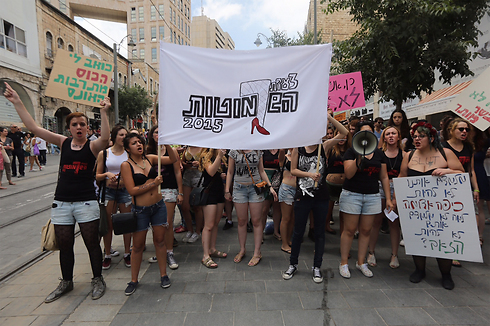
SlutWalk in Jerusalem (Photo: Gil Yohanan)

Y Net News:

“400 people embarked on a SlutWalk on Friday afternoon in Jerusalem, protesting sexual violence, sexual harassment and the objectification of women…

Tamar, a Jerusalem resident in her 20s, said she was taking part in the walk to protest against sexual violence. “It doesn’t matter what I’m wearing, my body is not public property. I’m not a sex object, I can dress however I feel like and it doesn’t give anyone the right to touch me, make offensive comments about me or talk to me disrespectfully,” she said.

Tamar said she experienced verbal sexual harassment in the past. “There is a lot of harassment on the street, a lot of terror. I have been harassed by men on the street since the age of 14. It happened in other cities in the country and actually anywhere in the world,” she said.”

Guardian:

“It’s never been my style, but dudes have been hollering, cat calling or cracking on women years before I was even born. I grew up in east Baltimore’s dope-boy culture, where the coolest guys attracted women by dressing nice, being popular and having conversations. Screaming at women and acting thirsty always looked stupid to me and always will. Seeing the look on that young woman’s face while she was walking with her child made me realize how scary it can be for a woman to walk down the street.

If we men are the problem, we can also be part of the solution…Us men are responsible for not only stopping guys from harassing women, but also telling others to do the same. For this is the only way to shift the culture.”

Herald-Review:

“Oregon lawmakers on Tuesday advanced a proposal aimed at closing a loophole in state privacy laws that recently let a man go unpunished after he took photographs up a teenager’s skirt.

The state Senate unanimously passed the bill, which would make it a misdemeanor to surreptitiously take photos up women’s dresses without their consent. A teachers union proposed the measure after a student took so-called upskirt cellphone photos of an educator and shared them online.

The Senate vote came three months after an Oregon judge ruled a 61-year-old man did nothing illegal when he snapped photos up a teen’s skirt in a Target store.”

Fortune:

“A driver contracted with U.S.-based online taxi company Uber Technologies was arrested near New Delhi on Tuesday, police said, after a woman passenger accused him of sexual harassment when she hailed his cab over the weekend.

Uber was banned in New Delhi in December after another woman passenger accused one of its drivers of rape. The company resumed its services in January after applying for a radio taxi licence, which it still awaits.”

Vice News:

“Holly Kearl, an adjunct professor of women’s studies at George Mason University in Virginia and author of two books about sexual harassment, said that many state laws haven’t caught up with technology, and that it often takes someone being acquitted for a crime before politicians are even aware laws aren’t adequate.

“One of the biggest weakness with many voyeurism laws is that they don’t include public spaces as places that people have the right to privacy,” she said. “Places like locker rooms or bathrooms are protected, but places like subways and parks often aren’t.”…Kearl said that while laws concerning voyeuristic photography become stronger, most would benefit from additional punishments for those who upload those images to the internet, something few laws currently address. And, as depressing as it might sound, we might not see any improvements to the law until more high-profile cases make upskirt photography impossible to ignore.

“This isn’t so common that it’s happening to someone every day,” Kearl said. “Until it is more prevalent, it might not gain traction or become a priority.”

Ravishly:

“It’s incredible how a short interaction can have such a huge effect on your day. Just one catcall can make me go from feeling fabulous to wishing I could curl up into a ball and disappear. It’s bad enough when I’m street harassed out by myself — I feel vulnerable and deciding how to respond can be hard. But it gets really complicated when I’m harassed and with my child.”

Share

Filed Under: News stories, street harassment

Reporter in Canada Stands up to Harassers

May 17, 2015 By HKearl

“F–k her right in the p—y” is a harassing phrase some men have yelled at female reporters across Canada for more than a year. One reporter decided to do something about it and bring this reality to light. Numerous Canadian news outlets covered it last week. Below are excerpts from two papers. And good for her!

But first, the Halifax Police issued this statement (good!):

“If you’re a news consumer and/or on social media, you’re likely aware of a disturbing trend that has been discussed in the media over the past few days where men are yelling vulgarities at women reporters while they’re while they’re on camera in public places. Halifax Regional Police has learned that this is also happening in our community. The individuals who are doing this may think it’s funny and harmless or within the boundaries of their freedom of expression, but we view this type of behaviour as a form of sexualized violence and take it very seriously. We want people to know that aside from being extremely degrading and disrespectful, it could also be criminal. Depending on the circumstances, a person who does this could be charged with mischief, criminal harassment, creating a disturbance or breach of the peace.

We encourage anyone who has had this happen, whether a reporter or otherwise, to report to police if they wish. We also urge those men who would be inclined to make these disgusting comments to think twice about the consequences. “

Via the Globe & Mail:

“‘This has nothing to do with you.”

That was the jarring retort when CityNews reporter Shauna Hunt turned the camera on male soccer fans at a Toronto FC game on Sunday to ask why they were standing around and snickering at her.

Moments earlier, and just before Hunt’s live news hit, a man had waltzed into her interview and uttered a vulgar slur into the microphone – “FHRITP,” an obscene quip calling for the sexual violation of the female broadcaster. The shouting of the sentence began as an online prank in 2014, and grew into a regular occurrence that female television news reporters have come to dread, as men and even young boys will routinely interrupt them to scream it live on the air.

One of the smirking men explained to Hunt that the prank wasn’t personal and that she should probably lighten up. Soccer fans in Britain do a lot worse to female newscasters, another added creepily.

By Tuesday, one of the fans had been fired from his job at Hydro One for violating the company’s code of conduct, which includes a zero-tolerance policy on harassment. Ontario Premier Kathleen Wynne tweeted her support for the journalists, stressing that the “prank” amounts to verbal assault and sexual harassment, on the job no less. Toronto police are reportedly consulting with the Crown attorney’s office on possible charges; police in Kingston tweeted that such hecklers could potentially face a charge of causing disturbance. The men involved also face a minimum one-year ban from all games hosted by the Toronto FC soccer club and the other teams owned by parent company Maple Leaf Sports and Entertainment. “We’re appalled that this trend of disrespectful behaviour would make its way to our city, let alone anywhere near our stadium,” an MLSE statement released Tuesday afternoon read.

The sexual harassment of female television reporters using this “crude trend” has been pervasive in North America since the stunt went viral a year and a half ago. Hunt said she’s had obscenities hurled at her up to 10 times a day.”

Via CBC:

“Shannon Martin has had “F–k her right in the p—y” hurled at her from a passing car, in a children’s area at the Exhibition and at a Toronto high school.

It was during that last instance — when several groups of students took turns hurling the crude phrase at her while she worked — that really shocked her.

“I want to curl up in myself. It’s mortifying,” Martin told CBC Radio’s Metro Morning.

“They were trying to get a laugh from their buddies, but I don’t think they were thinking about the words,” she said.

Still shaken days after, Martin alerted the school board of the incident and sent them the video. Eventually, for the students involved, they were able to use it as a learning opportunity.

But Martin says she, and many other female colleagues, encounter someone yelling the phrase at least once a week. Few male colleagues, she said, have similar experiences while reporting in public places.”

Share

Filed Under: News stories, public harassment

“BU Babes Beware”??

May 7, 2015 By HKearl

Via Boston Magazine:

“On Monday evening, BU police alerted people to three separate incidents of sexual assault near campus. In several of the incidents, a man approached a female from behind and attempted to lift up her skirt. Police said that a number of similar assaults had been reported over the weekend, suggesting they were the work of one serial creep.

Metro Boston devoted its Tuesday cover to the story. The image, though, seems to, uh, take the visual perspective of this skirt-obsessed groper. It shows a woman in a knee-length skirt and heels, her head and shoulders cropped out of the picture entirely. Accompanying the image is the headline “BU BABES BEWARE.” Critics argued the wording put the onus for preventing sexual assault on the skirt-clad ladies of Boston.”

Safe Hub Collective called them out on the sexism and victim-blaming and they apologized. Good work SHC!

“We appreciate the Metro’s quick response and sincere apology to its readers,” writes Safe Hub Collective. “However, the cover itself is indicative of how much work we still have to do when it comes to reporting on violence against women.”

Share

Filed Under: News stories, offensive ads, street harassment

#ThisisRapeCulture

May 6, 2015 By HKearl

Three stories have been going back and forth in my mind over the past 24 hours. The first is so horrific I literally got sick last night after I read it. All three are connected by showing how much our culture fosters rape and limits girls’ and women’s mobility and sense of safety in public spaces and in society as a whole.

1. Boko Haram has kidnapped many women and girls (with school girls kidnapped from their school a year ago the most well-known globally) in Nigeria. Many have been treated as sexual slaves. The very visible proof? 214 of the 234 teenage girls rescued were pregnant. Let that sink in. Fortunately they have been rescued and their communities are welcoming them back and they will receive medical help and counseling. But. No one should have to live through that pain, fear, and suffering, with their lives changed forever by not only the experience but by being forced into motherhood at a young age against their will. It shows how disposable and with how little respect or regard some men have for girls’ and women’s bodies.

Photograph by Taylor Yocom

2. Taylor Yocom, a 22-year old photography student from the University of Iowa created the “Guarded” project to show what women carry to protect themselves, like mace or their keys, which they hold as a weapon. Via BuzzFeed: “These loaded objects on key chains where trinkets should be really do portray how women are expected to always be on guard to protect themselves…when the rapists should not be raping,” she said. “I want people to see the sexual assault statistics (whether they are from strangers who attack on the streets or from date rape) as actual individuals impacted, not simply numbers.”

Good for her. I have carried mace with me since I was 14 years old. It is ridiculous that we have to live this way, have that mentality.

3. In New York City, via Gothamist: “[The] suspect attempted to engage the victim, a 34-year-old female, in conversation. When the victim ignored the suspect, the suspect spat at the victim, who then began to laugh at the suspect. The suspect then took out a sharp instrument, slashed the victim in the arm and then fled the station.” The woman was treated at the hospital and is okay. The man is at large.

But harassers are just trying to be nice and it’s a compliment, right? WRONG. Street harassment is about power, it’s about disrespect, and all too often, it’s about an underlying threat of violence.


Share

Filed Under: News stories, street harassment

Standing with Baltimore

April 30, 2015 By HKearl

On April 19, Baltimore resident Freddie Gray died in police custody from spinal injuries. How it happened has remained unknown, but it sparked protests in Baltimore this week akin to those in Ferguson, Missouri in 2014. To learn more about why, here is a Washington Post article written by a reporter who has lived in Baltimore for 30 years.

Maureen in Baltimore

Because a minority of people at the protests grew violent (some burned a CVS), some media outlets have unfairly focused on them rather than the majority of peaceful protesters who simply want justice for Gray and justice for their communities.

SSH Board member Maureen Evans Arthurs lives near Baltimore. She shares what she did on Wednesday:

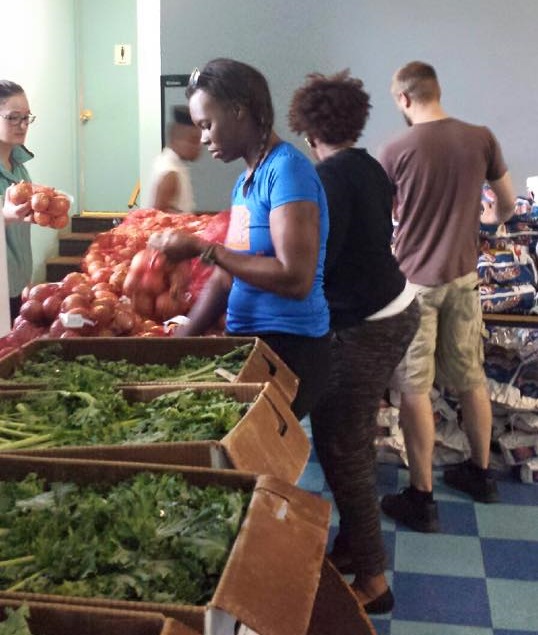
“I joined the No Boundaries Coalition at St. Peter Claver Parish in Sandtown, Baltimore to distribute food and toiletries to residents in need. The community asked for help, and we were right there to provide it. The media is depicting Baltimore as a city of lawlessness and upheaval, when really, communities are coming together to support one another and causing a positive uprising for change. #BmoreUnited

Every day this week there have been protests and that will continue, not just in Baltimore, but in other parts of the country. CNN reports:

“From coast to coast, marchers are taking to the streets to support Baltimore protesters and complain about police brutality in their own towns. The momentum only seems to be building as the week goes on.

Demonstrations are planned for Thursday in Cincinnati,CNN affiliate WXIX reported. And Philly.com said a “Philly is Baltimore” protest will be held at Philadelphia City Hall. Seattle, Portland, Oregon, and Oakland, California are on tap for Friday, which is also May Day or International Workers Day — often used to call attention to issues affecting the working class and minorities. In addition to Baltimore, protests took place in at least half a dozen cities Wednesday.”

Maliyka in NYC
Maliyka in NYC

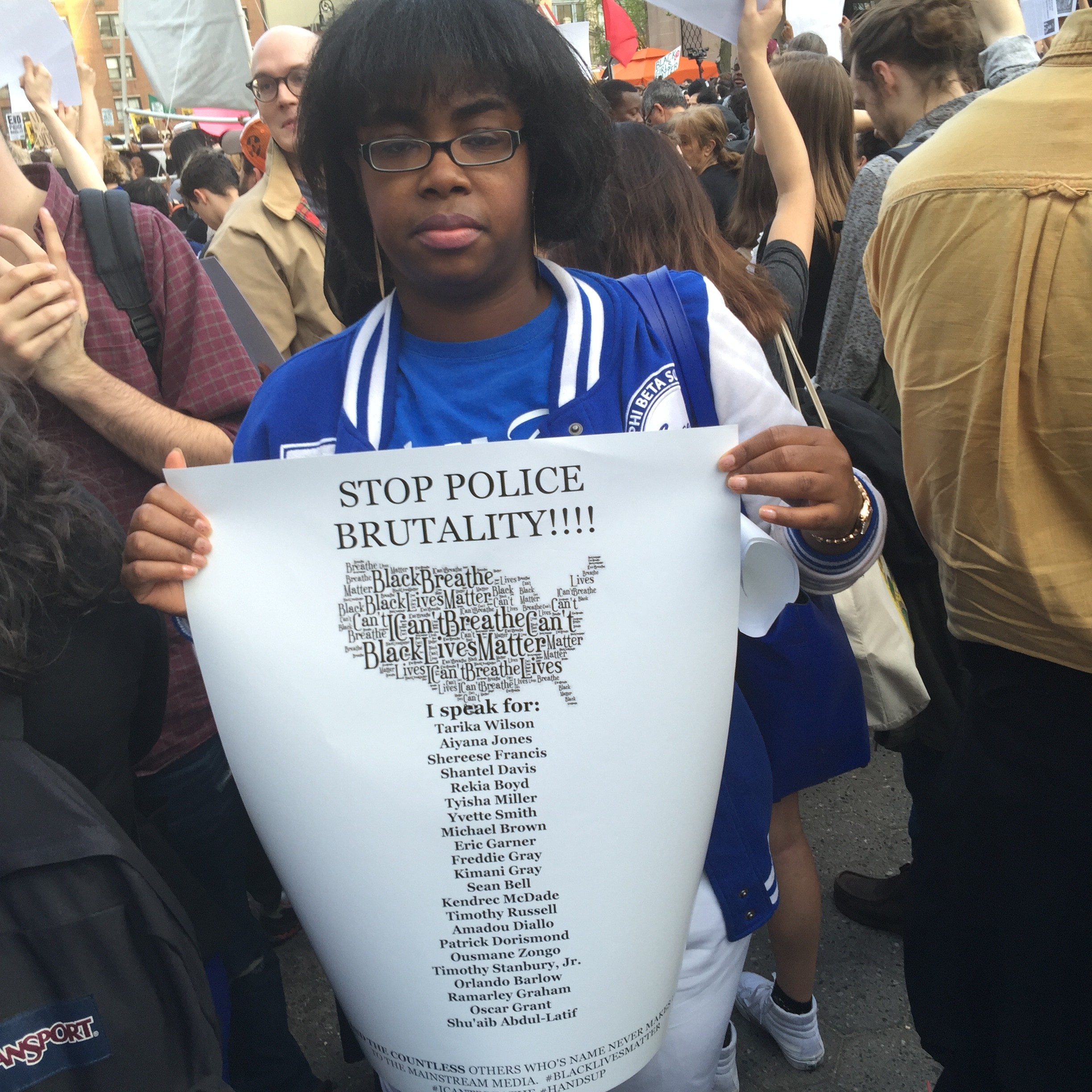
SSH Board member Malikya Muhammad lives in New York and she joined the “NYC Rise Up & Shut It Down With Baltimore” last night with 1000s of other protesters. Unfortunately though, she said it turned scary, “The cops turned a peaceful protest into a jail cell roundup folks who have been doing this for awhile. I never saw anything like this before.”

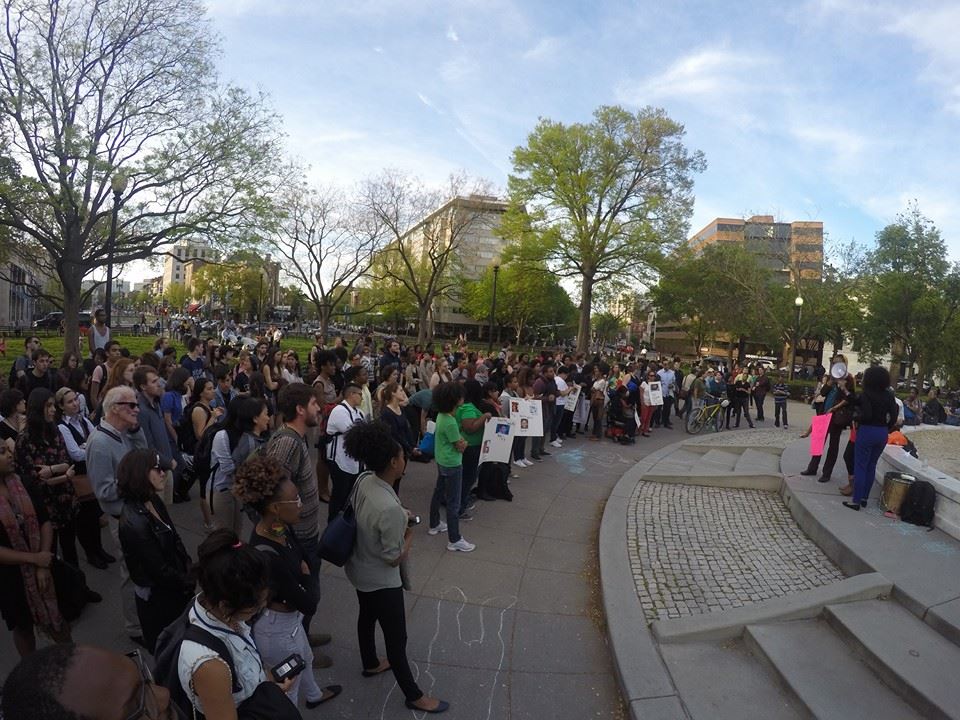
Men are not the only ones unfairly policed or killed. I attended a vigil in Washington, DC, last night for Rekia Boyd and other Black women who have been killed by police. The organizers had us chant out for justice for dozens of women and women in the crowd came up to share poems, songs, and thoughts. Several reminded the Black women in the audience that they matter, their stories, their voices matter. Indeed, they do.

We hope you will do something, take a stand (take part in the “Shut it Down” event May 1 in Baltimore), speak out, and advocate for a cultural shift where #BlackLivesMatter and everyone feels safe in their communities.

Photo by Ilana Alazzeh‎
Vigil in Washington, DC. Photo by Ilana Alazzeh‎
Share

Filed Under: Events, News stories, race Tagged With: baltimore, Freddy Gray, Rekia Boyd

« Previous Page
Next Page »

Share Your Story

Share your street harassment story for the blog. Donate Now

From the Blog

  • #MeToo 2024 Study Released Today
  • Join International Anti-Street Harassment Week 2022
  • Giving Tuesday – Fund the Hotline
  • Thank You – International Anti-Street Harassment Week 2021
  • Share Your Story – Safecity and Catcalls Collaboration

Buy the Book

  • Contact
  • Events
  • Join Us
  • Donate
  • Facebook
  • Instagram
  • Pinterest
  • Tumblr
  • Twitter
  • YouTube

Copyright © 2026 Stop Street Harassment · Website Design by Sarah Marie Lacy