• About Us
    • What Is Street Harassment?
    • Why Stopping Street Harassment Matters
    • Meet the Team
      • Board of Directors
      • Past Board Members
    • In The Media
  • Our Work
    • National Street Harassment Hotline
    • International Anti-Street Harassment Week
    • Blog Correspondents
      • Past SSH Correspondents
    • Safe Public Spaces Mentoring Program
    • Publications
    • National Studies
    • Campaigns against Companies
    • Washington, D.C. Activism
  • Our Books
  • Donate
  • Store

Stop Street Harassment

Making Public Spaces Safe and Welcoming

  • Facebook
  • Instagram
  • Pinterest
  • Tumblr
  • Twitter
  • YouTube
  • Home
  • Blog
    • Harassment Stories
    • Blog Correspondents
    • Street Respect Stories
  • Help & Advice
    • National Street Harassment Hotline
    • Dealing With Harassers
      • Assertive Responses
      • Reporting Harassers
      • Bystander Responses
      • Creative Responses
    • What to Do Before or After Harassment
    • Street Harassment and the Law
  • Resources
    • Definitions
    • Statistics
    • Articles & Books
    • Anti-Harassment Groups & Campaigns
    • Male Allies
      • Educating Boys & Men
      • How to Talk to Women
      • Bystander Tips
    • Video Clips
    • Images & Flyers
  • Take Community Action
  • Contact

New Anti-Harassment Transit Campaigns

April 21, 2015 By HKearl

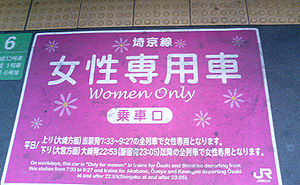
Sexual harassment is a problem on transit systems worldwide. Women in particular face a lot of harassment (one piece of evidence is this 2014 poll of riders from 16 major transit systems in the world). More than a dozen countries even offer women-only transit options as one (band aid, short-term) solution, including in Egypt, Japan, India, Mexico, and Nepal.

But anti-harassment PSAs and reporting efforts are gaining traction, too. Earlier this year, both New York City and Washington, DC, released new PSAs about harassment (SSH helped with the ones in the DC). In DC, there is an online reporting form and front line transit staff are trained to handle harassment complaints.

Last week, over International Anti-Street Harassment, transit systems launched new anti-harassment campaigns in:

London (“Report It To Stop It“)

Los Angeles (“It’s Off Limits” – passengers who see or experience sexual harassment can call the sheriff’s hotline at 888-950-7233 or report through the free LA Metro Transit Watch safety app)

Vancouver (#ItsNotaCompliment)
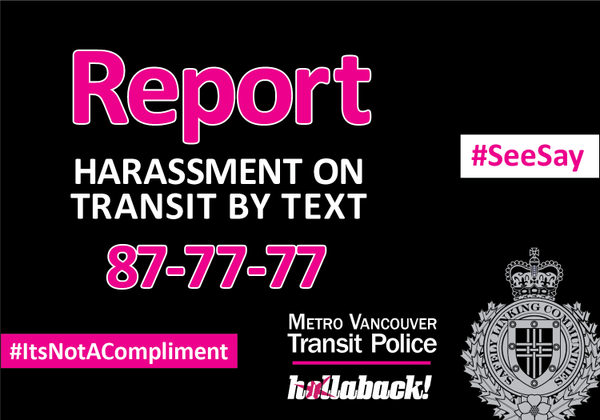
4.13.15 Vancouver Transit ads

In France, a new study released last week found that 100% of women had been harassed while riding public transportation and I talked to staff at the office of women’s rights who said they will be launching a nation-wide campaign next month to address it (to my knowledge, they will be the first country to do this on that scale).

This is all great news. We need more transit systems to step up and take this issue seriously.

Share

Filed Under: anti-street harassment week, News stories, public harassment Tagged With: transit harassment

Germany: Women-Only Transit Options

April 21, 2015 By Correspondent

Lea Goelnitz, Berlin, Germany, Blog Correspondent

women_only_public_transportIn more than one dozen countries, women-only public transportation is chosen as a short-term (or mid-term!) solution to street harassment. These countries are as diverse as Japan, India, Brazil, the Philippines and UAE, and offer sex segregated compartments in their trains or subways. In India public buses have benches reserved for women, entire trains for women and a women-only carriage in the Delhi metro. On the platform of the metro stop, the pink sign marks the “safe” area.

As the latest example of women-only transit, in the beginning of April the Guardian reported that there would be a new women-only rickshaw- service in Pakistan. The founder was fed up with facing daily harassment and now offers safe rides in pink rickshaws. I disagree with celebrating this business idea too much if the reason for the need of such women-only services is not sufficiently seen as a problem. We have to address the root causes.

Although I used to ride in the women-only carriage in Delhi and I guess it created a certain feeling of safety, I always felt like I was being put on display. Having all the women gathered in one space surrounded by men felt awkward. It is frustrating to know that these women-only spaces are a big move away from a gender equal society and from achieving real safety. Through sex-segregation, men do not need to adjust to a society in which women are equal and have the right to be in public spaces. The onus is on women to change.

In addition to women-only trains there are taxi services for women, which are even more widespread. There is SheRides in New York, Cab for Women by Women in Delhi and the Women´s Night Taxi in Hannover, Germany. In Germany there are also women-only parking lots, which are the ones closest to the building.

These interventions and businesses run by women create a safe option for women who otherwise might not go out or who will feel uncomfortable when they are out. As long as politics and culture fail women, this might be the only way to go. On the upside, in most cases it even provides women with economic empowerment. But of course even that is not perfect; the few female drivers may face safety issues as long as they are in the male-dominated space of taxi waiting lanes and rest areas.

Since January one of the major taxi companies in Delhi incorporated women drivers, catering to female passengers as well. This might be a small step forward. At least the men driving for this company will have to get used to having female colleagues.

In order for women to be safe, more women need to be out in public, as passengers and drivers.

Lea works in journalism and women´s rights and is involved in the women´s rights NGO Discover Football, which uses football as a tool for empowerment and gender equality. Follow her on Twitter, @LeaGoelnitz.

Share

Filed Under: correspondents, News stories, public harassment Tagged With: public transit, women-only

Los Angeles Metro Commits To Fighting Sexual Harassment

April 16, 2015 By BPurdy

(Photo by Juliet Bennett Rylah/LAist)

Great news out of Los Angeles! The LA Metro has launched a new campaign called “Its Off Limits” to dissuade harassment on trains and buses and encourage victims to report.

The campaign follows a recent survey that found that while approximately 20% of LA Metro’s 22,604 riders have experienced sexual harassment during their commute, only 99 people reported this behavior in the past year.

With the new campaign, victims can report harassment either using a special hotline or a phone app.

The campaign officially launches tomorrow with a press release at 11am at Union Station, though the posters are up today!

Share

Filed Under: News stories, public harassment, Resources, street harassment

Study: All Women In France have been Harassed on Public Transit

April 16, 2015 By HKearl

More soon, but quickly wanted to share that the first report on gender harassment and sexual violence on public transport across France was released today.  It found that ALL of the more than 600 women surveyed had experienced it at least once in their life on public transportation. In half of the cases, the victims were minors when it first occurred.

Via English RFI:

“You ask a woman, ‘Have you been a victim of harassment or violence in public transportation?’ And she will say, ‘No, not at all’,” explains Elisabeth Moiron-Braud. “But then you ask, ‘Has a man ever pressed up against you or put his hand on your bottom?’ And she will say, ‘Yes!’”

Moiron-Braud is a lawyer who worked on the report for the High Council on Equality between Men and Women (HCEfh) which was presented to the deputy minister for women’s rights, Pascale Boistard.

It is aimed at tackling the range of sexual harassment and assault on public transportation, from catcalls at bus stops, to groping in the metro, to rape in train cars.

The report calls these behaviours “manifestations of sexism” which affect women’s rights to feeling secure, and which limit their use of public space and their ability to move around.

The challenge is identifying the problem. Catcalls can be considered by women and men as flirtation; groping is seen as so common as to not warrant a complaint.

“Women are used to it,” says Laure Salmona, of the Association Mémoire Traumatique et Victimologie, a victims’ rights advocacy group.”

High Council for equality between women and men plans to launch a comprehensive national campaign around harassment on buses, subways and trains next month. To my knowledge, France would be the first country to do this across the whole country!!

H/T Dan Moshenberg

Share

Filed Under: News stories, public harassment, Resources

Breaking News: Five Chinese Women Free!!

April 13, 2015 By HKearl

Hong Kong protest in April 2015

“Police officers on Monday evening released five female activists who were detained early last month in China after trying to start a campaign against sexual harassment on public transportation, two lawyers representing the women said.”

YES!! Thank you everyone who signed petitions, tweeted, etc!!!! We joined SlutWalk DC in a protest outside the Chinese Embassy in Washington, DC last month to call for their release. It is ridiculous that they were detained at all.

CONGRATS to Free Chinese Feminists for their tireless work to free these brave women. #ActivismHeroes #FreetheBeijingFive


Share

Filed Under: News stories

« Previous Page
Next Page »

Share Your Story

Share your street harassment story for the blog. Donate Now

From the Blog

  • #MeToo 2024 Study Released Today
  • Join International Anti-Street Harassment Week 2022
  • Giving Tuesday – Fund the Hotline
  • Thank You – International Anti-Street Harassment Week 2021
  • Share Your Story – Safecity and Catcalls Collaboration

Buy the Book

  • Contact
  • Events
  • Join Us
  • Donate
  • Facebook
  • Instagram
  • Pinterest
  • Tumblr
  • Twitter
  • YouTube

Copyright © 2026 Stop Street Harassment · Website Design by Sarah Marie Lacy