• About Us
    • What Is Street Harassment?
    • Why Stopping Street Harassment Matters
    • Meet the Team
      • Board of Directors
      • Past Board Members
    • In The Media
  • Our Work
    • National Street Harassment Hotline
    • International Anti-Street Harassment Week
    • Blog Correspondents
      • Past SSH Correspondents
    • Safe Public Spaces Mentoring Program
    • Publications
    • National Studies
    • Campaigns against Companies
    • Washington, D.C. Activism
  • Our Books
  • Donate
  • Store

Stop Street Harassment

Making Public Spaces Safe and Welcoming

  • Facebook
  • Instagram
  • Pinterest
  • Tumblr
  • Twitter
  • YouTube
  • Home
  • Blog
    • Harassment Stories
    • Blog Correspondents
    • Street Respect Stories
  • Help & Advice
    • National Street Harassment Hotline
    • Dealing With Harassers
      • Assertive Responses
      • Reporting Harassers
      • Bystander Responses
      • Creative Responses
    • What to Do Before or After Harassment
    • Street Harassment and the Law
  • Resources
    • Definitions
    • Statistics
    • Articles & Books
    • Anti-Harassment Groups & Campaigns
    • Male Allies
      • Educating Boys & Men
      • How to Talk to Women
      • Bystander Tips
    • Video Clips
    • Images & Flyers
  • Take Community Action
  • Contact

Iowa college student in hospital after intervening

February 21, 2015 By HKearl

Our thoughts are with this brave student…

Via Iowa Public Radio:

“A group of men were harassing a woman in Ames when bystander Cale Truhlsen of West Des Moines stepped in to try and stop it. Truhlsen was attacked by the group…and he’s still in the hospital after suffering a broken nose, a black eye, and a hole in his intestine that required surgery….

Alan Heisterkamp, Director of Mentors in Violence Prevention Leadership Institute and the Center for Violence Prevention at the University of Northern Iowa, says Truhlsen did the right thing by intervening….He says it’s important to know your boundaries and not step in when you don’t think you can make a difference on your own.

‘At the end of the day, why do men harass women, and why do men assault other men who challenge those sexist or disrespectful behaviors? We have to have a conversation with our young men about this. I had three of my daughters go to Iowa State. I would have hoped if something like this had happened to one of them that someone like him would have stepped in.'”

Share

Filed Under: News stories, Stories, street harassment

Turkey Marches and Tweets, Los Angeles Prepares for a Transit Campaign

February 20, 2015 By HKearl

TURKEY: Last week, a mini bus driver tried to rape Ozgecan Aslan, a student at Cag University in the southern province of Mersin, when she was the last passenger. He beat and killed her, cut off her hands, burned her body and tossed it into a river. News of her grisly death sparked outrage. Over the weekend, thousands of people marched in black and online, the hashtag  #sendeanlat (#tellyourstory) trended as women shared their stories of harassment and abuse.

Via Al Jazeera:

“Women across Turkey used the hashtags to share experiences of public harassment, as well as incidents within the family, from adolescence through to adulthood.

Many said their lives were restricted by harassment and that they had to take precautions to avoid it, such as dressing more conservatively and carrying pepper spray.

Some said they have had to alter their routes on the street and get off public transportation to avoid harassment. Others said they have had to seek refuge in cafes and shops to avoid stalkers..”

USA: Peace Over Violence will be partnering with the Los Angeles County Metropolitan Transportation Authority on an anti-harassment transit campaign in April!  A survey last year showed that 1 in 5 riders has faced unwanted sexual behavior. In the meantime: “Anyone who sees inappropriate behavior can call 911 or the sheriff’s hotline: (888) 950-SAFE (7233).”

Share

Filed Under: News stories, street harassment

Street Harassment Weekly – Feb. 9-15, 2015

February 16, 2015 By BPurdy

How Wednesday Addams Would React to Catcalling – “In a new episode from the web series “Adult Wednesday Addams,” created by Melissa Hunter, Wednesday follows two dudes home to teach them a lesson after they catcall her. In true Addams family fashion, Wednesday effortlessly scares the men with her piercing tone and sardonic comebacks. (And the three terrifying friends she brought with her definitely helps.)”

Artist Tatyana Fazlalizadeh Combats Street Harassment in Mexico – “Tatyana Fazlalizadeh has traveled all over with “Stop Telling Women to Smile,” in which she wheatpastes the streets with portraits of women captioned with anti-harassment messages. In a comprehensive new series spearheaded by Fusion’s Anna Holmes, Fazlalizadeh takes her work internationally for the very first time, for a long project in México City that combines community activism and beautiful, important public art.”

Why Do Women Get So Much Grief When They Run? – “Talk to female runners, and most will tell you that they have experienced this sort of thing at some point. Friends have told me enough stories to fill this blog twice over: “I’ve had something thrown at me,” “I’ve been complimented on my ass,” and, a particular favourite, “A man said he liked how I jiggle.” One pal told me that for a winter run in London, you need two things: thermals and a scowl to ward off hecklers.”

Performance Becomes Therapy – ““How sex is performed was the question that was offered to the drama therapist students,” Shotwell said. “They then went ahead and with that prompt, came up with these proposals from which I chose.” Shotwell said the event was a form of therapeutic theater, as there is therapy in the performance for the directors, playwrights and the audience.”

Video: ‘Adult Wednesday Addams’ Takes on Street Harassment With Goth Perfection – “Wednesday is randomly catcalled on the street by a couple of D-bags in a truck, so she hunts them down by the scent of their Axe body spray and confronts them at their own home. They may think she’s there for some action, because they are really that full of themselves, but our heroine has a different idea in order to not only extract revenge, but also to give them a valuable lesson.”

A Helping Hand in India –  “Through the University of Utah Public Health Administration, Talboy works in organizing and recruiting volunteers for a yearly trip to India. While there, she interviews young women about their experiences with teasing and harassment. In the villages, discussion of harassment of any sort is a taboo, which has proved a difficult struggle in her journey. Her next steps include interviewing hundreds of girls and boys to gain a full understanding of eve-teasing, which many see as a normal part of life. She believes that bringing the community together and hosting a discussion will be the most efficient manner in beginning to improve life for the teenagers and young adults.”

On V-Day, Sena Activists Police Street Harassment – “Shiv Sena’s youth wing – ‘Yuva Sena’, activists poured on to streets not to vandalize property and disband love-birds on Valentine’s Day, but to conduct community policing to prevent eve-teasing.  Youths said unlike previous years of ‘gundagardi’, activists stepped on to roads to provide safety to women.”

Why Our Conversation About Street Harassment Needs to Include Trans Women– “Somehow we’ve forgotten the burden that trans women in particular carry when they walk down the street – not just from leering men, but from everyone, including law enforcement. Overwhelmingly, trans women carry a burden of harassment and violence on the streets. If a trans woman steps out into public, there is an 8% chance that the street harassment she is facing will turn violent – and a fairly good chance that no one will do a damn thing about it.”

Montana GOP Legislator Wants to Ban Yoga Pants–  “Montana Republican state Rep. David Moore has a plan to guide America out of the darkness—ban yoga pants. Moore, who is upset that group of naked bicyclists pedaled through Missoula last year, decided that what his state really needs right now is tighter regulations on trousers. His proposed bill, HB 365, would outlaw not just nudity, but also “any device, costume, or covering that gives the appearance of or simulates the genitals, pubic hair, anus region, or pubic hair region.””

Event: Holla:Revolution 2015 – “According to the Washington Post, 2014 was the year the conversation around street harassment hit a tipping point. On March 5th, let’s take the conversation to the next level at this year’s HOLLA::Rev. Come join leading thinkers and activists in the field to expand the definitions of street harassment and discuss what each of us can do to create on-the-ground activism in our communities.”


Share

Filed Under: News stories, weekly round up

Germany: One Billion Rising and Documenting Murder

February 13, 2015 By Correspondent

Lea Goelnitz, Berlin, Germany, Blog Correspondent

TRIGGER WARNING

“Men are afraid that women will laugh at them. Women are afraid that men will kill them.”

UK Women killed through suspected male violence in 2014, via Smith’s website

This quote by Margaret Atwood might seem extreme, but there is some truth to it. For example, in the U.S., at least one-third of all female homicide victims were killed by male loved ones, and nationally, one woman per 100,000 is killed by a man.

In the UK, two women per week are killed by a current or former intimate male partner. Ingala Smith started counting Britain´s murdered women three years ago to make the government pay attention. February 12 was the official launch of the Femicide Census in London, a database of every woman who is killed by a man. The project is designed to “force a recognition of the scale and significance of male violence against women.” Smith told the Guardian, “I want us to stop seeing the killings of women by men as isolated incidents: to put them together and to see the connections and patterns; to highlight what a big issue it is; and to make it feel real for people.”

Of course, homicide is relatively rare, but men’s violence against women and girls is quite prevalent. It differs from violence against men because it is based in the structural inequality between men and women. A recent European Union-wide study revealed that one in three women has experienced physical and/or sexual violence since the age of 15 and 75% of women experienced sexual harassment in the work place. The UN notes that at least 35% of women worldwide have experienced physical and/or sexual violence and some national studies place this at 70% of women.

Although there is increased awareness of gender-based violence (GBV) as a public health concern and an obstacle to development, there is still a lack of data to explain it and document it. This leads to a lack of awareness among the general public and an overall lack of visibility of violence against women. Further, some forms of GBV are considered normal or are even institutionalized as cultural practices, such as female genital mutilation. Street harassment is another example and is usually seen as acceptable, or at least not bad enough to be recognized as a form of violence.

But a recent article published in the Guardian reports that a new study found “that some of the sexism women face – from catcalling and sexual harassment to sexual objectification and violence – makes women generally more fearful and anxious. The researchers from the University of Missouri-Kansas and Georgia State University found a substantive ‘link between physical safety concerns and psychological distress”.”

It does matter.

This year´s Valentine´s Day marks the 4th time Eve Ensler’s One Billion Rising raises awareness about violence against women and GBV. We can join in by striving to call out every incident of street harassment, collect stories and explain to people that street harassment is a form of GVB too. As street harassment is sometimes a gateway crime to other forms of VAW like sexual assault and even murder, it is worth it and very necessary to do so.

Lea works in journalism and women´s rights and is involved in the women´s rights NGO Discover Football, which uses football as a tool for empowerment and gender equality. Follow her on Twitter, @LeaGoelnitz.

Share

Filed Under: correspondents, News stories, street harassment

Brazil: The hijab and the concept of oppression

January 29, 2015 By Correspondent

Juliana Guarany, Brazil, Blog Correspondent

Read it in Portuguese. 

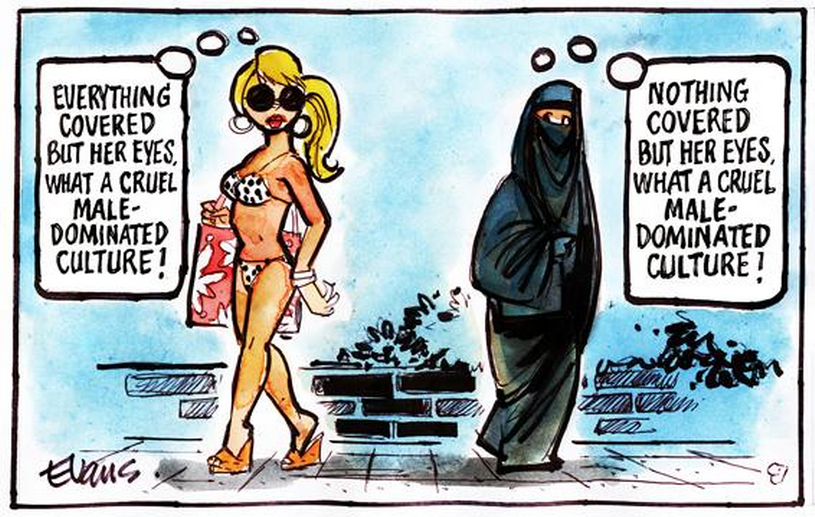
Image by Malcolm Evans

This week American First Lady Michelle Obama didn’t wear a headscarf on a trip to Saudi Arabia. This led to outrage from some and support from others. It is incredible how a headscarf or hijab, one piece of cloth, can cause such emotional reactions when the wearing of it is simply to signify: this woman is Muslim and her life is guided by the laws of Islam.

It has been said many times that the hijab is a symbol of oppression of women, and it actually has been transformed into that in countries like Saudi Arabia, Afghanistan or Iran: restricted societies have taken advantage of Islam’s values over modesty to oppress women, hiding them behind burkas, segregating them from men in public spaces. Because of that, the hijab has been demonized by western societies, but it really doesn’t have to be like that.

February 1st is World Hijab Day, a date created by New York resident Nazma Khan to encourage non-Muslim women to wear a hijab for one day and experiment how it is to walk out as a Muslim. The website makes a good effort to deconstruct the demonized vision western societies have over the hijab. Many women tell how they felt more protected and appreciated as a person than as a sexual object while wearing it. I have done the experiment in Germany and wrote about it. I talked to friends about it, too. It seems it is one thing when the hijab is a choice made by someone thinking of her religious beliefs. It is a completely different situation when the veil is mandatory by law.

A non-Muslim friend was in Malaysia for her vacation and was invited to try on the hijab. She lives in Germany and has seen many Muslims wearing dark clothes, but in Malaysia, as she could notice, women had colorful veils: “I fell in love with the clothes. I wanted to try it out, but felt a bit insecure, I didn’t know anyone. When I walked by a mosque, a group of women asked if I wanted to try. So I decided to do it. I opted for the niqab, leaving only my eyes out. I was stunned by how my eyes popped out, stronger than ever! I loved the experience”. I asked her if she faced any glimpses or any other problems by walking around without a hijab: “Not even a little bit”, she says, “in the western world we have the arrogance of thinking that anything different from us is wrong. I walked around Malaysia with modest clothes, but my hair was out there and I was never harassed because of it”.

Another friend visited Kuwait and had a very different experience: “it is a tribal society that treats people differently not only based in their gender, but also their social status, their family history and what line of Islam they follow. In the 70s you could see women wearing miniskirts in Kuwait. Now, you need a burka to go out, especially if it’s a traditional region”. As a foreigner, she was able to walk around without a hijab, but had local teens following her into malls and markets. She talked about Saudi Arabia in similar terms as well. Indeed, Saudi film director Haifaa al-Mansour recently spoke about segregation in her country on CNN. She has to direct her film from inside the car because she couldn’t be seen around men. But she said her country is changing – very slowly, but changing.

Another friend could not go out in the streets of Yemen without a burka, fearing she could be kidnapped for being a foreign woman: “It was not just the hijab, but also wearing pants. Just the line of my legs and crunch are seen as an act of disrespect”. In Iraq, she said, the veil can be optional, but going out without it makes people uncomfortable: “it’s like as if I was walking around naked”. But even in those countries, she said, women are not addressed with such disrespect as in Egypt: “I got spit on, pissed on, even a cab driver masturbated when I was in the car”, but that has very little to do with the veil, as both Muslim and non-Muslim women are harassed constantly in the streets. As a more opened Muslim country, Egypt seems to get the worst part of both worlds, creating the most disrespectful environment women can be exposed to.

Charlie Hebdo

In the light of the latest terrorist attempt in France, Muslims have suffered from prejudice. In Brazil, a country with a very limited Muslim community, there have been acts of aggression. Wearing a hijab is just another excuse for harassment. A woman was recently hit by a rock in plain daylight in São Paulo because she was wearing a hijab: “Usually, we do not have any problems, but when a terrorist attack takes place, people around us start to blame our religion due to wrongful information passed by the media.” She clarifies one vision that takes the light of the problem out of religion: “It is wrong to say that Muslim women face violence and are oppressed, because women all around the world face violence and are oppressed just as much. This is not a matter of religion, it is a matter of gender”.

It is sad to see how aggressive the clash of western and Islamic worlds is. On one side, non-Muslims tend to think Muslim women are oppressed by their clothes. On the other, Muslim women send the message that they are the ones being judged only by who they are instead of what they look like. As women in general, we need to unite and, on top of it all, respect the choices we each make.

Juliana is a fellow from Alexander von Humboldt Foundation and, together with Hamburg University, in Germany, is creating a digital campaign to connect all feminist initiatives around the globe. Read her blog Whistleblower and follow her on Twitter, @juguarany

Share

Filed Under: correspondents, News stories, street harassment

« Previous Page
Next Page »

Share Your Story

Share your street harassment story for the blog. Donate Now

From the Blog

  • #MeToo 2024 Study Released Today
  • Join International Anti-Street Harassment Week 2022
  • Giving Tuesday – Fund the Hotline
  • Thank You – International Anti-Street Harassment Week 2021
  • Share Your Story – Safecity and Catcalls Collaboration

Buy the Book

  • Contact
  • Events
  • Join Us
  • Donate
  • Facebook
  • Instagram
  • Pinterest
  • Tumblr
  • Twitter
  • YouTube

Copyright © 2026 Stop Street Harassment · Website Design by Sarah Marie Lacy