• About Us
    • What Is Street Harassment?
    • Why Stopping Street Harassment Matters
    • Meet the Team
      • Board of Directors
      • Past Board Members
    • In The Media
  • Our Work
    • National Street Harassment Hotline
    • International Anti-Street Harassment Week
    • Blog Correspondents
      • Past SSH Correspondents
    • Safe Public Spaces Mentoring Program
    • Publications
    • National Studies
    • Campaigns against Companies
    • Washington, D.C. Activism
  • Our Books
  • Donate
  • Store

Stop Street Harassment

Making Public Spaces Safe and Welcoming

  • Facebook
  • Instagram
  • Pinterest
  • Tumblr
  • Twitter
  • YouTube
  • Home
  • Blog
    • Harassment Stories
    • Blog Correspondents
    • Street Respect Stories
  • Help & Advice
    • National Street Harassment Hotline
    • Dealing With Harassers
      • Assertive Responses
      • Reporting Harassers
      • Bystander Responses
      • Creative Responses
    • What to Do Before or After Harassment
    • Street Harassment and the Law
  • Resources
    • Definitions
    • Statistics
    • Articles & Books
    • Anti-Harassment Groups & Campaigns
    • Male Allies
      • Educating Boys & Men
      • How to Talk to Women
      • Bystander Tips
    • Video Clips
    • Images & Flyers
  • Take Community Action
  • Contact

UK: Victim-blaming poster needs to go!

November 6, 2014 By HKearl

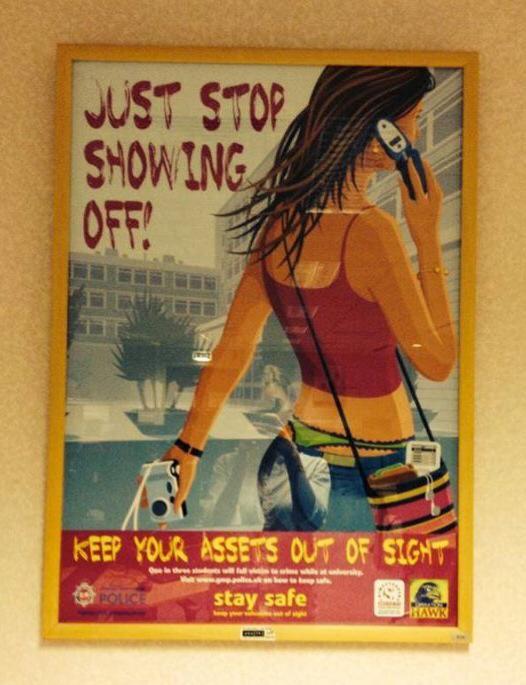
The Manchester police department is behind this poster targeted at college students. While the poster was created a while ago, it is finally receiving much-warranted attention/criticism.

Via The Tab:

“A third year Art History student was fuming from seeing this poster after recent events: “Everyone is terrified for their own safety after the rape in Fallowfield, and this is the last thing we want to hear.

“What the hell were they thinking?! Trying to suggest that we’re asking to get raped/mugged/attacked is disgusting and insensitive.

“The uni and the police should be trying to help and support us at this time, not rudely suggesting that it’s our own fault.”

“It’s so out dated” a second year Linguistics student told The Tab. “It’s like they’re trying to be ‘down with the kids’.”

Shocked students took so social media to express their outrage, branding the poster “bad taste”.

One student on Facebook sarcastically remarked: “I, for one, am very glad that I’ve seen this poster.

“I didn’t realise that wearing a thong makes it easier for people to steal my things. I will wear more clothing in the future!””

H/T Elizabeth Plank

Share

Filed Under: News stories, public harassment

New Studies: Power and Inequality

November 3, 2014 By HKearl

Two new reports/studies illustrate important points relating to street harassment.

1. Street harassment, like all forms of sexual harassment, is about power/control, not about attraction or someone just trying to be nice to someone else. A new study provides more evidence that this is true.

“Adolescent boys who bully peers and engage in homophobic teasing are more likely to perpetrate sexual harassment later on, suggests a new study of middle-school students conducted by researchers at the University of Illinois and the U.S. Centers for Disease Control and Prevention…

The association between bullying and sexual harassment may be indicative of a developmental pathway for some bullies and warrants greater prevention and intervention efforts in schools, said Dorothy L. Espelage, who is among the first researchers to investigate these problems in middle-school populations.

Primary prevention efforts may need to begin even earlier than middle school – in late elementary school – and focus on gender-based aggressive acts that precede sexual harassment perpetration, especially homophobic name-calling, Espelage said.”

The existence of a “bully-sexual violence pathway” among boys is shows that sexual harassment/street harassment is about power and itis behavior that can and should be prevented at a young age.


2. Street harassment reinforces and is a by-product of gender inequality.

The World Economic Forum released their annual Global Gender Gap Report a few days ago. Yet again, no country has achieved gender equality. Street harassment perpetrated by men against women is one more indicator and manifestation of this inequality. No country will ever achieve gender equality until street harassment ends and street harassment will not end as long as women are second-class citizens globally.

Share

Filed Under: News stories, Resources

Harassment on Public Transportation News Round-up

November 3, 2014 By HKearl

In the last two weeks there have been several new articles and initiatives around sexual harassment on public transportation. Here’s a sampling:

GLOBAL:

YouGov polling conducted in 16 major cities worldwide asked participants about how safe they feel at night, their experiences with verbal harassment and physical abuse, the public response to abuse, their confidence in authorities, and their overall feelings of safety in the city. They then ranked the 16 cities safest (New York City) to least safe (Bogota). Read more here.

ENGLAND:

Via Independent:

“In September 2013 London launched Project Guardian, a collaborative effort by the British Transport Police, the Metropolitan Police, the City of London Police and Transport for London, to boost levels of reporting of sexual offences.

The Everyday Sexism Project, the End Violence Against Women coalition and Hollaback advised the police on the project, which saw 2000 officers receive special training and 120 officers – both in uniform and plain clothes – carry out daily patrols on the transport network. Since the launch of the initiative, there has been a 20% increase in the reporting of sexual offences, and a 32% increase in the number of cases where offenders have been charged or summoned.”

FRANCE:

Osez le Féminisme (Dare Feminism) launched a campaign on Friday in support of women’s right to be un-harassed on public transportation in Paris

Via rfi:

“‘When you are a woman on the subway in Paris, you are often the victim of different types of sexual aggression […] We have done a study in the metro this summer in Paris, and the study showed that three out of four women were adapting their behaviour or their clothes and their way of dressing when they were going to take the metro.’

The group asks that the RATP, the French public transportation operator, will join in the fight against gender-based violence.”

INDIA:

Via New India Express:

“Thus was born Safe Safar, a campaign started in 2010, to make travel in autorickshaws in Lucknow safe for women, by creating awareness among auto drivers. The campaign blossomed into a full-fledged, successful project that was awarded the IIM-L Manfest Prerna Fellowship Award-2013 by IIM-Lucknow.

“Our survey prior to the campaign revealed that while about 97 per cent of women were sexually harassed at some point of time while travelling in autorickshaws, drivers often chose not to stand up against the crime, considering it none of their business. So, we decided to address the crime at its root by making the driver aware,” says Zeeshan, 30, a postgraduate in social work, who has been extensively working on gender and youth-centric issues for the past four years.

Besides sensitising auto-drivers to play a pro-active role in ensuring security of women commuters, the campaign involved persuading them to stop playing pulsating music and removing pictures of scantily clad women from their vehicles.

Spanning two successful years, the campaign reached out to over 2,000 auto-rickshaw drivers while training 350 of them. Owing to its success, Zeeshan converted it into a full-time programme under his NGO Yeh Ek Soch, which he runs along with partner Shariq Ahmad.”

Share

Filed Under: News stories, public harassment

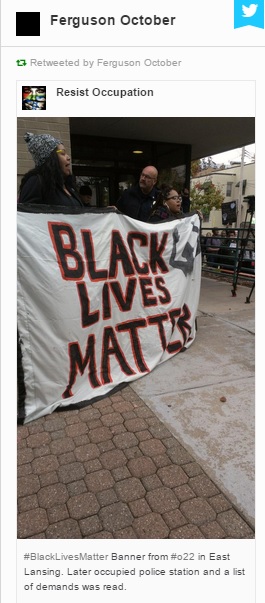
USA: Why #Ferguson matters

October 27, 2014 By Correspondent

Angie Evans, Washington, DC, SSH Blog Correspondent

Walking across the street to pay the parking meter, a man pulled to curb. I kept my “resting bitch face” on but he still rolled down his window to invite me for a ride. He made sure to comment on my pretty face. I wish this was a rare occurrence; but it isn’t. I wish I could say I was wearing something low cut or short; but I wasn’t. I wish I looked too good that day; but I didn’t. I always wonder what I could do differently when these things happen and realize the answer is nothing.

As a woman, you experience a daily barrage of commentary on all things. You can expect the opinion of strangers whether you smile out of politeness or frown as a defense mechanism. As I walked to a coffee conversation about #FergusonOctober and away from my harasser, the parallels between the microaggressions I experience as a white woman on the street and the institutional racism African Americans have grappled with for centuries that spurred the murder of Michael Brown were obvious. Racism and sexism leave us vulnerable and often disempowered in a society that normalizes both problems

One outcome of institutionalized racism is police harassment. There is no denying that black youth are portrayed negatively in the media. For every positive story about an African American thought leader, writer, or everyday joe, there are half a dozen stories reinforcing racial stereotypes about criminal activity or academic failure. And although you wouldn’t know it from watching the news, the majority of all violent crime in the US is committed by white people – not young black men.

Police are fed the same media we are though, so it’s not surprising that an 18-year-old black kid and a white cop would feel tension around one another. And it’s also not shocking that the media engaged in victim-blaming when the #Ferguson story came out. They wanted to find some way to justify this young man’s death…but lets be real, even if the kid had robbed a store, there was no justification for killing him. No law makes that moral.

A group of women in skirts doesn’t provide the grounds for catcalling anymore than black kids hanging out on the sidewalk warrants police harassment and violence.

As more African American families have been sharing their own stories of racially-motivated harassment in recent months, people like me are realizing that what happened in Ferguson wasn’t a one time event. Thanks to more video recordings, we can even see some of these stories. Like when a video was released earlier this month showing a police officer breaking the window of a black family’s car in order to pull the man in the passenger seat from it. Why did the officer stop the car? Because the driver wasn’t wearing her seat belt. Unfortunately the situation escalated quickly. With stories about young black men being killed by police officers are pouring forward left and right, the family was scared and even called the police station from inside the vehicle.

Perhaps the cop who broke through the window isn’t a bad guy. Perhaps the passenger isn’t an angel. But the real problem isn’t the players in this story, the problems are that police disproportionately target persons of color and many African Americans justifiably fear white police officers.

You can’t have a true democracy if one group lives in fear of another and yet, that is our society.

This kind of police violence is a symptom of racism and also poor training, recruitment, and a lack of accountability. If you want to learn more about what can be done to end police harassment, read the suggestions in SSH Blog Correspondent Sarah’s post from earlier this month, for example, offering community-wide trainings on how to report police abuse in your area.

Angie is a community organizer and social worker. Last year she quit her job to travel around the world with her husband. They have just returned and are continuing to write about travel and adventure at http://whereisseangie.com

Share

Filed Under: correspondents, News stories, public harassment, race

India: “SHE” teams to stop harassers

October 26, 2014 By HKearl

Via The Hindu:

“Cracking the whip on men sexually harassing women in public places by passing lewd comments or making indecent gestures, the city police on Friday formed ‘SHE’ teams to catch such persons.

‘Hundred of these teams, each comprising policewomen and policemen carrying secret video cameras, will look out for men harassing women at bus-stops, colleges, and junctions,’ said Hyderabad Police Commissioner M. Mahender Reddy at a press conference.

‘Clad in plainclothes, members of ‘SHE’ teams will mix with the general public and lay in wait searching for men stalking or pestering women. They will videotape them and then two members will catch the person while the other will stand by in support in case of emergency,’ the Commissioner said.”

Share

Filed Under: News stories, public harassment

« Previous Page
Next Page »

Share Your Story

Share your street harassment story for the blog. Donate Now

From the Blog

  • #MeToo 2024 Study Released Today
  • Join International Anti-Street Harassment Week 2022
  • Giving Tuesday – Fund the Hotline
  • Thank You – International Anti-Street Harassment Week 2021
  • Share Your Story – Safecity and Catcalls Collaboration

Buy the Book

  • Contact
  • Events
  • Join Us
  • Donate
  • Facebook
  • Instagram
  • Pinterest
  • Tumblr
  • Twitter
  • YouTube

Copyright © 2026 Stop Street Harassment · Website Design by Sarah Marie Lacy