• About Us
    • What Is Street Harassment?
    • Why Stopping Street Harassment Matters
    • Meet the Team
      • Board of Directors
      • Past Board Members
    • In The Media
  • Our Work
    • National Street Harassment Hotline
    • International Anti-Street Harassment Week
    • Blog Correspondents
      • Past SSH Correspondents
    • Safe Public Spaces Mentoring Program
    • Publications
    • National Studies
    • Campaigns against Companies
    • Washington, D.C. Activism
  • Our Books
  • Donate
  • Store

Stop Street Harassment

Making Public Spaces Safe and Welcoming

  • Facebook
  • Instagram
  • Pinterest
  • Tumblr
  • Twitter
  • YouTube
  • Home
  • Blog
    • Harassment Stories
    • Blog Correspondents
    • Street Respect Stories
  • Help & Advice
    • National Street Harassment Hotline
    • Dealing With Harassers
      • Assertive Responses
      • Reporting Harassers
      • Bystander Responses
      • Creative Responses
    • What to Do Before or After Harassment
    • Street Harassment and the Law
  • Resources
    • Definitions
    • Statistics
    • Articles & Books
    • Anti-Harassment Groups & Campaigns
    • Male Allies
      • Educating Boys & Men
      • How to Talk to Women
      • Bystander Tips
    • Video Clips
    • Images & Flyers
  • Take Community Action
  • Contact

Sri Lanka: Behind Serene Smiles: Shame on You!

September 18, 2014 By Correspondent

Menusha Gunasekara, Matale, Sri Lanka, SSH Blog Correspondent
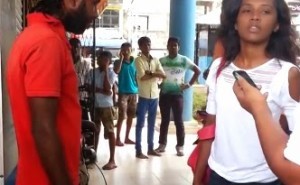
Via The Republic Square

Sri Lanka has been known to many outsides as a land full of natural beauty, serene smiles and helpful people. However, as a Sri Lankan I am not free to explore the beauty easily as a woman.

When it comes to street harassment, we often receive the advice from our parents, aunts, and others that men are men and mind your own way. The Wariyapola incident was an historical turning point in Sri Lanka in showing the power imbalance in the gendered phenomena of street harassment.

Let me draw your attention to the Wariyapola Incident. First, what was happened! A girl who was waiting to take a bus to Colombo was subjected to comments of a man. Briefly, if I listed actions involved in the situations, those were included commenting that her dress has more holes, following her and asking  her phone number, and publicly demonstrating signs of  masturbating  and asking to have sex with him. The result was she slapped him repeatedly and a video was released in the social media that only captured the part where she was slapping. Yes, the video went viral on social media sparking huge amount of comments.

This post is to look at the incident from different views.

First, I identified the focus on the woman provoking the sexist comments by men. Since the video of her slapping was shared, people said the man was “noble enough” to stay silent without hitting back the girl. It’s sad that the reporting on harassment to civil society comes through media in Sri Lanka. Many newspapers, radios shows and online newspapers were reporting the incident based on the portion which was recorded in the video clip. They were insulting the woman without realizing she was the victim first. They were forgetting the responsibility of investigating the truth and reporting it. I was surprised by this sexist journalism and found only few articles that supported the woman’s side.

The next interesting fact was comments about her dress. If she was dressed up appropriately, which means saree, people said she could not subjected to such harassment. Let me analyze this sexist argument. The saree or the Sinhalese Kandiyan Osariya which exposes back of shoulders, neck and waist of the body is much more appropriate than a wearing jean with a long sleeve blouse. The hidden point in so called appropriate dress is the amount body exposure to outside. However, I am quite sure the Sinhalese national dress exposes body more than any other casual dress. On the top of this, please keep in mind that women used to dress topless for many centuries in Sinhala society. So please do not tell me I can wear the national dress 24/7 and it will be the harassment- proof tool.

Next, the action of the victim, the girl, was unappropriated too according to many men and women in this country. If one asked why it was inappropriate, the answer is that she could have handled the situation without drama. She could have complained to the police and remained silent. Really? Should she?

I have been subjected to several incidents of street harassment each and every time I have used public transportation in last two months. I have exercised the minimum power in such situations as directly looking at the person but if I had the same incident that occurred in Wariyapola, I would not be different because I am aware my body and my dress is not for you entertainment and I am a person not a piece of meat or a sex object. What was the problem of hitting the perpetrator? Neither was it violating the law in the country or harming human rights, but the exercise of the power by the woman which is not the expected role in Sinhalese culture.

Looking at the incident as a whole, it is clear that nobody tells men in this country that you should not cat call, verbally harass or comment on dresses, or engage in any other form of harassment. It is illegal, shameful and not an act of real men. This is not taught in schools neither in religious institutions. I firmly believe that unless you identify these activities as illegal and that they really do exist behind the serene smiles of men in the “land like no other,” it will not absorb in to the  general consciousness.

We need to make it visible and show that women are harassed every minute in Sri Lanka regardless of their age, dress code and outlook.

 Menusha is a recent graduate of Asian University for Women, Bangladesh and holds a B.S in Public Health. She is an advocate for Peace and Human Rights, Women Issues and Environmental Protection. She can be reached via LinkedIn.

Share

Filed Under: correspondents, News stories, street harassment

Will Kansas City Pass An Anti-Harassment Ordinance?

September 17, 2014 By HKearl

Woo, great press this week for our Safe Public Spaces Mentees BikeWalkKC in Kansas City, Missouri, USA.

Via Kansas City Star:

“‘We’re encouraging people to walk and bike more,’ Kansas City Councilman John Sharp said, ‘and they certainly ought to be allowed to do that without harassment.’

Broad anti-harassment ordinances are already on the books in Kansas and Missouri.

But before the end of the month, Sharp, chairman of the council’s public safety and emergency services committee, hopes to pass an ordinance that would outlaw threatening and dangerous behavior to protect “vulnerable road users.” That includes everyone from bikers, walkers and cyclists to people in wheelchairs or waiting at bus stops.

The ordinance is based on similar ones passed in Columbia, St. Louis, Independence and Greenwood, Mo., in the last five years. Sharp and advocacy group BikeWalkKC hope to have Kansas City’s ordinance on the books by Oct. 8.

That’s International Walk to School Day. Fifty years ago, half of American school kids biked or walked to school. Now it’s less than 15 percent at a time when many children are overweight and need more exercise.

But attempts to reverse that trend aren’t going to work, Sharp said, unless parents believe the streets are safe. Nor will anyone other than the bravest cyclists use the new bike lanes the city is striping across town if they’re fearful of being run off the road by aggressive motorists.”

Via KC TV 5:

“The Kansas City Council is considering an ordinance to crack down on harassment and threats for those taking a stroll or riding a bicycle.

The ordinance amendment is sponsored by Councilman John Sharp. He said he hopes to protect anyone from being made to feel uncomfortable…

The council’s public safety committee will discuss the issue on Sept. 25. If it passes out of committee, the full council could take it up as soon as Sept. 26.

The following is the proposed ordinance:

 Sec. 50-205. Harassment of a Bicyclist, Pedestrian or Wheelchair Operator

(a) The following words, terms and phrases, when used in this section, shall have the meanings ascribed to them below, except where the context clearly indicates a different meaning:

Bicycle means any device upon which a person may ride, which is propelled by human power through a system of belts, chains, or gears, and may include an electric assist motor, and has wheels at least 16 inches in diameter and a frame size of at least 13 inches.

Wheelchair means any manual or motorized device designed specifically for use by a physically disabled person for means of conveyance.

(b) No person shall, for the purpose of frightening or injuring any person riding a bicycle, walking, running, or operating a wheelchair:

(1) Throw an object, direct a projectile, or operate a vehicle at or in such person’s direction; or

(2) Threaten such person; or

(3) Sound a horn, shout or otherwise direct loud or unusual sounds toward such person; or

(4) Place such person in apprehension of immediate physical danger; or

(5) Engage in conduct that creates a risk of death or serious physical injury to such person.

(c) Any person convicted of a violation of this chapter shall be punished for that violation by a fine of not less than $50, but not more than $500 or by imprisonment of not more than 180 days or by both such fine and imprisonment.”

Share

Filed Under: News stories, public harassment, SSH programs

Racial profiling of Black Women

September 14, 2014 By HKearl

Image via MIC

Via MIC:

“African-American actress Danièle Watts claims she was “handcuffed and detained” by police officers from the Los Angeles Police Department at CBS’s Studio City production facility on Thursday after allegedly being mistaken for a prostitute….

Sadly, this isn’t the first time something like this has happened. In 2008, a Galveston, Texas couple sued three police officers who arrested and beat their 12-year-old daughter after mistaking her for a prostitute. And at the 2011 Netroots Nation convention in Minneapolis, Minn., Cheryl Contee of Jack and Jill Politics asked a panel of African-American women to raise their hands if they had ever been mistaken for a prostitute. Everyone’s hands went up.”

This is UNACCEPTABLE. And even if she were a sex worker, LAPD should never have treated her this way.

Related, anecdotally, in my 7+ years of street harassment activism, I’ve found that Black women are more likely to be propositioned and called out to as if they are sex workers by street harassers compared with any other race of women. A student’s study about street harassment in Egypt a few years ago found the same thing to be true in Egypt — dark skinned women were more likely to be assumed to be and treated as prostitutes.

Related:

* Monica Jones was arrested basically for being a transgender woman of color walking down the street.

* A Sudanese woman featured on Humans of New York talked about being solicited “all the time”

Share

Filed Under: News stories, street harassment Tagged With: racial profiling

Inside Edition Covers Street Harassment

September 10, 2014 By HKearl

“Jillian Severin is a beautiful 25-year-old woman. But when she’s walking down the street, something inevitably happens that she dreads… rude cat calls.

“It makes you feel dirty,” Severin told INSIDE EDITION‘s Lisa Guerrero.

But this day, as Severin gets ready to hit the streets of New York City, she won’t be facing the cat-callers alone. INSIDE EDITION decided to tag along and try to capture what men do as she walks by.

INSIDE EDITION’s I-Squad documented Severin’s experience with multiple cameras. There were surveillance cameras behind her and in front of her. She even carried her own hidden cameras. And INSIDE EDITION’s Lisa Guerrero was just a few feet away, ready to turn the tables on the cat callers.”

Watch the segment:

Share

Filed Under: News stories, street harassment

“A Gentleman’s Guide to Rape Culture”

September 9, 2014 By Contributor

Hello! I want to point out this article, written by a man, which is titled ʺA Gentleman’s Guide to Rape Cultureʺ.

It is very interesting and I especially like this paragraph in which he describes, through a very explanatory metaphor, how a woman feels when she meets a man on the streets:

ʺ[…]Because when it comes to assessing a man, whatever one man is capable of, a woman must presume you are capable of. Unfortunately, that means all men must be judged by our worst example. If you think that sort of stereotyping is bullshit, how do you treat a snake you come across in the wild?

…You treat it like a snake, right? Well, that’s not stereotyping, that’s acknowledging an animal for what it’s capable of doing and the harm it can inflict. Simple rules of the jungle, man. Since you are a man, women must treat you as such.ʺ

– EZ

Share

Filed Under: News stories, street harassment

« Previous Page
Next Page »

Share Your Story

Share your street harassment story for the blog. Donate Now

From the Blog

  • #MeToo 2024 Study Released Today
  • Join International Anti-Street Harassment Week 2022
  • Giving Tuesday – Fund the Hotline
  • Thank You – International Anti-Street Harassment Week 2021
  • Share Your Story – Safecity and Catcalls Collaboration

Buy the Book

  • Contact
  • Events
  • Join Us
  • Donate
  • Facebook
  • Instagram
  • Pinterest
  • Tumblr
  • Twitter
  • YouTube

Copyright © 2026 Stop Street Harassment · Website Design by Sarah Marie Lacy