• About Us
    • What Is Street Harassment?
    • Why Stopping Street Harassment Matters
    • Meet the Team
      • Board of Directors
      • Past Board Members
    • In The Media
  • Our Work
    • National Street Harassment Hotline
    • International Anti-Street Harassment Week
    • Blog Correspondents
      • Past SSH Correspondents
    • Safe Public Spaces Mentoring Program
    • Publications
    • National Studies
    • Campaigns against Companies
    • Washington, D.C. Activism
  • Our Books
  • Donate
  • Store

Stop Street Harassment

Making Public Spaces Safe and Welcoming

  • Facebook
  • Instagram
  • Pinterest
  • Tumblr
  • Twitter
  • YouTube
  • Home
  • Blog
    • Harassment Stories
    • Blog Correspondents
    • Street Respect Stories
  • Help & Advice
    • National Street Harassment Hotline
    • Dealing With Harassers
      • Assertive Responses
      • Reporting Harassers
      • Bystander Responses
      • Creative Responses
    • What to Do Before or After Harassment
    • Street Harassment and the Law
  • Resources
    • Definitions
    • Statistics
    • Articles & Books
    • Anti-Harassment Groups & Campaigns
    • Male Allies
      • Educating Boys & Men
      • How to Talk to Women
      • Bystander Tips
    • Video Clips
    • Images & Flyers
  • Take Community Action
  • Contact

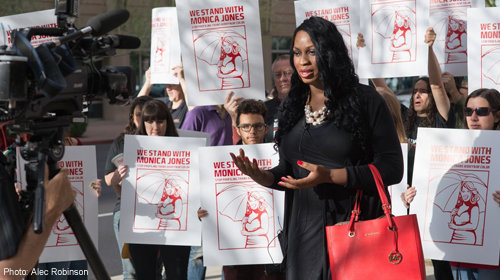
#StandWithMonica and #FreeEisha

August 28, 2014 By HKearl

Via ACLU

Transgender women of color face some of the highest rates of street harassment and violence of any demographic. Here are two of these women who need our help:

Via ACLU:

“When Monica Jones left her house on the evening of May 17, 2013, she expected to hang out at a local bar and restaurant and meet up with some friends. But for transgender women of color, just walking down the street can be a criminal act.

Especially in Phoenix, Arizona, where literally “any bodily gesture” can be sufficient evidence that you are intending to engage in prostitution.

When an undercover officer saw Monica Jones, a black transgender woman, walking down the street just a few blocks from her house, in an area that the officer described as being “known for prostitution,” that was enough to convince him that she intended to engage in prostitution. It was on that basis that he approached and stopped her.

In April of this year, Monica was convicted of violating this overbroad and vague law. Today she appeals that conviction, and the ACLU, along with other advocacy and civil rights organizations, filed a brief in support of her appeal.

We #StandWithMonica because transgender women of color should be able to walk down the street in their neighborhoods without being arrested, or worse, for simply being themselves.”

Via GLAAD:

“A trans woman of color, Eisha Love, is currently facing attempted murder charges after she was attacked by two men outside a gas station on Chicago’s West Side. According to a Change.org petition calling for Love’s release from prison with over 2,000 signatures at this time, she was with a friend when two men began harassing them with slurs and epithets, and Love was struck in the face.

As Love and her friend rushed to escape the attack in their car, one of their attackers standing near the vehicle was permanently injured. Later, Love turned herself in for the injury and was charged with 1st degree attempted murder. If convicted, she faces 10 years in prison….You can read more about Eisha’s story and support her by signing and sharing this Change.org petition, and by using hashtag #FreeEisha on social media”

Share

Filed Under: LGBTQ, News stories

Street Harassment is NOT a compliment

August 19, 2014 By HKearl

I am really floored that after the NY Post published an article about street harassment being flattering (and women should just deal with it), major outlets like USA Today, Time and Salon.com all ran pieces this afternoon disagreeing, as did sites like Bustle, the Frisky,

This would never have happened a few years ago, hell maybe not even last year. This is an incredible shift in how street harassment is viewed!! WOW. Let’s keep speaking out!

Share

Filed Under: News stories, street harassment

Aug. 11 Street Harassment News in the USA

August 11, 2014 By HKearl

“The Psychology Behind Street Harassment—And How You Can Stop It,” Shape.com

“Coping with catcalls: How some women brush off street harassment,” TODAY Show

“Buzzfeed’s video about street harassment is a must-see,” Washington Post

“Viewpoint: Street harassment is a female college student’s reality,” USA Today

“#ThatsWhatHeSaid Takes on Street Harassment Because Seriously, It Needs To Stop,” Bustle

“Man Knocked Unconscious After Defending Group of Women From Catcallers: Police,” NBC

“Women could learn to cope better with unwanted sexual advances — or men could stop making them,” Salon.com

“These Are The Things Men Say To Women On The Street,” Huffington Post

“#YouOkSis: Online movement launches to combat street harassment,” the Grio

“This Street Harassment Satire Teaches Women To Always Smile Like Lunatics,” Fast Co Create

“This is why you should stop telling us all to smile,” Metro UK

Construction worker Dylan Craine gives his advice for dealing with harassment by construction workers.

Share

Filed Under: News stories, street harassment

Aug. 2014: International News Round-Up

August 11, 2014 By HKearl

Peru:

“Peru’s Council of Ministers on Wednesday approved a bill amending Criminal Code to punish street harassment with the aim to protect children and women. The announcement was made by the newly-appointed Prime Minister, Ana María Jara, who expressed confidence that Congress will approve this initiative soon, as it is a “citizen outcry” intended to correct legislative omission. Meanwhile, the Minister of Women and Vulnerable Populations of Peru, María del Carmen Omonte, explained the bill amends sections 176 and 176-A of the Criminal Code to make street harassment a crime.”

Colombia:

“Over 60 percent of women are sexually harassed or assaulted while riding the Transmilenio. ‘Ya uno no se puede venir en falda ni nada porque los hombres nunca han visto unas piernas,’ or You can’t get on wearing a skirt or anything because these men have never seen [a woman’s] legs, one victim of inappropriate touching sarcastically told Noticias RCN. Luckily, the city of Bogotá is taking action. Its law enforcement branch created a team of 11 operatives who will be armed with Tasers and specially trained in recognizing and stopping sexual assault. Seven of the agents are female. Bogotá has a population of over 7,600,000, so that’s about 690,909 people per agent, but it’s a start. The very presence of the team could serve as a deterrent to repeat offenders.”

Turkey:

One of the most senior members of the Turkish government sparked an outcry on Tuesday, after declaring that women should not laugh loudly in public. The deputy prime minister, Bülent Arinc, one of the co-founders of the ruling Islamic-rooted Justice and Development party (AKP), made the comment while lamenting the moral decline of modern society. His comments provoked a storm on social media [and women posted photos of themselves laughing in public spaces].”

Mexico:

“The city government has implemented measures to try to make travelling safer or at least less horrific for women. The first three carriages on the metro are reserved exclusively for women and children, though this is not always policed. Since 2008, there have also been women only buses during rush hour, or anti-groping buses as they’re sometimes called. These are laudable and measures warranted in a country where violence against women is egregious, but clearly segregating women is not a long-term solution. Neither is sweltering in jeans and long sleeved tops on summer days in an attempt to protect yourself from harassment. Boys must be educated from a very young age to respect women rather than to want to own and violate them when they are older.

Being harried on the streets is at one end of the violence against women spectrum. More than 36,000 women have been murdered in Mexico between 1985 and 2010, according to UNIFEM and local NGOs. This includes hundreds of young women dismembered and murdered in Ciudad Juárez near the US border in the past few years. One women is raped in Mexico every four minutes, according to JASS (Just Associates), an international feminist organisation, that’s 120,000 a year. New laws to tackle the violence have not been implemented, which Amnesty International says has enabled impunity to persist. ‘The state of women’s rights in Mexico is alarming,” said Rupert Knox, from Amnesty International. “In recent years we have witnessed not only an increase in killings of women but a continuing routine lack of effective investigations and justice.'”

Brazil:

“Police in Brazil say the shooting deaths of 12 young women so far this year in the city of Goiania may be the work of a serial killer. The latest victim was a 14-year-old girl who was shot three times by a motorcyclist who drove up to her as she waited for a bus Sunday. Police inspector Murilo Polati told reporters Tuesday that all the victims were aged 13 to 29, had long hair and were in public places when killed. He says that in all the cases the gunman approached on a motorcycle, drew his gun, fired and fled without taking anything.”

Saudi Arabia:

“A Saudi survey has revealed that around 80 percent of people blame the rising incidents of sexual harassment in the country on the “deliberate flirtatious behaviour” of women.”

India:

“A community panchayat has banned girls from wearing jeans and keeping mobile phones claiming that they were having a “bad” effect on them and were responsible for eve-teasing [street harassment] incidents.”

Share

Filed Under: News stories, street harassment

#JusticeforRenisha

August 9, 2014 By HKearl

Finally, #JusticeforRenisha!

Via ABC News:

“A Detroit jury found Theodore Wafer guilty of murder today in the shooting death of unarmed teenager Renisha McBride on his porch. [She was knocking on his door, asking for help after crashing her car]….

McBride’s parents, Monica McBride and Walter Simmons, said they were pleased with the verdict, but said they never would have had to be in this position if Wafer had called 911 the night their daughter showed up on his porch.

“Me and Walter know who she was,” McBride said of her daughter. “She was not violent. She was a regular teenager…Her life mattered.”

Also, related, here is a really important op-ed about girls of color and why we can’t shortchange them by solely focusing on programs to help boys of color, via Girls for Gender Equity

“Renisha McBride, a young black woman from Detroit, knocked on the door of Theodore Wafer seeking help. The 19-year-old had run her car off the road and was hoping that someone in the home would give her a hand. Instead, Mr. Wafer, a white man, took her life, shooting her at close range from behind a locked door.

Like Trayvon Martin, who was shot by a neighborhood-watch volunteer, Renisha was unarmed at the time of her tragic death.

Following the acquittal of George Zimmerman, the man who killed Mr. Martin, President Obama and many of America’s leading philanthropies were inspired to start My Brothers Keeper: an unprecedented effort that now has attracted more than $300-million for a public-private partnership dedicated to responding to the racism that is devastating the lives of so many men and boys of color.

But questions remain: What if the epidemic levels of domestic violence against women of color were taken as seriously as violence committed by strangers? What if violence targeting all people of color—Renisha McBride as well as Trayvon Martin; women as well as men—inspired action?

Philanthropy has a key role to play in answering those questions and responding to the problems of systemic racism in our country.”

Share

Filed Under: News stories Tagged With: Renisha

« Previous Page
Next Page »

Share Your Story

Share your street harassment story for the blog. Donate Now

From the Blog

  • #MeToo 2024 Study Released Today
  • Join International Anti-Street Harassment Week 2022
  • Giving Tuesday – Fund the Hotline
  • Thank You – International Anti-Street Harassment Week 2021
  • Share Your Story – Safecity and Catcalls Collaboration

Buy the Book

  • Contact
  • Events
  • Join Us
  • Donate
  • Facebook
  • Instagram
  • Pinterest
  • Tumblr
  • Twitter
  • YouTube

Copyright © 2026 Stop Street Harassment · Website Design by Sarah Marie Lacy