• About Us
    • What Is Street Harassment?
    • Why Stopping Street Harassment Matters
    • Meet the Team
      • Board of Directors
      • Past Board Members
    • In The Media
  • Our Work
    • National Street Harassment Hotline
    • International Anti-Street Harassment Week
    • Blog Correspondents
      • Past SSH Correspondents
    • Safe Public Spaces Mentoring Program
    • Publications
    • National Studies
    • Campaigns against Companies
    • Washington, D.C. Activism
  • Our Books
  • Donate
  • Store

Stop Street Harassment

Making Public Spaces Safe and Welcoming

  • Facebook
  • Instagram
  • Pinterest
  • Tumblr
  • Twitter
  • YouTube
  • Home
  • Blog
    • Harassment Stories
    • Blog Correspondents
    • Street Respect Stories
  • Help & Advice
    • National Street Harassment Hotline
    • Dealing With Harassers
      • Assertive Responses
      • Reporting Harassers
      • Bystander Responses
      • Creative Responses
    • What to Do Before or After Harassment
    • Street Harassment and the Law
  • Resources
    • Definitions
    • Statistics
    • Articles & Books
    • Anti-Harassment Groups & Campaigns
    • Male Allies
      • Educating Boys & Men
      • How to Talk to Women
      • Bystander Tips
    • Video Clips
    • Images & Flyers
  • Take Community Action
  • Contact

Egyptian man sentenced to jail for taking inappropriate photo

June 22, 2014 By HKearl

The anti-sexual harassment law in Egypt is being used.

Via Reuters —

“A Cairo court sentenced a man to one year in jail on Saturday for harassing a woman, the swiftest such ruling since Egypt introduced a new law in early June to combat sexual harassment.

Abdel Lattif Abdel Fattah, a 39-year-old electrician, was arrested only three days ago, judicial sources said. He was accused of taking pictures with his mobile telephone of a woman passenger on a public bus while she was sleeping.

Abdel Fattah was dragged to the nearest police station by other passengers on the bus, who also testified against him, the source said. He was sentenced to hard labor during his imprisonment and fined 3,000 Egyptian pounds ($420).”

Thoughts?!

Share

Filed Under: News stories, street harassment

Round-Up: Egyptian Protests & More

June 20, 2014 By HKearl

Two weeks ago, Egypt passed an anti-sexual harassment law that encompasses street harassment. Sexual violence in Egypt has ironically been in the news in the weeks since….because it’s happening so much, law or no law. Here’s a round-up of some of the articles on our radar:

New  York Times:

“There, in the middle of throbbing mass of celebrators reveling in President Abdel Fattah al-Sisi’s recent inauguration, a woman was stripped naked days ago and sexual assaulted by a mob of men. Her backside, as shown in a now-viral YouTube video, was bruised and blackened before her limp form was carted off to a waiting vehicle.

A TV host, who later said she was misunderstood, brushed off the assault as “fun.”

“They are happy,” she giggled. “The people are having fun.”

The video illuminated what almost every woman in Egypt already knew: Sexual assault and harassment is endemic regardless of a recent law that criminalized it. Ninety-nine percent of Egyptian women say they have experienced sexual harassment and 97 percent say men have lewdly touched them without permission. At least 250 cases of “mass sexual rape and mass sexual assault” occurred between late 2012 and January of 2014, a cadre of 29 women’s rights groups said following the recent Tahir Square attack.”

Albawaba:

“Egyptian Interior Minister Mohamed Ibrahim has ordered a new department formed to combat crimes of violence against women in collaboration with the ministry’s department of human rights, a security source told Al-Ahram Arabic news website.

The source said the new department will receive complaints of assaults or violence against women and take the needed legal action, especially in cases of mass assault.

Forces of the new department should be present in crowded places, public transportation, festivals, sporting matches and other places where women are especially exposed to assault.

The decision on the new department comes after cases of mass sexual attack in Cairo’s iconic Tahrir Square during celebrations of the presidency of Abdel-Fattah El-Sisi. The president himself and his wife visited one of the victims in hospital, where El-Sisi apologised to Egyptian women and vowed to take strong action to confront increasing violence against women.”

Middle East Eye:

“Protesters took to the streets of Cairo on Saturday to call for more protections against sexual harassment which is seen as a critical problem the country.

The marchers’ demands included stricter punishment for sexual offenders, and an end to sexual violence as well as discrimination against women.

The protest was sparked by the uploading of a recent video on YouTube which showed a mob of men surrounding a 19-year-old woman and gang raping her in Tahir Square where crowds had gathered to celebrate the election of the President Abdel Fattah al-Sisi earlier this month.

The protest movement is being spearheaded by Deena al-Shabba a student who set up the “Walk like an Egyptian Woman” campaign in response to the video.”

New York Times:

“Mohamed Ibrahim, the interior minister, said this week that he would create a new department to combat violence, including sexual assault and harassment, against women. But throwing men in jail must not be considered a panacea. Accountability is necessary, but we also need a societal shift that aims for both justice and respect for women. I know that will take a long time.

We must connect domestic violence, marital rape and female genital mutilation with street sexual violence and clearly call them all crimes against women. And just as we stood next to men to overthrow President Mubarak, we need men to stand alongside us now. Where is their outrage? Do they want to be synonymous with a hatred of women?”

Human Rights Watch:

“This is what the Sisi government and the new committee should do:

First, enact further legal reforms. The Penal Code needs a comprehensive, modern definition of rape and a clear definition of sexual assault. Article 267 of the Penal Code refers to rape as “whosoever has sexual intercourse with a female without her consent.” The term “rape” should include all forms of penetration without consent or in coercive circumstances that negate consent, including vaginal, anal, and oral penetration by any body part or by other instruments. Articles 268 and 269 of the Penal Code criminalize “indecent assault,” but do not define “indecent assault.” The government should also enact legislation on all forms of violence against women which address prevention of violence, and protection and support of survivors, including for instance domestic violence.

Second, formulate a comprehensive national strategy on violence against women to implement such legislation. This should include a monitoring mechanism to oversee implementation of legislation which reports to Parliament, and craft national protocols and strategies for all relevant ministries. The authorities should consult with Egyptian women’s rights groups and survivors when drafting the strategy and any new legislation, and coordinate with all components of society in a position to raise awareness. There should be a mechanism to fund implementation of the legislative reforms and strategy.

Third, the government needs to develop protocols on ensuring adequate medical and psycho-social support for victims of sexual assault. These should address confidentiality, dealing with trauma, referring victims for other services, and providing timely treatment. Training should be provided to police and medical officials on all such protocols and laws.

The authorities can look to the United Nations Handbook for Legislation on Violence against Women which sets out components on combating violence against women.

The Egyptian authorities are required to act—both under the Convention on the Elimination of All Forms of Discrimination against Women, to which Egypt is a state party, and Egypt’s new constitution, to protect “women against all forms of violence.”

Share

Filed Under: News stories

Will a fake phone number keep you safer?

June 15, 2014 By HKearl

Via Yahoo! Shine:

“The Rejection Line, and others like it, play kiss-off messages when would-be suitors call. The person (or people) behind a new fake number had a different idea: every text or call is responded to with a quote from feminist activist bell hooks, such as “Whenever domination is present, love is lacking.” hooks is a respected professor, writer, and critic whose best-known book is “Feminism Is for Everybody.” She often talks about the intersection of race, gender, and class issues.

The number, (669) 221-2651, was created by an unknown feminist activist and started gaining attention on Thursday. So far, the creator is remaining anonymous, but she has posted a message on Tumblr. “Next time someone demands your digits and you want to get out of the situation, you can give them this number,” she wrote. “Protect your privacy while dropping some feminist knowledge when your unwanted “suitor” calls or texts.”…

While it may seem mean to give a guy your number only to have it turn out to be a feminist prank, many women have spoken out about the importance of having a fake number. “Oftentimes men become more aggressive when women say they’re not interested,” Jessica Gonzalez-Rojas, executive director of the NLIRH, tells Yahoo Shine. “[Giving out a fake number] is a safety mechanism to avoid any aggressive behavior.”

Sadly, there are many examples of women fearing for their lives simply because they said “no” when a guy asked them out. In April, a Connecticut teen was murdered by a male classmate when she turned down his request to go to the prom with him because she already had a date. Last month, a California man named Elliot Rodger shot and killed six people and injured many others because he was angry about girls not wanting to date or have sex with him.

Holly Kearl, founder of the organization Stop Street Harassment, agrees that many women feel scared to say no to a man. “During one of the 10 focus groups Stop Street Harassment held as part of our new national study on street harassment, a woman in Brooklyn said, ‘I’ve seen a guy knock a girl’s head into a brick wall that she was leaning on behind them because she did not want to talk to him. She was gushing blood. It’s unacceptable.'” Kearl reports. “Sometimes the safest way for a woman to get out of a situation is, sadly, to humor the harasser and if he wants a phone number, to give him a phone number.”

Would you use this fake phone number? Do you think it will help? I love bell hooks but I think perhaps a more direct message to the harasser would sink in beter?

Share

Filed Under: News stories, Resources, Stories, street harassment

Men Harass and Attack Transgender Women in Atlanta

May 28, 2014 By HKearl

Trigger Warning —

A group of men on a MARTA train in Atlanta, Georgia harassed two transgender women, theb stripped one nude and violently attacked them both. The men ignored the women’s requests to stop. Bystanders, the women said, did nothing to help and some videotaped the attack. Allegedly MARTA staff did nothing when the women tried to report it, but now, after their story has received media attention, MARTA is looking into what happened.

It’s too late though. Both women are moving away from Atlanta after the attack. “I don’t feel safe here,” one of the women said.

The attack began with the type of harassment familiar to many transgender people:

“[They] just kept of asking us was we real,” said Janell Crosby. “Like really trying to get us. ‘Are you real?’ ‘Are y’all this or that?’ Just trying to embarrass us.”

“They were trying to find out if we are men or women,” said Tyra Woods. “I shouldn’t have to disclose who I am to an innocent person who I’m not even interested in talking to.”

Exactly. Their attention, time, and personal history is not the business of random people they encounter in public spaces. They — and everyone — should have the right to be safe and respected in public spaces and have the freedom to just be themselves. And they — and we — need bystanders, transit agencies and law enforcement officers to take street harassment seriously and take appropriate action.

Share

Filed Under: LGBTQ, News stories, street harassment

Men are NOT Entitled to Our Attention, Bodies, or Lives

May 27, 2014 By HKearl

In the wake of the UC Santa Barbara shooting by a man angry at women and the shooting in Stockton, California, where a man allegedly fired his gun at three women Saturday morning who refused to have sex with him and his friends, a lot of people are speaking out about how common it is for some men to feel entitled to women’s attention and bodies.

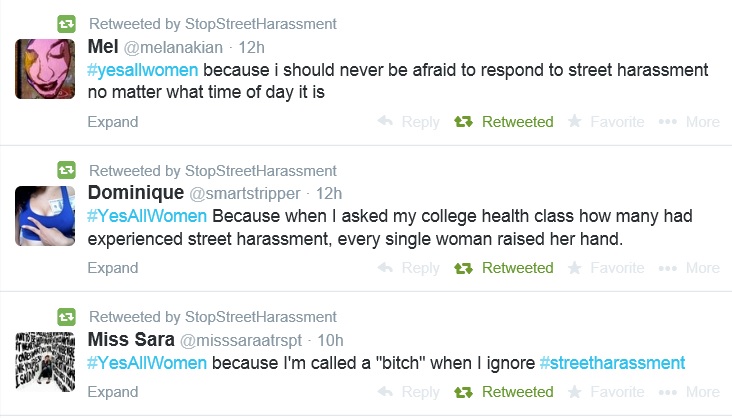
In addition to articles on news sites and posts on blogs on this topic, people are taking to Twitter and speaking out using the hashtag #YesAllWomen.

Also, Deanna Zandt started a new Tumblr called When Women Refuse (Trigger Warning), detailing the violence men incite on women for refusing their sexual advances.

Street harassment is coming up a lot in these conversations because it is a very clear manifestation of this type of behavior. I see this this all the time in the stories I hear and collect on this blog.

1 – In the first place, most street harassment is the outcome of men feeling entitled to comment on, follow and touch women (and men) they do not know, without their permission.

2 – Then, when women refuse to say thank you to the harasser, give him their phone number, agree to sex, smile when he tells them to or otherwise refuses men’s demands, some men get angry and call women stuck up or a bitch, push them, chase them, throw garbage at them*, run them over and shoot them. This is insane. It needs to STOP.

SSH is releasing a huge national report on street harassment in one week. It includes summaries of 10 focus groups and these kinds of stories came up many times. I hope the report can contribute valuable information to this conversation and show why male feelings of entitlement to women needs to be addressed.

Men are never entitled to women’s attention or bodies. This is an important message that we must all spread. Women’s lives depend on it.

* See the full film for the garbage story

Share

Filed Under: national study, News stories, street harassment

« Previous Page
Next Page »

Share Your Story

Share your street harassment story for the blog. Donate Now

From the Blog

  • #MeToo 2024 Study Released Today
  • Join International Anti-Street Harassment Week 2022
  • Giving Tuesday – Fund the Hotline
  • Thank You – International Anti-Street Harassment Week 2021
  • Share Your Story – Safecity and Catcalls Collaboration

Buy the Book

  • Contact
  • Events
  • Join Us
  • Donate
  • Facebook
  • Instagram
  • Pinterest
  • Tumblr
  • Twitter
  • YouTube

Copyright © 2026 Stop Street Harassment · Website Design by Sarah Marie Lacy