• About Us
    • What Is Street Harassment?
    • Why Stopping Street Harassment Matters
    • Meet the Team
      • Board of Directors
      • Past Board Members
    • In The Media
  • Our Work
    • National Street Harassment Hotline
    • International Anti-Street Harassment Week
    • Blog Correspondents
      • Past SSH Correspondents
    • Safe Public Spaces Mentoring Program
    • Publications
    • National Studies
    • Campaigns against Companies
    • Washington, D.C. Activism
  • Our Books
  • Donate
  • Store

Stop Street Harassment

Making Public Spaces Safe and Welcoming

  • Facebook
  • Instagram
  • Pinterest
  • Tumblr
  • Twitter
  • YouTube
  • Home
  • Blog
    • Harassment Stories
    • Blog Correspondents
    • Street Respect Stories
  • Help & Advice
    • National Street Harassment Hotline
    • Dealing With Harassers
      • Assertive Responses
      • Reporting Harassers
      • Bystander Responses
      • Creative Responses
    • What to Do Before or After Harassment
    • Street Harassment and the Law
  • Resources
    • Definitions
    • Statistics
    • Articles & Books
    • Anti-Harassment Groups & Campaigns
    • Male Allies
      • Educating Boys & Men
      • How to Talk to Women
      • Bystander Tips
    • Video Clips
    • Images & Flyers
  • Take Community Action
  • Contact

India: Board the Bus for Women’s Safety This Week!

March 4, 2014 By HKearl

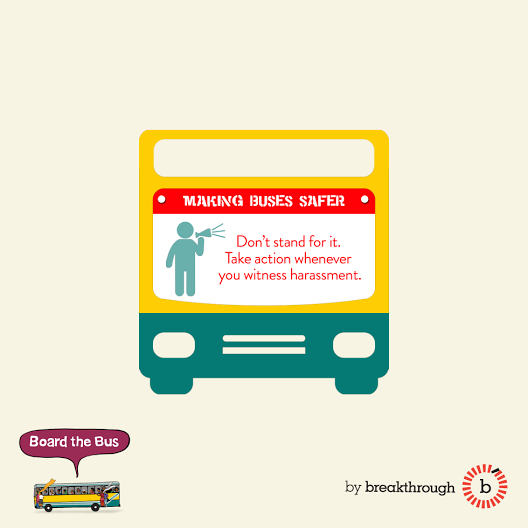
In Delhi, India, this week the global human rights organization Breakthrough launched a Board the Bus campaign, which runs through March 8, International Women’s Day. They want women to know that they have the right to occupy public places and suggest that having more women in public places can help reduce harassment.

“We’re calling on women who don’t normally take the bus to board the bus with us,” Digital Media Strategist Radhika Takru says. “We’re telling women who take the bus regularly that they don’t have to go it alone. If everyone goes together, there is a very real chance we can make the bus – or any public space – safer.”

The Board the Bus website encourages people to ride the bus to “get people thinking, talking, and acting,” and to “Take back the space that was always yours.” Participants can Tweet about their experiences with the hashtag #BoardtheBus and share a photo of their ride.

If you live in Delhi, consider joining the campaign and boarding a bus. On the last day of the campaign, March 8, join hundreds of women at 4 p.m. at Connaught Place Bus Stop. Help make those spaces safer through your presence and, as necessary, bystander intervention.

If you’re not in Delhi, you can help spread the word about the campaign to those who are, and you can participate by traveling through Delhi on your own virtual bus.

Share

Filed Under: Events, News stories, street harassment

60 percent of women face harassment on Delhi’s Metros

February 17, 2014 By HKearl

Via The Economic Times:

“NEW DELHI: The national capital has earned the dubious distinction of meting out maximum discrimination and harassment to women from northeast, a survey has said.

Around 60 per cent women from northeast have faced harassment and discrimination in the four metros — New Delhi, Mumbai, Kolkata and Bangalore.

While 23 per cent of the respondents admitted to having been harassed by landlords, an alarming 42 per cent said they were often subjected to verbal abuse. A total of 29 per cent reported harassment and molestation.”

Share

Filed Under: News stories, street harassment

Social media helps raise awareness of harassment in Saudi Arabia

February 16, 2014 By HKearl

Over the years, SSH has covered various aspects about harassment in Saudi Arabia, one of the world’s most conservative countries with the fewest rights for women. From the cleric who thought women were too seductive in veils that showed two eyes and said they should only be able to show one eye, to the group of men caught on tape harassing fully covered women outside a mall, to the on-going effort to pass an anti-harassment law.

Al-Monitor has a new article about how women are using social media to fight back. Excerpt:

“A study conducted by a female Saudi researcher about “sexual harassment of women” on a sample of women aged between 18 and 48 has shown that 78% of respondents claimed to have experienced sexual harassment directly, while 92% said that sexual harassment is on the rise. The study found that 27% of them have been subjected to verbal harassment; 26% were subject to “tarqim” attempts, which is the attempt to pass on a phone number; 24% were subject to harassment by looks; and 15% were physically touched…

Harassment in Saudi Arabia has become a serious phenomenon. The tip of the iceberg has now been revealed because of a general desire by the victims to reveal the criminals. Posting photos and videos documenting certain events has shed light on sensitive topics that the kingdom wishes to avoid dealing with….

A video shot at a building’s entrance in Dammam shows a young man harassing a young girl waiting for the elevator. He lifts her school dress and touches her private parts, then enters the elevator with her. The disturbing video ends at this point, but without putting an end to the incident.

The girl didn’t scream or resist. It was a brutal, smooth and scary scene. The video went viral, Saudi Twitter users applied their usual pressure and the criminal was caught. He could be punished by several lashings and a short prison stay. The absence of a law that deters the crime has worsened the harassment phenomenon targeting women and girls….

The collective harassment incident that took place in a shopping mall in the eastern region was the cornerstone for a law intended to fight the growing phenomenon. In the incident, a group of Saudi women were collectively harassed by a group of young men. One of the women shot the scene and put it up on social media to expose the perpetrators.

Before the video’s publication, there had been efforts to put in place penalties to reduce harassment. The Shura Council is studying an integrated penalties schedule for verbal and physical harassment. The bill, which aims to combat harassment and stop its growth, sets penalties that depend on the offense, starting with a warning and censure, followed by fines that reach up to half a million riyals (more than $120,000), flogging and imprisonment for up to five years.”

I hope the videos and other activism on social media can bring more attention to this widespread problem and show that the harassment is not women’s fault! They are harassed no matter what they’re wearing because the problem is the patriarchal, disrespectful attitudes of the men harassing them.

Share

Filed Under: News stories, street harassment

Increase harassment on Indian trains

February 16, 2014 By HKearl

Quick news hit, via Bernama:

“Despite introducing measures to ensure women’s safety on trains, the Indian railways has reported an increase in molestation cases and eve teasing on trains in the past one year.

Data from the Rail Ministry shows a total of 189 sexual harassment cases were reported in 2013 by female passengers, an increase from 119 cases in 2012 and 72 in 2011, Press Trust of India (PTI) reported.

Incidents of eve teasing (a local term for sexual harassment) have risen from 34 in 2011, 46 in 2012 and 53 in 2013. Rape cases on the other hand fell from seven in 2012 to five last year. A total of 290 suspects were arrested for crimes against women last year, the rail ministry said.”

Share

Filed Under: News stories

Video: Oppressed Majority

February 12, 2014 By HKearl

After many people sent it my way, I just watched the 10 minute film Oppressed Majority (Majorité Opprimée) by Eléonore Pourriat whose version with English subtitles has been watched over 2 million times in a week. In the film, roles are reversed and it’s a female-dominated society, and not in a nice way. They belittle, harass, assault and disbelieve the main character Pierre, in essence showing what every day life IS actually like for women worldwide.

An article in The Guardian provides background information —

“[Pourriat] says that the film “came from a personal experience. I was a woman. I was 30 years old. And my husband didn’t believe that I was – I was not assaulted, but I got remarked on in the street. Very often. He said, ‘Wow. That’s incredible.’ His surprise was the beginning of the idea for me. Sometimes men – it’s not their fault – they don’t imagine that women are assaulted even with words every day, with small, slight words. They can’t imagine that because they are not confronted with that themselves.”

SSH is working hard to reveal the every day street harassment women (and many men) experience worldwide. It’s part of our Everyday Sexism experiences. Don’t believe it, read our stories, read the stories on Everyday Sexism. This is a big problem and — if we care about girls and women at all — it needs to end now.

Share

Filed Under: News stories, Resources, street harassment

« Previous Page
Next Page »

Share Your Story

Share your street harassment story for the blog. Donate Now

From the Blog

  • #MeToo 2024 Study Released Today
  • Join International Anti-Street Harassment Week 2022
  • Giving Tuesday – Fund the Hotline
  • Thank You – International Anti-Street Harassment Week 2021
  • Share Your Story – Safecity and Catcalls Collaboration

Buy the Book

  • Contact
  • Events
  • Join Us
  • Donate
  • Facebook
  • Instagram
  • Pinterest
  • Tumblr
  • Twitter
  • YouTube

Copyright © 2026 Stop Street Harassment · Website Design by Sarah Marie Lacy