• About Us
    • What Is Street Harassment?
    • Why Stopping Street Harassment Matters
    • Meet the Team
      • Board of Directors
      • Past Board Members
    • In The Media
  • Our Work
    • National Street Harassment Hotline
    • International Anti-Street Harassment Week
    • Blog Correspondents
      • Past SSH Correspondents
    • Safe Public Spaces Mentoring Program
    • Publications
    • National Studies
    • Campaigns against Companies
    • Washington, D.C. Activism
  • Our Books
  • Donate
  • Store

Stop Street Harassment

Making Public Spaces Safe and Welcoming

  • Facebook
  • Instagram
  • Pinterest
  • Tumblr
  • Twitter
  • YouTube
  • Home
  • Blog
    • Harassment Stories
    • Blog Correspondents
    • Street Respect Stories
  • Help & Advice
    • National Street Harassment Hotline
    • Dealing With Harassers
      • Assertive Responses
      • Reporting Harassers
      • Bystander Responses
      • Creative Responses
    • What to Do Before or After Harassment
    • Street Harassment and the Law
  • Resources
    • Definitions
    • Statistics
    • Articles & Books
    • Anti-Harassment Groups & Campaigns
    • Male Allies
      • Educating Boys & Men
      • How to Talk to Women
      • Bystander Tips
    • Video Clips
    • Images & Flyers
  • Take Community Action
  • Contact

SSH Board Member Shares What Men Can Do

November 5, 2013 By HKearl

Relando Thompkins

Check out this awesome interview our board member Relando Thompkins did for The Root last week!

“”One of the best things men can do to work against street harassment is talk to other men,” says Relando Thompkins, who sits on the board of directors of Stop Street Harassment. As a resident of Detroit, he talks to a lot of men who gripe about the responses they get from women, and he tries to make them understand that what she finds offensive is not up to him. “Just like a white person can’t tell me what I find offensive in terms of race relations, I can’t tell a woman what’s offensive.”

In my conversation with Thompkins, he compared men who holler at woman to police who engage in stop and frisk. Whatever benefit the New York Police Department claims from its stop-and-frisk programs, numerous studies and statistics have shown it targets men of color more than any other group, thus making an already complicated relationship between the police and black and brown communities more fraught.

“My experiences with racism have helped me become increasingly aware of others who have to deal with oppression of any sort because of targeted identities,” said Thompkins, referring to woman who are cat-called and consider it a form of harassment.

There are also other benefits to talking to other men about street harassment. Every guy I know has a story of being out with a woman and hearing another man say something to that woman. That kind of experience can probably help a man check himself. Then there’s also the benefit of being able to better understand that rejection from women happens to the best of men. Just like we mean no offense when we approach a woman, most women don’t mean any offense when they reject us. Is it offensive for women to label as street harassment every unwelcome but respectful attempt at engagement? Well, no one can tell you what offends, right? Our reaction is up to us.”

Share

Filed Under: male perspective, News stories, SSH programs, street harassment

How to Prevent Sexual Harassment?

November 5, 2013 By HKearl

More and more studies are showing that sexual harassment – including street harassment – is a widespread problem that negatively impacts the lives of harassed persons. But there is less information available about why sexual harassment happens and how to prevent it from occurring.

A reporter for the International Business Times covers what IS known:

“What are some of the causes of sexual harassment? Despite popular perceptions, it’s usually not about innocent flirtation. In one 2008 study published in the journal Sex Roles, researchers interviewed 80 men from the Arlington, Texas area. They found that a man was more likely to exhibit harassing behavior if he was also more likely to suspect that women were criticizing and rejecting him.

 “These findings also support recent speculation that men’s sexual harassment of women is related to aggression rather than seduction,” the authors wrote.

When you turn to the literature to try and find scientific evidence for what interventions actually work, there’s an incredible gap of scientific evidence. In his 2007 meta-analyses reviewing 8 studies from between 1995 and 2006, researcher Bruce Douglas found that diversity training tends to have only a small effect on attitudes or behavior. Other studies also report just marginal benefits from sexual harassment prevention training.

“The lack of quantitative studies on diversity training continues to be prevalent,” Douglas wrote.

So what is to be done? There may be another avenue to help the victim that doesn’t rely on educating the harasser: all the other people in the office. Bystanders – such as people who hear about sexual harassment through the office grapevine, or directly from the harassed colleague – can also be powerful tools in combating harassment in the workplace, according to a July 2012 report from the Australian Human Rights Commission.“

For suggestions on what to do as a bystander, visit our webpage, watch “Shit Men Say to Men who Say Shit to Women on the Streets” and read our new book 50 Stories about Stopping Street Harassers.

Our proposed national study on street harassment will survey both women and men and ask questions about if survey takers have ever been harassers and if so, why. This is sorely needed data! You can donate $10 or more today to help make this study, about the people and funded by the people, possible.

Share

Filed Under: News stories, Resources, SSH programs, street harassment

A Few New Fall Anti-Harassment Campaigns

November 5, 2013 By HKearl

Check out these new anti-harassment campaigns, from Canada to the UK to the USA.

1. A campaign to address harassment on Translink in Vancouver, Canada

Via Straight.com:

SFU students Alexa Dredge and Katie Nordgren. Image via Straight.com

“Katie Nordgren and her Simon Fraser University classmate Alexa Dredge launched a website to share stories of harassment from public-transit riders across Metro Vancouver. For now, Harassment on TransLink is a project for their third-year gender, sexuality, and women’s studies course, but Nordgren hopes its scope will grow beyond that.

According to Nordgren, the site received more than a dozen submissions in its first day, and stories of “aggressive” and “scary” behaviour continue to come in to translink.harassment@gmail.com. In one post, a woman—who is anonymous, like all of the site’s contributors—recalls a man, with his hands in his pants, telling her he wanted to “shove it” in her butt on the SeaBus. Another woman wrote that she was harassed on the SkyTrain by two men who said she wanted to “fall all over their dicks” and then joked about shooting her in the head….

Metro Vancouver Transit Police has heard stories like those posted on Harassment on TransLink, according to spokesperson Anne Drennan. She told the Straight that transit police take sexual harassment and assaults “extremely seriously”, but they’re concerned that many people aren’t reporting incidents to them.

“It’s great to see people being encouraged to tell their stories,” Drennan said by phone from New Westminster. “That’s cathartic, right? But we want them to tell us.”

2. New student campaigns in England aim to combat sexual harassment and assault in night clubs

Via The Guardian:

“The Sheffield Anti-Sexual Harassment (SASH) is campaigning for clubs to hang posters on their walls to raise awareness. It is also asking them to train their bouncers and staff to spot and deal with harassment…. SASH wants to put a list of clubs online that are believed to be “safe spaces” for women. It plans to talk to student societies to make sure that they are not collaborating with clubs that are unsafe. The group hopes that the commercial incentive to get on to the approved list will encourage bars to work with it…

Students in Leeds are also demanding change. There, the feminist society and student paper are running a campaign to get the club night that hosted ‘Fresher’s Violation’ – where female staff “have what is meant to look like semen on their trousers” – closed down. Their online petition has reached over 3,500 signatures, at the time of writing, and has attracted attention from police and the local council. In addition to this, Leeds Femsoc want to persuade clubs around Leeds to sign a pledge against sexual harassment….

Students in Bristol have used Facebook to draw attention to the problem, creating a page called ‘Spotted: Sexism at Bristol‘, where students can name and shame those involved. “One post showed a young girl in a club who had passed out,” says Alice Philips, women’s officer at Bristol University. “Instead of helping her, four boys took pictures up her skirt.”  She adds: “We want to show people that this is happening. It’s dangerous for people to say there’s nothing wrong and everything’s alright. We are giving women a voice and enabling them to shout back.”

3. A new Safe Sites effort in Massachusetts led by the Coalition for the Prevention of Domestic Abuse and the North Shore Rape Crisis Center

Via Wickedlocal.com:

“Participating businesses will display a Safe Sites decal in their windows to indicate that help is available, if needed [for people facing street harassment, sexual assault, or other forms of violence]. Safe Sites are provided with basic written information about emergency services and local resources to share with anyone seeking assistance. They may also offer use of their phones and allow someone feeling threatened to remain in their business until help arrives. Safe Sites is modeled after the successful Safe Streets program of the Arizona Center against Sexual Assault and is also being implemented in other North Shore communities by the YWCA North Shore Rape Crisis Center.


Share

Filed Under: News stories, street harassment

2013 Global Gender Gap Report

October 26, 2013 By HKearl

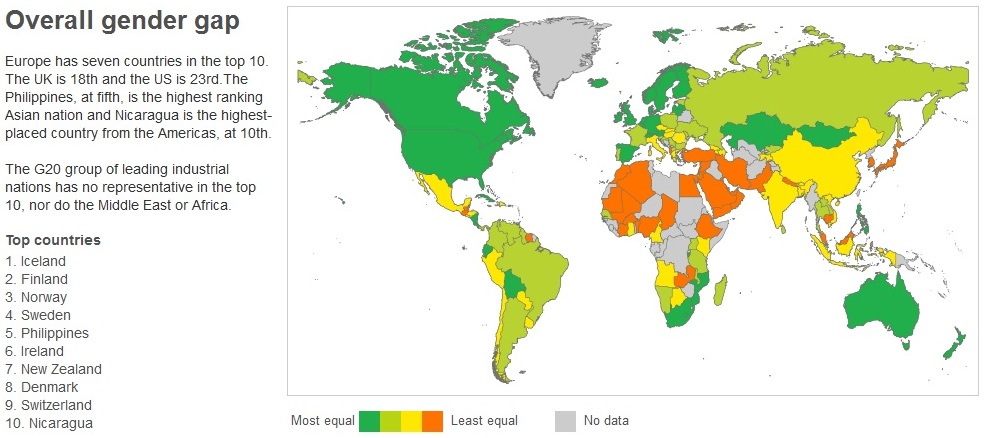
Every year, the World Economic Forum determines the global gender gap country by country, by analyzing different factors, such as women’s versus men’s education, political representation, and health.

This year, Iceland ranked number one in The Global Gender Gap Report and is followed by Finland, Norway and Sweden. This means women in these countries enjoy the most equal access to education and healthcare and they’re most likely to be able to participate fully in the country’s political and economic life.

BBC Reports:

“Overall, the gender gap narrowed slightly across the globe in 2013, as 86 of 133 countries showed improvements. However, “change is definitely slow”, says one of the report’s authors, Saadia Zahidi.”

Via BBC

The U.S. comes in at number 23. We’re pretty good on issues like education and health (e.g. very few women die at childbirth), but we’re very bad on political participation.

I often note that no country has achieved gender equality and this is always the report I have in mind when I say that. Year after year, this fact remains true. I see street harassment as a symptom of this inequality and a contributor to it — women are less likely to be in the workforce, receive an education, and be in politics if they face harassment simply trying to go to those venues.

Ending street harassment is one of many inter-related pieces we need to work to address before we can see true equality.


Share

Filed Under: News stories, Resources

Saudi Arabia: Men Harass Women at Shopping Mall

October 23, 2013 By HKearl

This week, a group of young men harassed a group of young women outside a shopping mall in Saudi Arabia and many people who have seen the video footage blame the women — for not covering their faces, for wearing makeup, and for not having a male chaperon. Learn more from a Global Voices article.

This is not okay. Women all over the world deserve equal access to public spaces and should be safe from harassment!

Share

Filed Under: News stories, street harassment

« Previous Page
Next Page »

Share Your Story

Share your street harassment story for the blog. Donate Now

From the Blog

  • #MeToo 2024 Study Released Today
  • Join International Anti-Street Harassment Week 2022
  • Giving Tuesday – Fund the Hotline
  • Thank You – International Anti-Street Harassment Week 2021
  • Share Your Story – Safecity and Catcalls Collaboration

Buy the Book

  • Contact
  • Events
  • Join Us
  • Donate
  • Facebook
  • Instagram
  • Pinterest
  • Tumblr
  • Twitter
  • YouTube

Copyright © 2026 Stop Street Harassment · Website Design by Sarah Marie Lacy