• About Us
    • What Is Street Harassment?
    • Why Stopping Street Harassment Matters
    • Meet the Team
      • Board of Directors
      • Past Board Members
    • In The Media
  • Our Work
    • National Street Harassment Hotline
    • International Anti-Street Harassment Week
    • Blog Correspondents
      • Past SSH Correspondents
    • Safe Public Spaces Mentoring Program
    • Publications
    • National Studies
    • Campaigns against Companies
    • Washington, D.C. Activism
  • Our Books
  • Donate
  • Store

Stop Street Harassment

Making Public Spaces Safe and Welcoming

  • Facebook
  • Instagram
  • Pinterest
  • Tumblr
  • Twitter
  • YouTube
  • Home
  • Blog
    • Harassment Stories
    • Blog Correspondents
    • Street Respect Stories
  • Help & Advice
    • National Street Harassment Hotline
    • Dealing With Harassers
      • Assertive Responses
      • Reporting Harassers
      • Bystander Responses
      • Creative Responses
    • What to Do Before or After Harassment
    • Street Harassment and the Law
  • Resources
    • Definitions
    • Statistics
    • Articles & Books
    • Anti-Harassment Groups & Campaigns
    • Male Allies
      • Educating Boys & Men
      • How to Talk to Women
      • Bystander Tips
    • Video Clips
    • Images & Flyers
  • Take Community Action
  • Contact

Philadelphia Survey, City Council Hearing & More

October 2, 2013 By HKearl

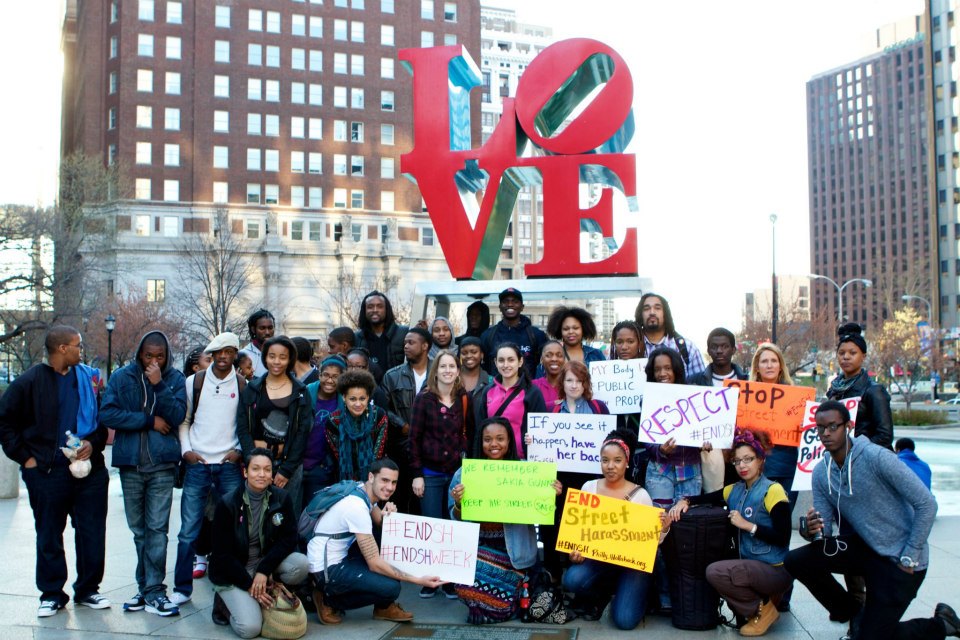
Hollaback! Philly, FAAN Mail and other groups took part in International Anti-Street Harassment Week in April 2013. Photo by Craig Carpenter.

From comic books to subway ads about street harassment, Hollaback! Philly regularly undertakes creative and compelling work. Here are a few current and upcoming things they’re doing!

1 – Survey:

Right now, they’re conducting an online survey for Philadelphia residents — please take it if you live in Philadelphia!

2 – Event with SSH:

On November 6, they will join me and FAAN Mail at the Wooden Shoe Book Store at 7 p.m. for a community discussion about street harassment. The comic book artist will be signing copies of it and I’ll be talking about/signing copies of my book 50 Stories about Stopping Street Harassers. RSVP for the free event.

3 – City Council Hearing:

The most exciting news of all is that they are working with the City Council to hold a street harassment hearing!!

The hearing will be held on November 7, 10 a.m. and Hollaback! Philly will present their survey results. Many members of the public have already signed up to share their stories. One of the main recommendations they’ll all make is for the City Council to sponsor community safety audits.  I will also testify to bring a national and international context to the issue.  Stay tuned for more information closer to the date.

4 – iReport:

Finally, check out this CNN iReport about Hollaback! Philly’s awesome work!

Share

Filed Under: News stories, SSH programs, street harassment

USA: Hollaback! Boston Releases State of the Streets

September 30, 2013 By Correspondent

By: Delia Harrington, Massachusetts, USA, SSH Correspondent

“I Hollaback because I shouldn’t ride my bike in order to avoid harassment.” – Nai

Hollaback! Boston released their State of the Streets report today, based on data collected from over 500 Bostonians during the month of August.  A startling 88% of respondents had experienced street harassment, proving that there is absolutely a place in Boston for the work of organizations like Hollaback!, Everyday Feminism, and of course Stop Street Harassment.

As readers may know, Hollaback! was co-founded in New York City by Emily May, and has since become a worldwide movement.  The organization strives to end street harassment; conducting workshops and campaigns, and empowering those affected by street harassment by gathering and sharing their stories.

The Boston chapter was co-founded by current leaders Britni de la Cretaz and Kate Ziegler in 2011.  While each branch operates autonomously, they share strategies with one another.  According to today’s Report, the Boston branch was inspired by Hollaback! Ottawa’s own fact-finding.  Similarly, some recommendations mention the successes of other Hollaback! branches.

The report details how Bostonians define harassment, where and how often they experience it, how it makes them feel, as well as recommendations moving forward from Hollaback!  According to the report, Hollaback! Boston decided to collect information not only to see the scope of the issue in Boston, but also to educate others.  While the site leaders hear stories of street harassment often, many others don’t.  As they say in the report,

“We wanted to find a way to communicate this fact to people, especially people that may not think that street harassment is really a problem or people that don’t experience street harassment themselves. We wanted to put the reality of what we face when we walk out the doors and out onto the streets of Boston in black and white.”

Respondents to the survey were overwhelmingly women (86%) and  people in the LGBTQIA community (31%).    Of those respondents, 87% were female-identified,  90% were LGBTQIA-identified, 94% identified as a person of color, 96% identified as both LGBTQIA & POC,  and 90% identified as being a person with a disAbility, reported experiencing street harassment.  This supports the notion long held among those attempting to end street harassment that POC, LGBTQIA folks and those with a disAbility experience particularly high levels of street harassment.

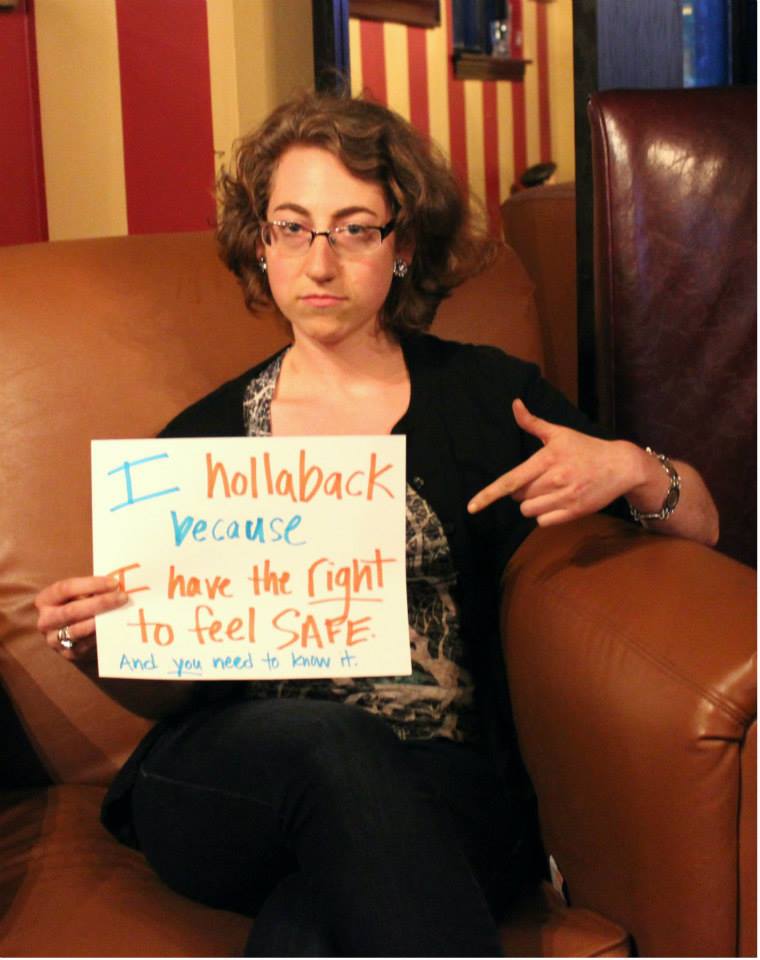
“I Hollaback because I have the right to feel safe. And you need to know it.” – Becca

Harassment is largely taking place on the street (97%), on the MBTA (63%),  in bars or clubs (37%),  in public parks (32%), and at  school (14%).  Not surprisingly, those respondents experiencing harassment said it made them feel angry (85%), nervous (80%) , annoyed (78%), disgusted  (72%) , and scared (64%).   And for  those who claim street harassment is enjoyable for the victim, or that it is not a big deal, only 14% of respondents said  they were ‘flattered’, and only4% said street harassment ‘didn’t bother’ them.  While the report refrained from editorializing, I’d like to note that while some respondents were flattered or not bothered, it is impossible to tell whether the person you’re seeing on the street will be nervous or flattered by the attention, so it’s best to err on the side of caution (and the numbers) and treat everyone as though they wouldn’t like it.

Like many working in this space, Hollaback! Boston sees bystander intervention as a key tool to combat street harassment.  Unfortunately, only 14% of respondents reported an instance of someone intervening on their behalf.   As a result, Hollaback! suggests the, “creation of a public education campaign that focuses on tangible ways that people can safely intervene.”

The data is likely unsurprising to readers of this site and fans of Hollaback’s work, but it is incredibly valuable to have hard statistics to show to potential partners moving forward.  For example, given that 63% of respondents reported feeling harassed on the MBTA, the report’s suggestion of an ad campaign (similar to that created by Hollaback! Philadelphia and run on SEPTA trains), training for MBTA employees on how to respond to street harassment, and an awareness campaign (à la “See Something, Say Something”) about available reporting mechanisms may all be seen as higher priorities by MBTA officials.  Moreover, while Hollaback! makes several suggestions moving forward, they are all constructive and include next steps for themselves as an organization.  Hopefully this approach will continue to be successful as they use their model of presenting a problem and a potential solution that includes their assistance at the same time.

I hope that other Hollaback! branches and similar organizations are able to conduct a similar survey in the future, so other cities can wield statistics that accurately reflect the unique picture of street harassment in their area.  I hope Hollaback! Boston continues to receive good local press coverage, which could pressure businesses and city officials to prioritize street harassment.  Congratulations to Hollaback! Boston, and we look forward to the implementation of the recommendations.

Delia Harrington is a recent graduate of Northeastern University and calls Boston home. In recent years, she has found herself studying, working, and volunteering in Egypt, Cuba, France, Benin, the Dominican Republic, Turkey, Germany, and Greece.  You can read more of her writing on her blog, or follow her on Facebook and Twitter, @deliamary.

Share

Filed Under: correspondents, News stories, Resources, Stories

Police Arrest Street Harasser Who Attempted to Murder 14-Year-Old

September 26, 2013 By HKearl

Trigger Warning

Police have arrested a 21-year-old man in Florida after he strangled and ran over a 14-year-old girl whom he offered $200 to have sex with him (he didn’t know her) and she refused. He left her on the side of the road and her injuries were life threatening, but THANKFULLY she is stabilized.

Want to know why street harassment is serious and scary a lot of times? Because of stories like this. Because this could happen to any one of us, especially to teenagers/young women. THIS IS NOT OKAY. Street harassment is not okay. Male entitlement, disrespecting women and girls (and any living creature) is unacceptable. Our hearts go out to this young woman and to everyone who has been harmed by street harassers and abusers.

H/T Soraya Chemaly

Share

Filed Under: News stories Tagged With: attempted murder, serious crime, street harassment

Guilty Verdict for Delhi Gang Rape Perpetrators

September 13, 2013 By HKearl

Trigger Warning

More than nine months after the street harassment and then brutal gang rape and eventual death of a young woman in Delhi, India, a Delhi court found the four perpetrators guilty for the crime and have sentenced them to death.

While I appreciate that for once a rape/murder case received the gravity it deserved, I am against the death penalty, even for these young men. Yes, they need to face consequences for their actions, but not an end to their lives.

I also think that some of the huge amount of time and resources spent on them could have been better spent going to schools and villages and cricket games (formal and informal) to talk about respect for women and girls, etc. This is a cultural problem in India (and every other country in the world) and every day there are numerous rapes and gang rapes. More needs to be done to chance cultural norms and prevent it from happening!

SSH’s friend Dhruv Arora who runs GotStared.At in India wrote an article today about why he is not in favor of this ruling and shared similar sentiments:

“The problem with this retributive approach to justice is that the problem is completely sidelined in favour of the desire for revenge. The problem is that sexual assaults are not lust-crimes at all, but are much more deeply linked to the roots of our society and have strong ties with the culture of power and domination. Yes, these things take time to change and till then we cannot do anything, but if we lose our heads in favour of personalizing justice to fit our emotionally triggered desire for “real action”, then we are failing as a society. True, it takes time, but till then we need to work on removing our ties to violence and not engrain them into our legal definitions. The least we need to ensure is that while this slow and painful process of change takes its due course, we don’t make things worse. If we let our deep frustration, anger and the helplessness of not being able to make an immediate change in the culture of sexual crimes take control of our better judgment of being able to identify positive change; we’re going to only make matters worse.”

If you want to do something about sexual harassment and sexual violence in India, I suggest getting involved with groups like GotStared.At, Breakthrough, Safe Delhi/Jagori, and Blank Noise!

Share

Filed Under: News stories Tagged With: Delhi Gang Rape

USA: Street Harassment in India and Beyond

August 28, 2013 By Correspondent

By: Delia Harrington, Massachusetts, USA, SSH Correspondent

Michaela Cross in India. Photo credit: Caety Klingman.

Last week, under the username Rosechasm, University of Chicago student Michaela Cross published a CNN iReport that has shaken readers and spurred reactions across the web.  The piece, entitled “India, the Story You Never Wanted to Hear” details many terrifying examples of street harassment, staring, groping, and attempted or threatened rape that the author says happened to herself or fellow classmates during a semester abroad in India through their university.

CNN has since called for women all over the world to share their own stories of street harassment and perspectives on Cross’s original iReport as well as potential solutions or methods to mitigate street harassment and other gender-based violence.  Many women, including Stop Street Harassment’s founder Holly Kearl, have since heeded that call, and their stories are well worth a read.

Many have misread the article as a universal condemnation of Indian men and India in general.  The author expresses repeatedly that her experience in India was one of contradiction, including both those of the positive, once in a lifetime variety and those of a more traumatic nature.  While it is hard not to feel lately that some observers and media outlets are holding up India as a problematic “other”, that doesn’t mean people should stop telling their stories or reporting on the stories of others.

Another common criticism is that Cross’s article ignores the treatment Indian women receive within their own country.  That was not the focus of her article, and it seems reasonable that Cross would only write of her own experience and the experience of those she knew through her program, especially given iReport’s format.  However, since it bears repeating, here are some stories Indian women have since posted to CNN about their own treatment, good or bad.  Gender-based violence looks different for local women than it does for foreigners, but as travelers and allies in the struggle against such violence, we must remember that eventually we will leave, and many women don’t have that option.

Finally, many have highlighted the prevalence of street harassment and gender-based violence worldwide, especially within the writer’s (and my) native United states.  Again, I think this is rightfully outside the scope of Cross’s article, but the very existence of this blog and others like it demonstrates that street harassment is not limited to India or the developing world.  However, that doesn’t make Cross’s experience any less real or traumatic.

Cross’s experience shows how street harassment is unfortunately only one part of the spectrum of gender-based violence, which includes stalking, groping, sexual assault, and murder.  For a victim of this type of violence, even the more “minor” incidents can feel (and become) incredibly dangerous.   In a statement to CNN, the University of Chicago writes that all students are offered, “extensive support and advice to students before, during and after their trips abroad,” and yet Cross didn’t approach them during her program.  In her own words, she thought she was prepared to handle the stress of India:

“When I went to India, nearly a year ago, I thought I was prepared. I had been to India before; I was a South Asian Studies major; I spoke some Hindi. I knew that as a white woman I would be seen as a promiscuous being and a sexual prize. I was prepared to follow the University of Chicago’s advice to women, to dress conservatively, to not smile in the streets. And I was prepared for the curiosity my red hair, fair skin and blue eyes would arouse.  But I wasn’t prepared.”

Contrary to what many online commenters have accused, it appears Cross was as fully equipped as a person could be for the potential stresses of travel.  Not only that, she seems to have taken all the usual precautions advised to female travelers (and females in their own countries.)  If all of the University of Chicago’s years of experience sending students to India, as well as her personal knowledge from traveling to India previously weren’t enough to help keep her safe, would anything be enough?  Short of not going to India, which is not an option for many Indian women and isn’t a viable option for travelers, what more could a woman do to avoid this situation?  I think perhaps it’s time for the onus to prevent street harassment to come off of women, and be placed on perpetrators as well as our law enforcement and legislators.

I am impressed that Cross was able to share her story so publicly, and I love that so many women worldwide have taken to CNN’s iReport assignment to join her in sharing their lived experiences with street harassment.  I’m a firm believer that speaking up and supporting those among us who speak up is one way of fighting back.  Instead of devolving into an argument over where harassment is worse, I hope we remember that women in America, India, and the world over have something in common right now: we are speaking up, and we are fighting back.

Delia Harrington is a recent graduate of Northeastern University and calls Boston home. In recent years, she has found herself studying, working, and volunteering in Egypt, Cuba, France, Benin, the Dominican Republic, Turkey, Germany, and Greece.  You can read more of her writing on her blog, or follow her on Facebook and Twitter, @deliamary.

Share

Filed Under: correspondents, News stories, Stories, street harassment Tagged With: India, Michaela Cross

« Previous Page
Next Page »

Share Your Story

Share your street harassment story for the blog. Donate Now

From the Blog

  • #MeToo 2024 Study Released Today
  • Join International Anti-Street Harassment Week 2022
  • Giving Tuesday – Fund the Hotline
  • Thank You – International Anti-Street Harassment Week 2021
  • Share Your Story – Safecity and Catcalls Collaboration

Buy the Book

  • Contact
  • Events
  • Join Us
  • Donate
  • Facebook
  • Instagram
  • Pinterest
  • Tumblr
  • Twitter
  • YouTube

Copyright © 2026 Stop Street Harassment · Website Design by Sarah Marie Lacy