• About Us
    • What Is Street Harassment?
    • Why Stopping Street Harassment Matters
    • Meet the Team
      • Board of Directors
      • Past Board Members
    • In The Media
  • Our Work
    • National Street Harassment Hotline
    • International Anti-Street Harassment Week
    • Blog Correspondents
      • Past SSH Correspondents
    • Safe Public Spaces Mentoring Program
    • Publications
    • National Studies
    • Campaigns against Companies
    • Washington, D.C. Activism
  • Our Books
  • Donate
  • Store

Stop Street Harassment

Making Public Spaces Safe and Welcoming

  • Facebook
  • Instagram
  • Pinterest
  • Tumblr
  • Twitter
  • YouTube
  • Home
  • Blog
    • Harassment Stories
    • Blog Correspondents
    • Street Respect Stories
  • Help & Advice
    • National Street Harassment Hotline
    • Dealing With Harassers
      • Assertive Responses
      • Reporting Harassers
      • Bystander Responses
      • Creative Responses
    • What to Do Before or After Harassment
    • Street Harassment and the Law
  • Resources
    • Definitions
    • Statistics
    • Articles & Books
    • Anti-Harassment Groups & Campaigns
    • Male Allies
      • Educating Boys & Men
      • How to Talk to Women
      • Bystander Tips
    • Video Clips
    • Images & Flyers
  • Take Community Action
  • Contact

Share your Street Harassment Story with CNN!

August 24, 2013 By HKearl

Via CNN –

“An iReport by University of Chicago student Michaela Cross, in which she says she experienced relentless sexual harassment during a study abroad trip in India last year, has sparked huge debate online and become the most viewed iReport of all time.

Much of the reaction has been from India, with both men and women apologizing to Cross and in many cases relating their own experiences of harassment.

Others, however, have pointed out that the problem is not confined to India’s borders and warned against singling out one country when the problem is faced by women worldwide.

We want to hear your thoughts on Cross’ iReport and the reaction it’s generated. What do you think men and women should do to combat sexual harassment, both in India and where you live? Have you had personal experiences with sexual harassment?

Send us your thoughts in a personal essay or short video and you could help shape CNN’s coverage of the issue.”

I shared my story. Share yours too!

(Here are some stories by women in India about the harassment they face daily.)

Share

Filed Under: News stories, street harassment

NYC: New App for Reporting Harassment

August 20, 2013 By HKearl

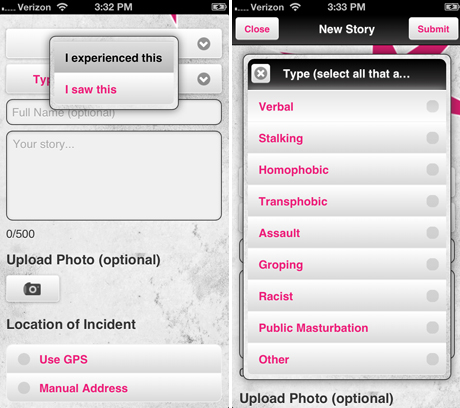
Building on a recommendation from the SSH Book to document where street harassment is happening to better be able to address it, Hollaback! has teamed up with the New York City Council to launch the Hollaback! app.
Via Think Progress:

“The new app allows victims or witnesses to upload, in real time, information about where they experienced harassment on the street. It creates a map of pinned locations where harassment occurs, providing near-instant feedback to the city council’s and mayor’s offices. The app collects demographic data, too, to help officials better understand the details of where harassment occurs and who it happens to.”

This easier way to report incidents to Hollaback’s database and the option to report it to city council members has the potential to make a difference in how street harassment is documented and understood. It’s great that the app isn’t just for tracking gender-based street harassment, but also forms like racial harassment. It also lets you report harassment  you witness, not just what you experience.

However, it’s important to note that often the people who are most vulnerable to harassment may not have access to a phone with an app (such as young teenagers, homeless people, poor people) so they will still have a harder time reporting incidents.

And, city council speaker and mayoral candidate Christine Quinn is the main backer of the app, yet she favors a form of street harassment: Stop and Frisk (which, as of last week, is now unconstitutional).

Via Jezebel:

“Mariame Kaba (@PrisonCulture), founder of Project NIA, an advocacy organization that supports youth in trouble with the law, argued in a series of tweets that it’s “not as simple as throwing around slogans about ‘keeping women safe.”

“Which women?” she asked. “What do you mean by ‘safe?; HOW are you proposing to create that safety? ALL of these questions are gendered, racialized + age-specific, geographically-specific, etc… It isn’t neat and it isn’t simple.”

Street harassment is complex and there are no easy answers for how to deal with it… in fact there will never be just one answer because it impacts so many groups of people in various communities differently.

I do see it as promising that city council members want to address this issue, and I hope they will listen to the concerns of people like Kaba so they can improve their efforts and make them more inclusive and effective. It will be interesting to see how the app is used and what impact it may or may not have on stopping street harassment.

Share

Filed Under: hollaback, News stories, street harassment

UK: New Campaign Addresses Transit Harassment

August 13, 2013 By Correspondent

By: Tilly Grove, London, UK, SSH Correspondent

Via www.BTP.police.uk

As a student at a London university, the city’s transport system is something I use daily during term time. Consequently, I stand alongside the 15 per cent of women who responded to a Transport for London (TfL) survey and reported that they had experienced some form of sexual harassment or assault on the London transport network. In fact, I consider myself to stand alongside a much larger percentage of women. That 15 per cent is only of the women who responded to the survey, and only those who felt comfortable talking about what had happened to them in the first place. Often, women do not even realise that what has occurred to them is sexual harassment. Either way, 90 per cent of the women in that survey said that they had not reported what happened to them to the police, and TfL have rightly identified that this is a huge problem.

Project Guardian is the initiative that seeks to change that. The British Transport Police (BTP), working closely with TfL, Metropolitan Police and the City of London Police, have recognised that sexual harassment on public transport is a major concern for travellers, and vastly under-reported. Having studied a similar exercise in Boston, and with guidance from women’s campaign groups like the End Violence Against Women coalition, Everyday Sexism, and Hollaback London, Project Guardian will see all 2,000 of the officers working on the public transport network receive training in victim awareness, and selected officers given extra training on sexual offences courses.

The core aim of Project Guardian is to increase awareness of sexual offences, and encourage victims to come forward. By clearly outlining what constitutes a sexual offence, the BTP are taking a good first step. A lot of women – myself included – will likely not have been aware, for example, that any comments or actions that make them uncomfortable on their journeys constitute harassment. When I have had men actively stalk me across platforms and through carriages, or make obvious efforts to stare up my skirt, or make sexually charged comments about my appearance, I would certainly never have thought that this was something I should report, and not just something I had to shrug off. The BTP insists that any offence of this nature will be taken “extremely seriously”, and urges anyone who has witnessed or experienced something to come forward.

While not the primary objective of the initiative, a reduction in instances of sexual assault would certainly be desirable too, as has been seen in Boston. Project Guardian seeks to deter offenders by deploying up to 180 officers to stations at a time, using undercover officers, creating a high police profile at vulnerable times and places (like quiet stations late at night), working in partnership with railway businesses, using CCTV footage, and publishing details of all successful prosecutions. Judging by the figures from its first week, it might be set for success: reporting of sexual offences increased by 26%, and 10 arrests were made. This may see the initiative rolled out elsewhere across Britain.

The Twitter hashtag #ProjGuardian illustrates clearly that experiences of sexual harassment are not a rarity, and not a one-off. There are thousands of women sharing their stories, all of them demonstrating that this has become an accepted part of our experiences as women in public. Even when it is not physically happening to us, the possibility of it is always hanging over us. If Project Guardian can change one thing, it can change the idea amongst so many of us that it has to be this way, that we must be silent and accept it. Ideally, it will change more than that. When Ellie Cosgrave had a man ejaculate on her on the train, she took matters into her own hands and put on a brilliant and intelligent protest, Take Back the Tube; she did this because she had reported it to TfL, who did not even respond. Women deserve more than this. We deserve organisations that listen to us and take us seriously, and most importantly, we deserve to be able to use the public transport network without constant fear and anticipation of someone violating us in the first place. Let’s hope Project Guardian is the start of that.

To report sexual offences to the British Transport Police, talk to staff or officers at the station, text 61016, or call 0800 40 50 40.

Tilly is studying for a BA in War Studies at King’s College London, where she is writing her dissertation on the effect that perceptions of gender have on the roles which women adopt in conflict. You can follow her on Tumblr and Twitter, @tillyjean_.

Share

Filed Under: correspondents, News stories, public harassment Tagged With: London, Project Guardian

Researchers to Map the Anti-Street Harassment Network

August 6, 2013 By HKearl

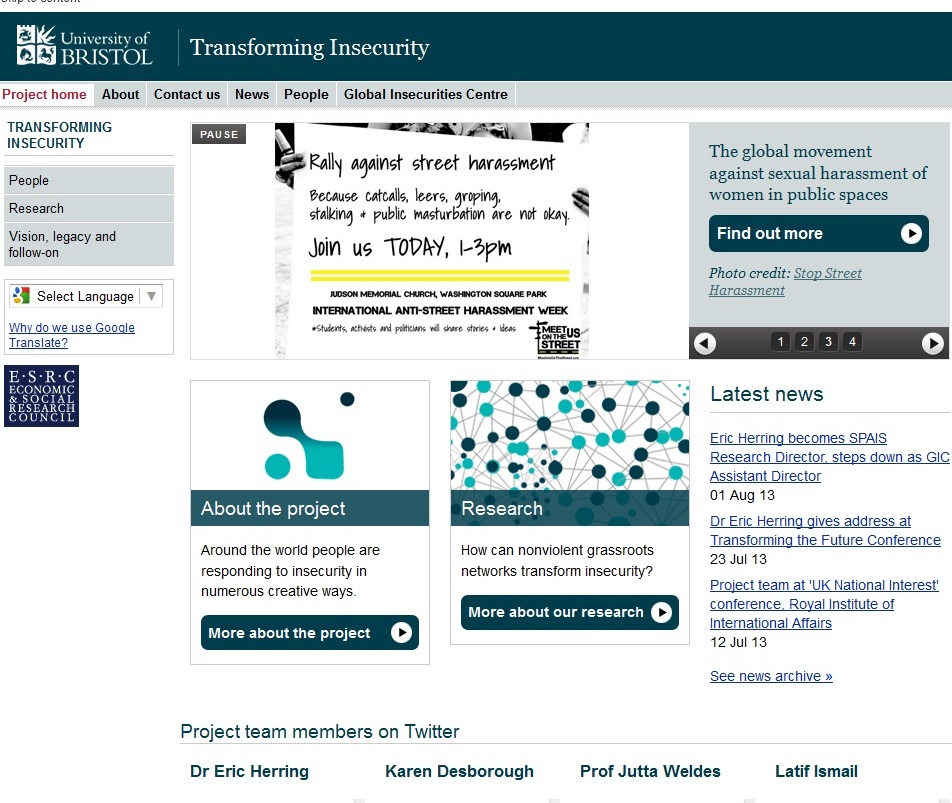
How can nonviolent grassroots networks – including the network to stop street harassment – transform insecurity?

This is a research question that a team at the University of Bristol will answer over the next 18 months thanks to the Economic and Social Research Council (ESRC) grant they were recently awarded. The team is led by Dr Eric Herring, Research Director of SPAIS (School of Sociology, Politics and International Studies).

Here’s a brief summary of the project:

“The project will explore how three existing networks — a neighborhood watch to prevent suicide bomb attacks in Somalia; projects to record every casualty of armed conflict in many countries in the global South; and projects to stop the street harassment of women in the global North and South — relate to the state, global governance and all actors that use and threaten violence. It will also explore these ideas in relation to grassroots security actors which are seeking to network with each other across issue areas.”

Visit the project’s website to learn more.

I’ve chatted twice with Eric and his colleague Karen Desborough and I’m excited to report that I am now a “Research Collaborator” for the street harassment-specific part of the project. So stay tuned for more information about the project and how it will help strengthen our network and efforts to stop street harassment!

Share

Filed Under: News stories, Resources, SSH programs

Afghanistan Street Harassment Documentary

August 5, 2013 By HKearl

“Do Not Trust My Silence” is a powerful new short film about street harassment in Afghanistan (English subtitles), directed by Afghan filmmaker Sahar Fetrat. She won the first prize in Italy’s “Universocorto Elba Film Festival” for her “extreme courage of reporting the Afghan women’s condition in the streets of Kabul and for the technique of shooting with a hidden camera.”

She writes:

“‘Do Not Trust My Silence’ was my fourth film which was produced in April 2013 and it is one of my favorites. When I first joined the Afghan voice’s media training, I had the vision of making a documentary about street harassment. This documentary for me is more than just a 10-minute film, there is a lot in it. There is a big pain in it that all women, especially Afghan women, can feel. This documentary shows only a little of what we see, feel and experience every day.

When I made this film, I knew that both women and men should be my audience. For men to see and feel a part what we experience every day, and for women to say no to street harassment. I wanted to show that, as a young woman, I do not accept harassment as my destiny and other women should do the same.

While producing this film, I put myself as the main character and I filmed most of the parts with a small flip camera. It was not easy to film men while harassing me or other women, some of them were throwing small rocks towards us. But I did not stop my work because my aim was to show harassment and how destructive it is. I totally believe that we women are strong enough to not give up and fight against it and we have the power to stop it.”

H/T to SSH’s SPS Mentoring Program Mentee Masooma Maqsoodi

Share

Filed Under: Activist Interviews, News stories, Resources, street harassment Tagged With: Afghanistan, documentary

« Previous Page
Next Page »

Share Your Story

Share your street harassment story for the blog. Donate Now

From the Blog

  • #MeToo 2024 Study Released Today
  • Join International Anti-Street Harassment Week 2022
  • Giving Tuesday – Fund the Hotline
  • Thank You – International Anti-Street Harassment Week 2021
  • Share Your Story – Safecity and Catcalls Collaboration

Buy the Book

  • Contact
  • Events
  • Join Us
  • Donate
  • Facebook
  • Instagram
  • Pinterest
  • Tumblr
  • Twitter
  • YouTube

Copyright © 2026 Stop Street Harassment · Website Design by Sarah Marie Lacy