• About Us
    • What Is Street Harassment?
    • Why Stopping Street Harassment Matters
    • Meet the Team
      • Board of Directors
      • Past Board Members
    • In The Media
  • Our Work
    • National Street Harassment Hotline
    • International Anti-Street Harassment Week
    • Blog Correspondents
      • Past SSH Correspondents
    • Safe Public Spaces Mentoring Program
    • Publications
    • National Studies
    • Campaigns against Companies
    • Washington, D.C. Activism
  • Our Books
  • Donate
  • Store

Stop Street Harassment

Making Public Spaces Safe and Welcoming

  • Facebook
  • Instagram
  • Pinterest
  • Tumblr
  • Twitter
  • YouTube
  • Home
  • Blog
    • Harassment Stories
    • Blog Correspondents
    • Street Respect Stories
  • Help & Advice
    • National Street Harassment Hotline
    • Dealing With Harassers
      • Assertive Responses
      • Reporting Harassers
      • Bystander Responses
      • Creative Responses
    • What to Do Before or After Harassment
    • Street Harassment and the Law
  • Resources
    • Definitions
    • Statistics
    • Articles & Books
    • Anti-Harassment Groups & Campaigns
    • Male Allies
      • Educating Boys & Men
      • How to Talk to Women
      • Bystander Tips
    • Video Clips
    • Images & Flyers
  • Take Community Action
  • Contact

End of March News Round-Up

March 31, 2017 By HKearl

Here are the street harassment-related news stories that caught my eye this month:

Women in Barbados, Trinidad and Tobago, Dominica, Guyana, Jamaica, and The Bahamas marched to protest sexual violence. #LifeinLeggings

Women wrote about street harassment in Australia, Italy, Pakistan, and the USA.

Women in India shared their street harassment stories using the hashtag #NotMyShame.

Female students at the University of Delhi (India) were locked in the dorm due to fears of sexual harassment at the Holi festival.

Tambourine Army is a new organization fighting gender-based violence in Jamaica.

Malawi police arrested 17 men for “inhumane and humiliating treatment” of a mentally ill woman in the street.

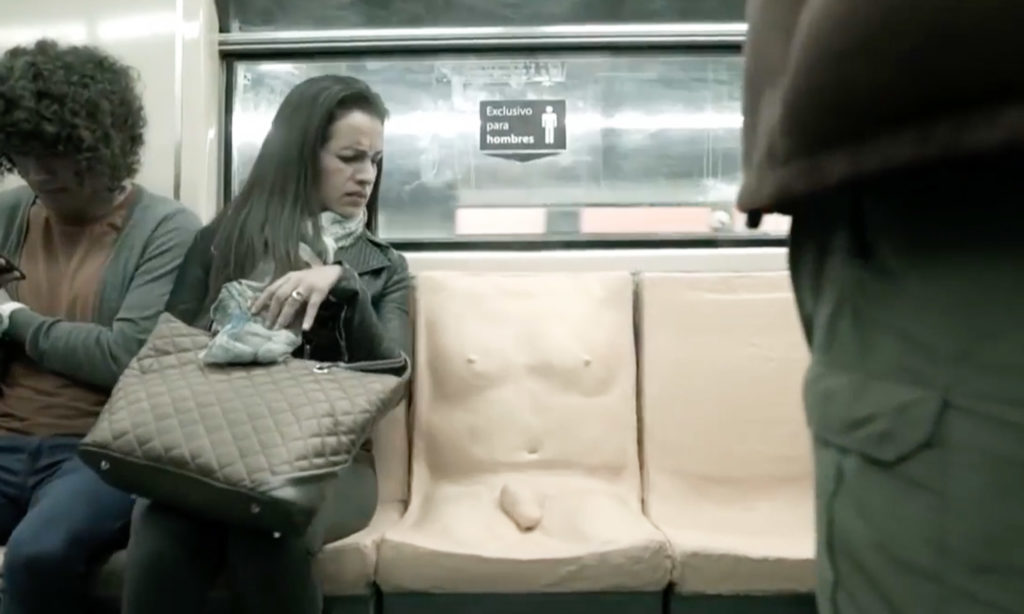
Mexico City has a “sexist” seat on the subway to raise awareness about sexual harassment.

Teenage girls in Wellington, New Zealand, protested street harassment and other forms of sexual violence outside Parliament.

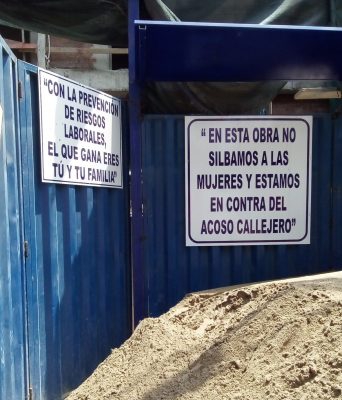
A construction site in Peru posted a sign saying they are against street harassment.

CNN Philippines covered street harassment and related forms of sexual violence.

A survey conducted by United Nations Population Fund found that 90% of women and girls in Sri Lanka have faced sexual harassment on public transport.

TFL and Met Police in the UK launched a ‘Report It to Stop It’ campaign to raise awareness about how to report sexual harassment on the London transit systems.

A man in Florida called out a street harasser – that man then punched him and sent him to the hospital. The harasser/assailant was arrested.

Legislation introduced in New York City would require police officers to undergo sensitivity training on dealing with sexual assault and street harassment.

Share

Filed Under: News stories, street harassment

The “Sexist” Seat on Mexico City’s Subway

March 30, 2017 By HKearl

Via The Pool:

“A new campaign hoping to tackle sexual harassment in Mexico has introduced a ‘sexist’ seat on the metro exclusively for men – complete with chest and penis. The seat was created to make men feel as uncomfortable as women on public transport and, judging by the accompanying video, it worked. Men are seen to consciously avoid sitting on the seat, or sitting on it without realising, only for them to quickly jump up and move. In front of the seat is a message to men, reading, ‘It’s uncomfortable to sit here, but it doesn’t compare with the sexual violence that women suffer in their everyday lives.’ The anti-harassment message has since gone viral, with the hashtag #NoEsDeHombres.”

I was in Mexico City a few weeks ago for the UN Women Safe Cities Global Leaders’ Forum and we heard from many Mexico City leaders, including the mayor, about their efforts to make public places safer for women. What struck me was that nearly every effort they discussed, such as women-only transit options and the distribution of thousands of whistles, put the onus on women to try to stay safe. What I appreciate about the “sexist” seat is that the message is directed at men. While no, the seat by itself is not enough to change the cultural norms that allow sexual harassment to occur, I think it is an example of a unique and attention-grabbing way to start discussions with men about sexual harassment in public spaces and why men must help stop it.

That said, would-be harassers are not the only ones who ride the subway and consideration should be made for survivors of sexual assault and others who could be upset by it.

UPDATE: I did an interview for BBC News on this initiative.

Share

Filed Under: News stories, Resources Tagged With: engaging men, mexico city, public transit, subway

Northern Ireland: How Do We Best React to Street Harassment?

March 10, 2017 By Correspondent

Elaine Crory, Belfast, Northern Ireland, SSH Blog Correspondent

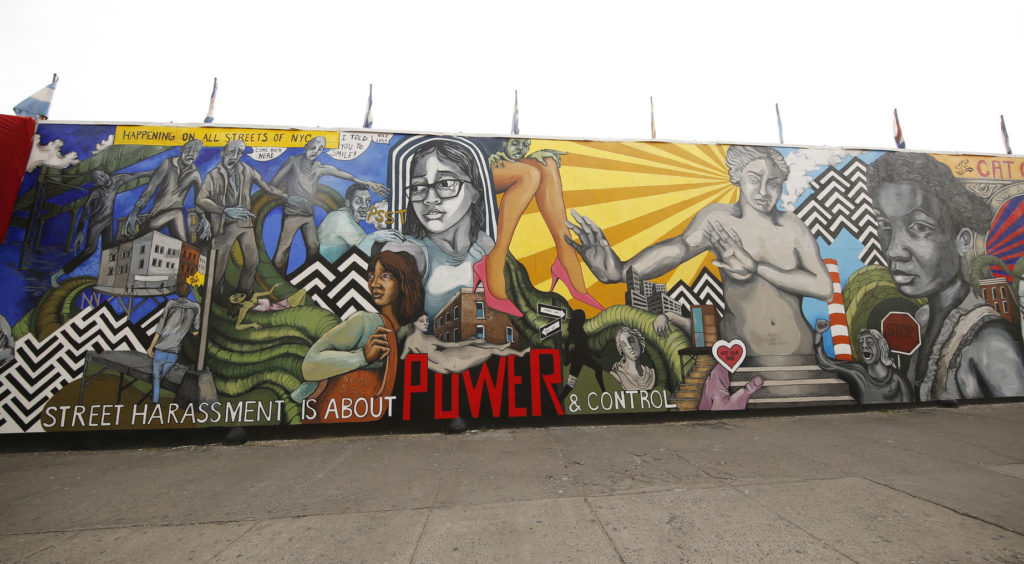
2016 street harassment themed mural in Brooklyn, NY

I’ve written at length about the damaging long-term implications of street harassment; about how it hurts the self esteem of women and girls and encourages the idea that public space belongs to men. It teaches us at a young and impressionable age that we should expect to receive comments on our appearance, be they positive or negative, when out in public. It teaches us to feel scared and ashamed when we are yelled at, followed or groped by men rather than to feel defiant and angry.

In the spirit of International Women’s Day’s 2017 theme Be Bold for Change, I want to look at some of the positive steps individual women and activist groups have taken to challenge the assumptions that allow street harassment to continue, and to suggest some ways that we can try to dismantle rape culture altogether and boldly change the rotten structures that hold it up.

Over the past decade, technology has advanced a great deal. Smartphones mean that most people have excellent cameras to hand at all times, and internet access at the touch of a button. When Hollaback! was originally conceived it was intended primarily as a way for women to share their stories and to gain strength from the expression of solidarity from others who “have your back”. Women were encouraged to snap photos, if they felt confident enough, and to challenge their harassers verbally.

Soon the word spread and it became clear that street harassment was an international phenomena with many regional quirks which allowed for responses as diverse and inventive as the women who experienced it. Women began to use social media to spread stories and share ideas, and a number of different groups sprang up, including our own Stop Street Harassment, with the aim of spreading resistance and standing up to the tired narrative that tried to convince us that it is all a harmless joke.

Individual women have spoken of how freeing it is to challenge harassers peacefully but forcefully, to put them in the spot and demand that they account for their behaviour – which, invariably they cannot – and how it becomes clear in doing so that what has happened is not their fault. Victim blaming is one of the decaying planks upon which the whole structure of rape culture rests, and challenging that has proven again and again to be a powerful antidote to the power of street harassment. In India a project by Blank Noise called I Never Ask for It collects stories and images of what women were wearing when they were harassed or sexually assaulted, the mundanity of the clothing giving the lie to the old excuse. Jezebel conducted an informal survey of circumstances in which women had endured harassment, and the variety is both impressive and proof positive that is is not about what we wear or where we go. The point of these exercises, more than anything else, seems to be to prove to ourselves and to society generally, that victim blaming will not wash. And there is power in that, in saying “no, this is all in you”.

What next, though? This list is endless and growing, a testament to the creativity and dedication of activists all over the world.

  • In Mexico, activists chase their harassers with blaring feminist punk music and confetti guns, turning the shaming around quite beautifully.
  • A Minneapolis woman created Cards Against Harassment that a victim can present to a harasser to challenge their behaviour.
  • A beautiful and challenging mural has appeared in Brooklyn, New York.
  • There is a week of action against street harassment coming up in April organized by SSH.
  • Activists worldwide are organising events such as Reclaim the Night in my own city of Belfast and many other sites, to make it clear to all that street harassment will not be tolerated.

All of these actions are positive, confronting harassment directly in an active way. They challenge behaviour and help to put power back in our hands.

But the root causes of street harassment remain, and far too many people fail to understand why it is wrong. So the problem persists across generations. But it does not have to. When a number of universities introduced mandatory consent classes a significant number of young men reacted angrily, as though an understanding of consent and appropriate behaviour was simply innate and did not have to be taught. I would argue that this reaction demonstrates just how deeply rape culture has permeated, and shows that we have reached many of these young people too late. Comprehensive and compulsory sex and relationship education (SRE) that covers sexist attitudes and treatment of women in public space as well as in interpersonal relationships would go a long way towards preventing these harmful ideas from taking root to start with.

Let’s start where the problem starts. If the timbers that hold up rape culture are rotten, let’s replace them with some new planks fit to hold up confident, respectful and responsible relationships between all humans. Let’s be bold for change.

Elaine is a part-time politics lecturer and a mother of two. She is director of Hollaback! Belfast, co-organises the city’s annual Reclaim the Night march, and volunteers with Belfast Feminist Network and Alliance for Choice to campaign for a broad range of women’s issues.

Share

Filed Under: correspondents, News stories Tagged With: activism ideas, consent in school, International Women's Day, victim blaming

Peru: Construction Workers against Street Harassment

March 9, 2017 By HKearl

“In Miraflores, a traditional middle-class neighborhood in Peru’s capital, Lima, where construction sites abound, a group of construction workers [posted this sign]: ‘At this construction site, we don’t whistle at women and we are against sexual street harassment'”!!!

Let’s see these kinds of signs EVERYWHERE!!

Share

Filed Under: male perspective, News stories, street harassment

February Global News Round-Up

February 28, 2017 By HKearl

Here are the global news stories that caught my attention this month:

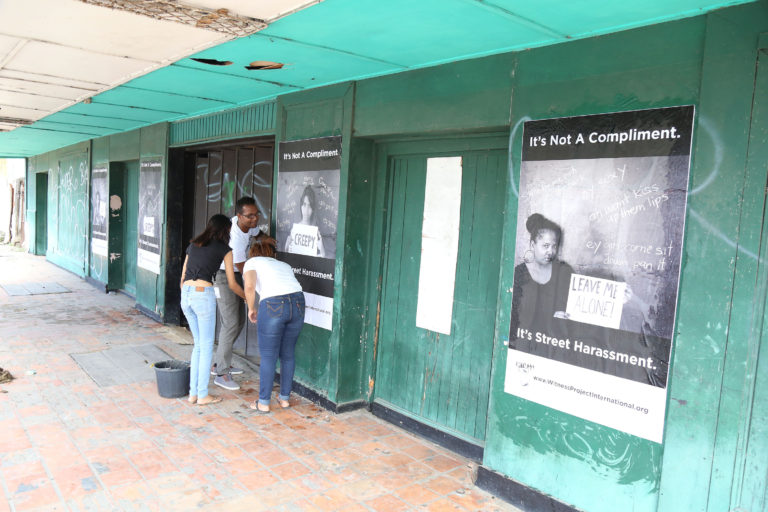
Witness Project in Guyana

Women in Argentina held a topless protest over men’s censorship of their bodies in public spaces.

Calls for bystanders to stop sexual assault in festival crowds in Australia.

TBILISI-Safari Union launched an anti-harassment campaign in Georgia, including legislation and education suggestions.

Members of the Witness Project in Guyana put up posters that say “It’s Not a Compliment. It’s Street Harassment.”

The punk band Sløtface in Norway is tackles street harassment and rape culture in their video Bright Lights.

In Pakistan, sisters Zara and Zoya Khan stood up to street harassers, garnering national attention.

A senator in the Philippines introduced the national-level Senate Bill 1326 to address street harassment.

A national study conducted by UNFPA in Sri Lanka found that 90% of women and girls have faced sexual harassment on public transit.

Women in Trinidad ask men to leave them alone during Carnival.

Thousands of people took to the streets of Manchester (UK) during the annual Reclaim the Night march.

A Sacramento (USA) artist did an audio art project on street harassment called “This is What It Feels Like.”

The Muslim self-empowerment group WISE + two Muslim girls created a self-defense toolkit.

Share

Filed Under: News stories, street harassment

« Previous Page
Next Page »

Share Your Story

Share your street harassment story for the blog. Donate Now

From the Blog

  • #MeToo 2024 Study Released Today
  • Join International Anti-Street Harassment Week 2022
  • Giving Tuesday – Fund the Hotline
  • Thank You – International Anti-Street Harassment Week 2021
  • Share Your Story – Safecity and Catcalls Collaboration

Buy the Book

  • Contact
  • Events
  • Join Us
  • Donate
  • Facebook
  • Instagram
  • Pinterest
  • Tumblr
  • Twitter
  • YouTube

Copyright © 2026 Stop Street Harassment · Website Design by Sarah Marie Lacy