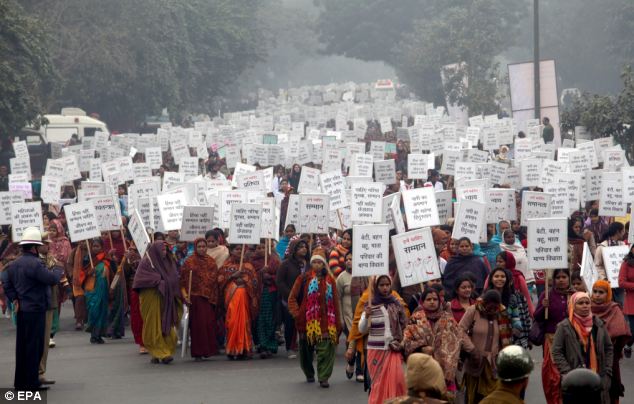
Thousands of women marched in Delhi, India, today, calling for an end to sexual violence.

Making Public Spaces Safe and Welcoming
Thousands of women marched in Delhi, India, today, calling for an end to sexual violence.
 “I want to live,” said “Braveheart” to her mother and brother.
“Braveheart,” one of the nicknames given to an unidentified 23-year-old woman, was in an intensive care unit after six men brutally gang-raped and attacked her on a moving bus in Delhi, India, two weeks ago.
They targeted her because she was traveling alone with a male friend to whom she was not married or related. The men harassed her at first to punish her and when her friend stood up to them, they assaulted him and took her to the back of the bus and raped and beat her. More than an hour later, they threw them, unconscious, off the bus, where a passerby found them and called for help.
On Thursday, Braveheart was transported to a hospital in Singapore because she needed a multi-organ transplant and she was suffering from brain injuries and lung and abdomen infections.
Her wish, her hope to live makes the news of her death that much harder to hear, that much harder to comprehend.
The six men who attacked her have been indicted and they now will be charged with murder. But it is little consolation.
In a city where rape—a vastly underreported crime—is reported every 18 hours and in a country where there were more than 24,000 reported rape cases in 2011, Braveheart’s ordeal is not unusual.
When many women routinely kill themselves after being harassed, groped, or raped by men, it’s not even unusual that she is dead.
In early December, a 16-year-old girl committed suicide after a man tried to hold her against her will on her way home from school. In mid-December, a 17-year-old girl set herself on fire and died from the burns after a boy in the area repeatedly harassed her. In late December, a 17-year-old girl killed herself after she was allegedly gang-raped and then pressured by police to drop the case and marry one of her attackers.
It’s also not unusual that her male friend was beaten up for standing up for her. Many men are routinely hurt and even murdered for challenging street harassment. A father told two young men to stop harassing and following his daughter and the men beat him up. A 30-year-old man stood up to young men he observed street harassing girls during a procession. Later, in retaliation, they stabbed him to death. A 20-year-old man confronted a group of boys who were harassing his female friend and stabbed him to death, too.
What is unusual about Braveheart’s story is the outcry her rape, her fight to live, and now her death, have sparked.
Every day since her case became public, hundreds and then thousands of people marched, protested, and held vigils in Delhi and in other cities across India. Even when police prohibited gatherings of more than five people, protestors would not be deterred and stood up to water cannons and attacks. Since her death, even more have taken place.
What I also hope will be unusual about her story is that real change will occur to make India safer for women.
Over the last few months, because gender violence is such an obvious problem in India, various promising government initiatives have been announced to address sexual harassment, especially in public places, as many see that as a potential precursor to rape, just as it was in the case of Braveheart.
In Uttar Pradesh’s Meerut town, the police started posting photos of street harassers as a way to shame them and deter future harassment incidents. In Madhya Pradesh, the Chief Minister announced in November that anyone found guilty of street harassment would be denied a passport and driver’s license. In Guwahati, the police force introduced a special all-women division in November to focus on street harassment and assault.
Most important, in November, India’s Supreme Court acknowledged that sexual harassment is a rampant problem, especially on the streets and on public transportation, and one that negatively impacts the lives of the harassed persons. They issued a country-wide standard for addressing the problem.
In Delhi specifically, over the past week, many protest leaders have met with police and government officials and these are some of the proposed measures. 1) More police night patrols; 2) More investigation of bus drivers and their assistants; 3) Banning buses with tinted windows or curtains; 4) Posting photos, names and addresses of convicted rapists on an official website; 5) setting up a committee to speed up trials of sexual assault.
In a meeting with police, the group I Stand for Safe Delhi said they proposed additional measures, such as sensitization training for the police force, crime mapping in the city, and more female police officers.
In November, India’s Supreme Court acknowledged that sexual harassment is a rampant problem, especially on the streets and on public transportation, and one that negatively impacts the lives of the harassed persons. They issued a country-wide standard for addressing the problem.
Street harassment and rape are about a lack of respect for women and about abuse of power though and until there is a shift in how women are viewed and treated, these measures will not be enough, though they are a good start.
There are two other measures that I hope can help create that shift.
The International Center for Research on Women runs a successful program in India called Parivartan. It targets 10 to 16 year old boys in Mumbai and uses the popular sport cricket to challenge them to question traditional notions of manhood in their society and teach them about respecting women and girls and preventing violence against them. In 2013, this program will launch in Delhi. It is important to change the mentality of young men so they learn to respect women.
Because so often the response to men harassing and raping women is measures restricting women’s ability to be in public, the Indian group Blank Noise has launched a #SafeCityPledge to encourage women to be in public. The more women there are in public places, the more people will be used to seeing them there and not challenge their presence, and the safer those places become for everyone. I agree.
So, what is your #SafeCityPledge? What will you do to help make your community safer?
At the end of every year, I like to look back, document and reflect on everything that has transpired in the global movement to end street harassment and assault. Yesterday I wrote about 10 of Stop Street Harassment’s achievements. Today, I’m posting a five-part series about the highlights of ALL activism that happened this year (PDF format). WHAT A YEAR!
Post 1 (this one): New anti-street harassment campaigns, new initiatives within existing campaigns, and protests.
Post 2: Creative anti-street harassment initiatives.
Post 3: Government initiatives/collaborations
Post 4: New studies, reports, and significant news articles.
Post 5 : Stories from 25 people who stood up to street harassers this year.
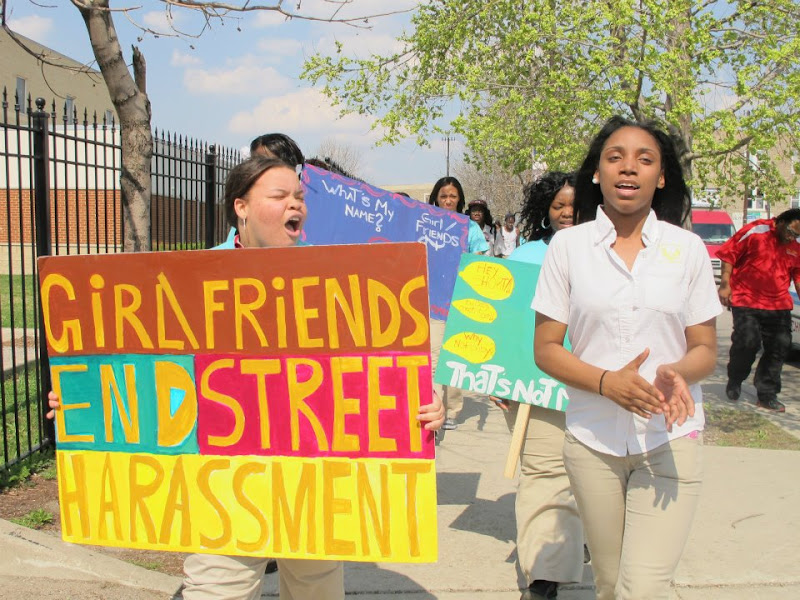
1. Global: In March, Stop Street Harassment organized more than 100 groups in more than 20 countries (on five continents) and tens of thousands of people to collectively speak out against street harassment during Meet Us on the Street: International Anti-Street Harassment Week. This is what happened, including rallies, marches, sidewalk chalk messaging, workshops, film screenings, viral videos, safety audits, report releases, street theater, passing out fliers, art exhibits, and more.
2. Global: Hollaback! now has chapters in 60 cities worldwide, and this year they launched an “I’ve Got Your Back” Bystander Campaign in partnership with Green Dot to show bystanders who to intervene, educate them about their options, and allow them to document their successes online. Green dots on the Hollaback! maps show intervention stories. (Read their State of the Streets 2012 report for more information.)
3. Australia: People Against Street Harassment launched in December. Their mission is “confronting street harassment in Sydney via stickering, leafleting, social media and other such sweet guerilla action.”
 4. Australia: Cat Calls: Called Out is another new Sydney-based anti-street harassment campaign that works to bring attention to the issue and spread ideas for stopping it.
5. Belgium: In the fall, ELLE launched a Touche Pas à Ma Pote! (Don’t Touch my Girl friend) campaign with the support of local government agencies in Brussels and it includes signs plastered on trams for the next six months.
6. Canada: Women in Cities International is part-way through a multi-year project to conduct a Blueprint project on the theme of “preventing violence against women and girls and improving their security in Canadian cities.” This year, they worked with adolescent girls in the greater Montréal area and held workshops, focus group discussions and training sessions with them. Participants also conducted women’s safety audit walks and they had the opportunity to creatively illustrate their findings and recommendations.
7. Egypt: HarassMap collects street harassment stories on its online map. During 2012, they organized more than 500 HarassMap volunteers who went outside once per month to talk to shop owners, police, doormen and others with a presence in the street about street harassment and to let them know they need to not harass and to stand up if they see harassment happening.
8. Egypt: On June 13, activists in Egypt led a day of online action to speak out against street harassment and sexual violence using the hashtag #EndSH.
9. Egypt: After several mass sexual assaults of women at Tahrir Square and after a woman was murdered by a street harasser, there were numerous protests in the summer and fall (and one protest ended because men swarmed, attacking the protesters).

10. Egypt: There were many campaigns against street harassment in Egypt ahead of the Eid holidays. In August, volunteers organized by the Imprint Movement patrolled the streets and subway stations, watching out for harassers and helped police arrest several. In October there was a “Catch a Harasser” initiative, men spray painting harassers, and special harassment reporting hotlines.
11. Egypt: Because there are so many instances of sexual harassment and sexual assault during political protests in Tahrir Square, during political protests in November and December, people volunteered their time to serve as patrollers, working to make the area safe for women. One of the groups is called Tahrir Bodyguard.
12. India: College students in Mumbai organized a Chal Hatt Tharki campaign asking women to raise their voices against sexual harassment and street harassment.
13. India: In April, thousands of women in Kannur, a district in Kerala, gathered in the city center to ask for the right to travel safely at night and in October in Chandigarh, college students and staff of Government College Sec 42 took to streets to protest street harassment and sexual violence.
14. India: In December, the Patiala-based organization Punjab Today Foundation launched a major awareness movement against what it called the “collective guilt of society” against girls and women called SMASH (Society’s Movement Against Street Harassment).
15. India: The organization Breakthrough launched a bystander campaign for the holiday Diwali in November, because everyone deserves a safe Diwali.
16. India: In July, Blank Noise curated a series of stories about people’s first recollection of experiencing street harassment called Recall. In December, they launched the #SafeCityPledge campaign.

17. India: After a 23-year-old college woman was brutally gang rape and nearly murdered by six men on a bus (and her male friend was also beaten up by them) in mid-December, tens of thousands of people in Delhi have protested and marched daily, calling for an end to street harassment, rape, and all forms of sexual violence. For a time, they clashed with police who forbad people from gathering in groups larger than five people.
18. Jordan: In July, youth in Jordan formed a human chain from Al Hussein Sports City to the Interior Ministry Circle to protest various gender-based crimes, including street harassment, the practice of forcing rape survivors to marry their rapist, and honor killings.
19. Lebanon: Hundreds of people rallied in Beirut, Lebanon, in January to protest rape and sexual harassment and the weak laws against such crimes. The rally was organized by Nasawiya, a feminist collective that also runs The Adventures of Salwa campaign against street and sexual harassment.
20. Myanmar: In February, a new anti-harassment campaign launched called “whistle for help.” As part of the campaign 150 volunteers distributed whistles and pamphlets to women at eight busy bus stops in Yangon each Tuesday morning that month and they’ve continued to do so for nine months. The pamphlets tell women to blow the whistle when they experience sexual harassment on the bus and advises them to help other women when they blow the whistle.
21. Malawi: Women’s groups organized a protest in January, demanding the right to wear pants and mini-skirts and to demanding an end to sexual violence. Their actions were prompted by a series of attacks from gangs of men who targeted women wearing pants and short skirts.
22. Nepal: In April, 500 youth participated in a Walk for Respect against street harassment/sexual harassment in Kathmandu.
23. Nepal: After a 2011 ActionAid Report showed that street harassment is a big problem in Nepal, numerous groups came together to launch the Safe City Nepal campaign. It includes a public transportation component. Already, they have conducted a safety audit (evidence collection), held forums, and are now working on policy advocacy initiatives.
 24. Peru: In February, university faculty and students launched the anti-street harassment initiative el Observatorio Virtual contra el Acoso Sexual Callejero. They have 20 volunteers who conduct interview and research on the topic, share information on their website and social media, meet with government officials, engage in awareness campaigns, and speak out against groups/people who dismiss street harassment (e.g. in September a radio show talked about street harassment as compliments and they protested it, issued a statement, etc).
25. Russia: This year the feminist group RosNahal tackled street harassment. They made a video about it (it has over two million views) and engaged in lobbying and activism that has led the Russian government to take notice.
26. Sri Lanka: Sri Lanka Unites organized the “S.H.O.W You Care” project. After receiving training, hundreds of young men boarded more than 1000 buses across a week and, according to a previously formulated strategic plan, apologized to women in the buses for any harassment they encountered in the past and provided them with information on legal recourse available to them. They also told men to take responsibility and not harass.
27. South Africa: After two teenagers wearing miniskirts were harassed and groped by a group of 50-60 men at a taxi rank, around 3,000 South Africans marched through Johannesburg in protest. The ruling African National Congress Women’s League organized the march to emphasize “that women had the right wear whatever they wanted without fear of victimization.”

28. South Africa: A new campaign against street harassment in Cape Town launched this year.
29. UK: Laura Bates launched the Everyday Sexism Project in the spring, in part because of her own street harassment experiences and other ways she faces daily sexism. In September she wrote, “The project is an ever-increasing collection of thousands of stories of sexism experienced by women around the world. In just over 5 months, the project has received nearly 6500 entries, with the last 5000 flooding in in just the last month as the momentum has gathered and word has spread.”
30. USA: Halloween in Isla Vista, the college town where University of California Santa Barbara is located, is a huge party every year. Unfortunately, some people use this as an excuse to street harass and assault people. In October, two student groups teamed up to organize a campaign against street harassment.
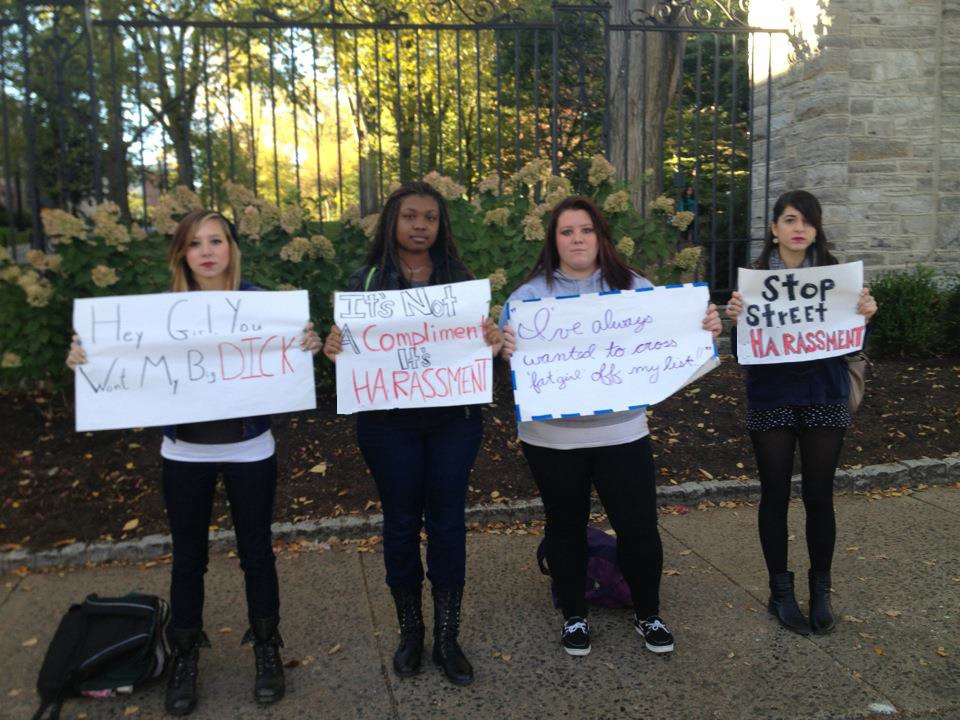 31. USA: Members of Penn State’s TRIOTA, the Women’s Studies Honor’s Society, held an anti-street harassment demonstration on a busy Friday afternoon in downtown State College in October. They held signs proclaiming their anti-harassment message, and even included specific remarks that had been yelled at them during their time at PSU.
32. USA: In March, Sarah Harper launched the Little Bird project to raise awareness about street harassment through the arts in San Francisco, California.
33. USA: Since January 1, 2012, at least 63 transgender individuals have been hatefully murdered, often by strangers in the streets, and many of the recent murders have been in Washington, DC. In September the DC Office of Human Rights launched a groundbreaking Transgender and Gender Identity Respect Campaign to improve the treatment of transgender and gender non-conforming people.
34. Yemen: This year, the Safe Streets campaign has encouraged women to report their stories to their website and highlighted the issue through social media and articles like this one, published on Open Democracy.
Last month, women in Swaziland marched to protest rape and to ask for protection.
In response, instead of addressing why so many men are raping women or examining reporting/enforcement of laws, police decided to place the blame on women. They have now banned women from wearing miniskirts, shirts revealing their midriff, and low cut jeans. “The act of the rapist is made easy, because it would be easy to remove the half-cloth worn by the women,” police spokeswoman Wendy Hleta said.
That response and the ban are completely ridiculous. Clothing does not cause rape nor do certain clothes “make it easier” to rape. They need to focus on the perpetrators, not the survivors!

Yesterday and today, tens of thousands of people marched in Delhi, India, because they feel sick and angry knowing there is a rape reported every 18 hours in their city and they are outraged over the gang rape of a 23-year-old woman last weekend (she is in critical condition in a hospital).
Sadly, in response to this righteous outrage and rallying together, police have used tear gas and water cannons to push back the swelling numbers and they have recently forbidden gatherings of more than five people. But the protesters will not be deterred! They continue on.
This is a partial list of protests that took place today across India, compiled by GotStared.At:
Protests taking place on Sunday, 23 December:
Ahmedabad: Gormoh Circle, 6:30 PM
Ajmer: Circuit House to Collectorate, 6 PM
Bangalore: Town Hall, 11 AM
Chennai: Gandhi Statue, 9:45 AM
Dehradun: Parade Ground, 2:30 PM
Delhi: India Gate, 8 AM, Silent March | India Gate, 3 PM, SlutWalk Protest
Hubli: BVB College of Engineering & Technology, 5 PM
Hyderabad: People’s Plaza, Necklace Road, 4 PM
Jaipur: Statue Circle, 5:30 PM
Kolkata: City Centre, Salt Lake, 12:00 PM
Mumbai: Marine Drive, 5 PM
Nagpur: RBI Square, 11 AM
Follow what is happening via the Twitter hashtag “#DelhiGangRape”
Here are seven things you can do to keep pressure on the government re: this issue.
Related, someone posted this very good article on the Stop Street Harassment Facebook page. Here is an excerpt, with advice on what to do now to stop sexual violence in India:
“Dear young women and men of Delhi, if you want rape to end, you will have to confront those traditions. Confronting those traditions, confronting the known history of patriarchy is not the same thing as demanding capital punishment. In fact, they can be the opposites of each other. By demanding ‘death’ for the rapist, you are tacitly entering into a compact with those who see rape not necessarily as a crime against a free agent, but also as a property crime, as an assault on honor and dignity. My understanding is, and my appeal to all of you is – stop treating rape as a matter of honor and dishonor altogether, and expose and boycott those who would insist it is a matter of honor and dishonour. Treat it as ordinary, disgusting, evil violence, as the naked expression of power, and you will see that the expression of power is never challenged by the demand for death. It is easy for those who think of women as property to demand death for those who violate their property rights over women. That is why many men who will demand death penalty for rapists will happily go home and rape their wives. (Because in their understanding they cannot ‘rape’ their wives, only strangers can rape ‘their’ wives.)If you want to end rape, to end the forced sexual subjugation of one human being by another. You will have to look elsewhere than the gallows for comfort.
Rape and sexual assault, and other kinds of violence centered on the enjoyment of humiliation are different from other kinds of violence. You could be in the company of violent men, as a man, in a bus, and they would not necessarily slap you around just for the heck of it (unless you ‘looked’ racially different, or were different because of the way you expressed your sexual orientation). But imagine or remember what it is to be a woman on that bus, or to be the ‘wrong’ kind of male – queer, child, racially other, submissive because you are held captive – and things can suddenly go wrong. This is what happened on that bus that the 23 year old paramedic and her friend had boarded. This is what happened when Sharma, Sharma, Singh, Gupta and Thakur and their unnamed juvenile accomplice, decided to assert their position as bipedal upper primates on top of their imagined sexual pyramid. Let us not forget that the matter spiraled when one of the assaulters taunted the woman and her friend for being together at night in Delhi. In their eyes, she had broken the code of sexual slavery, by being a person who had acted as a free agent, as someone who could choose to enjoy her claim to the city, its entertainments, with a companion who happened to be male.
Of course she need not have acted as this free agent for this horrible event to happen. She could have been at home, confined within narrow domestic walls where most rapes in Delhi, and India occur. (I have yet to hear of policemen and politicians advocate the abolition of marriage in the same breath as the closure of pubs, although more rapes happen within marriage than do at or around pubs, clearly neither marriage nor pubs are in themselves the causes of rape, but it is always curious that one should be asked to be banned, though sometimes judges do ask rapists to marry their victims, though no one has yet asked a woman who was attacked or molested at a pub to return to the place where she was assaulted). In this instance, were we to go by the law of statistical averages, the brave 23 year old paramedic was not, but could easily have been the sister, niece, daughter, daughter-in-law or wife of one of the accused. Because the majority of those who get raped in our society are sisters, daughters, daughters-in-law, nieces and wives – and they are raped by brothers, fathers, uncles, fathers-in-law and husbands. Or she could have been a worker raped by her boss, or her colleague. She could have been a student raped by a teacher, a patient raped by a doctor or a warden in a hospital or clinic, an undertrial raped by a policeman, an insurgent or suspect raped by a soldier. She could have been dressed in clothes that she felt helped her enjoy and assert her sexuality, or she could have been dressed in work clothes, she could have been dressed in a burqa, a sari, salwar kameez or in a nun’s habit. She could have been a three year old infant, a teenager, a young woman, a post menopausal woman, even a grandmother.
Anybody at all, other than a man in a position of real or imagined power, can be raped by a man in a position of real or imagined power. We might as well call this the first and most important law of rape.
This means that you can be raped in order to punish you for having broken the code of sexual slavery (patriarchy) – which is what happens when you are ‘accused’ of being up and about in the night in the city with a man who is not related to you. Or, on the other hand, you can be raped, in order to enforce it, maintain it, irrigate it, generally show the world – how it works, who’s on top – which is what happens when rapes happen within the four walls of homes, work places, institutions and prisons.
Where does this sense of impunity that seems to govern the actions of so many men come from ? It cannot come from biology alone. Because, thankfully, not all men, not even all men in positions of real or imagined power, are rapists. Rapists choose to access a cultural code of permission. There is something in the cultural baggage or vocabulary available to us all that normalizes sexual violence, even renders it trivial, as a bit of horseplay at worst, or the hallowed order sanctified by tradition, at best.
Dear young men and women of Delhi. There are things you can do to stop rape.
* Shame any man who casually passes misogynist, sexist, remarks. Shame all those cowards who try to humiliate anyone because of the way their bodies or desires are. Shame them in public.
* Young women, do not retreat from public space. Take back the night. Insist on being out and about. Insist on the conditions that enable your safety. Ask why there are no women bus drivers, women cab drivers. Ask what the Delhi police is doing to punish misogynist officers and constables.
* Young women, please understand that when you hear songs that are violent and misogynist, you can choose to boycott the radio stations and recording companies that put them out. Leave a party or a celebration that plays a Honey Singh song. If you are young man who is a friend of a young woman at any such gathering, leave the celebration with your friend. Call the radio stations, phone in and demand that they stop playing misogynist songs.
* Demand more public transport. Demand a thousand more buses that ply all night. Demand a metro system that stays open late into the night. Demand street lighting. Ask why the car lobby in Delhi can systematically stymie the expansion of public transport in Delhi. If there are not more public buses and metro trains, understand that those who run this city are responsible for rape and assault.
* Take your traditions seriously, and recognize that every religion teaches the subjugation and humiliation of women. Ask men and women of religion what they are going to do to recognize the misogyny in their traditions, to confront and challenge them. Insist that under no conditions can any woman pollute anything around her. insist that women are not property. Not of their fathers, brothers, boy-friends or husbands. Not of the state. Not of God.Understand that people can never be property and must never be viewed as such.Combat and confront anyone who says they can be.
* Shame and expose those politicians and police or army officers who try to cover up cases of sexual assault and rape in Kashmir and the North East and elsewhere. Do not create a hierarchy of more and less important victims.
* Young men, decide now, and for all time, that you will treat the women you encounter first of all as friends, as equals, as people who have as much right to your city as you. Learn to respect a woman’s right to pleasure. To her right to say yes and no. Do not think that ‘no’ means ‘yes’.
* Young men, if you confront a situation in which any man harasses another woman, or any other person, make sure that you will stand up and protest, call attention to what is going on, and make sure that this stops.
* Young men, and young women, do not reduce the matter of confronting rape and molestation to one of asking the attacker whether or not he has ‘sisters and daughters’ at home. Rapists pray on their sisters and daughters just as easily as they do on strangers.
* Young men and young women, do not ever let anyone tell you that under any circumstances, that your life is not worth living.
I hope you change Delhi forever. I hope that the rest of the country follows your example.
I remain hopeful because of what you did yesterday and today. Do not disappoint me, do not disappoint yourselves. Make your protest viral. Take it everywhere, to workplaces, schools, streets, parks, the metro, to dark and unlit streets, to lit streets and corners. Take over the city. Make it a city that belongs to you and me and the brave 23 year old paramedic still fighting for her life.”