• About Us
    • What Is Street Harassment?
    • Why Stopping Street Harassment Matters
    • Meet the Team
      • Board of Directors
      • Past Board Members
    • In The Media
  • Our Work
    • National Street Harassment Hotline
    • International Anti-Street Harassment Week
    • Blog Correspondents
      • Past SSH Correspondents
    • Safe Public Spaces Mentoring Program
    • Publications
    • National Studies
    • Campaigns against Companies
    • Washington, D.C. Activism
  • Our Books
  • Donate
  • Store

Stop Street Harassment

Making Public Spaces Safe and Welcoming

  • Facebook
  • Instagram
  • Pinterest
  • Tumblr
  • Twitter
  • YouTube
  • Home
  • Blog
    • Harassment Stories
    • Blog Correspondents
    • Street Respect Stories
  • Help & Advice
    • National Street Harassment Hotline
    • Dealing With Harassers
      • Assertive Responses
      • Reporting Harassers
      • Bystander Responses
      • Creative Responses
    • What to Do Before or After Harassment
    • Street Harassment and the Law
  • Resources
    • Definitions
    • Statistics
    • Articles & Books
    • Anti-Harassment Groups & Campaigns
    • Male Allies
      • Educating Boys & Men
      • How to Talk to Women
      • Bystander Tips
    • Video Clips
    • Images & Flyers
  • Take Community Action
  • Contact

UK Campaign, Philippines Law

February 15, 2017 By HKearl

Two big stories this week –> a new anti-harassment campaign in the UK and a new law introduced in the Philippines

Via The Gazette

“A poll by England Athletics revealed that a large proportion of women feel anxious when running alone, with nearly half of those surveyed stating that this is due to personal safety concerns…

Of those who had experienced harassment, shouting and car horns beeped by passing motorists were the most common.

But RunTogether, a national programme from England Athletics to get more people jogging regularly, aims to erase this via its This Girl Can Run campaign…

The RunTogether website provides instant access to a rapidly growing network of multiple local running groups in Lancashire.”

Via the Manila Bulletin:

“Sen. Risa Hontiveros [in the Philippines] filed on Tuesday a bill that seeks to protect women and members of the lesbian, gay, bisexual and transgender (LGBT) community from harassment, especially on the streets and other public spaces.

Hontiveros said she filed the measure, Senate Bill 1326, in response to the growing number of gender-based harassment in public spaces such as the case of a female student from the University of Santo Tomas (UST) who was allegedly groped in a public utility vehicle by a fellow student.

The bill, also known as the “Safe Streets and Public Spaces Act of 2017,” seeks to penalize gender-based street and public spaces harassment such as catcalling, wolf-whistling, cursing, leering, groping, persistent request for name and contact details and the use of words tending to ridicule on the basis of actual or perceived sex, gender expression, or sexual orientation and identity including sexist, homophobic and transphobic slurs.”

Quezon City already has a similar bill at the city-level, passed last year.

Share

Filed Under: News stories, Resources, street harassment Tagged With: england, legislation, philippines, running, UK

Late January 2017 News Round-Up

January 31, 2017 By HKearl

Here are some of the news articles that caught my eye this month.

First, a new study says sexually objectifying a woman, including through catcalling, can lead to aggression towards women.

Via HuffPost:

“A study published late last year by the University of Kent says sexually objectifying a woman can very well lead to aggression towards women and “reduced moral concern for the objectified.”

The researchers, who worked with more than 200 participants aged 12 to 16, found the link between catcalling and aggression can begin to develop in the early teen years, and can lead to the harmful perception that women are solely to be seen as sexual objects as they age.”

Global News:

A female-only ridesharing service will launch in Queensland, Australia… but addressing root causes of street harassment is a must, too.

A Bartenders Against Sexual Harassment event was held in Canada to raise money and awareness about sexual harassment and assault in the Toronto bar scene.

In Egypt, the Central Agency for Public Mobilization and Statistics surveyed young people ages 15 to 29 in “informal urban areas of Greater Cairo” and 48% viewed street harassment as a problem.

Hundreds of men sexually assaulted women in Bangaluru, India, on New Year’s Eve. Among those speaking out afterward were those advocating for education and socialization of children to be respectful.

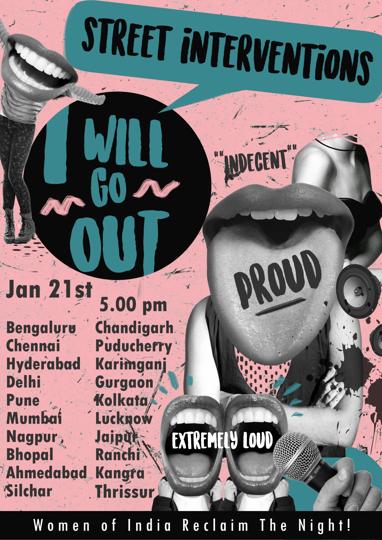
On Jan. 21, women across India marched to protest sexual harassment and misogyny using the hashtag #IWillGoOut.

Air India launched a women-only section of their airplane due to incidents of sexual harassment.

There’s a national competition in India encouraging people to rewrite the lyrics of sexist Bollywood songs.

Women in Jakarta, Indonesia, are taking action against street harassment.

The powerful Irish spoken word piece “Heartbreak” addresses street harassment.

A New Zealand woman writes an open letter to all cat-callers.

In Punjab, Pakistan, the Women Safety Smart Phone App launched.

Pakistani singer Atif Aslam called out and interrupted an incident of sexual harassment happening at his concert in Karachi

Reports of street harassment are on the rise in Cambridge, UK.

“Road to Equality” is a seven-minute documentary about street harassment in the UK.

USA News/Stories:

The Los Angeles Metro launched a hotline staffed by professional counselors to help people facing sexual harassment on the transit system.

Best-selling author and comedian Jen Kirkman tackled street harassment in her stand-up special Just Keep Livin’?.

What it’s like to be street harassed while seven months pregnant.

This is why street harassment is a mobility issue.

Hate crimes have swept the USA since the November presidential election and not even the liberal San Francisco Bay Area has been immune to it, including to street harassment.

A Maryland police officer pled guilty to taking upskirt photos of women.

Share

Filed Under: News stories, street harassment, weekly round up

Philippines: City of Stars Has ‘Anti-Catcalling Ordinance’

January 24, 2017 By Correspondent

Ken Rodrigo, Makati City, Philippines, SSH Blog Correspondent

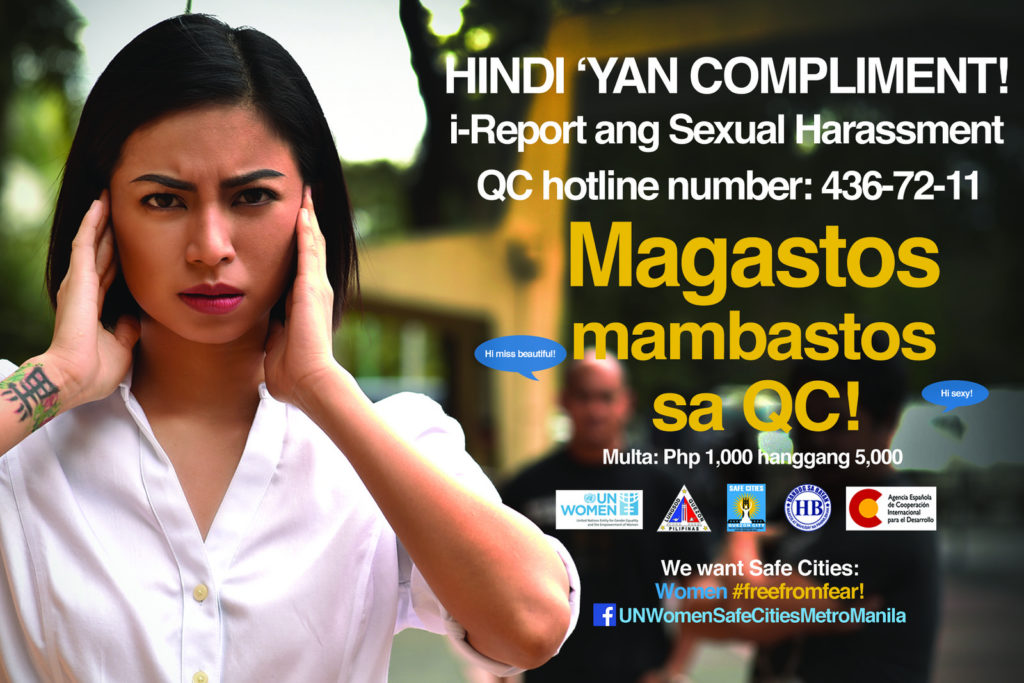
More than being the Philippines’ Hollywood and Metro Manila’s largest city, Quezon City recently made its mark as the first local government to enact a law penalizing street-level harassment. Enacted last May, the ‘Anti-Catcalling Ordinance’ intends to protect and empower women by imposing a fine and prison term for acts constituting sexual harassment in public spaces. While only women (and girls) may be victims under the local law, the offender may be of any sex.

The ordinance proposed by lady councilor Lena Mari Juico is part of the Safe Cities and Safe Public Spaces Initiative of UN Women.

The ordinance divides violations into light, medium and severe.  A person may be fined or jailed up to a month for committing light violations such as cursing, catcalling, repeatedly asking the subject for a date or her contact number, or taunting a woman with constant talk about sex. With the same penalties as light, medium violations include stalking, making offensive mouth, hand or body gestures with intention to demean or threaten a woman.

Acts such as unnecessary touching, pinching or brushing against the subject’s body, public masturbation or lascivious exhibition directed at a woman, or inserting any object into the genitalia, anus or mouth of a victim regardless of sex constitute severe violations which carry a higher fine or jail term from one month to a year. Corresponding penalties are also provided for repeated violations.

Victims may file a complaint at the women’s desk of police precincts or seek assistance by calling the Quezon City Police Department (QCPD) hotline. Other implementation measures were also set such as strengthening the ‘barangays’ or community administrations.

The attention gained by the ordinance allowed Filipinos to discuss the important yet neglected issue of street harassment. Some were delighted by the city’s initiative and called other cities to follow suit. There were others who wished for the policy to be a national legislation. However, those who disapproved criticized the ordinance’s penal provisions arguing that a jail term is disproportionate to the offense, and expressed concern about the vagueness of the acts constituting harassment, the feasibility of implementation, and the possibility of the abuse of the ordinance by women against men. While the breakthrough ordinance spells hope for the anti-street harassment movement, it also reflects the movement’s struggle with breaking misogynist culture.

The City of Stars shines bright with this safe public spaces initiative. It champions women’s rights and serves as a model for other cities. Next, the national government should include street harassment in its human rights agenda in order to meaningfully promote safe cities and public spaces throughout the country.

Ken is a teacher of international studies at a university in Manila. After law school, she traveled to Denmark and eventually studied in Malmö University in Sweden where she earned her master’s in Human Rights. You can contact her at krnrdrg@gmail.com or on Facebook.

Share

Filed Under: correspondents, News stories, street harassment Tagged With: law, ordinance, philippines, quezon city

Late December 2016 News Round-Up

December 30, 2016 By HKearl

Some of the highlights of this month:

Across one weekend, women from 43 cities in 29 countries reported their experiences of street harassment to the BBC for the 100 Women season.

VICE offices asked women from 13 European cities if and where they feel unsafe alone at night, and how they deal with that feeling.

The city of Buenos Aires (Argentina) enacted a law making public sexual harassment illegal and requiring public education campaigns.

Eleanor Gordon-Smith, a writer/reporter in Australia confronted her catcallers and figure why they do it.

Youth in Cambodia made films on topics like street harassment.

In Timbío, Colombia, there is a new non-binding decree around street harassment along with a city-wide public education campaign.

Protests erupted in Bogota, Colombia, after a man kidnapped a seven-year-old girl from her yard, then raped, tortured and killed her.

A group of Egyptian women organized a “short-dress march” to call for respect and a change of attitudes around street harassment.

Street harassment is contributing to high obesity rates among women in Morocco.

More than 1000 people took the #IWalkFreely survey in Nepal and 98 percent of all women said they had been harassed.

Activists in NYC prepare bystanders to take action against harassment as bias-based attacks soar following the U.S. election.

American singer Ariana Grande speaks out against street harassment, sexism and objectification.

In this video, the woman speaks back to her street harassers.

Share

Filed Under: News stories, street harassment

Highlights of Street Harassment News, Efforts & Activism in 2016

December 28, 2016 By HKearl

The march today, via TN.com
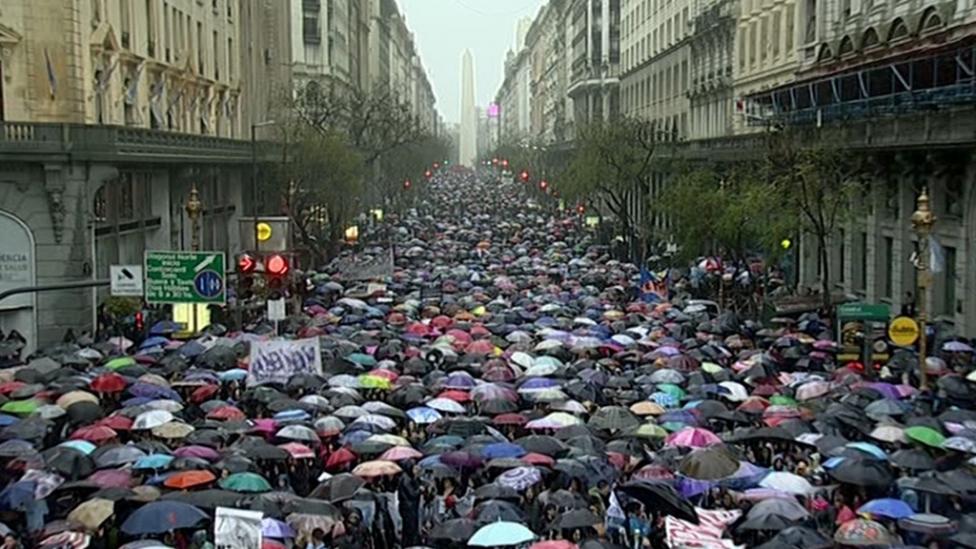
Women in Argentina march against street harassment and other forms of violence against women in October 2016. Image via TN.com

Compared to the close of the eight previous years I’ve worked on this issue, the vastness of what we’re up against in our goal to create a world where people have equal and safe access to public spaces is weighing heavily on me. When men who are sexual abusers and sexual harassers and clearly do not respect women are voted into positions of power and leadership, it is hard to not feel completely discouraged and disheartened.

But what is giving me the glimmer of hope I need to keep going are the positives of the year. The gains we’ve made. The countries where the governments have recognized street harassment as a serious issue. The people who have stood up and said enough. Everyone who has declared that they deserve the right to be in public, safely.

Each year I write a series of round-up blog posts featuring the major news from the year relating to street harassment. The last two years those series of posts have gotten shorter – because so much more is happening than ever before, it’s a bit overwhelming to try to document it all. That said, I think it’s an important exercise to do each year, especially this year when we (or at least, I) need to see the gains we’ve made this year. So here is a (short-ish) round-up of some of the government actions, glorious activism, studies, and big news stories of 2016. And of course, hundreds of actions took place in 36 countries over International Anti-Street Harassment Week, too.

Government Action:

In a unanimous vote in December, the city of Buenos Aires (Argentina) enacted a law making public sexual harassment illegal and requiring public education campaigns.

“Respectful relationship” curriculum will be mandatory in all Victoria, Australia, schools next year and students will learn about social inequality, gender-based violence, and male privilege.

A new anti-harassment transit campaign launched in Vancouver, Canada, by the transit agency with the posters reading, “Unwanted touching is a crime. Keep your hands to yourself.”

A woman-only bus line launched in the city of Zhengzhou, China.

In Timbío, Colombia, a non-binding decree was made on November 25, 2016, to ban public-sector workers and contractors from making “lewd, coarse catcalling that offends ladies.” Those in violation will face verbal reprimand, sensitivity training, or counseling. A city-wide campaign against street harassment launched, too.

Costa Rican President Luis Guillermo Solis and his wife and daughters joined a march against street harassment in San Jose.

Finnish cops can now write tickets against sexual harassment in public spaces.

Seventeen women who have served as ministers in France said they would no longer be silent about sexual harassment in politics.

Thanks to SHE teams launched two years ago in Hyderabad, India, street harassment is down by 20%.

Police in Mumbai (India) made it easy for people to report harassers during the Holi celebration.

All mobile phones sold in India will be required to have a panic button as of next year, the country’s telecommunications ministry announced.

An increase in non-consensual up-skirt recordings in tourist areas in Kyoto, Japan, has prompted more police patrolling.

The transit authority in Mexico City began deploying more police officers to look out for sexual harassment.

The Mexican City government distributed whistles at metro stations to try to curb street harassment.

A minister in Morocco proposed a sexual violence law that would include street harassment.

A regulation has been proposed in Amsterdam (the Netherlands) to make it illegal to “bother others buy jeering or offensive language, gestures, noises or behavior” in public spaces.

Guards at a Pakistani park whack street harassers with a stick to stop them and deter future incidents.

Portugal has a new national law against street harassment.

There was a trial run of women-only subway cars on Metro 1 during rush hour in Busan, South Korea.

A viral video of street harassment in Trinidad prompted the Office of the Prime Minister (Gender and Child Affairs) to state that such behavior is illegal.

Nottinghamshire police in the UK are now logging sexist abuse like street harassment as a hate crime. Soon after, police across England and Wales began considering making misogyny a hate crime too.

A new bill in Georgia (USA) will outlaw “upskirt” photos and video recordings.

The Los Angeles transit authority launched a new component of their anti-harassment campaign. So did the transit authority in Washington, D.C. (in partnership with SSH and CASS) and in Boston. USA

Both USA President Barack Obama and First Lady Michelle Obama (x2) talked about street harassment publicly this year.

California became the first U.S. state to make sexual consent lessons mandatory in high school, starting next year.


Grassroots Activism:

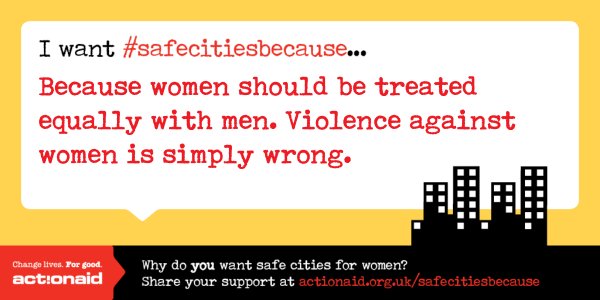
SafeCitiesBecause ActionAid May 2016ActionAid mobilized groups in 17 countries on May 20 under the theme #SafeCitiesBecause.

Three women in Afghanistan developed a phone app to address street harassment.

Tens of thousands of women marched in Argentina to protest violence against women.

Student and faculty at the University of Belize donned orange clothing and marched against street harassment.

Activists in Brazil tackled harassment during Carnival with the campaign #CarnivalSemAssedio.

Youth in Cambodia made films on topics like street harassment.

During the Calgary Stampede festivities in Canada, there was a #SafeStampede campaign to promote consent and respectful behavior.

Activists in Chile worked to pass a country-wide anti-street harassment law.

A video of a woman walking for two hours in San Jose, Costa Rica, garnered a lot of discussion about street harassment.

A group of Egyptian women organized a “short-dress march” to call for respect and a change of attitudes around street harassment.

Here’s a guide created by a woman in France about what to do if you witness Islamophobic harassment

In a small German town, after a resident raised concerns that girls were being harassed on their way to school, the mayor blamed the girls saying they ‘provoked’ it and should avoid the area. There was outrage among members of the community.

Prajnya Trust is highlighting street harassment by covering a mannequin with stickers (with slogans) in the Chamiers Cafe in Chennai, India.

Through the leadership of Blank Noise, women in India took naps in public parks as a form of protest against harassment. Blank Noise also is collecting the clothes people wore when they experienced sexual harassment and assault. They are also encouraging women to #WalkAlone.

A female high school student in Tokyo, Japan, who was regularly groped by men on her ride home from school (and reported it, but that did not stop it) and her mother designed a button that said “Groping is a crime” and “I won’t let the matter drop” which she attached to her school bag. They made hundreds and distributed them to other girls and women.

More than 2,000 women have been trained in self-defence at Amman’s SheFighter studio in Jordan.

Through community efforts, Jhpiego in Kenya was able to stop young men from harassing and robbing pregnant women on their way to clinics to give birth.

Young women in Kosovo are writing code to fight harassment.

Women in Beirut, Lebanon, launched an online tracker to map street harassment.

Las Hijas de Violencia, a female punk group, battled catcalls with confetti and song in Mexico.

Four young women have a Youtube channel “Morras” where they post videos in which they talk about street harassment in Mexico and show hidden camera footage of harassers.

Twenty women wearing dark clothing across their body and faces held a flash mob protest against sexual harassment on the transit system in Mexico City. They were organized by the group Information Group on Reproductive Choice after one of the women’s colleagues was attacked.

Men in Amsterdam (the Netherlands) marched in mini-skirts to protest men’s attacks on German women.

College students in New Zealand penned a letter asking their university to help address street harassment near campus.

Illustrator Shehzil Malik in Pakistan created a series of images she called #WomenInPublicSpaces.

Activists in South Africa spoke to taxi drivers, painted a mural on the inside of a taxi rank and staged two street performances to protest sexual and homophobic harassment by taxi drivers.

A Japanese musician performed at Trinidad‘s Carnival and was found dead in a patch of bushes, likely raped and murdered. If this wasn’t bad enough, the mayor blamed her for it based on her clothing choice. Fortunately, a successful petition and general public outrage led to his resignation.

Thousands of women in Turkey rode bicycles to claim public space.

3,500 people marched against sexual harassment and violence in public spaces in Manchester, UK.

There was a new film “The Ovarian Psycos” about women in Los Angeles (USA) who ride through their neighborhoods confronting violence, including street harassment.

In Washington, D.C. (USA), bartenders are learning how to stop sexual assault through Safe

Hollaback! released 19 lesson plans, videos, role-play exercises and more (global).

#SayHerName was created to raise awareness about the number of women and girls that are killed by law enforcement officers.

Our board member Lindsey started #ShirtlessShamers2016, a Twitter hashtag in which she juxtaposes men’s sexist, slut-shaming social media posts about women’s bodily respectability with their own bare-chested pictures.


Studies and Reports:

Three in four women have been subjected to harassment and violence in cities across the world, according to new research by ActionAid UK, which described the situation as an “epidemic”.

The Women’s Refugee Commission released the report “No Safety for Refugee Women on the European Route: Report from the Balkans.”

In Toronto, Canada, there were 577 reports of sexual assault on the transit company’s property or vehicles between 2011 and 2015.

In Delhi, India, 40% of women had experienced street harassment during the previous year. An alarming 17% had quit jobs and 33% stopped going out in public because of the harassment.

Half of all women in Ireland have faced some form of sexual harassment in their life.

In Israel, 68% of girls had been harassed by a man they didn’t know on the street.

At least 28 out the Israeli parliament’s 32 female members have experienced sexual harassment or assault.

A new report on sexual harassment in Kosovo found that 64% of women and 32% of men had been harassed.

More than 1000 people took the #IWalkFreely survey in Nepal and 98 percent of all women said they had been harassed.

In the Philippines, 88% of women ages 18-24 had faced street harassment, and 34% said it included forms like flashing, public masturbation and groping.

Sudanese security forces have used sexual violence, intimidation, and other forms of abuse to silence female human rights defenders across the country, Human Rights Watch said in a report.

An Amnesty International report found that women refugees from Syria and Iraq face sexual abuse at every stage of their journey.

In the United Kingdom, the first national poll on sexual harassment in public spaces found that it affected 64% of women of all ages and 85% of women ages 18-24.

Data show that most sexual abuse on the London (UK) Tube happens during rush hour. Also, half of women feel unsafe riding the transit system.

A poll of 14,000 students in the UK showed that 95% of women and 61% of men had been groped against their will at a nightclub.

A report in the UK found that the country is ‘failing girls’ due to sexism in schools and harassment on the streets.

A Runner’s World survey of 4,670 runners in the USA found that 43 percent of women at least sometimes experience harassment on the run, compared with just 4 percent of men. (Read more in a feature article for their December issue)

The U.S. Transgender Survey released by the National Center for Transgender Equality found that 46 percent of trans people experienced verbal harassment and 9 percent faced physical harassment in public spaces in the past year.

A randomized poll of American women showed that 45% of them had experienced unwanted sexual touching and 56% had faced catcalling.

There was a 53% increase in reports of sexual harassment on the New York City (USA) transit system.

“African-American Girls in High-Risk Neighborhoods Experience Threats and Objectification, Study Finds“

SSH worked with CASS and WMATA to release the biggest study about sexual harassment that any transit system in the United States has conducted. In the 1,000 person-regionally representative survey, 21 percent of riders had experienced some form of sexual harassment and women were three times more likely than men to experience it.


Story-Telling:

VICE offices asked women from 13 European cities if and where they feel unsafe alone at night, and how they deal with that feeling.

Across one weekend, women from 43 cities in 29 countries reported their experiences of street harassment to the BBC for the 100 Women season.

NPR did a two-part series about what street harassment is like in countries around the world.

More than 140,00 women used the hashtag #NoWomanEver to “humorously highlight their not-so-funny experiences of wolf whistles, sexual comments from passing strangers and other street harassment.”

50,000 people used #WhenIwas to share experiences of sexism, harassment and abuse

There’s a new website for reporting street harassment in Afghanistan.

Two Argentinian women were killed while backpacking, & there was victim-blaming. In protest, women tweeted their stories with #viajosola (I travel alone) and it trended.

Plan International Australia and CrowdSpot created a digital campaign “Known as Free to Be” and invited young women aged 15 to 19 to mark public spaces on a map as either “happy”, where they have had good experiences or “sad”, where they have experienced feeling unsafe or unwelcome.

A woman in Australia wrote an op-ed calling attention to the harms of “fat-calling.”

Barbadian women used the hashtag #LifeInLeggings to share their personal experiences of street harassment, as well as sexual and other forms of abuse and women in other Caribbean countries such as Jamaica and Trinidad began using it, too.

With the hashtag #MiPrimerAcoso, or #MyFirstHarassment, hundreds of Mexican women posted their first experiences with male bullying and harassment.

Groundviews mapped street harassment in Sri Lanka.

In a video, Tunisian women shared their street harassment stories.

During an interview with Esquire magazine, British actress and UN Goodwill Ambassador Emma Watson spoke about her experiences of street harassment and how it’s commonly faced by most women but shouldn’t be.

The Southern Poverty Law Center released a report three weeks after the presidential election in the United States showing the more than 860 post-presidential election hate incidents that had been reported so far. These are examples of street harassment.

An episode of Bustle’s documentary series NSFWomen (Not Safe For Women) focuses on how street harassment affects female bike messengers in the USA.

Other News:

Globally, airlines are ill-equipped to deal with sexual harassment and assault on airplanes.

As many as 200 incidents of reported sexual harassment took place over Eid in Egypt.

A French TV commentator kissed a young woman’s breasts without consent on live TV, sparking a national conversation about sexual abuse.

In France, police literally policed women’s bodies at the beach.

Men in Cologne, Germany, attacked at least 500 women on New Year’s Eve.

In India, there were many horrific events, including a 15-year-old girl being killed by a man who had regularly street harassed her; a high school girl who was routinely harassed and in response, set herself on fire and is in critical condition; and men who allegedly pulled women commuters out of their vehicles and raped them.

When model Gigi Hadid fought off a harasser in Italy, some media outlets shamed her while others celebrated her actions.

South African president Jacob Zuma called street harassment an innocent compliment.

More than 40 cases of sexual violence took place at two of Sweden’s biggest music festivals.

A harasser stabbed a man in San Francisco (USA) after the man told him to stop harassing his friend.

A harasser shot a woman in Los Angeles (USA) after she told him and his friends to stop harassing her teenage daughter and her friend.

A harasser in Florida (USA) shot a man after that man told him to stop disrespecting his wife.

A harasser shot into a women’s shelter after the woman he had been following and harassing entered it in Philadelphia (USA).

In Pittsburgh (USA), Charles McKinney attempted to talk to Janese Talton-Jackson at a bar. News reports say that when she turned him down and left the bar, he followed her and shot her in the chest, killing her.

A man shot and killed Texan Sara Mutschlechner after one of her friends in her car told the man and his friends that their derogatory and sexual comments were offensive. (USA)

Two different men groped teenage girls traveling alone on two different airplanes (USA).

A bus driver stopped street harassment in Wisconsin (USA).

Three women in California (USA) stopped a date rape in progress.

Share

Filed Under: News stories, street harassment, year end

« Previous Page
Next Page »

Share Your Story

Share your street harassment story for the blog. Donate Now

From the Blog

  • #MeToo 2024 Study Released Today
  • Join International Anti-Street Harassment Week 2022
  • Giving Tuesday – Fund the Hotline
  • Thank You – International Anti-Street Harassment Week 2021
  • Share Your Story – Safecity and Catcalls Collaboration

Buy the Book

  • Contact
  • Events
  • Join Us
  • Donate
  • Facebook
  • Instagram
  • Pinterest
  • Tumblr
  • Twitter
  • YouTube

Copyright © 2026 Stop Street Harassment · Website Design by Sarah Marie Lacy