• About Us
    • What Is Street Harassment?
    • Why Stopping Street Harassment Matters
    • Meet the Team
      • Board of Directors
      • Past Board Members
    • In The Media
  • Our Work
    • National Street Harassment Hotline
    • International Anti-Street Harassment Week
    • Blog Correspondents
      • Past SSH Correspondents
    • Safe Public Spaces Mentoring Program
    • Publications
    • National Studies
    • Campaigns against Companies
    • Washington, D.C. Activism
  • Our Books
  • Donate
  • Store

Stop Street Harassment

Making Public Spaces Safe and Welcoming

  • Facebook
  • Instagram
  • Pinterest
  • Tumblr
  • Twitter
  • YouTube
  • Home
  • Blog
    • Harassment Stories
    • Blog Correspondents
    • Street Respect Stories
  • Help & Advice
    • National Street Harassment Hotline
    • Dealing With Harassers
      • Assertive Responses
      • Reporting Harassers
      • Bystander Responses
      • Creative Responses
    • What to Do Before or After Harassment
    • Street Harassment and the Law
  • Resources
    • Definitions
    • Statistics
    • Articles & Books
    • Anti-Harassment Groups & Campaigns
    • Male Allies
      • Educating Boys & Men
      • How to Talk to Women
      • Bystander Tips
    • Video Clips
    • Images & Flyers
  • Take Community Action
  • Contact

Street Harassment is Illegal in Buenos Aires

December 8, 2016 By HKearl

Another city passed a law against street harassment in Latin America!

Via Broadly:

“In a unanimous vote, the city of Buenos Aires has enacted a law making public sexual harassment illegal in hopes of diminishing gender-based violence….

The law takes both a punitive and educational approach. It creates an easy way for women to report street harassment as a crime and requires police to take the situation seriously, which has not always been the case in Argentina. Proven cat-callers could be slammed with small fines or court-mandated public service. The legislation also creates educational campaigns within the health, education, and transportation ministries that would teach Argentines that any comment or interaction in the street still requires a woman’s consent. These programs will also emphasize how to spot street harassment and intervene on a victim’s behalf.”

Stay tuned, for UN Women I am working on a guide about street harassment and laws around the world, and I will share a full list in the coming weeks.

Share

Filed Under: News stories, public harassment, street harassment Tagged With: Argentina, bueons aires, city ordinance, illegal, latin america, laws

The Bahamas: Interview with Founder of #LifeInLeggings

December 7, 2016 By Correspondent

Guest post by former Blog Correspondent Alicia Wallace

Image via: https://redforgender.files.wordpress.com

From #BlackLivesMatter in the U.S. to #SupportThePuff in The Bahamas, we’ve seen the power of social media, the rise of hashtag movements, and the propensity of new media to create change. Recently, #LifeInLeggings has gained the attention of the Caribbean region, giving women the space to share their stories of sexual violence ranging from harassment to rape. Started in Barbados by Ronelle King, the hashtag made its way to Guyana, Jamaica, Trinidad and Tobago, and The Bahamas among among other countries.

King, founder of #LifeinLeggings, told me she was frustrated by her own experiences of sexual violence. “I had an idea to create a hashtag that would create a forum for Caribbean women to share their daily experiences of sexual harassment and abuse.” She recently worked with B-GLAD (Barbados Gays, Lesbians and All-Sexuals Against Discrimination), but has found social media and blogging to better suited forms of activism for her personality and schedule.

The launch of #LifeInLeggings on the first day of 16 Days of Activism against Gender-Based Violence was coincidental. “I wasn’t aware of the 16 days of activism until the hashtag took off and people starting mentioning it in correlation with the hashtag.” King noted the importance of the annual campaign, and said she is happy to have #LifeInLeggings play a role in bringing awareness to the issue of gender-based violence.

It is difficult to predict the success of a hashtag movement, whether by geographical reach or number of participants, but King was certain she would receive support from her friends and women in Barbados, knowing it’s an everyday reality for them.

“I did intend for it to spread through the Caribbean. Rape culture isn’t just a Barbadian issue; it’s a Caribbean issue as well as a global one, so I know that support would pour in from the other countries.”

Sexual violence is a pervasive issue in the Caribbean, as evidenced by statistics. In a survey conducted in nine Caribbean countries 48% of adolescent girls reported that their sexual initiation was “forced” or “somewhat forced.” The United Nations Office on Drugs and Crime and the Latin America and the Caribbean Region of the World Bank report noted, “While the worldwide average for rape was 15 per 100,000, The Bahamas had an average of 133, St. Vincent and the Grenadines 112, Jamaica 51, Dominica 34, Barbados 25 and Trinidad and Tobago 18.”

#LifeInLeggings has given Caribbean women space to put their names, faces, and stories next to those statistics, making them a visible reality for the people around them.

In Dominica, Delroy Nesta Williams and Khadijah Moore saw the effects of #LifeInLeggings and the potential to have a national conversation. The pair started #LévéDomnik to engage the country of less than 73,000, primarily on Facebook, in the discussion. Within days, they had collected over 400 stories, some of which were shared anonymously — sent to someone’s inbox and then posted on their behalf.

Williams said this is only the beginning of the conversation in Dominica. The #LévéDomnik has met with the country’s Bureau of Women’s Affairs and several NGOs, and is planning activities for 2017 that include advocacy training, yoga sessions, focus group meetings, and educational talks. “We want people to be more empathetic towards survivors, and we want to address institutional issues that act as emotional and psychological barriers to reporting sexual offenses and seeking redress through the judicial system.”

For King, #LévéDomnik is proof that #LifeInLeggings is serving its purpose. “The hashtag was created to not only show the realities of rape culture in Barbados, but in the Caribbean. It is a defiant cry for justice and a blatant refusal to be silent.”

Sexual violence is still a taboo subject, and survivors often find it difficult to talk about their experiences. In sharing our stories, we have the opportunity to sensitize people and bring attention to an issue that is often avoided in both private conversations and public discussion. Unfortunately, large numbers of people are unmoved by issues that do not directly affect them or people close to them. People participating in the #LifeInLeggings movement have commented on changes in attitudes of men around them who have been privy to the conversation. King shared that she personally received numerous messages from men who admitted they were a part of the problem, and intend to do better.

The Barbados team encourages those following #LifeInLeggings to reflect on their own experiences with sexual violence, and think of ways to keep the discussion going in family, peer, and community groups. It is also imperative that we consider the ways our words and actions contribute to women’s everyday experiences.

#LifeInLeggings started as a simple idea, and a group of dedicated women worked together to make it region-wide conversation. It caught the attention of two women in politics and Tanya Stephens among others, and is evidence of the power we all have to make a difference. In sharing our stories, women call upon men in The Bahamas and throughout the Caribbean to respect women as human beings, and take on the responsibility in engaging other men in these important conversations and holding them accountable for their actions.

We are not only responsible for what we do, but for what we allow to happen. Bystander intervention is critical to the creation of a new culture where sexual violence has not place. Bahamian women are invited to share their stories on Facebook and/or Twitter using #LifeInLeggings. Hollaback! Bahamas is accepting stories via an online form and will post on Facebook and/or Twitter for those who would like to remain anonymous.

Alicia Wallace is a women’s rights activist, public educator, and movement builder. She is the Director of Hollaback! Bahamas, produces The Culture Rush monthly newsletter, and tweets as @_AliciaAudrey. 

Share

Filed Under: Activist Interviews, correspondents, News stories, street harassment Tagged With: Bahamas, hashtag, interview, sexual violence

Female Bicycle Messengers Talk about Street Harassment

December 3, 2016 By HKearl

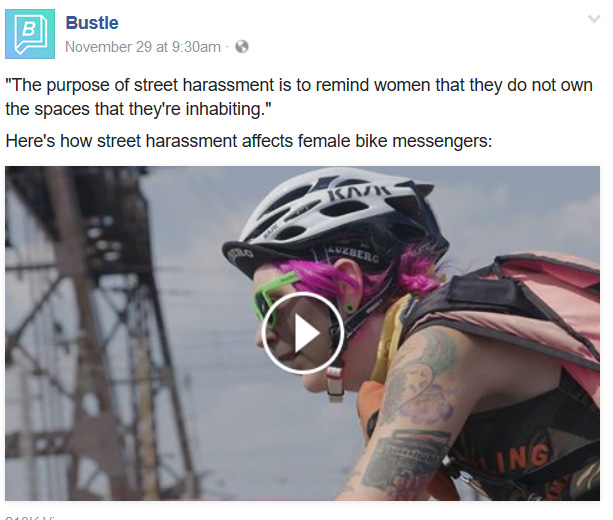
bustlebikemessengerThe new episode of Bustle’s documentary series NSFWomen (Not Safe For Women) focuses on how street harassment affects female bike messengers. Bustle’s Senior Publicist, Corporate Communications, Caitlin Eadie, shared this:

“Only 24% of all bicycle trips in the U.S. are made by women. 65% of women have reported being targeted by street harassment and 23% of women have experienced ‘sexual touching’ as a form of street harassment. To explore this issue, Bustle met with several female cyclists in Philadelphia who struggle with the fears and risks that go along with doing the job they love. One woman details a cycling incident when a male car passenger leaned out the window and grabbed her. Another discusses losing out on money because she fears for her safety when taking trips further away or past dark.

As the video’s intro states, ‘The purpose of street harassment is to remind women that they do not own the spaces that they’re inhabiting.’ A horrifying reality made even worse when Bustle reached out to 12 major U.S. city police departments and seven confirmed that they do not keep specific records of violence against female cyclists. The other five did not respond for comment.

NSFWomen tackles critical issues surrounding gender inequality, addressing the more nuanced, and sometimes undiscussed, struggles that women face on a daily basis.”

Check out the third episode of NSFWomen (Not Safe for Women).


Share

Filed Under: News stories, Stories, street harassment Tagged With: bicycles, bike messengers

City in Colombia Bans Street Harassment, Survey in Nepal & More

December 2, 2016 By HKearl

Here are four notable news stories from the past day:

DECREE:

In Timbío, Colombia, a non-binding decree was made on November 25, 2016, to ban public-sector workers and contractors from making “lewd, coarse catcalling that offends ladies.” Those in violation will face verbal reprimand, sensitivity training, or counseling.

Along with the decree was the launch of a city-wide campaign against street harassment, including ads at harassment hotspots, like public transit and stadiums.

iwalkfreelysurveynepalnov2016The decree is supported by la Casa de Mujer, a local women’s organization.

Learn more here.

SURVEY:

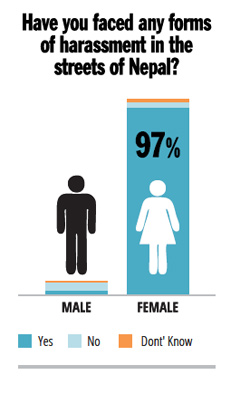
More than 1000 people took the #IWalkFreely survey in Nepal and 98 percent of all women said they had been harassed. Besides the streets, 71 percent of respondents also reported harassment in public transportation, 63 percent said they were subjected to physical harassment of some form, and 20 percent reported sexual harassment. Nearly half the participants who said they had faced harassment were between 20-29 years old, and 41 percent were between 13 and 19.

DOCUMENTING:

Here are two efforts to show what street harassment is like globally.

Via BBC News:

“As part of the BBC’s 100 Women season we would like you to join in and help us build up a picture of street harassment around the world.

We would like you or any of your female friends or family who experience harassment between Friday 2 December and Sunday 4 December to share your story with us.

We only need a brief description of the incident and the city where it happened. Tweet it using the hashtag #mappingharassment or if you prefer, email bbc100.women@bbc.co.uk

Do not put yourself at risk or try to take any pictures of the incident. Also do not give us further elements that could lead to your full identification, like your name, or address. Only post a brief description, the city and the hashtag.”

Via Vice News:

“As a woman walking around the city alone at night, there’s not much you can do if some creep decides to follow you around and harass you. But many women try to find a way to deal with feeling unsafe – to project an aura that will stop the harassment from happening. A brisk and confident step, eyes on the pavement and a hand in the pocket of your coat, clutching your phone.

To see how women from different countries in Europe deal with street harassment, VICE offices across the continent asked women from 13 cities if and where they feel unsafe alone at night, and how they deal with that feeling.” Read more.


Share

Filed Under: News stories, Resources, street harassment Tagged With: BBC, colombia, europe, latin america, law, Nepal, survey

Late November 2016 News Round-Up

November 30, 2016 By HKearl

November 25 was the International Day for the Elimination of Violence against Women and groups globally commemorated it with events, marches, and online campaigns.

nov2016bctransitpoliceharassmentposterPlan International Australia and CrowdSpot created a digital campaign “Known as Free to Be” and invited young women aged 15 to 19 to mark public spaces on a map as either “happy”, where they have had good experiences or “sad”, where they have experienced feeling unsafe or unwelcome.

Barbadian women have been using the hashtag #LifeInLeggings to share their personal experiences of street harassment, as well as sexual and other forms of abuse and now women in other Caribbean countries such as Jamaica and Trinidad are using it, too.

Student and faculty at the University of Belize donned orange clothing and marched against street harassment.

In Toronto, Canada, there were 577 reports of sexual assault on the transit company’s property or vehicles between 2011 and 2015.

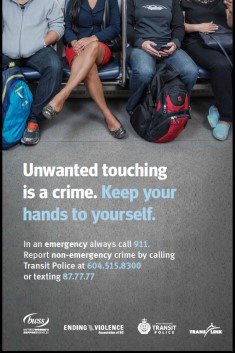
A new anti-harassment transit campaign launched in Vancouver, Canada, with the posters reading, “Unwanted touching is a crime. Keep your hands to yourself.”

Prajnya Trust is highlighting street harassment by covering a mannequin with stickers (with slogans) in the Chamiers Cafe in Chennai, India.

Four young women have a Youtube channel “Morras” where they post videos in which they talk about street harassment in Mexico and show hidden camera footage of harassers.

A regulation has been proposed in Amsterdam (the Netherlands) to make it illegal to “bother others buy jeering or offensive language, gestures, noises or behavior” in public spaces.

Women in New Zealand say no to street harassment.

Thousands of women in Turkey rode bicycles to claim public space.

A new poll of 14,000 students in the UK showed that 95% of women and 61% of men had been groped against their will at a nightclub.

A new bill in Georgia (USA) will outlaw “upskirt” photos and video recordings.

Share

Filed Under: News stories, street harassment

« Previous Page
Next Page »

Share Your Story

Share your street harassment story for the blog. Donate Now

From the Blog

  • #MeToo 2024 Study Released Today
  • Join International Anti-Street Harassment Week 2022
  • Giving Tuesday – Fund the Hotline
  • Thank You – International Anti-Street Harassment Week 2021
  • Share Your Story – Safecity and Catcalls Collaboration

Buy the Book

  • Contact
  • Events
  • Join Us
  • Donate
  • Facebook
  • Instagram
  • Pinterest
  • Tumblr
  • Twitter
  • YouTube

Copyright © 2026 Stop Street Harassment · Website Design by Sarah Marie Lacy