• About Us
    • What Is Street Harassment?
    • Why Stopping Street Harassment Matters
    • Meet the Team
      • Board of Directors
      • Past Board Members
    • In The Media
  • Our Work
    • National Street Harassment Hotline
    • International Anti-Street Harassment Week
    • Blog Correspondents
      • Past SSH Correspondents
    • Safe Public Spaces Mentoring Program
    • Publications
    • National Studies
    • Campaigns against Companies
    • Washington, D.C. Activism
  • Our Books
  • Donate
  • Store

Stop Street Harassment

Making Public Spaces Safe and Welcoming

  • Facebook
  • Instagram
  • Pinterest
  • Tumblr
  • Twitter
  • YouTube
  • Home
  • Blog
    • Harassment Stories
    • Blog Correspondents
    • Street Respect Stories
  • Help & Advice
    • National Street Harassment Hotline
    • Dealing With Harassers
      • Assertive Responses
      • Reporting Harassers
      • Bystander Responses
      • Creative Responses
    • What to Do Before or After Harassment
    • Street Harassment and the Law
  • Resources
    • Definitions
    • Statistics
    • Articles & Books
    • Anti-Harassment Groups & Campaigns
    • Male Allies
      • Educating Boys & Men
      • How to Talk to Women
      • Bystander Tips
    • Video Clips
    • Images & Flyers
  • Take Community Action
  • Contact

Thanks, WMATA for the new campaign against sexual harassment on the Metro!

April 2, 2012 By HKearl

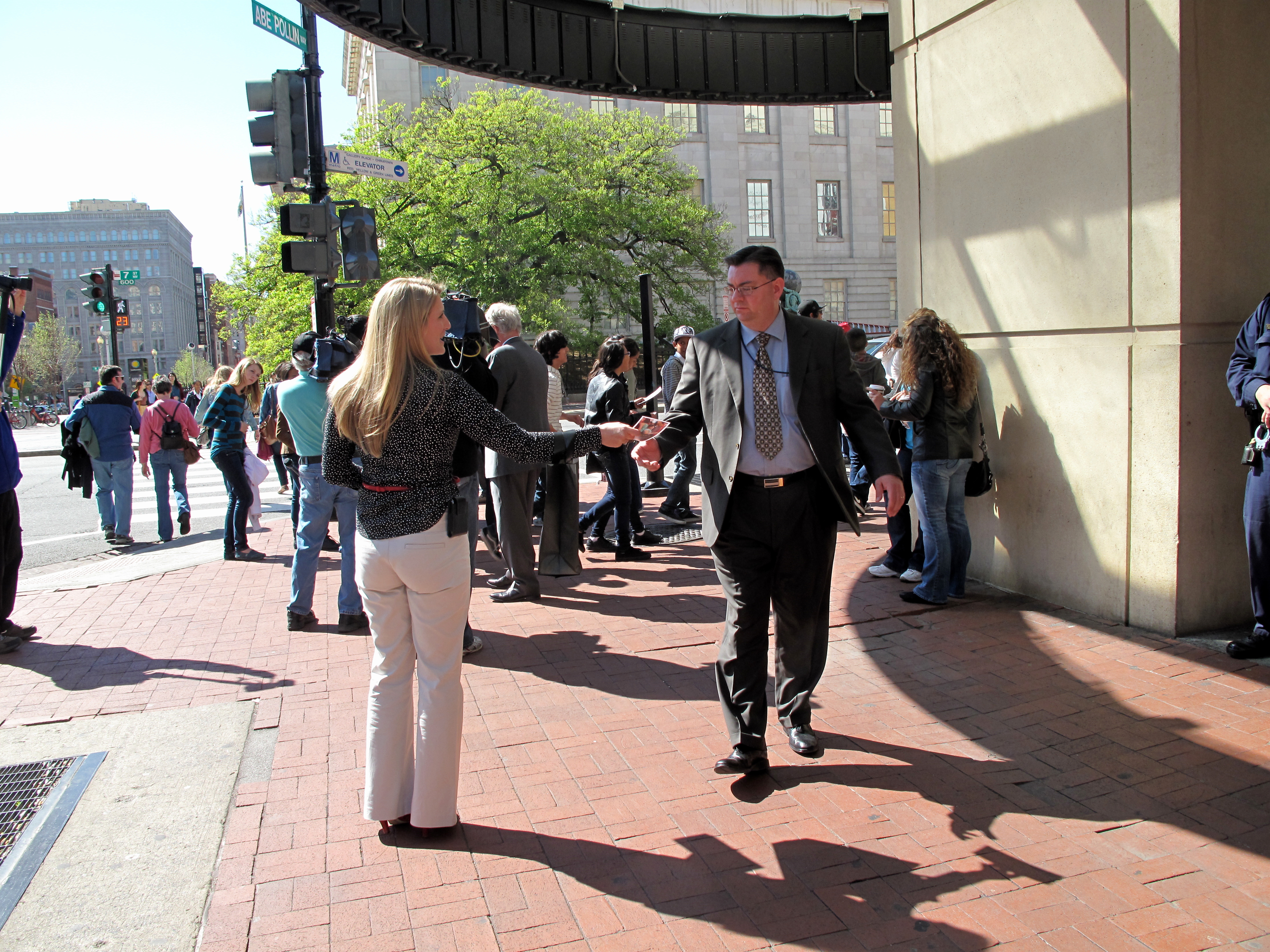
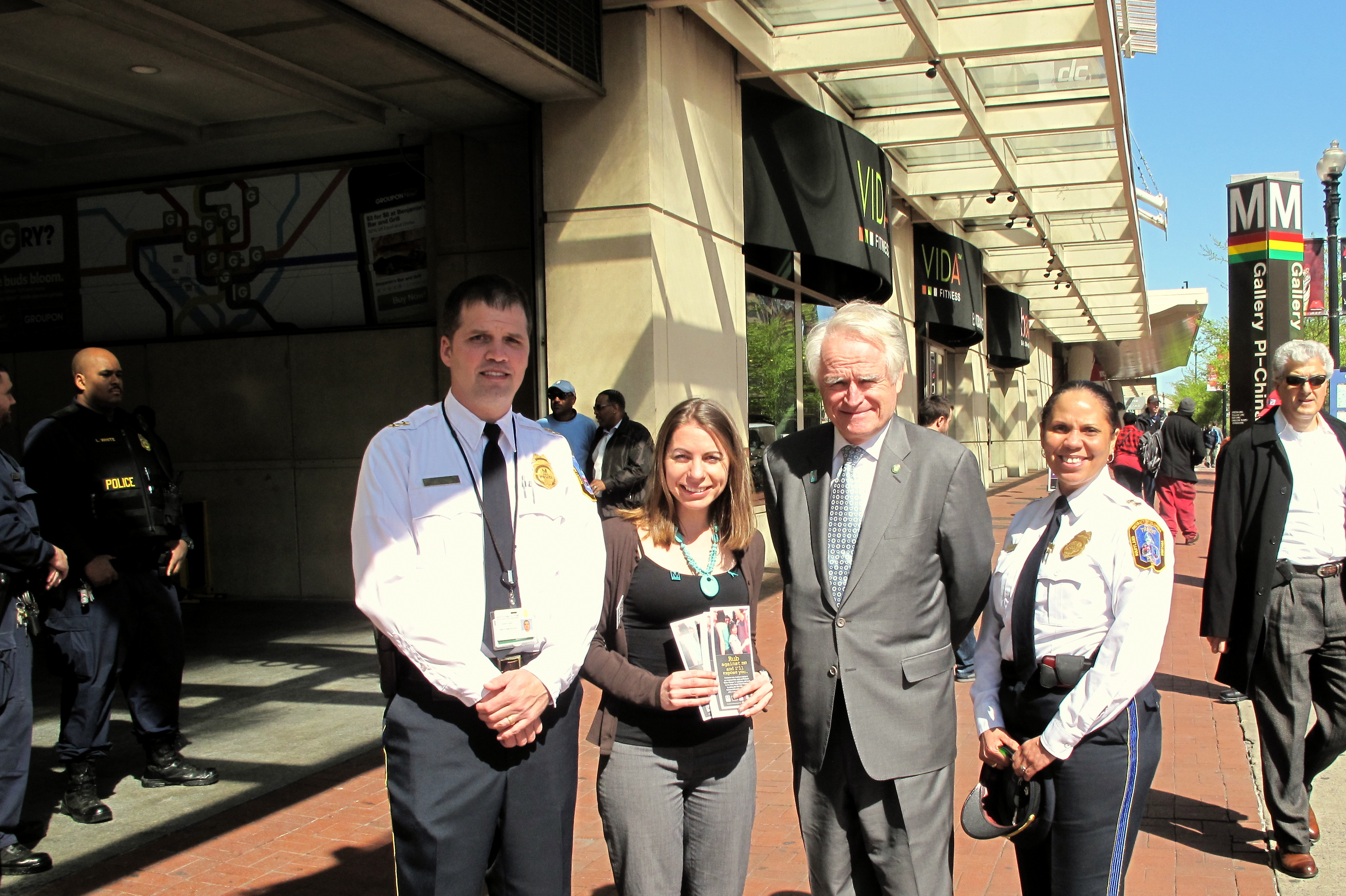
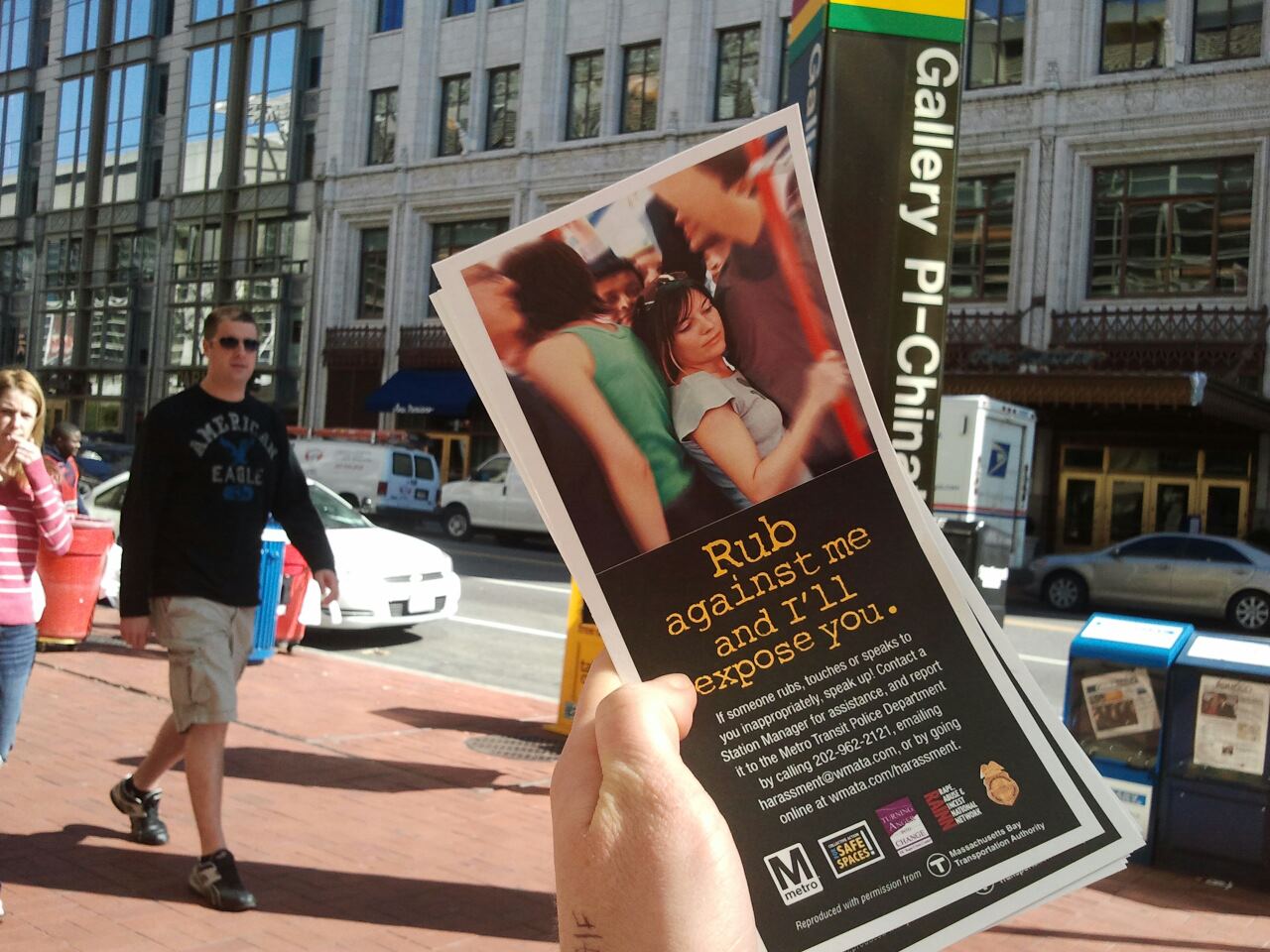
This afternoon outside the Gallery Place/Chinatown metro station entrance in Washington, DC, wearing teal “M” pins for Sexual Assault Awareness Month, Washington Metropolitan Area Transit Authority (WMATA) staff (including the General Manager and several transit police officers) joined volunteers from Collective Action for Safe Spaces (CASS), the Rape, Abuse & Incest National Network, and the DC Rape Crisis Center. We all handed out brand new fliers to passersby as part of the official launch of WMATA’s anti-sexual harassment campaign (the flier was the image on the right).

There were about ten of us who passed out the fliers for an hour to regular commuters and tourists alike. Some women eagerly grabbed the fliers when they heard about the campaign. Many men took fliers too and one man told me it was a disgrace that harassment happened. I overhead one young woman who’d picked up a flier from someone else but was passing by me say to her friend, “Oh my gosh! Finally someone is doing something about this. I deal with this all the time.” And of course, many people refused fliers before we could even tell them what it was about, but thankfully, no one was rude or harassed us.

Every major local tv station was there. While most stations only interviewed the General Manager, Fox 5 interviewed CASS board member Ben Merrion and me for their news clip.

I have to say, I am floored. I tracked the launches of the anti-sexual harassment campaigns in Boston, New York City and Chicago on my blog, and WMATA’s efforts stand out for their fast pace and thoroughness.

It was fewer than six weeks ago that six members of the public and board members of CASS testified before the DC City Council about sexual harassment on the DC-area transit system. We were nervous and felt we had to be on the defensive and explain why this issue matters, especially after we heard some of the soundbites WMATA gave the media which made it sound like they didn’t care about the issue. We didn’t have much hope that anything would come out of our testimonies, not even when WMATA said they would do something immediately. We feared that was just lip service. But then they invited us to a meeting at their offices two weeks later.

On March 7, three CASS board members met with WMATA and they gave us an overview of their campaign plans and we were blown away how responsive they were, how comprehensive their plans were, and how it had only been two weeks since we’d given testimony!

In March they quietly released a new webpage and email address (harassment@wmata.com) where people can report sexual harassment – including, for the first time, verbal harassment. The fliers we handed out today inform people about the new ways to report harassment. Additionally, a PSA ad campaign will roll out soon and WMATA is finalizing a new training video for their employees. To make the issue more accessible, the training video includes the harassment stories of several members of the public who agreed to be filmed during The REAL Metro Forum, held during International Anti-Street Harassment Week.

The WMATA task force for this issue has been great to work with, especially the project lead Caroline Lukas. They’ve treated the issue with the gravity it deserves and have asked for input throughout the process. They have obviously made the issue a top priority if they were able to launch their campaign so soon after we brought the issue to their attention. It’s also refreshing to hear them acknowledge that it will take time to get the word out and then even more time to track the effectiveness of the campaign. Caroline has assured us WMATA is in this for the long haul.

If you’re in the DC-area or know anyone who is, spread the word about the new campaign and encourage them to report anything they experience or see. Help WMATA track the problem so that they can then more effectively address it. Social change doesn’t happen overnight, but it certainly has a chance of happening faster with the help of a major institution like WMATA. Thanks, WMATA.

WMATA Media Relations Manager Caroline Lukas hands out fliers

Holly Kearl with WMATA staff, including the General Manager

Handing out fliers

Teal pin
Share

Filed Under: News stories Tagged With: PSA campaign, sexual harassment, WMATA

Why men should NOT keep staring at women

March 26, 2012 By HKearl

This is what some men think will happen to women if they are not stared at by men...they will wither. HA.

Last year, the Globe & Mail in Toronto, Canada, published a nice piece about International Anti-Street Harassment Day. One year later, during International Anti-Street Harassment Week, I’m very disappointed to say that they published a terrible piece written by a 58-year-old man about how wonderful it is to stare at the body parts of young women he acknowledges to be the age of his daughter, and how it’s a good thing that men like him do this.

From beginning to end, the tone of the article irked me. The entitlement. The male gaze. The age gap was plain creepy and disgusting.

No, there is nothing wrong with people looking at each other, but there is something wrong with objectifying other people and believing their purpose is to be attractive, for you. Young women are going to work, going to meet friends, going to classes, you know, doing things that people do, people who have pursuits and interests and are not just ornaments to be stared at.

I would suggest that men NOT keep staring at women, despite what the author argues. It will make us feel more comfortable in public places if we are not constantly being sized-up in a sexual way by men. Plus, added bonus, we will have time to solve problems like world hunger if we do not have to spend our time looking for escape routes and memorizing what people look like for future police reports because we’re not sure if the creep staring at us intends to try to follow us, grab us, or assault us. I often hear women say that the men who just stare at them are more scary/unnerving than the ones who yell stuff but move on because of this very reason. You don’t know what they’re plotting as they stare.

Meghan Murphy at The F Word Feminist Media Collective wrote a great piece about the article yesterday:

“…Much of the piece is dedicated to pornified descriptions of female bodies. That, in and of itself, could and should have (in my humble opinion) led the editors to question the usefulness and/or necessity of publishing the piece. The lack of thought, research, and analysis which fills in the empty spaces in between descriptions of Brown’s favorite 20 year old body parts should have been the second clue.

It’s not that Brown wasn’t able to find folks who agree with his thesis, which I summarize as such: “It is not only biologically natural for me to objectify much younger women, but they actually like it.” He does find men and even women to help ease the little guilt, shame, and uncertainty he may have around his fetishization of the female body. His male friends are, unsurprisingly, just like him. They support his hopeful thesis that says: “this is not only right and natural, but good.”

For example:

[Y] holds up his BlackBerry. “I don’t see what’s wrong with it. In a world where, thanks to this thing, I am only two clicks away from double penetration and other forms of pornographic nastiness, the act of merely looking at a girl who is naturally pretty – I mean, we should celebrate that.”

Another friend takes it further. Acting as though the objectification is a compliment:

“Beautiful women are like flowers,” W interjects. “They turn to the sun. But if they don’t receive a certain amount of attention, they wither.”

Oh dude. You are so right. If you don’t stare at my ass I will actually die.

As if the flower analogy wasn’t enough to signal red flags with “Women are not human beings, they are pretty things that exist for me to look at” written all over them, the idea that women will wither and die if old dudes stop objectifying them really solidifies the deep misogyny of these kinds of arguments and beliefs….

Though Brown claims that the intent of his article is to “investigat[e] the famous male gaze,” he has zero understanding of it. The male gaze is a concept which was explored initially within feminist film theory and has since extended into an explanation and analysis of the objectifying, disempowering male gaze. So when a 58 year old man decides that a 20 year old woman is a beautiful flower which exists in order for him to look at, he dehumanizes her. And, as many of us know already, dehumanizing a human being is a dangerous thing. It means we no longer need to treat said human being with respect. A body part is just a body part, not a whole, complex being with thoughts and feelings.

One of the most minor consequences of the male gaze is that, and I will speak from personal experience here, a lifetime of being looked at makes you feel as though your self-worth is largely dependent on your ability to be desired by men. This is not a good thing. It is something many women fight at every turn. Yet we still internalize that male gaze. This means that many women see themselves through male eyes. We also believe, to a certain extent, that we exist for your viewing pleasure. Should women really have to fight to believe that their value exists outside your desire?

I won’t speak for any other woman aside from myself at this point, but “Hi, Ian Brown! I am a woman and I don’t want you to look at my ass. It doesn’t feel flattering, it feels creepy. It makes me feel self-conscious and it makes me not want to leave my house. I may be too old for you at 32 (gross!), but many old men stare at me regardless. I hate it. It makes me want to punch them. So stop. Please. I guarantee your penis will survive.”

The fact that men believe women exist for their viewing pleasure IS A PROBLEM. It doesn’t matter how much men like it. I should be able to leave my house without feeling watched…

I’d like to be able to go to the beach without feeling as though I am on display, being judged, being sized up. I’d like to walk down the street in a dress without feeling like some 60 year old dude is fucking me with his eyes. It’s gross, not flattering. I don’t need the gaze of a 60 year old man to validate my existence. All that gaze does is make me hate 60 year old men.

I am not your right. No woman is. No matter how beautiful she is. You have no right to her. She is more than just body parts. Allow me to confirm what I assume was the fear which led you to write this piece, Ian Brown, you are a perv. Stop staring at us. We have the ability to exist without your eyes on our asses.”

If you want to write to the Globe & Mail to protest this article, please do (info via Hollaback Ottawa):

letters@globeandmail.com
Executive editor (Jill Borra): jborra@globeandmail.com
Editor of the “Life” section (Rasha Mourtada): rmourtada@globeandmail.com

Share

Filed Under: News stories Tagged With: globe and mail, staring, terrible journalism

Anti-sexual harassment law finalized in Saudi Arabia

March 26, 2012 By HKearl

Image via Arabian Business

The Shura Council in Saudi Arabia has finalized the draft of an anti-sexual harassment law that they started working on in December. Before the law can become legislation, it must be approved by the 150-member Shura Council within 30 days. Then it will go to ruler King Abdullah, who has the ultimate say.

Via The Saudi Gazette:

“The law classifies harassment violations and imposes penalties ranging from warnings and reprimands to fines, lashes and jail, Dr. Fadil was quoted by Al-Eqtisadiya Arabic newspaper as saying.

Dr. Fadil also said that the Council suggested that emirates of regions be responsible for enforcing the law; however, this suggestion is being revised and the Council will appoint another body to discover violations and enforce the law.

“We need such law in the light of the fact that women labor force has increased. Besides, directives allowing young men to enter malls have been issued recently. The law will fight any form of sexual harassment and put an end to it.”

The law regulates mixed environments where men and women interact whether in workplaces, malls or other places and protects freedoms safeguarded by Islam, Dr. Fadil pointed out.”

All of this sounds fine, better in some respects than what we have in the United States since public spaces are included i the law. In the United States, our sexual harassment laws are restricted to schools that receive federal funds and to workplaces.

But then, this part of the article threw me off:

“The law calls for separating men and women in workplaces including public facilities such as recreational areas, restrooms etc.”

Wait, so they are going to further gender segregate people? Is this one step forward, two steps back?

What do people who are familiar with Saudi culture and laws think about this proposed law?

Share

Filed Under: News stories Tagged With: gender segregation, law, saudi arabia, sexual harassment

Trayvon Martin: The streets should be safe for everyone.

March 21, 2012 By HKearl

Image via USA Today

The tragic and outrageous killing of 17-year-old Trayvon Martin by a Neighborhood Watch leader in Florida because he looked “suspicious” has become national news. Martin was unarmed, carrying snacks from a local convenience store, dressed like many teenagers dress: in a hoodie. What made him suspicious seems to be that he was black. George Zimmerman, the Neighborhood Watch leader, has not been charged with a crime because he says he was acting in self-defense, despite the mounting evidence showing Martin was not a threat at all.

Via USA Today:

“The case has resonated for many who say Martin died because of stereotypes of young black men as violent criminals. The shooting is already being compared with high-profile and historic civil rights cases — for instance, a doctored photograph has circulated throughout many social media sites that compares Martin to Emmett Till, a young man lynched by white men in 1950s Mississippi.

“It’s not about these individual acts of racism,” said Mark Neal, a professor of African and African American Studies at Duke University. “It’s about the way that black males are framed in the larger culture … as being violent, criminal and threats to safety and property.”

The tragic case played out in Sanford, population 54,000, about 30 minutes north of Orlando, when Martin left his father’s home to buy candy and iced tea for his little brother at a nearby 7-Eleven…

The fatal shooting touched a chord of community outrage in Sanford on Tuesday night. The killing was “a senseless murder as far as we are concerned,” Seminole County NAACP President Clayton Turner told a capacity crowd at the start of a town-hall-style meeting at Allen Chapel AME Church.

Clayton said the Sanford city manager and mayor were unable to attend because they had been “summoned” to Washington by Attorney General Eric Holder.

“The line has been drawn in the sand,” Clayton said. “We as people of color are going to stand our ground. We are going to do it in a non-violent way, and we are going to prevail.”

Before his son’s death, Tracy Martin warned son Trayvon that being a black man in America could be dangerous.

“I’ve always let him know we as African Americans get stereotyped,” Tracy Martin told USA TODAY. “I told him that society is cruel.”

As I often say and write, people are harassed – and killed – on the streets for all kinds of reasons: racism, homophobia, transphobia, classism, xenophobia, ablism, and sexism. And too often they are harassed for a combination of those reasons. Martin’s death is a very, very sad example of the racial harassment and profiling that still occurs.

While this site focuses on harassment motivated by gender, that harassment does not happen in isolation. The issues are complex and often inter-related. And the streets should be safe for everyone.

If you’re on twitter, join the Women’s Media Center #SheParty chat today, 3-5 p.m. EST. Martin’s death, racial profiling, harassment of men of color by police and how these topics intersect with gender-based street harassment will be one of the topics of conversation.

Share

Filed Under: anti-street harassment week, News stories Tagged With: murder, street harassment, Trayvon Martin

Will Street Harassment be Outlawed in the UK?

March 8, 2012 By HKearl

Executive Director of UN Women Michelle Bachelet at the Convention opening signing in 2011. Image via UN

Today the United Kingdom becomes the 19th country and Turkey the 20th country to sign the “Council of Europe Convention on preventing and combating violence against women and domestic violence,” which was written in April 2011. (See which countries have already signed it.)

The Convention states that gender-based violence is a “violation of human rights and a form of discrimination against women and shall mean all acts of gender-based violence that result in, or are likely to result in, physical, sexual, psychological or economic harm or suffering to women, including threats of such acts, coercion or arbitrary deprivation of liberty, whether occurring in public or in private life.”

Countries that sign the Convention agree to pass legislation or criminalize or impose sanctions against different types of gender violence, including domestic violence, honor killings, stalking, and sexual harassment. Here’s the exact language about sexual harassment, which presumably includes street harassment since it does not say the sexual harassment must occur in workplaces or schools:

“Parties shall take the necessary legislative or other measures to ensure that any form of unwanted verbal, non-verbal or physical conduct of a sexual nature with the purpose or effect of violating the dignity of a person, in particular when creating an intimidating, hostile, degrading, humiliating or offensive environment, is subject to criminal or other legal sanction.”

Given this language of this article in the Convention, anti-street harassment activists in the UK are lobbying for new legislation against street harassment. Way to go!

But of course, they’re getting pushback.Via the Guardian:

“Former attorney general Baroness Scotland, who worked on the convention for four years under the Labour government, said the clause on sexual harassment was not intended to cover less serious incidents such as wolf-whistling and public teasing. However, campaigners on the issue said the convention was “what we’ve been trying to get for years”.

Julia Gray, founder of the London branch of US movement Hollaback, dedicated to getting rid of street harassment, said: “The way we see it is if you want to tackle it you tackle all of it – you say no to all forms of unwanted sexual harassment; that includes wolf-whistling, comments, everything.”

A Downing Street spokesman said it was too early to discuss possible sanctions for sexual harassment.”

With all due respect to Baroness Scotland, why isn’t the Convention supposed to include “less serious incidents”? Those are the incidents that are the most common. They are the incidents which annoy, degrade and anger us, and which allow harassers to become emboldened to escalate to more serious crimes. I agree with Julia Gray, it’s only a half-hearted attempt to address this form of gender discrimination unless it includes all forms of sexual harassment!!

Even though this is a Convention for European Countries, countries like  Canada, Mexico, and the U.S. could sign it too as they are “Non-Member States of the Council of Europe.” But considering how the U.S. still has not signed the Convention on the Elimination of All Forms of Discrimination against Women (CEDAW), adopted in 1979 by the UN General Assembly, I doubt the U.S. will sign this Convention either.

Clearly, we still have a lot of work to do to change attitudes about sexual harassment, especially “less serious forms.” So let’s keep speaking — share your street harassment stories and talk about the ways in which street harassment impacts your life.

UPDATE: Read an op-ed by Hollaback London founders Bryony Beynon and Julia Gray in the Guardian

Share

Filed Under: News stories Tagged With: Council of Europe Convention on preventing and combating violence against women and domestic violence, hollaback london, sexual harassment, street harassment, turkey, united kingdom

« Previous Page
Next Page »

Share Your Story

Share your street harassment story for the blog. Donate Now

From the Blog

  • #MeToo 2024 Study Released Today
  • Join International Anti-Street Harassment Week 2022
  • Giving Tuesday – Fund the Hotline
  • Thank You – International Anti-Street Harassment Week 2021
  • Share Your Story – Safecity and Catcalls Collaboration

Buy the Book

  • Contact
  • Events
  • Join Us
  • Donate
  • Facebook
  • Instagram
  • Pinterest
  • Tumblr
  • Twitter
  • YouTube

Copyright © 2026 Stop Street Harassment · Website Design by Sarah Marie Lacy