• About Us
    • What Is Street Harassment?
    • Why Stopping Street Harassment Matters
    • Meet the Team
      • Board of Directors
      • Past Board Members
    • In The Media
  • Our Work
    • National Street Harassment Hotline
    • International Anti-Street Harassment Week
    • Blog Correspondents
      • Past SSH Correspondents
    • Safe Public Spaces Mentoring Program
    • Publications
    • National Studies
    • Campaigns against Companies
    • Washington, D.C. Activism
  • Our Books
  • Donate
  • Store

Stop Street Harassment

Making Public Spaces Safe and Welcoming

  • Facebook
  • Instagram
  • Pinterest
  • Tumblr
  • Twitter
  • YouTube
  • Home
  • Blog
    • Harassment Stories
    • Blog Correspondents
    • Street Respect Stories
  • Help & Advice
    • National Street Harassment Hotline
    • Dealing With Harassers
      • Assertive Responses
      • Reporting Harassers
      • Bystander Responses
      • Creative Responses
    • What to Do Before or After Harassment
    • Street Harassment and the Law
  • Resources
    • Definitions
    • Statistics
    • Articles & Books
    • Anti-Harassment Groups & Campaigns
    • Male Allies
      • Educating Boys & Men
      • How to Talk to Women
      • Bystander Tips
    • Video Clips
    • Images & Flyers
  • Take Community Action
  • Contact

“I felt good about speaking up for myself”

September 15, 2016 By Contributor

I leave home pretty early for work, somewhere between 5:20 and 5:30 am. Anyway I braced myself for the typical AM catcalls before stepping foot out of the door. I made it halfway up the street and hadn’t heard any misogynistic or derogatory remarks and so I thought to myself, “I’ll be okay, so far so good.”

Nope. my optimistic thought immediately vacated as soon as I heard the honk of a horn. The honk came from a black truck who I assumed was only occupied by just the driver alone. I continued to walk further down the street where I came upon the 7-11. I braced myself once again because this 7-11 in particular tends to have an unwelcomed crowd of men just “hanging” out there at odd hours of the night. Anyway I soon realize that the same black truck that honked at me was sitting in the parking lot including not only the driver but three other passengers. GREAT. Next thing I hear is, “Good morning sexy!” Normally I would ignore situations like this because men tend to be bold because they’re in their vehicle, a confined space where they feel safe enough to make unflattering remarks. Ironic. I couldn’t keep walking this time, I was so fed up. I snapped and said, “Shut-up. Just shut the f*** up!”. Silence. They didn’t say anything else to me. I felt good about speaking up for myself but I do wish I didn’t have to go to those lengths to get respect and a peace of mind.

Ever since I snapped a lot of the catcalling I normally experience in the morning and leaving work has declined tremendously. I think the worst part of catcalling, street harassment, etc. is that 98% of the time the perpetrator is a black male. I’m sure I’m not the only one to attest to this. I’m black as well and it just saddens me to know how disrespected the black female is in America, even by her own race.

– Mercedes

Location: Washington, DC

Need support? Call the toll-free National Street Harassment hotline: 855-897-5910

Share your street harassment story for the blog.
See the book 50 Stories about Stopping Street Harassers for idea
s.

Share

Filed Under: race, Stories, street harassment

“I just wish it would stop happening to me”

August 19, 2016 By Contributor

I was out hunting for Pokemon, barely three blocks from my house when a car drove by me and a man yelled that, “I’d F*ck you, n*gger!” It wasn’t even 8 p.m. on a Monday.

Optional: Do you have any suggestions for dealing with harassers and/or ending street harassment in general?

I just wish it would stop happening to me.

– Cara

Location: Eugene, OR

Need support? Call the toll-free National Street Harassment hotline: 855-897-5910

Share your street harassment story for the blog.
See the book 50 Stories about Stopping Street Harassers for idea
s.

Share

Filed Under: race, Stories, street harassment Tagged With: car harassment, intersectionality, oregon, racism

Jordan: Taking up Space in the City

May 18, 2016 By Correspondent

Minying Huang, Amman, Jordan, SSH Blog Correspondent

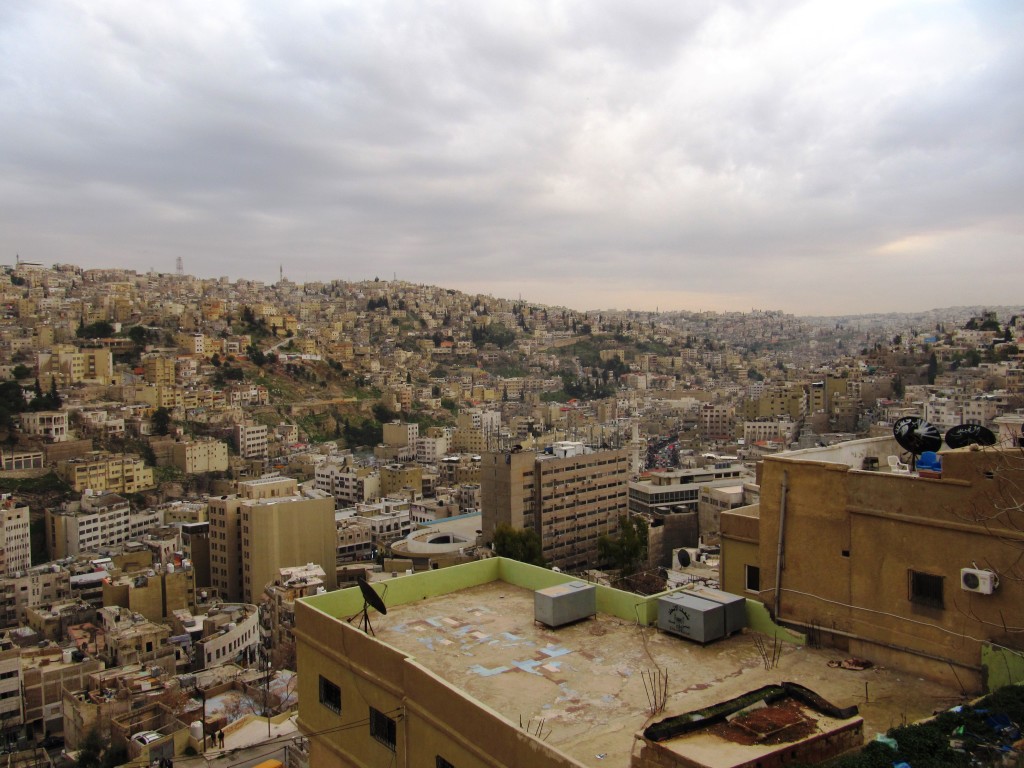
Photo of AmmanFor women in Amman, street harassment is a daily reality and, due to its prevalence, one to which many have grown de-sensitized. Though I still feel anger that it occurs, it’s frightening how easily I can brush off verbal and physical harassment and how little emotional impact it has on me now. Equally, I realize that life would be exhausting if I were to let every catcall, every grope, and every micro-aggression get to me.
My internal reactions to incidents of harassment were very different when I first moved here from the UK at the start of October of last year: after being felt up twice in one night in the streets of downtown Amman, I remember feeling acutely uncomfortable, ashamed, and angry at myself for having remained silent as wandering hands touched me, shielded from public view by shopping bags. Despite knowing that victims of harassment shouldn’t have to feel shame or guilt for what is done to them, I couldn’t shake my unwarranted feelings of dirtiness and humiliation – showing that, on some level, I, along with many others, have internalized the damaging, socially-entrenched myths surrounding sexual harassment.

As a foreigner living here, and especially as a young woman of East Asian descent, it’s easy to fall into the trap of thinking that you are targeted for your racial difference and on account of common misconceptions regarding non-Arab women. Whilst this is certainly a factor that comes into play (and one that I hope to explore in future posts), it’s also clear that sexual harassment in Jordan is by no means solely limited to foreign women and it happens regardless of what you wear.

In 2012, a group of students at the University of Jordan created a short film titled ‘This is my privacy’ in an attempt to combat on-campus sexual harassment and draw attention to the issue. The original video was taken down but you can watch a re-uploaded version. It speaks volumes that Professor Rola Qawas, who supervised the making of the film, was dismissed from her post as Dean of the Faculty of Modern Languages after senior management deemed it a distorted representation of university life and an attack on the overall reputation of the university.

I’d like to emphasize that sexual harassment is a global phenomenon not exclusive to Jordan and the Middle East. I have encountered sexual harassment in the UK where I grew up; however, without wishing to generalize, I don’t think that it would be too far-fetched to suggest that cultural ideas of space and notions of “honor” perpetuate and intensify the problem here, reinforcing the adaptive behaviors women engage in to avoid putting themselves in vulnerable situations. As a result, men are able to continue exerting control over public spaces, and progress toward redefining these established boundaries is slow.

More often than not, sexual harassment is about power. In Jordan, where high youth unemployment is a major socio-economic concern, young people are becoming increasingly disillusioned with politics and worried about their future prospects. Restless, sometimes without the means to achieve independence and further their aspirations, the shabab – literal translation: ‘the youth’; commonly used to refer to young men in the streets – may be inclined to resort to expressions of dominance in communal areas in order to offset the sense of powerlessness found in other aspects of their life.

The question is: how do we bring this conversation into the public sphere without compromising the safety of those wishing to effect change? How do we promote the idea that public spaces are not male spaces but shared spaces accessible to people of all genders? The social and legal framework here in Jordan fails to protect women from harassment. Instead, society attaches stigma and shame to the victims. The law does not explicitly condemn the act, with lawmakers neglecting to clearly define the crime. The law states that offenders can be punished for committing violations against “modesty” and “humanity”, but the use of such nebulous and subjective terminology makes it difficult for victims of harassment to actually achieve justice.

The repercussions of speaking out impose a culture of silence on Jordanian society. Few people openly discuss the realities of sexual harassment, and those that do are subject to public criticism. Yet, in private spaces, the consensus is that something needs to be done to tackle the underlying causes of this recent phenomenon in response to a rapidly increasing number of Jordanian women setting foot outside the confines of the home and entering the public space. When a woman dares to occupy the public space and asserts her right to an equal share in it, the ownership of her body should not then be up in the air and up for grabs.

Minying is a 19-year-old British-born Chinese student from Cambridge, England. She is studying for a BA in Spanish and Arabic at Oxford University and is currently on her Year Abroad in Amman, Jordan. You can follow her on Twitter @minyingh.

Share

Filed Under: correspondents, race, Stories Tagged With: jordan, traveling

Survey about African American Women’s Experiences in Public Spaces

April 24, 2016 By HKearl

4/29/16 UPDATED: Women ages 18-40 may take the survey.

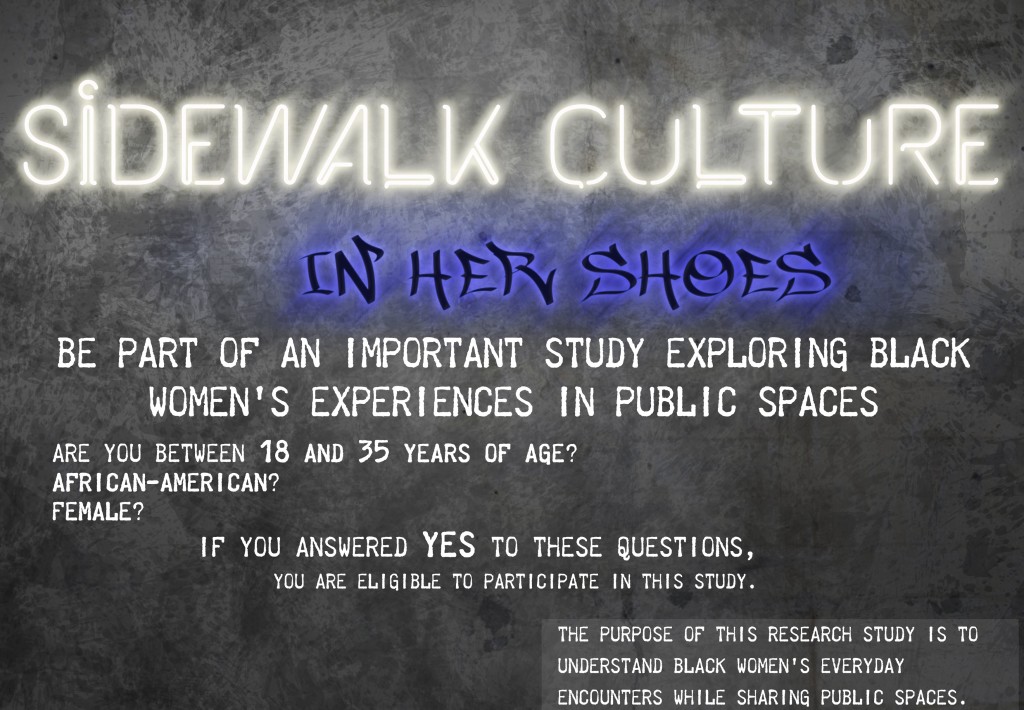
Attention African American women ages 18-35 years old, female African American researchers at Yale University are studying YOUR experiences in public spaces and would love to hear from you.  The survey will take 22-25 minutes of your time. The researchers believe that everyone has a unique story to tell, and they would like to help tell your story. Get updates via the Sidewalk Culture Facebook page.

sidewalkposter

Share

Filed Under: race, Resources, Stories Tagged With: african american women, research, yale

The Black Girl Movement: A National Conference

April 4, 2016 By HKearl

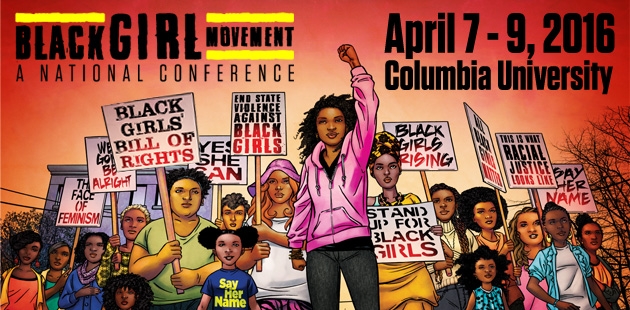
BlackGirlMovementVia Girls for Gender Equity:

“In 2014 Girls for Gender Equity joined a planning committee of activists, scholars, and artists to plan “Black Girl Movement: A National Conference” a free, three-day public gathering at Columbia University in New York City that will focus on Black girls, cis, queer, and trans girls in the United States. Bringing together artists, activists, educators, policymakers, and black girls who are leaders themselves, this first national conference on Black girls seeks to address the disadvantages that Black girls in the United States face, while creating the political will to publicly acknowledge their achievements, contributions, and leadership.

‘The Black Girl Movement is more than a conference,’ says Girls for Gender Equity founder Joanne N. Smith. ‘It is an uprising, a declaration, a demand, and an affirmation. Black girls and women have been leading racial and gender justice movements for centuries, so our conference is a space for us to connect our multiple movement building goals and strategies as we continue to lead the way.'”

Joanne will moderate two panels on Friday, April 8th, Best Practices, Policy and Philanthropy and Sisters in Strength youth organizers will lead a School Pushout workshop and curate strategies for a Black Girls Bill of Rights. Registration is full so if you haven’t registered, you can watch April 8th via Livestream  https://livestream.com/accounts/557662   

Join GGE for the opening reception on April 7th! It begins with PICTURING BLACK GIRLHOOD EXHIBIT –At 5:00pm – The EXHIBIT is FREE, open to ALL and will display until Saturday.  Check out the event page.“

Share

Filed Under: News stories, race, Resources Tagged With: Black Girl Movement, conference, girls for gender equity, race

« Previous Page
Next Page »

Share Your Story

Share your street harassment story for the blog. Donate Now

From the Blog

  • #MeToo 2024 Study Released Today
  • Join International Anti-Street Harassment Week 2022
  • Giving Tuesday – Fund the Hotline
  • Thank You – International Anti-Street Harassment Week 2021
  • Share Your Story – Safecity and Catcalls Collaboration

Buy the Book

  • Contact
  • Events
  • Join Us
  • Donate
  • Facebook
  • Instagram
  • Pinterest
  • Tumblr
  • Twitter
  • YouTube

Copyright © 2026 Stop Street Harassment · Website Design by Sarah Marie Lacy