• About Us
    • What Is Street Harassment?
    • Why Stopping Street Harassment Matters
    • Meet the Team
      • Board of Directors
      • Past Board Members
    • In The Media
  • Our Work
    • National Street Harassment Hotline
    • International Anti-Street Harassment Week
    • Blog Correspondents
      • Past SSH Correspondents
    • Safe Public Spaces Mentoring Program
    • Publications
    • National Studies
    • Campaigns against Companies
    • Washington, D.C. Activism
  • Our Books
  • Donate
  • Store

Stop Street Harassment

Making Public Spaces Safe and Welcoming

  • Facebook
  • Instagram
  • Pinterest
  • Tumblr
  • Twitter
  • YouTube
  • Home
  • Blog
    • Harassment Stories
    • Blog Correspondents
    • Street Respect Stories
  • Help & Advice
    • National Street Harassment Hotline
    • Dealing With Harassers
      • Assertive Responses
      • Reporting Harassers
      • Bystander Responses
      • Creative Responses
    • What to Do Before or After Harassment
    • Street Harassment and the Law
  • Resources
    • Definitions
    • Statistics
    • Articles & Books
    • Anti-Harassment Groups & Campaigns
    • Male Allies
      • Educating Boys & Men
      • How to Talk to Women
      • Bystander Tips
    • Video Clips
    • Images & Flyers
  • Take Community Action
  • Contact

Asian American Women Share their Stories

November 29, 2015 By HKearl

Note: Last year, SSH released a national study on street harassment that includes the results of a 2,000 person nationally representative survey and 10 focus groups with under-represented voices. As I have the opportunity and resources to do so, I will continue holding focus groups. Focus group #11 was with Asian American women in Boston, Massachusetts earlier this month. Below is a two-page summary from it, which is also now included in the research report (see pages 59-60). Thank you to the women who participated and to Sarah Chang for inspiring it and hosting it.
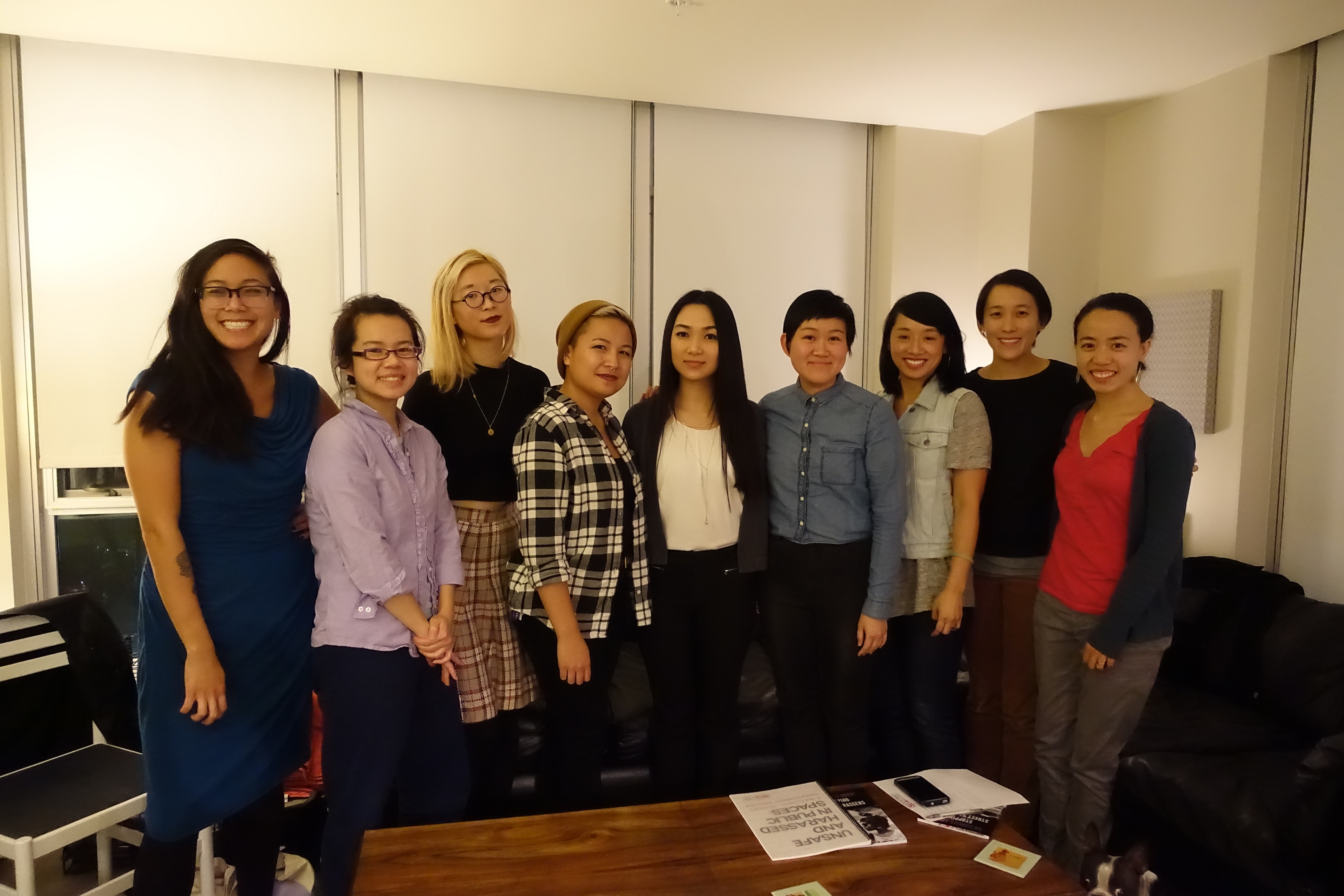
11.4.15 Asian American women SSH focus group in Boston, MAAsian American women in the SSH focus group in Boston, MA.

Asian American women’s harassment experiences are often overlooked. Thus, in November 2015, nine women with nations of origin from varying East Asian and Southeast Asian countries came together in Boston, Massachusetts, to document and talk about their experiences.

Participant Pam said, “I appreciate talking about identity and race. I think a lot of times in data and research, the Asian American voice is not included, which unintentionally leaves us silenced and reinforces the stereotype that we are silent.”

In sharing their stories, men following them, blocking their path, or engaging in repeated harassment emerged as common themes.

A man followed Catherine for approximately 45 minutes until she was able to lose him in a grocery store that had a back exit. She talked about her feeling of paranoia and fear. “All you want to do is shut down but you have to somehow keep going or something bad may happen.”

Eight white men harassed Jenn as she entered a subway station, then followed her and sat all around her as she waited for the subway. Then they surrounded her on the subway. “At this point I’m terrified,” she said. “I’m like what if they follow me to the stop? What if they get off at the stop with me?” Finally, before her stop, they got off.

Angela was in her car in an empty grocery store parking lot and as she was getting ready to leave, a man in a black SUV pulled up behind her, blocking her in. He came over and tapped on her window. Thinking he needed directions, she rolled down her window only for him to then tell her she was beautiful and hit on her. She rolled up her window and yelled that she needed to go. Fortunately, he drove away and let her.

A man engaged Cassie and the woman she was dating in conversation outside a club. Then he escalated to harassment, following them inside. He only left them alone once a bouncer ejected him from the club.

A man followed D. from the post office nearly all the way to her office. Finally he got the hint that she was uncomfortable

A man harassed Sarah three different times near her home, including telling her to “suck my dick.” She filed a police report.

Like women in other racial groups, many of their experiences with street harassment are racialized. They all agreed it is common for men to yell “Nǐ hǎo” or “Konichiwa” (“hello” in Chinese and Japanese, respectively) at them. Notably, this happens no matter the woman’s nation of origin.

When Catherine was reading on a park bench, a man repeatedly said “Nǐ hǎo” and “Konichiwa” to her, but then he quickly escalated to sexualized epithets. “Things like, ‘Oh your pussy must be sideways,’ and ‘has anyone ever fucked you?’” she said.

Various men have asked the women what they are. Katie said, “Instead of hello, they say what are you? Are you Chinese?”

Every woman said most, if not all, of her harassers have been non-Asian men, some of whom seem to be fetishizing them. Pam mused this may be because “There is this special race power element of ooh you’re this little Geisha who won’t talk about it.”

Several of them noted that the harassment tends to be worse when they are with another Asian American woman who is either a romantic partner or a friend.

Pam said, “It’s like some sick white man’s fantasy that there are two Asian American women together. It excites them even more.” As an example, she shared this story: “I was on the train with another Asian American female late at night and there were a bunch of white frat dude types and one was like, ‘Oooh who wants to eat Chinese food?’ and they just started getting nasty. You could tell they were so excited to see two Asian American women together.”

Cassie shared that “If I’m out with a woman [I’m dating], especially an Asian American woman, it’s usually like it’s really hard just to be out [because of harassers]…It feels really complicated in terms of race. I want to date people who look like me. But I feel safer with white people because they’re usually the ones I feel the most scared to be around. So if I’m with a white man, I feel like I have this pass… But it feels shitty.”

Many noted that the harassment began around puberty, usually by older men. N., for instance, said, “I have memories of my childhood and being in my teen years when people would harass me.”

Jenn began walking home from the bus stop around age 10 and she was often harassed, including by older Asian men. “That’s when I learned that my body was a sexual object,” she said. “I was a child learning that I would never be safe in my own body.”

When Diana was in middle school, she had to take the subway to the library alone in the afternoon. One day on the platform, a man repeatedly touched her lower back. She’s always tucked in her shirts ever since.

Several women noted that they try to drive or bicycle everywhere as a way to avoid harassment. Most women agreed they are never or rarely harassed when they are with another man, either a romantic partner or friend. N. observed from her experience, “If you don’t use public transportation, if you bike around, if you don’t interact with people, you don’t really get those catcalls.”

A few women shared how they feel they must be rude or stern in public because as soon as they are smiling, pleasant or engage in small talk with men, it escalates into harassment. Katie said, “I feel like any time I’ve just been pleasant out in the public space, I’ve been approached.”

Numerous women shared how their family and friends normalize the experiences or see it as a compliment. Angela said in her family it was seen as “boys being boys.” Now, she shares how she feels scrutinized and unsafe to explain why it’s not okay.

These were their ideas for change:

  1. Changing the normalcy of street harassment and ending the perception that it’s a compliment.
  2. Having boys and men listen to women’s stories so they can understand the effects of street harassment.
  3. Teachers talking to their students. Katie has had success asking her male students if that’s how they’d like their sister or mother treated.
  4. Men who get why it’s not okay talking to young men and boys.

 

Share

Filed Under: national study, race, SSH programs, street harassment Tagged With: Asian American, focus group, national study

The Netherlands: Demystifying Dutch Tolerance

October 26, 2015 By Correspondent

Eve Aronson, Amsterdam, the Netherlands, SSH Blog Correspondent

Have you heard of the Dutch Myth of Tolerance? It’s not a myth in the mythical sense, and it’s not a fairytale, though it does sound admittedly magical.

Since the 17th century, the Netherlands has been a smorgasbord of races, ethnicities and religions and has continuously championed itself on what are known as “pillars” of tolerance.

The Dutch Myth of Tolerance is reflective of the disintegration of these pillars towards what has become an increasingly harsh critique of the narrative of ‘acceptance and multiculturalism’ in the Netherlands (or the lack thereof).

At first, the presence of this myth throughout my research was subtle. People told me about their experiences of street harassment and may have thrown in some (racially) identifying characteristics of their harassers. But after several months, it became evident that a more solid smokescreen lurked, and that the notion of Dutch pluralism and tolerance was not always as strong as it presented itself to be.

When people talk about street harassment in Amsterdam, it is not uncommon to highlight the race or ethnicity of one’s harassers, particularly if they are of Moroccan or Turkish decent, two of the largest minority populations in the Netherlands. Often times, the harasser is also tied to a particular neighborhood. For example, one person I talked to said: “In my experience, harassment was worse in neighborhoods with a lot of immigrants from cultures…Moroccans for example.” Another echoed: “A lot of catcalling, primarily from members of black communities”.

A report released in March of this year by the city of Amsterdam also highlighted particular minority-populated neighborhoods and communities as being more affected by street harassment, which arguably worked to further emphasize the link between street harassment and race or ethnicity.

Many of you might also recall the October 2014 video of a woman walking through the streets of New York in the US. The video heavily criticized for selectively showing a disproportionate number of men of color harassing the (white) woman in the video. Emphasizing connections between street harassment, race and location is not only completely inaccurate; it also strips accountability from a significant proportion of harassers who fall outside of these stereotypes and who are harassing women in Amsterdam just as often.

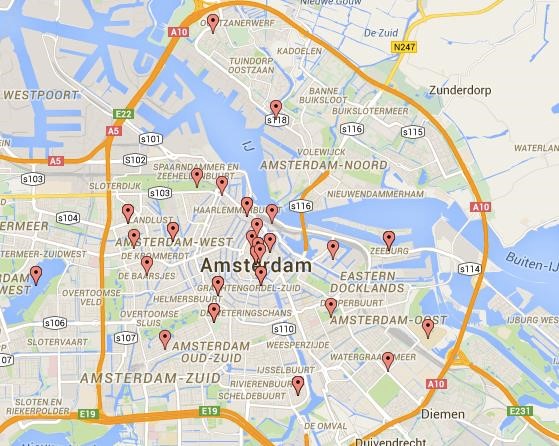
Below is a map of locations tagged by 48 respondents of a recent street harassment survey that I conducted in Amsterdam. Take a good look at where the majority of incidents are reported:

Amsterdam-BatchGeo2015(Source: BatchGeo 2015)

The majority of the geotagged incidents were reported in the center of the city, mostly around touristy areas and not in areas of the city known to have large minority populations (Biljmer, Zuid-Oost and Oost, for example). What this data does then, is encourage a revisiting of stereotypes of street harassment in Amsterdam, albeit from a purely geographic perspective. And this is just a start. The more stereotypes are checked—particularly using visual tools and visualizations—the more people are realizing that street harassment extends beyond race, ethnicity and geographical area.

What kind of impact does this have on the ground? Understanding street harassment as part of broader power structures does not mean that everyone gets this memo, and in this vein, individuals’ lived experiences are critical to take into account. But without denying individual experiences with street harassment, it is important to underline the implications of making generalized statements about races or communities.

Starting up a Hollaback! in Amsterdam is one way to work towards exposing exactly what happens on the ground and where. Geotagging experiences of street harassment not only confronts the Dutch Myth of Tolerance but it also provides an important starting point for conversations about street harassment and race in the Netherlands. Coupled with other awareness-raising initiatives and campaigns, addressing racial stereotyping in conversations about street harassment through such visual tools also encourages a look at street harassment through a much broader lens—one that unfortunately does not make the fight against street harassment easier but who said this was going to be easy? Ultimately, what taking a more comprehensive approach to street harassment does, is it makes the work more strategic and more effective in the long run.

You can find the full analysis of the Amsterdam survey results here or by contacting Eve at evearonson@gmail.com. Follow Eve and Hollaback! Amsterdam on Twitter at @evearonson and @iHollaback_AMS and show your support by liking Hollaback! Amsterdam’s Facebook page here.

Share

Filed Under: correspondents, hollaback, race, Resources, street harassment Tagged With: Amsterdam, hollaback, maps, statistics

USA: Police Violence is a Form of Street Harassment

October 24, 2015 By Correspondent

Hannah Rose Johnson, Arizona, USA, SSH Blog Correspondent

This month I talked with Pat Farr, a member of Hey Baby! Collective, in Tucson, AZ, about the intersections of sexual violence that are embedded in societal institutions; the sort of intersections that are more complex to organize around—specifically how profiling by police and police brutality constitute street harassment.

Farr presented an analysis of the nuances, scopes and the limits of perfect-victim narratives. When we think of street harassment solely as a cat-calling, where is power moving, what identity is created and who is being left out?

Farr says, “…rape culture is really a complex system that creates a framework for identifying who is a victim and who is a perpetrator. And if someone doesn’t fit into these tropes of victim/perp then it they fall outside of the discourse and are not victims and not perpetrators. So I like the term perfect and imperfect victim…[…] With street harassment it’s even more difficult. There’s very few protections against street harassment to begin with. So this notion of a perfect victim becomes subjectively very difficult to define.”

The first is the Office on Violence Against Women’s definition of sexual assault, which is defined as: any type of sexual contact or behavior that occurs by force or without consent of the recipient of the unwanted sexual activity. Farr says that “The definition of sexual assault by the OVW includes street harassment.”

The second is the Center for Disease and Control’s uniform surveillance on sexual violence, which extends to noncontact unwanted sexual experiences. “This,” says Farr, “is very similar to non-consensual behavior of a sexual nature as described by the OVW.”

The third is the Equal Employment Opportunity Commission’s definition of sexual harassment which includes offensive remarks about a person’s sex. The EEOC goes on to define sex-based discrimination as: discrimination against an individual because of gender identity, including transgender status, or because of sexual orientation. “As such,” Farr argues that “because sexual harassment is a form of sexual discrimination, according to the EEOC, harassment based on a person’s gender identity or sexual orientation is a form of sex discrimination.”

“This gives us the opportunity to extend the definition of street harassment,” Farr says, “according to these definitions, it is street harassment when a transgender woman walking down the street is attacked because of her gender identity, and hence this would count as sexual violence.”

Farr brought up the case of Monica Jones—a black transwoman, sex worker rights activist and MSW student in Phoenix, AZ. She was arrested after a demonstration for sex workers when she took a ride from an undercover, and refused the driver’s proposition. Farr told me that “even though she refused the driver’s propositions, she was still arrested on the prostitution related crime against morality, manifestation of prostitution.” This kind of law, within the city municipal code crimes against morality, is known as “manifestation of prostitution.” It’s a kind of profiling law when a police officer thinks someone looks like a sex worker and is doing something in an area where sex workers would be.

“…it’s essential to recognize that people of color, lower class people, LGBQ people, transgender people, and HIV positive people all are at greater risk of police violence that’s based largely on culturally defined stereotypes of sexuality,” Farr states, “Compulsive heterosexuality, heteronormativity, white supremacy, neoliberal economics, and the prison industrial complex are all bound up with street harassment as a form of institutional violence against particular identities.”

Identities in the margins present different relationships to power which are reinforced through all of our state-sanctioned systems. These identities—these people and their lives—are vulnerable in the face of systems that reproduce heterosexuality, white supremacy, patriarchy and transphobia. These systems rely on exclusion and violence to function, and create our cultural understanding of who is a victim and what terms make a victim.

What Farr is saying here gives us a wider framework to think about who is a victim of street harassment. It is no longer only the person walking down the street being cat-called, it’s also person being profiled by police and arrested because of their gender identity and race.

This allows us to see police violence as a form of street harassment that is inevitably tied to the state.

Share

Filed Under: correspondents, LGBTQ, police harassment, race, street harassment Tagged With: ACLU, monica jones, police harassment, sexual violence, transgender

Together We Must Change the Culture of Masculinity

October 15, 2015 By HKearl

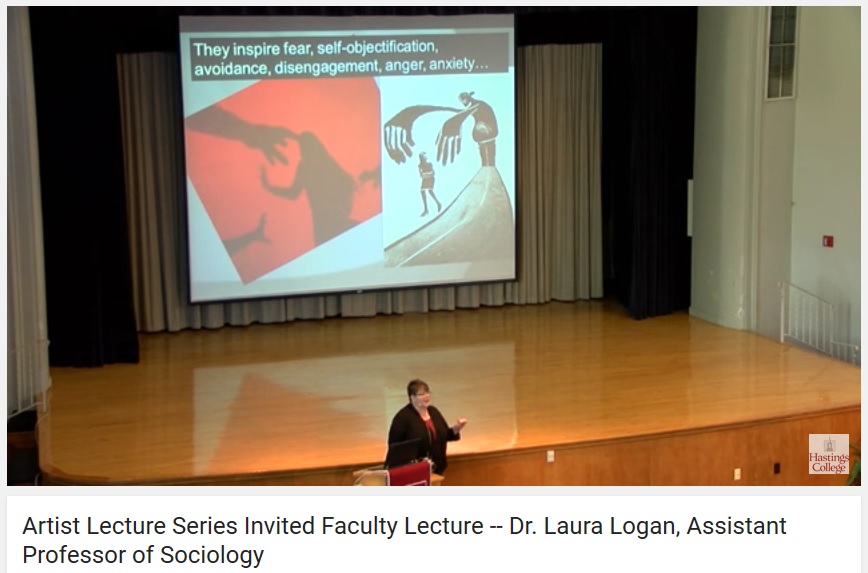
We have some pretty amazing people serving on our board of directors, including Dr. Laura S. Logan, an assistant professor of sociology at Hastings College in Nebraska. In 2013, she wrote her PhD dissertation on street harassment: “Fear of violence and street harassment: accountability at the intersections.”

DrLauraLoganlectureNEOct2015Last week, she gave a lecture at her university on street harassment + intersectionality. Her lecture was covered in the campus paper by Mallory Gruben. Here is an excerpt:

“Through her research, Logan found that the underlying theme of street harassment stemmed from socialized gender roles. In the majority of the cases she studied, harassers that were “coded as masculine” targeted individuals they “coded as feminine.” Although this coding is often unique to each case, the harasser was typically male, and he typically identified the target as female or feminine.

Logan closed her lecture by offering a solution to fighting street harassment: stop gender policing. The prevalence of masculinity and femininity in cases of street harassment suggest a fulfillment of socialized gender roles. By allowing people to act within human nature instead of within set gender roles, there would be less expectation for men to be dominant and women to be sexualized, thus changing the culture of masculinity and breaking socialized gender roles.

Logan explains that in order to stop gender policing and change the culture of masculinity, everyone must play an active role.

“I don’t want anybody to be mistaken and think that means that we have to change men or that men are the ones responsible,” Logan said. “All of us—men, women, those who don’t identify as any particular gender, or gender queer—are responsible for changing the culture of masculinity.”

Agreed! You can view/listen to her full speech on YouTube.

Share

Filed Under: LGBTQ, race, SSH programs, street harassment

Two More Women Dead

July 17, 2015 By HKearl

Trigger Warning

India: So horrific, two harassers stabbed a 19-year-old woman 35 times, killing her, as she entered a market because she protested their actions. Her mother was injured while trying to protect her. She filed a case against the men in 2013 several times, but the police did not do anything. So sad. So enraging. Our thoughts go out to her family.

Sandra Bland, via Heavy Editorial

USA: Sandra Bland just moved to Texas to start a new job when police pulled her over for failing to signal that she was changing lanes. The situation quickly escalated and two officers physically hurt her, slammed her to the ground, possibly broke her arm, and then arresting her for the vague offense of “assaulting an officer.” Bland was in jail for a few days and then allegedly hanged herself. Her relatives don’t believe it and neither do many people in the USA. Whatever the truth is about her death, everything leading up to it is certainly racism and police harassment. And if she was killed by police, which seems probable, there just are no words.

Today people have made #IfIDieInPoliceCustody a trending hashtag on Twitter, imploring people to never believe that if they die in police custody that they committed suicide. It is sobering and sad that Black people feel they must say this because the justice system is not to be trusted. And death is not so unfathomable.

In a recent online video Bland posted, she said, “What I need you guys to understand is that being a black person in America is very, very hard.” ‪

#‎SayHerName‬ ‪#‎SandraBland‬

Share

Filed Under: News stories, race

« Previous Page
Next Page »

Share Your Story

Share your street harassment story for the blog. Donate Now

From the Blog

  • #MeToo 2024 Study Released Today
  • Join International Anti-Street Harassment Week 2022
  • Giving Tuesday – Fund the Hotline
  • Thank You – International Anti-Street Harassment Week 2021
  • Share Your Story – Safecity and Catcalls Collaboration

Buy the Book

  • Contact
  • Events
  • Join Us
  • Donate
  • Facebook
  • Instagram
  • Pinterest
  • Tumblr
  • Twitter
  • YouTube

Copyright © 2026 Stop Street Harassment · Website Design by Sarah Marie Lacy