• About Us
    • What Is Street Harassment?
    • Why Stopping Street Harassment Matters
    • Meet the Team
      • Board of Directors
      • Past Board Members
    • In The Media
  • Our Work
    • National Street Harassment Hotline
    • International Anti-Street Harassment Week
    • Blog Correspondents
      • Past SSH Correspondents
    • Safe Public Spaces Mentoring Program
    • Publications
    • National Studies
    • Campaigns against Companies
    • Washington, D.C. Activism
  • Our Books
  • Donate
  • Store

Stop Street Harassment

Making Public Spaces Safe and Welcoming

  • Facebook
  • Instagram
  • Pinterest
  • Tumblr
  • Twitter
  • YouTube
  • Home
  • Blog
    • Harassment Stories
    • Blog Correspondents
    • Street Respect Stories
  • Help & Advice
    • National Street Harassment Hotline
    • Dealing With Harassers
      • Assertive Responses
      • Reporting Harassers
      • Bystander Responses
      • Creative Responses
    • What to Do Before or After Harassment
    • Street Harassment and the Law
  • Resources
    • Definitions
    • Statistics
    • Articles & Books
    • Anti-Harassment Groups & Campaigns
    • Male Allies
      • Educating Boys & Men
      • How to Talk to Women
      • Bystander Tips
    • Video Clips
    • Images & Flyers
  • Take Community Action
  • Contact

Suspect Charged in Spears’ Murder

November 15, 2014 By HKearl

Trigger Warning!

Via Huffington Post

“A suspect has been charged in connection with the death of Mary “Unique” Spears, aDetroit woman shot to death after allegedly rejecting the man’s sexual advances.

Mark Dorch, 38, was charged with first degree murder and assault with intent to murder, among other charges. His trial is scheduled to begin February 9….

Though the circumstances that surround Spears’ death are not entirely clear, her story has been shared frequently online at a time when street harassment has been at the forefront of feminist conversations. It’s served as an extreme example of the danger women can face when they receive unwanted attention from men, and a powerful refutation of the argument that such harassment is harmless.

Writer, activist and social worker Feminista Jones began using the #YouOKSis hashtag on Twitter earlier this year in an effort to shine a light on black women’s experiences with street harassment and discuss solutions, namely non-confrontational intervention from bystanders. She told The Huffington Post that Spears’ tragic death also illuminates racial disparities in conversations about street harassment and its consequences.

“Often, black women and women of color are subjected to more harsh or harsher forms of street harassment,” Jones said. “I think that black womanhood has been devalued so much that we are more likely to be treated as property or as objects than maybe other woman, [though] that’s not to say that other women aren’t treated that way.”

Spears had a fiancé and three sons, ages 8, 4 and 1.

“I hope that her family finds some sort of reprieve from this tragic, tragic death that should never have happened,” Jones said. “No woman should lose her life because she declines a man’s advances.”

Share

Filed Under: News stories, race, street harassment

Important Videos about Street Harassment

November 6, 2014 By HKearl

Each day over the past several days there have been scores of articles about #streetharassment as well as critiques of the Hollaback! viral video released last week. Some people have said, where is the viral video about women of color?

Well, while none of these videos have gone viral yet, there are LOTS of existing videos that have been made by women of color or are about women of color’s experiences. Unfortunately, almost no one has mentioned them in the various articles I’ve read; it’s as if no videos on street harassment ever existed before the one released last week. But they do and they matter. 

And wouldn’t it be great if some of these did go viral? You can help by watching and sharing them. And of course you can always make your own!

Girls for Gender Equity’s Hey… Shorty! documentary

Nuala Cabral’s video Walking Home that even has a discussion guide.

Nuala’s group FAAN Mail has done a few more videos, including this one with teenage girls about things men have said to them and people’s stories from their soapbox event in Philadelphia in April 2014 for International Anti-Street Harassment Week.

Tracey Rose’s Black Woman Walking

Charla Harlow’s short interviews about street harassment with persons of color

Sydnie Mosely’s work on street harassment through The Window Sex Project

Here are some of her dances.

Women in San Jose share their stories

Women in the Bronx share their stories.

The Saartjie Project’s street theater

Thee Kats Meoww’s video on street harassment

Back Up! Concrete Diaries by Nijla Mumin and Monique Hazeur

The Queer Women of Color Media Arts Project’s video “Hollering Back”

Safiya Washington and Kai Davis of the Philly Youth Poetry Movement perform their poem “Stares” in Philadelphia

The Chicago Free Spirit Media teen youth’s video

DC activist Dienna Howard speaking about her experiences of street harassment as a Black woman.

Earlier this year, Dienna made her own documentary about street harassment and activism in DC.

Share

Filed Under: race, Resources, street harassment

USA: Why #Ferguson matters

October 27, 2014 By Correspondent

Angie Evans, Washington, DC, SSH Blog Correspondent

Walking across the street to pay the parking meter, a man pulled to curb. I kept my “resting bitch face” on but he still rolled down his window to invite me for a ride. He made sure to comment on my pretty face. I wish this was a rare occurrence; but it isn’t. I wish I could say I was wearing something low cut or short; but I wasn’t. I wish I looked too good that day; but I didn’t. I always wonder what I could do differently when these things happen and realize the answer is nothing.

As a woman, you experience a daily barrage of commentary on all things. You can expect the opinion of strangers whether you smile out of politeness or frown as a defense mechanism. As I walked to a coffee conversation about #FergusonOctober and away from my harasser, the parallels between the microaggressions I experience as a white woman on the street and the institutional racism African Americans have grappled with for centuries that spurred the murder of Michael Brown were obvious. Racism and sexism leave us vulnerable and often disempowered in a society that normalizes both problems

One outcome of institutionalized racism is police harassment. There is no denying that black youth are portrayed negatively in the media. For every positive story about an African American thought leader, writer, or everyday joe, there are half a dozen stories reinforcing racial stereotypes about criminal activity or academic failure. And although you wouldn’t know it from watching the news, the majority of all violent crime in the US is committed by white people – not young black men.

Police are fed the same media we are though, so it’s not surprising that an 18-year-old black kid and a white cop would feel tension around one another. And it’s also not shocking that the media engaged in victim-blaming when the #Ferguson story came out. They wanted to find some way to justify this young man’s death…but lets be real, even if the kid had robbed a store, there was no justification for killing him. No law makes that moral.

A group of women in skirts doesn’t provide the grounds for catcalling anymore than black kids hanging out on the sidewalk warrants police harassment and violence.

As more African American families have been sharing their own stories of racially-motivated harassment in recent months, people like me are realizing that what happened in Ferguson wasn’t a one time event. Thanks to more video recordings, we can even see some of these stories. Like when a video was released earlier this month showing a police officer breaking the window of a black family’s car in order to pull the man in the passenger seat from it. Why did the officer stop the car? Because the driver wasn’t wearing her seat belt. Unfortunately the situation escalated quickly. With stories about young black men being killed by police officers are pouring forward left and right, the family was scared and even called the police station from inside the vehicle.

Perhaps the cop who broke through the window isn’t a bad guy. Perhaps the passenger isn’t an angel. But the real problem isn’t the players in this story, the problems are that police disproportionately target persons of color and many African Americans justifiably fear white police officers.

You can’t have a true democracy if one group lives in fear of another and yet, that is our society.

This kind of police violence is a symptom of racism and also poor training, recruitment, and a lack of accountability. If you want to learn more about what can be done to end police harassment, read the suggestions in SSH Blog Correspondent Sarah’s post from earlier this month, for example, offering community-wide trainings on how to report police abuse in your area.

Angie is a community organizer and social worker. Last year she quit her job to travel around the world with her husband. They have just returned and are continuing to write about travel and adventure at http://whereisseangie.com

Share

Filed Under: correspondents, News stories, public harassment, race

Racial Discrimination + Street Harassment

October 21, 2014 By HKearl

This Huffington Post article, written by our board member Patrick McNeil, is excerpted with permission.

“Today marks 20 years since the United States ratified an international human rights treaty aimed at protecting people from racial discrimination (it’s called the Convention on the Elimination of all forms of Racial Discrimination, or CERD).

The committee that monitors implementation of the treaty met in Geneva earlier this year, and it dedicates an entire section of its observations and recommendations to violence against women.

In acknowledging steps the United States has taken to reduce how often violence against women occurs, the committee said it “remains concerned at the disproportionate number of women from racial and ethnic minorities, particularly African-American women, immigrant women, and American Indian and Alaska Native women, who continue to be subjected to violence, including rape and sexual violence.” That includes — as advocates know all too well — street harassment….

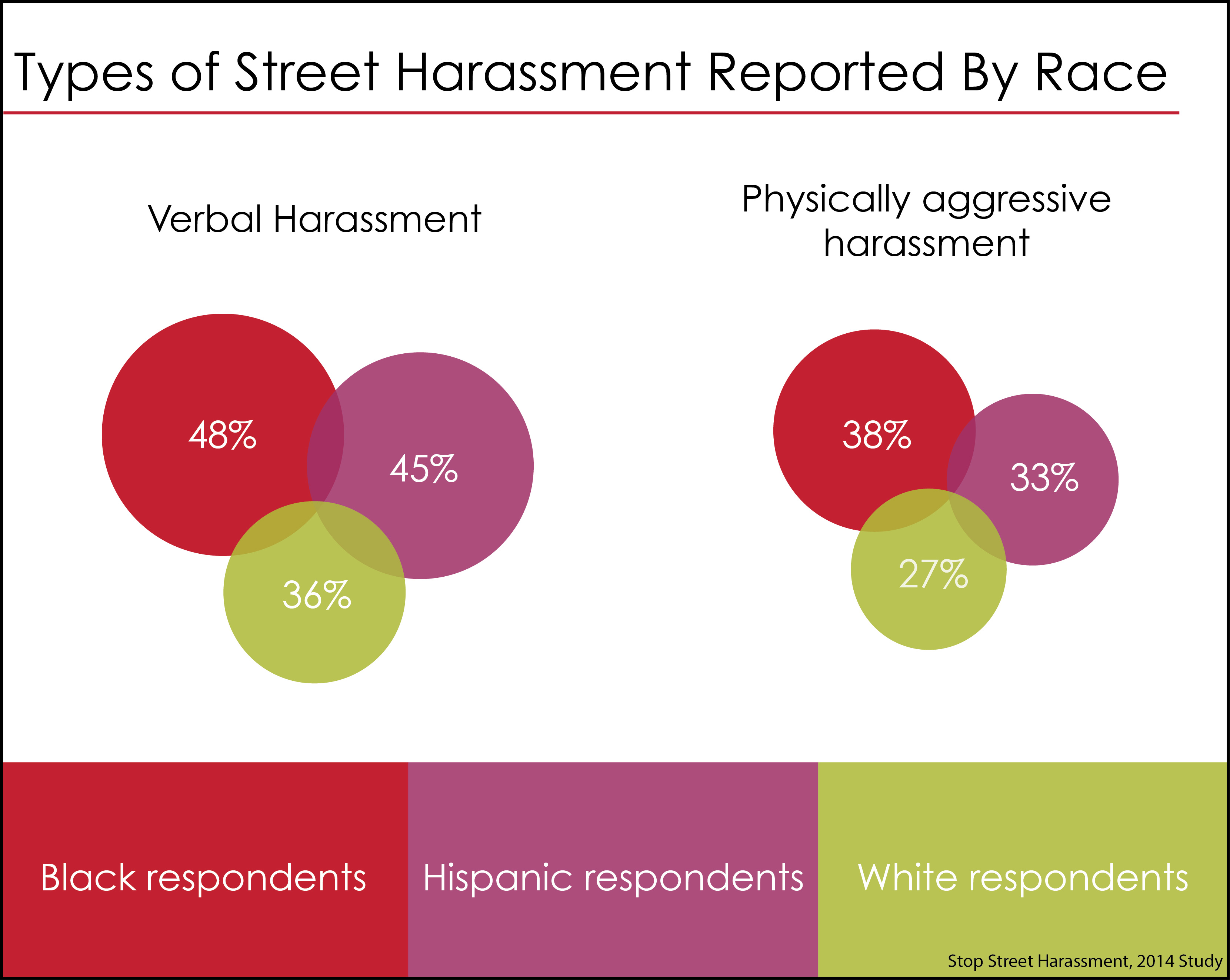
In a national study released earlier this year, SSH found that Black and Hispanic respondents were more likely to say they’ve experienced street harassment (though due to sample size, the racial categories were combined for women and men). And the incidents normally aren’t isolated. Compared to white people, people of color were more likely to report experiencing it sometimes, often or daily (41 percent vs. 24 percent), while white people were more likely to say they’ve experienced it once or rarely.

While the study’s sample is limited, what it suggests is a story we see all too often: women of color in public spaces being harassed — or worse.

Earlier this month, a woman named Mary Spears was killed in Detroit after saying no to a man’s advances and refusing to give him her phone number, prompting Mychal Denzel Smith to ask — who cries when black women die from street harassment?

“Mary Spears’s right to move about freely in the world was denied to her, her life taken from her, and there are no marches,” Smith said. “There are no widespread calls to protect the autonomy of black women and their bodies. The community leaders haven’t deemed this unacceptable and a fate no one should ever face simply because they reject a man’s advances.”

Perhaps street harassment — and these sometimes ugly, horrifying extensions of it — isn’t what the CERD committee had in mind when writing about the ongoing violence enacted toward women in the United States. But it certainly should be.

The committee also urged the United States to “undertake awareness raising campaigns on the mechanisms and procedures available to seek remedies for violence against women.” Organizations like SSH, Hollaback and others are doing just that. Their efforts to teach men and boys not to harass — we should all hope — will lead, someday, to that permanent, systemic change we need to achieve safer public spaces for all.”

Share

Filed Under: national study, race, street harassment Tagged With: CERD, racial discrimination

« Previous Page

Share Your Story

Share your street harassment story for the blog. Donate Now

From the Blog

  • #MeToo 2024 Study Released Today
  • Join International Anti-Street Harassment Week 2022
  • Giving Tuesday – Fund the Hotline
  • Thank You – International Anti-Street Harassment Week 2021
  • Share Your Story – Safecity and Catcalls Collaboration

Buy the Book

  • Contact
  • Events
  • Join Us
  • Donate
  • Facebook
  • Instagram
  • Pinterest
  • Tumblr
  • Twitter
  • YouTube

Copyright © 2026 Stop Street Harassment · Website Design by Sarah Marie Lacy