• About Us
    • What Is Street Harassment?
    • Why Stopping Street Harassment Matters
    • Meet the Team
      • Board of Directors
      • Past Board Members
    • In The Media
  • Our Work
    • National Street Harassment Hotline
    • International Anti-Street Harassment Week
    • Blog Correspondents
      • Past SSH Correspondents
    • Safe Public Spaces Mentoring Program
    • Publications
    • National Studies
    • Campaigns against Companies
    • Washington, D.C. Activism
  • Our Books
  • Donate
  • Store

Stop Street Harassment

Making Public Spaces Safe and Welcoming

  • Facebook
  • Instagram
  • Pinterest
  • Tumblr
  • Twitter
  • YouTube
  • Home
  • Blog
    • Harassment Stories
    • Blog Correspondents
    • Street Respect Stories
  • Help & Advice
    • National Street Harassment Hotline
    • Dealing With Harassers
      • Assertive Responses
      • Reporting Harassers
      • Bystander Responses
      • Creative Responses
    • What to Do Before or After Harassment
    • Street Harassment and the Law
  • Resources
    • Definitions
    • Statistics
    • Articles & Books
    • Anti-Harassment Groups & Campaigns
    • Male Allies
      • Educating Boys & Men
      • How to Talk to Women
      • Bystander Tips
    • Video Clips
    • Images & Flyers
  • Take Community Action
  • Contact

Renewed Efforts to Address Harassment on the NYC Subway

February 23, 2016 By HKearl

More efforts are underway in New York City to address sexual harassment on the subway system. This includes training transit police, with input from Hollaback!

Here’s some info about it overall, via the New York Times:

“Opportunistic sex crimes aboard subways are not new, nor are they news to many women. Some have been grabbed or leered at by a man who is masturbating. Many others have heard a story from a friend who felt an uncomfortable touch but was unsure if she should say something.

But cellphone cameras and social media have given women tools to fight back and provided the police a way to identify some offenders. Last year, in an effort to encourage more victims to come forward, the police began training more female officers to work the cases.
 
The police now send out a steady stream of alerts about such crimes using photos from victims’ phones to try to identify suspects. One recent Twitter post shared a photo of a man suspected of grabbing a 27-year-old woman’s buttocks on a No. 7 train in Queens this month. Two days earlier, the police posted a photo of a man who they say exposed himself to women on two trains at Grand Central Station.
 
Reported sex crimes on the subways rose 19 percent last year, to 738 from 620 in 2014. Many of those crimes were forcible touching and public lewdness, the offenses most commonly charged in connection with the sort of sexual misconduct that Detective Cross and his colleagues were on the lookout for that morning on the Lexington Avenue line.
 
Joseph Fox, the chief of the Transit Bureau, said he believed the increase in reported sex crimes was a result of more women coming forward. He expects the number of reports will keep rising as the police continue to talk about the problem.”

Share

Filed Under: News stories, public harassment, Resources Tagged With: MTA, New York City, public transit, subway

USA: Shine Squad Confronts Violence in Activist Organizations

February 22, 2016 By Correspondent

LB Klein, Georgia, USA, SSH Blog Correspondent

ShineSquadGender-based violence is currently ingrained in our society, and only true culture change will eradicate it. While we want to believe that organizations and groups working to end this violence and advance social justice are immune, abuse happens in these spaces as well. What happens when though when spaces that have a mission to end violence are actually perpetuating it? What happens when the perpetrators are our colleagues, our fellow activists, our leaders?
Enter Shine Squad, a tumblr space by and for folks who have experienced harassment and abuse while they’re working within these movements. As Shine Squad’s first video mentions, we often expect that abuse will be “overt and straight out of Mad Men.” However abusers, particularly those who know the language and values of our movement-building spaces, use more subversive strategies. Shine Squad’s tumblr is full of stories from women and trans folks whose colleagues and supervisors used these spaces against them in overt and covert ways.

It can be challenging to “rationalize [perpetrators’] work in the movement with their abusive behavior.” Because it is so disarming and surreal to experience violence in these spaces that are supposed to be safe, survivors can feel “on an island.” This cognitive dissonance leads to isolation, silencing, and self-blame that shifts the focus from what the perpetrator did wrong to blaming the survivor.

The painful consequences of violence in these spaces can be overwhelming to face alone, so Shine Squad provides a platform for “story sharing, expressing needs, and action taking.” Through their online form, anyone can submit anonymous stories of the harms they have experienced in activist communities and social justice organizations. These reports encompass a wide range of behaviors from subtle workplace discrimination that was “gross but you can’t quite put your finger on it” to intimidation to financial threats to digital harassment to sexual assault and abuse.

Shine Squad is not stopping with story sharing, however, they are also providing connections. They’re introducing survivors to others who have also survived abuse, even connecting those who might name the same perpetrator. They’re offering emotional support, connections with journalists, legal referrals, and opportunities for activist and organizing opportunities around addressing the “systematic problems of discrimination, harassment, and abuse in social justice movements.” They also give opportunities for members to help others through hosting conversations, sharing skills including legal and HR, or offering opportunities to advance the public conversation.

By building networks and sharing stories, Shine Squad is addressing a valuable need. This activist space provides a powerful reminder that for our movements to be successful, we must start at home, by fostering organizational environments that support survivors, prevent violence, and hold perpetrators accountable.

LB is an Atlanta-based researcher, advocate, and educator dedicated to ending gender-based violence, supporting survivors, and advancing social justice.  You can follow her on twitter @LB_Klein.

Share

Filed Under: correspondents, Resources Tagged With: abuse, sexual violence, share story, shine squad

Portugal’s Law Against Street Harassment

February 19, 2016 By HKearl

Via Equal Times:
“In 2015 Portugal’s Social Democratic Party made verbal sexual abuse a crime, carrying a prison sentence of up to a year.
 
“Whoever harasses another person, practising before her acts exhibitionist in character, formulating proposals of a sexual tenor or embarrassing her with contact of a sexual nature, is punished with a penalty of imprisonment of a year, or a penalty fine of up to 120 euros if a more serious penalty is not applicable under any other legal provision,” reads the new wording of Article 170 of the penal code.
 
Ferreira Leite co-authored a report after Portugal became the first country to ratify the Istanbul Convention– by which the Council of Europe sets out standards to protect victims of gender-based violence – in 2013. She was also involved in advocating for amendments to Article 170.
 
“Before, sexual contact was included but it was restrictive. You had to touch the victim, so we decided to include threatening and intrusive comments,” says Ferreira Leite.
 
She says she has been surprised by some of the reactions to the amendments.
 
“Some men think that [harassment] means freedom of speech. That it is a compliment and that they shouldn’t have to walk around silent.”
 
But the amended law has its limits, Leite explains. “Not every comment is a crime; it has to have sexual context or a pornographic reference. Saying that someone is pretty doesn’t count….

The necessity for a measure to combat verbal abuse toward women was first proposed by the non-profit organisation UMAR (Union of Women for Alternatives and Answers), which received funding in 2010 from the Dutch government to travel around the country and raise awareness of the issue.

“We found that most women had been verbally assaulted on the street and also that both men and women confused sexual assault with seduction or praise,” says UMAR head Maria Jose Magalhaes. “They didn’t know what assault was. There was an idea that it wasn’t serious because sexism is so ingrained in our culture.”

The radical Left Bloc party – which was founded by four feminists and whose leader, Catarina Martins, is the only woman leader amongst Portugal’s major parties – took the discussion of verbal assault to parliament in 2014.

Left Bloc MP and sociologist Sandra Cunha says the law was necessary to show that sexual assault is unacceptable.”

Share

Filed Under: News stories, Resources, street harassment Tagged With: law, Portugal

NYC Male Focus Group Opportunity

February 19, 2016 By HKearl

4inRinOc_400x400SAFER: NYC is a social enterprise founded by Columbia University School of International and Public Affairs graduate students, dedicated to engaging men in ending street harassment in New York City.

SAFER: NYC is currently working on a large-scale research project within the issue of street harassment in order to deepen our understanding of what solutions will have the most impact in making our streets safer for everyone.

As part of this research, they are conducting focus group conversations with small groups of adult men across NYC’s boroughs. These are 30-minute conversation with you and 5-8 of your male peers. They can provide some compensation to all participants as well as refreshments during the session. Furthermore, all participants will remain completely anonymous.

If you are interested or want more information, contact them at safernewyorkcity@gmail.com.

Share

Filed Under: male perspective, Resources, street harassment Tagged With: focus group, men, NYC, research

Speech Project and Online Harassment

February 16, 2016 By HKearl

There’s a new Speech Project about online harassment at Women’s Media Center, led by our friend, ally and supporter Soraya Chemaly!!

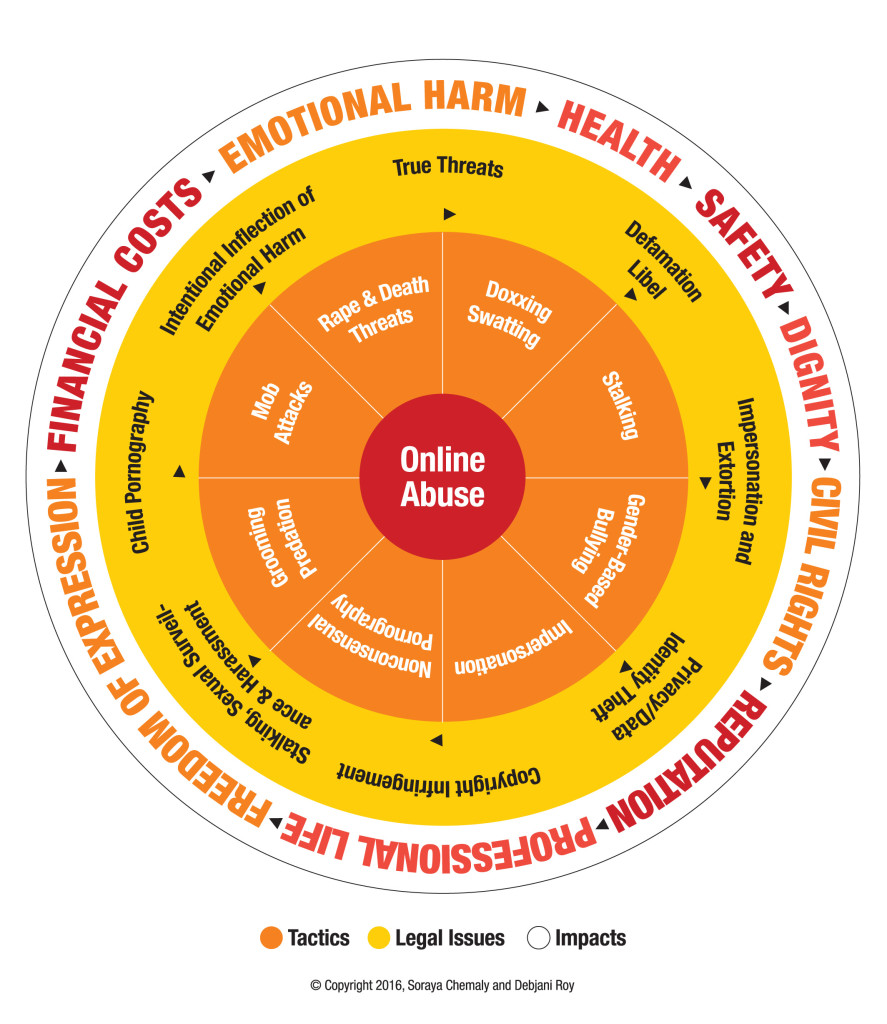
“The prevalence of online harassment toward women leads them to feel limited in their online interactions, and its frequent dismissal leads them not to take their own harassment seriously. By treating online harassment as the crime that it is, we make women less likely to blame themselves — because going online should not be another item on the list of behaviors women are told to avoid to stay safe….

The website contains a glossary of terms related to online harassment, research and statistics about its different forms, and a wheel demonstrating the different types, consequences, and legal classifications of online harassment.”

Print

Share

Filed Under: online harassment, Resources Tagged With: online harassment, Soraya Chemaly, women's media center

« Previous Page
Next Page »

Share Your Story

Share your street harassment story for the blog. Donate Now

From the Blog

  • #MeToo 2024 Study Released Today
  • Join International Anti-Street Harassment Week 2022
  • Giving Tuesday – Fund the Hotline
  • Thank You – International Anti-Street Harassment Week 2021
  • Share Your Story – Safecity and Catcalls Collaboration

Buy the Book

  • Contact
  • Events
  • Join Us
  • Donate
  • Facebook
  • Instagram
  • Pinterest
  • Tumblr
  • Twitter
  • YouTube

Copyright © 2026 Stop Street Harassment · Website Design by Sarah Marie Lacy