• About Us
    • What Is Street Harassment?
    • Why Stopping Street Harassment Matters
    • Meet the Team
      • Board of Directors
      • Past Board Members
    • In The Media
  • Our Work
    • National Street Harassment Hotline
    • International Anti-Street Harassment Week
    • Blog Correspondents
      • Past SSH Correspondents
    • Safe Public Spaces Mentoring Program
    • Publications
    • National Studies
    • Campaigns against Companies
    • Washington, D.C. Activism
  • Our Books
  • Donate
  • Store

Stop Street Harassment

Making Public Spaces Safe and Welcoming

  • Facebook
  • Instagram
  • Pinterest
  • Tumblr
  • Twitter
  • YouTube
  • Home
  • Blog
    • Harassment Stories
    • Blog Correspondents
    • Street Respect Stories
  • Help & Advice
    • National Street Harassment Hotline
    • Dealing With Harassers
      • Assertive Responses
      • Reporting Harassers
      • Bystander Responses
      • Creative Responses
    • What to Do Before or After Harassment
    • Street Harassment and the Law
  • Resources
    • Definitions
    • Statistics
    • Articles & Books
    • Anti-Harassment Groups & Campaigns
    • Male Allies
      • Educating Boys & Men
      • How to Talk to Women
      • Bystander Tips
    • Video Clips
    • Images & Flyers
  • Take Community Action
  • Contact

HeartMob

January 27, 2016 By HKearl

Via Hollaback!:

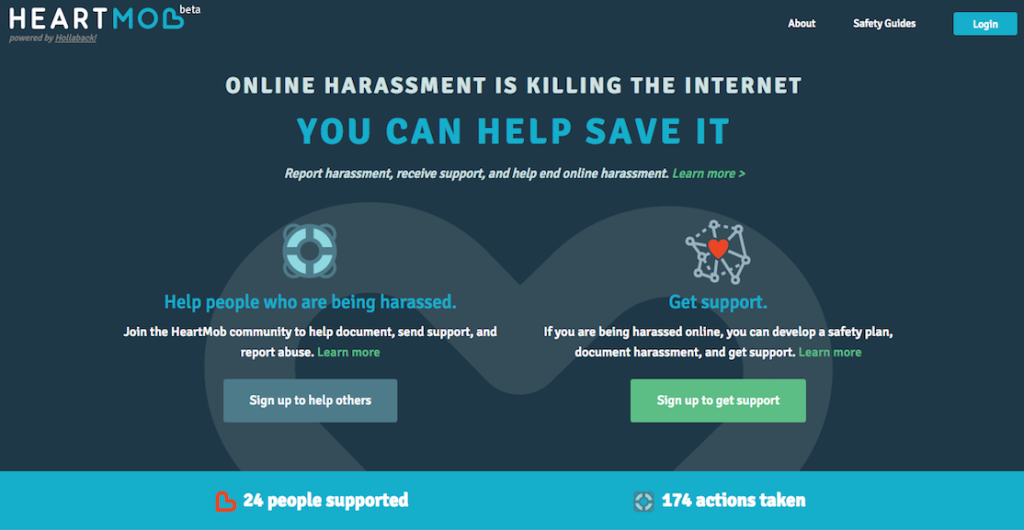
BIG NEWS: HeartMob launches today and is ready to help you reclaim the internet!i HeartMob is the first online platform to tackle online harassment by providing real-time support to individuals experiencing online harassment and gives bystanders concrete actions they can take to step in and save the day. With HeartMob, love and support is just one click away!

Watch this short video to see it in action!
HeartmobHollaback

Here’s how it works: Users who report harassment will have the option of keeping their report private and cataloguing it in case it escalates, or they can make the report public. If they choose to make it public, they will be able to choose from a menu of options on how they want bystanders to support them, take action, or intervene. Bystanders looking to provide support will receive public requests, along with chosen actions of support. You can “have someone’s back” and know that you’re helping them out in a time of need while directly contributing to safer spaces online!

The internet is the world’s largest public space, and just like in the streets, we ALL have the right to safety and respect. HeartMob is here to drown out the hate with lots of love and support by giving voice to people who experience online harassment, and tools to people like you who want to end it.

Check out HeartMob here, and get ready to reclaim your space on the internet!

Share

Filed Under: hollaback, online harassment, Resources

USA: Harassment should not be an Intrinsic Part of Using Public Transportation

January 25, 2016 By Correspondent

Kathleen Moyer, Philadelphia, Pennsylvania, USA, SSH Blog Correspondent

Los Angeles Metro Ad“Why don’t we get off the bus right here and go get something to eat?” said the man sitting next to me, who had been harassing me since he got on the bus.

“No,” I responded immediately for what must have been the fifth consecutive time. When I looked out the grimy bus window at the surrounding area, I noticed there were no restaurants in clear sight and doubtfully wondered whether he really wanted me to get off the bus so he could take me somewhere to eat. Before he got off at his stop, he asked for my number. When I wouldn’t give it to him, he gave me his instead, leaning over me to make sure I was saving it in my phone. I guess he wanted to be sure that I had it, just in case I changed my mind and decided that his incessant remarks about my appearance were actually charming.

This was the first time that I experienced harassment on public transportation. Seeing as I live in a large city and don’t yet drive, I rely on public transportation often. Unfortunately, since that first incident, I’ve learned that harassment on public transportation is something that’s simply expected, especially if you’re a woman. Recently, I asked other frequent public transportation users I know about their experiences with harassment.

“The conversation started out normal, but then he started asking me uncomfortable questions,” one woman began. “He said that he had a wife that he didn’t live with anymore and some grown children, and asked if I’d like to come with him to a hotel for sexual interaction…I told him no thank you and how he should be loyal to his wife, but he kept insisting and told me he’d even pay me for my time, because in Russia, that’s what he used to do. He then put his hand on my thigh, and then I stood up and moved to another seat on the bus to get away from him.”

Another woman I spoke to shared an experience in which she was harassed by a clearly intoxicated man who should not have been on the bus in the first place. “I was on the bus leaving work…I started eating a hoagie and this drunk guy in the row next to me started moaning and making obscene gestures at me. Then he moved to the seat next to me and said ‘Do you want to play?’ and reached out to grab me. Before he could, I yelled ‘Get away from me!’ and luckily that was enough to make him run out of the bus before anything else could happen.”

Fortunately, this woman, as well as another woman I spoke to, was able to scare off her harasser. I assume that the harassers ran away in these instances because they were taken by surprise. After all, we’re taught to simply ignore harassers on buses and trains, because sadly, that’s usually the safest and easiest response. I believe that harassers know this and try to take advantage of it. That’s why they sometimes act in such a cowardly manner when their victims respond in a way that deviates from what they’ve come to expect. However, victims of harassment shouldn’t be solely responsible for addressing the issue.

Thankfully, some transit authorities have taken action to fight harassment, with Boston’s transit authority leading the way in 2008 and Chicago in 2009.

* Since 2012, Stop Street Harassment and Collective Action for Safes Spaces have worked on a campaign with the Washington, DC area transit authority that includes PSAs, an online reporting portal, and training for frontline employees.

* In 2014, the New York City Metropolitan Transit Authority created a webpage through which victims of harassment would be able to anonymously report incidents and submit photo evidence.

* Transport for London launched a campaign called “Report it to stop it” in April of last year. As the name suggests, the goal of the campaign was to encourage more people to report instances of harassment.

* A similar campaign called “Speak Up” was developed in Los Angeles, in October of last year.

* Also last fall, the French government launched a campaign in which public transportation lines were plastered with posters printed with sexual remarks typical of those frequently heard on public transport lines. The bottom of the posters say, “A woman’s life should not look like this.”

While these efforts are promising, the problem seems to still remain unaddressed in most areas, allowing harassment to continue to be seen as an intrinsic part of using public transportation. Perhaps public transportation companies know that most people who use their services do so because it’s their only method of transportation; the fact that these companies won’t lose customers could be a factor in them not prioritizing the issue. Perhaps local governments are not aware of how prevalent the problem is. No matter what is preventing the problem from being addressed, it must change immediately. No one should feel threatened anytime they travel via bus or train and unwanted sexual behavior should not be a normal part of someone’s daily commute.

As the posters in France say, a woman’s life should not look like this. No one’s life should look like this.

Kathleen is a full-time graduate student studying professional and business communication. She plans initiatives to increase awareness of sexual assault, domestic violence, and other related issues through her university’s anti-sexual violence group, Explorers Against Sexual Violence.

Share

Filed Under: correspondents, public harassment, Resources Tagged With: Boston, London, los angeles, metro, paris, philadelphia, public transportation, Washington DC

Amnesty International Says Refugee Women Face Sexual Abuse

January 18, 2016 By HKearl

Amnesty International just released a report about sexual abuse of refugee women traveling to Europe. Here’s an excerpt from their press release:

“Governments and aid agencies are failing to provide even basic protections to women refugees traveling from Syria and Iraq. New research conducted by Amnesty International shows that women and girl refugees face violence, assault, exploitation and sexual harassment at every stage of their journey, including on European soil.

The organization interviewed 40 refugee women and girls in Germany and Norway last month who travelled from Turkey to Greece and then across the Balkans. All the women described feeling threatened and unsafe during the journey. Many reported that in almost all of the countries they passed through they experienced physical abuse and financial exploitation, being groped or pressured to have sex by smugglers, security staff or other refugees.”

Share

Filed Under: News stories, public harassment, Resources Tagged With: amnesty international, europe, harassment, iraq, refugee, report, sexual abuse, smugglers, Syria

Most Sexual Abuse on London Tube Happens During Rush Hour

January 10, 2016 By HKearl

New information was released about sexual abuse on the London Tube.

Via The Independent.

“The majority of sexual assaults on the Tube are committed during peak travel times, according to new figures which challenge the popular belief that women are most at risk when travelling late at night.

Statistics from the British Transport Police (BTP) showed that between 1 January 2014 and 8 December 2015, 322 sexual assaults were reported on the London Underground network between 5pm and 7pm, along with 291 from 8am until 10am. This compares to just 110 between 11pm and 1am.

Sarah Green, the acting director of the End Violence Against Women Coalition, said: “These figures tell a compelling story about how sexual harassment is mostly experienced during daytime commuter journeys – not during late-night social hours.”

The findings “explode a myth that women who have been drinking or who are dressed a certain way provoke sexual harassment, because the victims at peak morning and early evening travel times are largely working women making commuter journeys”, she added.”

This has also been true on other transit systems where data have been collected. It shows that the advice to women to stay in at night isn’t effective… most harassment and violence is happening during daylight hours, in crowded places.

Share

Filed Under: News stories, public harassment, Resources Tagged With: London, public transit, reports, sexual assault, tube, UK

Video: #JuventudSinAcoso: Nuestra generación puede erradicar el acoso callejero

January 5, 2016 By HKearl

Slavery used to be considered normal. Now it’s not. Women not having the right to vote used to be normal. Now it’s not. Street harassment used to be normal…. oh wait, it still is! But we can stop that. With our generation we can change things.

This is the powerful message conveyed in a new PSA by OCAC Chile. English subtitles and sign language interpretation are available. #JuventudSinAcoso

Share

Filed Under: male perspective, Resources, street harassment Tagged With: chile, video

« Previous Page
Next Page »

Share Your Story

Share your street harassment story for the blog. Donate Now

From the Blog

  • #MeToo 2024 Study Released Today
  • Join International Anti-Street Harassment Week 2022
  • Giving Tuesday – Fund the Hotline
  • Thank You – International Anti-Street Harassment Week 2021
  • Share Your Story – Safecity and Catcalls Collaboration

Buy the Book

  • Contact
  • Events
  • Join Us
  • Donate
  • Facebook
  • Instagram
  • Pinterest
  • Tumblr
  • Twitter
  • YouTube

Copyright © 2026 Stop Street Harassment · Website Design by Sarah Marie Lacy