• About Us
    • What Is Street Harassment?
    • Why Stopping Street Harassment Matters
    • Meet the Team
      • Board of Directors
      • Past Board Members
    • In The Media
  • Our Work
    • National Street Harassment Hotline
    • International Anti-Street Harassment Week
    • Blog Correspondents
      • Past SSH Correspondents
    • Safe Public Spaces Mentoring Program
    • Publications
    • National Studies
    • Campaigns against Companies
    • Washington, D.C. Activism
  • Our Books
  • Donate
  • Store

Stop Street Harassment

Making Public Spaces Safe and Welcoming

  • Facebook
  • Instagram
  • Pinterest
  • Tumblr
  • Twitter
  • YouTube
  • Home
  • Blog
    • Harassment Stories
    • Blog Correspondents
    • Street Respect Stories
  • Help & Advice
    • National Street Harassment Hotline
    • Dealing With Harassers
      • Assertive Responses
      • Reporting Harassers
      • Bystander Responses
      • Creative Responses
    • What to Do Before or After Harassment
    • Street Harassment and the Law
  • Resources
    • Definitions
    • Statistics
    • Articles & Books
    • Anti-Harassment Groups & Campaigns
    • Male Allies
      • Educating Boys & Men
      • How to Talk to Women
      • Bystander Tips
    • Video Clips
    • Images & Flyers
  • Take Community Action
  • Contact

#16Days of Activism: Distributing Cards (Day 3)

November 27, 2015 By HKearl

Nov. 25 – Dec. 10 are the 16 Days of Activism Against Gender-Based Violence. To commemorate the week, we are featuring 1 activism idea per day. This information is excerpted from my new book Stop Global Street Harassment: Growing Activism Around the World (Praeger 2015).

Distributing cards about street harassment to harassers or to educate passersby is a tactic that’s been used for years, especially when it became easy to post the cards online for others to download. The Street Harassment Project, for example, has offered cards on its site since the early 2000s and Stop Street Harassment has made cards available since 2008. But in recent years, individuals have been creating their own. In 2012, for example, American Mirabelle Jones created “catcalling cards” with a phone number printed on them for women to give to men who won’t leave them alone. If the men call the number, they will hear pre-recorded messages from women telling harassers exactly what they think of them. On her Tumblr I Am Not an Object, she invites women to leave recordings and download the cards.
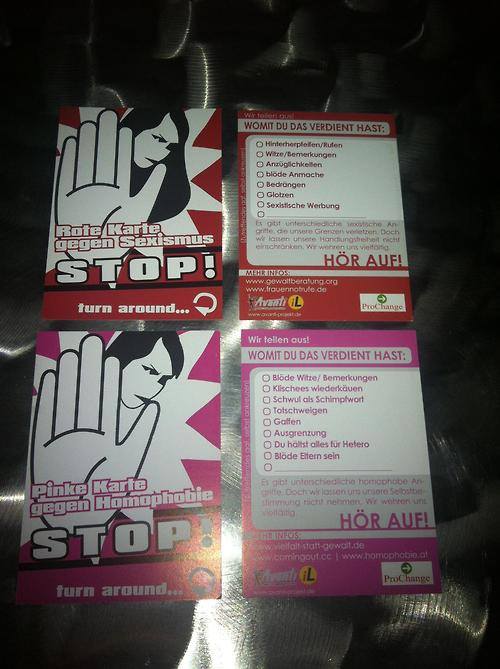
ProChange Germany
ProChange Germany

In Dortmund, Germany, the women in the feminist group ProChange devised another clever way to use cards. Living in a country that is obsessed with football (American soccer), they created “Red Cards” against sexism, “Pink Cards” against homophobia and “Purple Cards” of courage. Individuals can hand out these cards to challenge or commend others’ actions without having to directly talk to them. “This can be easier than having any other reaction,” the women told me. A group called Avanti had the same idea and had already created cards that they let ProChange adopt. ProChange also created special coasters with information about street harassment for the pubs, bars, and clubs of Dortmund.
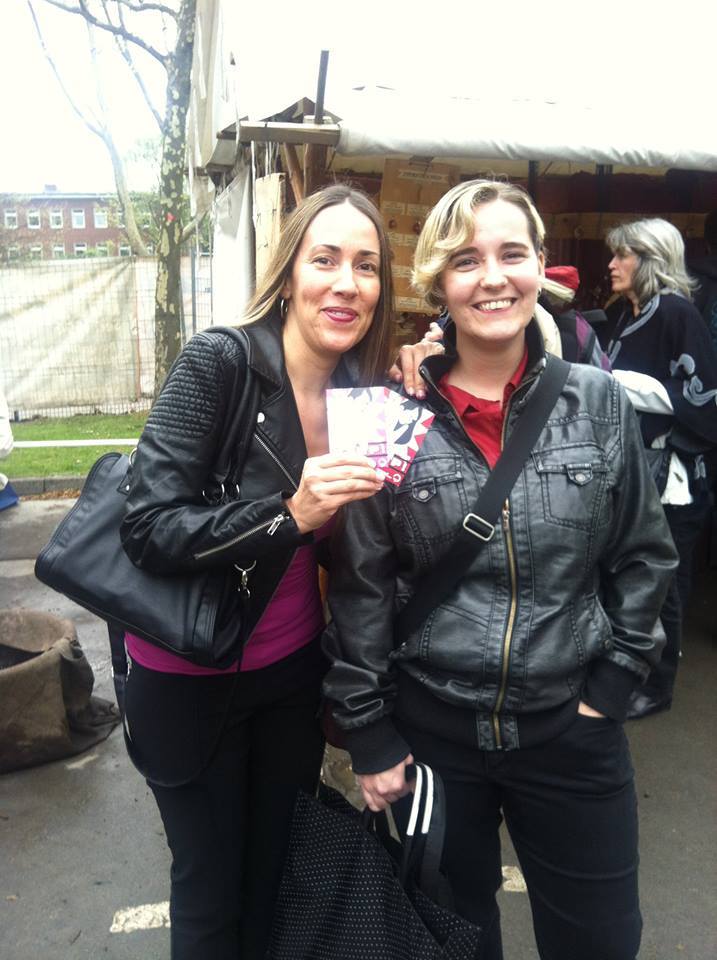
ProChange Members in Germany, 2014

One of their first distribution occurred during International Anti-Street Harassment Week 2012 when they handed out 2,000 of these cards and coasters. They have distributed thousands more since, often coinciding with specific days like Equal Pay Day, One Billion Rising (against gender violence), Frauenkampflag (Women’s Day), and Fahnentag (the International Day for the Elimination of Violence against Women).

“We get mostly positive feedback regarding the cards,” the group members informed me. “Even men approach us to ask for more cards they can give to their partners or daughters. Often people email us to ask for our cards. Our favorite story was when we were in front of the city hall distributing cards. It was too cold and only a few people passed by. An old grumpy-looking man approached us. He took one of the cards and looked at it. Then he shook everybody’s hands and thanked us for standing in the cold for women and girls.”

Help fund our work in 2016, donate to our end-of-year giving campaign!

Share

Filed Under: 16 days, Resources, street harassment Tagged With: 16 days of activism, activism, distributing cards, gender-based violence, Resources

#16Days of Activism: Sidewalk Chalking (Day 2)

November 26, 2015 By HKearl

Nov. 25 – Dec. 10 are the 16 Days of Activism Against Gender-Based Violence. To commemorate the week, we are featuring 1 activism idea per day. This information is excerpted from my new book Stop Global Street Harassment: Growing Activism Around the World (Praeger 2015).

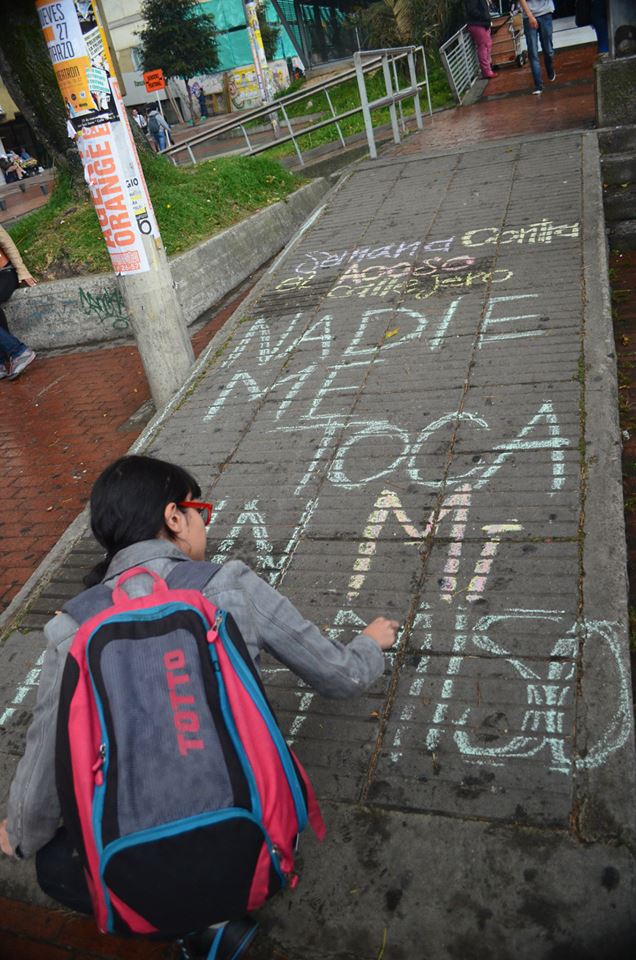
Colombia, 2014
Colombia, 2014

Using sidewalk chalk to write messages like “My body is not public space” has become a popular way to quickly raise awareness about street harassment. It is inexpensive, easy, and something an individual or a small group can do, and the impact can be huge. In addition to raising the awareness of people passing by while the chalking happens, dozens, hundreds, or even thousands of people can see it as they pass by—barring rain or other conditions that might wipe out the message. Anti-street harassment chalking parties have taken place all over the world, including in Melbourne, Australia; Ottawa, Canada; Bogota, Colombia; Berlin, Germany; and Dublin, Ireland, as well as in American states like California, Florida, Georgia, Hawai’i, Illinois, Massachusetts, New York, Oregon, Pennsylvania, and South Dakota.

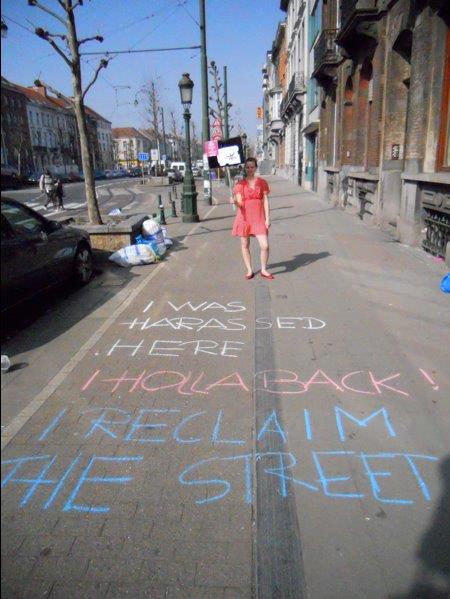
A unique approach to chalking is the Chalk Walk the group Rebellieus, formerly Hollaback! Brussels, held in 2012. Four young women met at Ribaucourt, Molenbeek in Brussels, Belgium, on a spring morning. Their meeting place was significant because it was where one of the women, Angelika, had been harassed. With a bright-colored piece of chalk, Angelika stooped down and wrote on the sidewalk, “I was harassed here. I Hollaback. I reclaim the street.”

Brussels, 2012
Belgium, 2012

She proudly stood by her message as her friends hugged her and congratulated her on reclaiming the space. Together, they made a pilgrimage to other spots where they had been harassed: a busy four-lane boulevard for Anna, the sidewalk of a busy bridge for Julie, and the staircase at the Metro stop De Brouckere for Ingrid. At each place, they shared their stories, reclaimed the space with chalk, and hugged. Several people stopped to talk to them, to hear their stories, and to support their message.

Bahamas Chalk Walk 2014
The Bahamas, 2014

“AWESOME is not even a strong enough word to describe it! EMPOWERING comes close!” the women wrote on their Facebook wall. “What we discovered was that writing with chalk on the sidewalk, on the street, on the bridge, telling Brussels: “I was harassed here’ ‘I reclaim the street’ is a powerful, liberating ritual and an amazing [experience].” In 2013, they launched a We Chalk Walk Tumblr where anyone can submit anti-street harassment chalk messages.

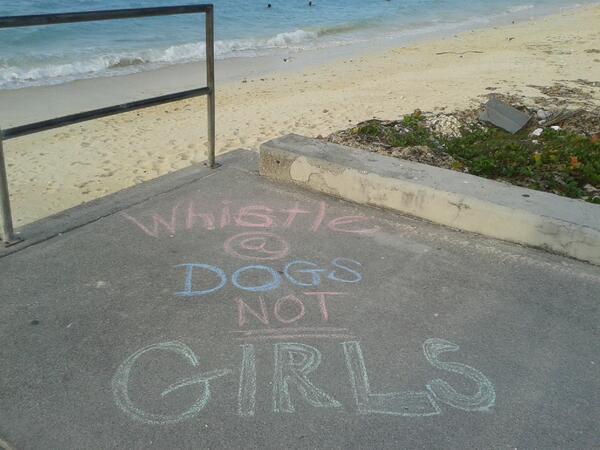
Chalking can be an effective way to start conversations and change minds. In Nassau, the Bahamas, two young women wrote messages such as “Whistle at dogs, not girls” and “Respect girls” on a sidewalk along the beach. They said that among the people who stopped to talk to them was a man “who thought we were writing the message specifically to him. We explained what we were doing to him and told him what he did WAS in fact street harassment. He, of course, did not believe us, and we had to break it down for him. He ended up understanding what we were saying, so we hope we have a converted man in Nassau!”

This is exactly the kind of impact they hoped to have. Alicia Wallace, one of the women, told the local newspaper: “Chalk messages are not common here, and we knew it would attract the attention of pedestrians. … It is unacceptable, and educating the general public on the definition and everyday examples of street harassment is the first step to combating this problem.”

Help fund our work in 2016, donate to our end-of-year giving campaign!
Share

Filed Under: 16 days, Resources, street harassment Tagged With: 16 days of activism, gender-based violence, sidewalk chalking

On World Kindness Day – Ask if They are Okay

November 13, 2015 By HKearl

Eight years ago when I conducted research on street harassment for my master’s thesis, I attended a Street Harassment Summit in New York City organized by Girls for Gender Equity. During a breakout session, the women in the room, from various diverse backgrounds, took turns sharing a story.

While each story was moving and infuriating and I included several in my thesis, one woman’s story still stands out to me today. She shared this:

“Street harassment is a huge part of my day and it makes me very angry and I think it’s always tied in with my racial identity. The worst thing that happened to me lately was I was on my way to work at a new job and I was very happy, and this guy said something to me and I kept walking. Then he came up around me in my face and said, ‘You look just like Bin Laden’s sister.’

My mouth was closed, and I was like, why aren’t I responding? He continued to scream at me and I kept walking, and he said, ‘You should get home, women like you don’t work. Don’t your men keep you locked up? Oh that’s right, your men aren’t real men. I’ll show you what a real man is.’ And he proceeded to tell me the actions that real men do to their women.

People on the street were stopped and were staring at me but no one said anything.”

As terrible as every part of her experience was, I will never forget the pain and betrayal she voiced at the end: that no one said anything.

In the years since then, I have heard her hurt echoed in so many people’s stories who feel doubly traumatized by the lack of kindness or even simple acknowledgement from the people around them. The sentiments also appear in stories submitted to my blog Stop Street Harassment, including incidents in Denver, London, and the Bahamas.

Street harassment can be annoying and upsetting, but it can also trigger deeper concerns. A study released last year by researchers at the University of Mary Washington found that sexual harassment is often traumatizing for women, especially for those who have experienced sexual abuse. A 2014 national study on street harassment in the USA showed that it can be frightening; 69% of harassed women and 49% of men said they feared the harassment would escalate into something worse.

Feeling alone and as if there must be something wrong with you since no one around you is speaking up can add to these feelings of trauma and fear.

There are many reasons why people may not speak up when they see street harassment happening. They may not be sure it IS harassment. They may not know what to do. They may think someone else will intervene. They may fear for their own personal safety. Those are all legitimate concerns and organizations like Green Dot and government entities like New York Department of Health provide tools and trainings to walk people through them.

Image via http://bitsofpositivity.com

But as we commemorate World Kindness Day, in addition to the obvious request to be kind and NOT harass others, the plea that I have to bystanders is a simple one: Ask the person if she or he is okay.

I am not the first to say this, of course, and last year social worker and avid Twitter user Feminista Jones launched the hashtag #YouOkSis? to especially encourage persons of color to reach out to women of color who are being harassed to check in and possibly interrupt a street harassment situation. But it warrants repeating.

What I want to emphasize is that if you feel too unsafe or cannot react in time to interrupt harassment, you can still check in with the person after the harasser is gone or the harassment has stopped. Let the person know you saw what happened and that you understand it can be upsetting. Let them know what happened is not okay.

A woman named Sara recently penned an open letter to her street harasser, a man in a car who told her to “move her fat ass along” as she walked through a crosswalk. Included in her piece was this: “To the woman on the sidewalk who said, ‘that’s so rude’ and shook her head when he drove off, thank you. Your three simple words in solidarity were my saving grace and snap back to reality, that no one, not even myself, has the right to disrespect my body.”

After hearing so many stories about the devastation people felt when no one around them acknowledged what was happening or how much of a difference it made when someone did, whenever I overcame my shyness and began asking women I saw if they were okay.

The first time I did this was in 2011 in Florida. I was attending a conference and I was out on a run. As I approached a bus stop where a young woman was waiting alone, men in a car swerved over and it looked like they yelled at her. When I reached her, I stopped and asked, “Hey, were those men bothering you? Are you okay?” She said that the men had circled around and harassed her three times. I told her how sorry I was and offered to wait with her. The bus came around the corner then, so she said it was okay, she could get on the bus now. I told her about my website and told her to reach out if I could help.

The next time I did it I was in New York City at Penn Station. A woman and a man were walking toward me and he was gesturing and talking loudly and she looked very uncomfortable and like she was trying to inch away from him. As they approached, I said, looking directly at the woman, “Are you okay? Is he bothering you?” She thanked me and laughed and said he was her coworker and he was just messing around and being annoying but she was fine.

I felt a little foolish — and that’s a perfect example of not knowing if someone is a harasser or not – but I have no regrets about asking. What if she had needed help?

The third time I spoke out I was walking from my office in Washington, DC to the Metro and I could see that as a woman ahead of me passed by a man, he reached out to touch her and talk to her and she recoiled. By the time I caught up to her, he was gone, but I told her I saw what had happened and that I was sorry – she shouldn’t have to deal with that. I asked if she was okay. She gave me a quick yes and thank you before she hurried on to catch her bus.

Street harassment, especially the accumulation of it, can be so tiring. So upsetting. With the three kind words of “Are you okay” or “You ok sis?”, you can help lighten someone’s load just a bit and let them know they are not alone.

Share

Filed Under: Resources, street harassment Tagged With: bystander

Egypt: Comic Stories Against Harassment

October 29, 2015 By HKearl

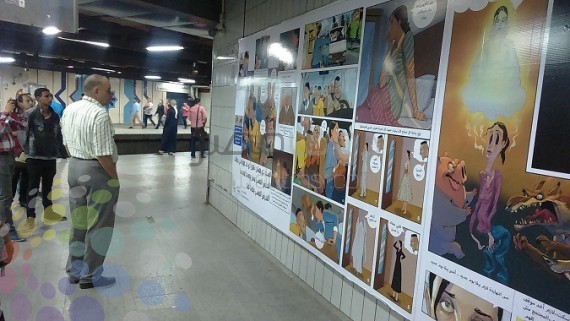
Imprint Movement's new campaign. October 2015

Our friends at Imprint Movement, in collaboration with Al-Moltqa for Consulting and Training, launched a new anti-harassment campaign in Cario’s subways yesterday.

Their press release says:

“The campaign aims aims to communicate to subway passengers and security personnel how sexual harassment affects the entire Egyptian society and not only the girl or the woman who gets sexually harassed.

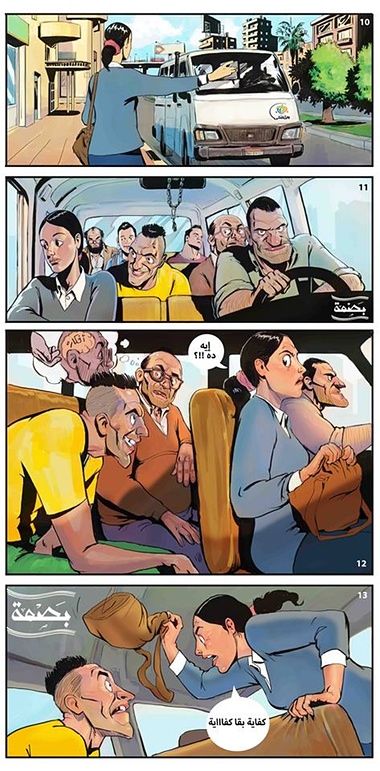
Imprint has chosen a new approach to draw attention, “Comic Stories”. The comic stories address the challenges that women face created by sexual harassment, the victim blaming culture, to what extend do women and girls feel safe in public space, reactions of the public, its reflection on her personal and professional life and how that effects the entire society. Many posters will be put up to show how the crime of sexual harassment increases when the public don’t interfere to support the girl/woman who get sexually harassed.
The comic story will be circulating around the Cairo subway, It’s Now at Al-Shohadaa, Then it will take place at Mohamed Naguib then Al-Sadat and finally Al-Attaba  metro stations. Twelve posters will be put up at Helwan University station, Manshyet Al Sadr Station and Cairo university station as these station are considered to have the most activity and gets huge amount of people daily.

The launching of “What will you do?” campaign is 24th of October, 2015 and ends on the 15th of February 2016.”

Congratulations to them on this innovative campaign!

Learn more about the campaign and see photos here.

Via the Guardian: An illustration depicting a young woman’s experience on a minibus. Illustration: Ahmed Nahby/Mada Masr/Imprint

UPDATE: The Guardian has a great feature article about their campaign. Here is an excerpt:

“Imprint, the organisation behind the campaign, has been raising awareness of sexual harassment through events ranging from one-on-one conversations to workshops, co-founder Abdel Fattah al-Sharkawy explained.

He said participants – both male and female – often found they weren’t aware of what constitutes sexual harassment, and rarely related the term to their own day-to-day experiences.

‘We wanted to make that link’ through the comic campaign, he said.

The group decided to work with comics because ‘they’re catchy and colourful’, drawing people of all ages in to explore the stories they tell, Sharkawy added.

Another image from the series shows male passengers on a minibus reacting to the young woman.

‘This woman can be an influential person in your life,’ the illustration reads. ‘Sexual harassment doesn’t harm her alone, it harms us all.’

They differ from typical public service announcements because they rely on storytelling instead of propagandistic slogans, so they ‘make you think and form an opinion,’ he said.”

Share

Filed Under: News stories, Resources, street harassment Tagged With: Egypt, imprint movement, transit campaign

The Netherlands: Demystifying Dutch Tolerance

October 26, 2015 By Correspondent

Eve Aronson, Amsterdam, the Netherlands, SSH Blog Correspondent

Have you heard of the Dutch Myth of Tolerance? It’s not a myth in the mythical sense, and it’s not a fairytale, though it does sound admittedly magical.

Since the 17th century, the Netherlands has been a smorgasbord of races, ethnicities and religions and has continuously championed itself on what are known as “pillars” of tolerance.

The Dutch Myth of Tolerance is reflective of the disintegration of these pillars towards what has become an increasingly harsh critique of the narrative of ‘acceptance and multiculturalism’ in the Netherlands (or the lack thereof).

At first, the presence of this myth throughout my research was subtle. People told me about their experiences of street harassment and may have thrown in some (racially) identifying characteristics of their harassers. But after several months, it became evident that a more solid smokescreen lurked, and that the notion of Dutch pluralism and tolerance was not always as strong as it presented itself to be.

When people talk about street harassment in Amsterdam, it is not uncommon to highlight the race or ethnicity of one’s harassers, particularly if they are of Moroccan or Turkish decent, two of the largest minority populations in the Netherlands. Often times, the harasser is also tied to a particular neighborhood. For example, one person I talked to said: “In my experience, harassment was worse in neighborhoods with a lot of immigrants from cultures…Moroccans for example.” Another echoed: “A lot of catcalling, primarily from members of black communities”.

A report released in March of this year by the city of Amsterdam also highlighted particular minority-populated neighborhoods and communities as being more affected by street harassment, which arguably worked to further emphasize the link between street harassment and race or ethnicity.

Many of you might also recall the October 2014 video of a woman walking through the streets of New York in the US. The video heavily criticized for selectively showing a disproportionate number of men of color harassing the (white) woman in the video. Emphasizing connections between street harassment, race and location is not only completely inaccurate; it also strips accountability from a significant proportion of harassers who fall outside of these stereotypes and who are harassing women in Amsterdam just as often.

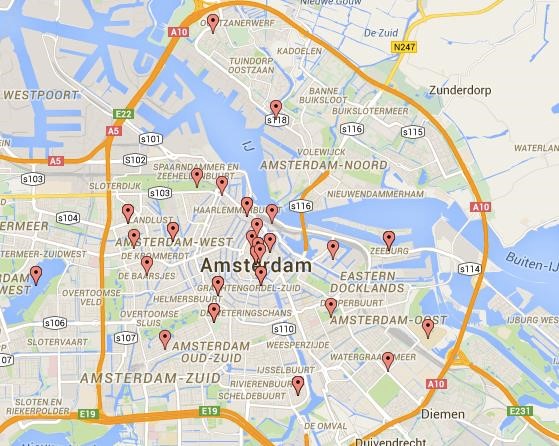
Below is a map of locations tagged by 48 respondents of a recent street harassment survey that I conducted in Amsterdam. Take a good look at where the majority of incidents are reported:

Amsterdam-BatchGeo2015(Source: BatchGeo 2015)

The majority of the geotagged incidents were reported in the center of the city, mostly around touristy areas and not in areas of the city known to have large minority populations (Biljmer, Zuid-Oost and Oost, for example). What this data does then, is encourage a revisiting of stereotypes of street harassment in Amsterdam, albeit from a purely geographic perspective. And this is just a start. The more stereotypes are checked—particularly using visual tools and visualizations—the more people are realizing that street harassment extends beyond race, ethnicity and geographical area.

What kind of impact does this have on the ground? Understanding street harassment as part of broader power structures does not mean that everyone gets this memo, and in this vein, individuals’ lived experiences are critical to take into account. But without denying individual experiences with street harassment, it is important to underline the implications of making generalized statements about races or communities.

Starting up a Hollaback! in Amsterdam is one way to work towards exposing exactly what happens on the ground and where. Geotagging experiences of street harassment not only confronts the Dutch Myth of Tolerance but it also provides an important starting point for conversations about street harassment and race in the Netherlands. Coupled with other awareness-raising initiatives and campaigns, addressing racial stereotyping in conversations about street harassment through such visual tools also encourages a look at street harassment through a much broader lens—one that unfortunately does not make the fight against street harassment easier but who said this was going to be easy? Ultimately, what taking a more comprehensive approach to street harassment does, is it makes the work more strategic and more effective in the long run.

You can find the full analysis of the Amsterdam survey results here or by contacting Eve at evearonson@gmail.com. Follow Eve and Hollaback! Amsterdam on Twitter at @evearonson and @iHollaback_AMS and show your support by liking Hollaback! Amsterdam’s Facebook page here.

Share

Filed Under: correspondents, hollaback, race, Resources, street harassment Tagged With: Amsterdam, hollaback, maps, statistics

« Previous Page
Next Page »

Share Your Story

Share your street harassment story for the blog. Donate Now

From the Blog

  • #MeToo 2024 Study Released Today
  • Join International Anti-Street Harassment Week 2022
  • Giving Tuesday – Fund the Hotline
  • Thank You – International Anti-Street Harassment Week 2021
  • Share Your Story – Safecity and Catcalls Collaboration

Buy the Book

  • Contact
  • Events
  • Join Us
  • Donate
  • Facebook
  • Instagram
  • Pinterest
  • Tumblr
  • Twitter
  • YouTube

Copyright © 2026 Stop Street Harassment · Website Design by Sarah Marie Lacy