Learn about a new anti-harassment campaign in Guyana.
And a new campaign by Stop Harcèlement de Rue in France launched for International Anti-Street Harassment Week.

Making Public Spaces Safe and Welcoming
Learn about a new anti-harassment campaign in Guyana.
And a new campaign by Stop Harcèlement de Rue in France launched for International Anti-Street Harassment Week.
““Stripped” is a social drama broaching the most sensitive and often neglected aspect of a woman’s life. This is a story about Ana, who is a modern working girl. She’s well educated and quite liberated. Yet, whenever she has to deal with the perversion of men around her, she feels violated. Otherwise, a brave woman, she finds the act of ogling very disturbing. Given that, it’s not seen as a crime, she feels helpless and is forced to go through the process day in day out. The movie, narrates the story of a normal day in her life, what happens around her and what she feels inside.”
Robert Wood Johnson Foundation:
“Julia Retzlaff, age 18, loves exploring her city and visiting friends all over San Francisco. But the fear of being sexually assaulted on public transportation is forcing her to reconsider going out at all. Produced for the Robert Wood Johnson Foundation’s Equity Workshop at TED 2015 in association with the Bay Area Video Coalition in San Francisco, Calif”
FAAN Mail created short videos featuring Philadelphia people’s stories at their International Anti-Street Harassment Week event on April 12. Watch them all on their YouTube channel. Here is one example:
Last week in Argentina, a new anti-street harassment law was proposed.
“The bill would establish fines ranging from AR$100 pesos (approx. US$7) to AR$7,000 ($547), and aims to protect anyone who “self-identifies as a woman” from verbal or physical harassment. Furthermore, the bill proposes a “National Week against Street Harassment” be commemorated yearly from April 12 to 18…
Raquel Vivanco, coordinator for Womean of the Latin American Matria (MUMALA), also lent her support to the bill. ‘Street harassment should be considered a crime, because women should not be intimidated and harassed. It does not only have to do with our privacy but also in the way it limits our free movement.'”
Earlier this month, Aixa Rizzo‘s video against street harassment went viral.
Peru passed a law against street harassment last month and laws were introduced in both Chile and Panama this spring.
Emily Gillingham, Washington, DC, USA, Blog Correspondent
 Every now and again, someone in a newspaper editorial, blog post, or conversation will argue that a law or policy restricting street harassment violates Americans’ First Amendment right to free speech. Though these people’s dedication to their desire to hurl sexual remarks at strangers or defend those who do so is admirable, here’s why that assertion is way off-base.
The First Amendment to the United States Constitution reads in pertinent part, “Congress shall make no law . . . abridging the freedom of speech . . . ” This is about things that Congress does; an easy way to think about it is whether the government is restricting the speech.
The First Amendment protection against government abridgement of free speech is not absolute. While the First Amendment has been found to protect rights to things like the speech of protestors outside of abortion clinics, it has been found to not protect “speech” like public school students holding a banner at a school event that reads “BONG HITS 4 JESUS” and unsolicited mailing of graphic brochures advertising pornographic books. For how often the old adage that the First Amendment doesn’t protect falsely shouting “fire” in a crowded theater is brought up in free speech arguments, no such set of facts was ever before the US Supreme Court, and in fact the case from which the concept sprung has since been overruled. But the basic premise remains: First Amendment rights are not absolute.
The U.S. Supreme Court has upheld laws restricting public place speech before. For example, in Chaplinsky v. State of New Hampshire, a man was convicted of violating a state law that read, “No person shall address any offensive, derisive or annoying word to any other person who is lawfully in any street or other public place, nor call him by any offensive or derisive name, nor make any noise or exclamation in his presence and hearing with intent to deride, offend or annoy him, or to prevent him from pursuing his lawful business or occupation” for standing outside City Hall in Rochester, New Hampshire and saying things like, “[y]ou are a God damned racketeer” and “a damned Fascist and the whole government of Rochester are Fascists or agents of Fascists.”
The Supreme Court upheld the constitutionality of the state law over Chaplinsky’s argument that the law violated his First Amendment rights because the law was limited in scope, Chaplinsky’s words lacked social value, and the law did not “unduly impair liberty of expression.” The Court wrote that Chaplinsky’s words “by their very utterance inflict injury or tend to incite an immediate breach of the peace.”
First Amendment cases use several different rules and rationales because they are so heavily fact-dependent. And we don’t have a Supreme Court case directly on this issue to compare. But one line of cases focuses on whether the restriction focuses on the content of the speech, or instead the “time, place, or manner” of the speech, which is scrutinized under a less stringent standard. This line is drawn in several Supreme Court cases.
An anti-street harassment law which regulated the content of speech, like a law that prevented shouting “compliments” at strangers in public, might fail. But a law that prohibited a certain manner of speech, like unwanted verbal contact with another person on public transportation, should pass constitutional muster. Not to mention, street harassment can sometimes be prosecuted criminally or civilly as hate speech, sexual assault, threats, defamation, intentional infliction of emotional distress, “fighting words,” intimidation, or obscenity, which receive limited or no First Amendment protection.
Street harassment is about exerting power over others who dare to enter a public space to go to work or the grocery store. The man who rode his bike dangerously close to me to force me to make eye contact and then hissed “I WANT TO TASTE YOUR PUSSY” was not trying to pay me a compliment. He was not trying to make friendly conversation. He was not informing me about a political issue he’s concerned about. He was not asking the time. He was not letting me know that I dropped a glove a half block back. He was not wishing me a good morning or remarking on the weather. His speech was not designed to convey an idea; it was intended to intimidate, dehumanize, and subjugate me.
Street harassment impacts what I wear, how I travel to work, how late I stay out, and whether or not I feel safe outside. Would educating and persuading street harassers to change their ways be a preferable course of action to legislating against that type of behavior? I think so. But that isn’t going to change attitudes overnight, and frankly, certain people, like “TASTE YOUR PUSSY” guy, probably aren’t going to change short of a criminal or civil statute giving him a reason to change that he cares about (because intimidating strangers is clearly not enough).
So while it’s an easy cop-out to blurt “BUT MAH ‘MERICAN FREEDOMS” when the government acts to prevent people from making others feel unsafe, the First Amendment argument falls flat. If this topic interests you, I’d strongly suggest reading Cynthia Grant Bowman’s wonderful Harvard Law Review article on the subject and articles and a book by Dr. Laura Beth Nielsen.
Disclaimer: this article is an opinion and is not intended to be used as legal advice.
Emily is a 3L at Michigan State University College of Law, and the president of her school’s chapter of LSRJ. Follow her on Twitter @emgillingham.
Innovative street signs went up in Toronto, New York City and Philadelphia during International Anti-Street Harassment Week last week.
Toronto (via blogTO):
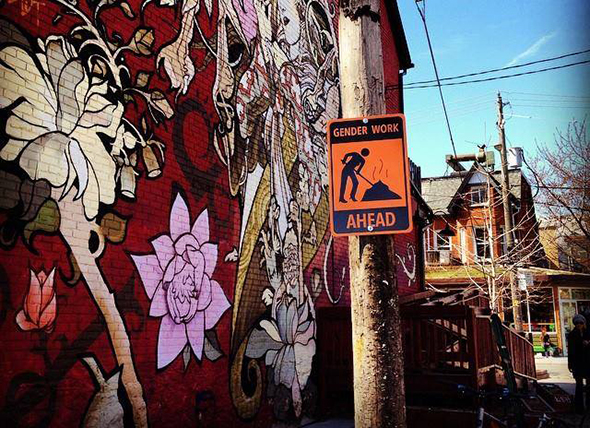 “A new public art project in Kensington Market kindly asks catcallers to STFU. Dubbed the The Street Talk Project, the artistic intervention involves street signs that admonish sexual harassment on Toronto streets and that support equal rights for women and trans* people.
“Using humour and subversive advertising, The Street Talk Project [brings] attention to the ways in which public space is navigated differently by different people,” reads the organizers’ description of the project. It also addresses “how sexism is felt viscerally on a day-to-day basis” and promotes “solidarity for the safety of women and trans* people.”
The project debuted yesterday and also involves an exhibition at Whippersnapper Gallery. There are seven signs in total, which have been installed around the Market. The idea was to place them in a highly trafficked area to generate as much discussion as possible.”
New York City and Philadelphia (via my article at Feministing.com):
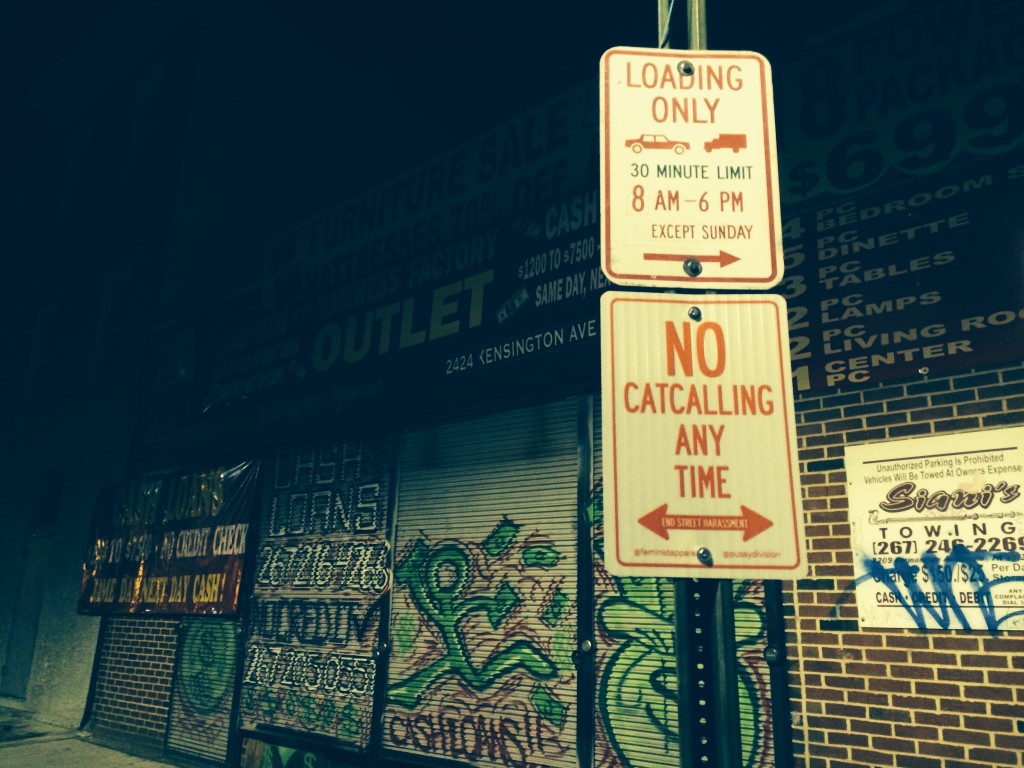 “Members of Feminist Apparel and Pussy Division put up 25 street signs against catcalling in Philadelphia and New York City. They worked with a street sign manufacturer to produce them and released them specifically for International Anti-Street Harassment Week. Their goal was to create ‘further dialogue surrounding the issue of street harassment,’ Alan Martofel, production coordinator for Feminist Apparel, told me.
Since it is a form of guerrilla activism, they did not gain permission from the city to post the signs and they are unsure how long they will be up. But they say that already they are having an impact.
One of the members of Pussy Division, a group based in Philadelphia who has done other street art activism, such as posting “stop rape” stickers and spray painting anti-harassment messages on sidewalks around the city, told me, ‘We’ve had so much positive feedback. A lot of people will share harassment that just happened to them and say they are happy to see the sign and feel less alone.’
For her, the goals of the project are to spread the message that street harassment is an important issue everywhere and to help survivors. ‘We would like people who deal with street harassment every day to look at it and feel validated about their feelings of really hating going through it and feeling objectified.’ She continued, ‘We are taught — especially women — that this is part of life and that we should deal with it and be happy about it. But we’re not happy about it. It’s important for harassed people to hear from other people who are on the same page as them.’