• About Us
    • What Is Street Harassment?
    • Why Stopping Street Harassment Matters
    • Meet the Team
      • Board of Directors
      • Past Board Members
    • In The Media
  • Our Work
    • National Street Harassment Hotline
    • International Anti-Street Harassment Week
    • Blog Correspondents
      • Past SSH Correspondents
    • Safe Public Spaces Mentoring Program
    • Publications
    • National Studies
    • Campaigns against Companies
    • Washington, D.C. Activism
  • Our Books
  • Donate
  • Store

Stop Street Harassment

Making Public Spaces Safe and Welcoming

  • Facebook
  • Instagram
  • Pinterest
  • Tumblr
  • Twitter
  • YouTube
  • Home
  • Blog
    • Harassment Stories
    • Blog Correspondents
    • Street Respect Stories
  • Help & Advice
    • National Street Harassment Hotline
    • Dealing With Harassers
      • Assertive Responses
      • Reporting Harassers
      • Bystander Responses
      • Creative Responses
    • What to Do Before or After Harassment
    • Street Harassment and the Law
  • Resources
    • Definitions
    • Statistics
    • Articles & Books
    • Anti-Harassment Groups & Campaigns
    • Male Allies
      • Educating Boys & Men
      • How to Talk to Women
      • Bystander Tips
    • Video Clips
    • Images & Flyers
  • Take Community Action
  • Contact

“The objectification of women increases their fears of sexual assault”

January 20, 2015 By HKearl

Via Vocativ:

“In a study published late last week, researchers found the treatment of women as sexual objects has been shown to contribute to anxiety over their physical safety.

“Our research supports previous findings that the rampant sexual objectification of women, an act of sexual terrorism, can heighten women’s fears of incurring physical and sexual harm,” says lead author Dr. Laurel Watson, a psychology professor specializing in traumatology at the University of Missouri-Kansas City…

The study looked at a sample of 133 African-American and 95 white female undergraduates—a demographic for which the incidence of rape is believed to be five to seven times higher than the general population. The African-American respondents reported more sexual objectification experiences and fear of crime than white women, and therefore experienced more psychological stress.

Regardless of race, though, all women (consciously or not) took various measures to alleviate their fears, from avoiding walking alone at night to carrying pepper spray in their handbags. And while such behaviors may be seen as common sense, Watson argues they should not be misinterpreted as solutions because they place the burden of maintaining safety on women, rather than on the perpetrators themselves.

“Partnerships with men in stopping violence may help transform unequal power distributions between men and women—a chief reason why violence against women occurs in the first place,” says Watson says.

Share

Filed Under: News stories, Resources, street harassment

Video: Fashion Institute of Technology Project

January 6, 2015 By HKearl

Devon is a student at the Fashion Institute of Technology. This past semester, her class was given the task of creating a video about a social cause of their choosing. Being a young woman living in New York City, she felt the topic of street harassment was a personal and meaningful cause she wanted to address in hers.

Share

Filed Under: Activist Interviews, Resources, street harassment

Street Harassment Cartoon: Deafening Voices

January 5, 2015 By HKearl

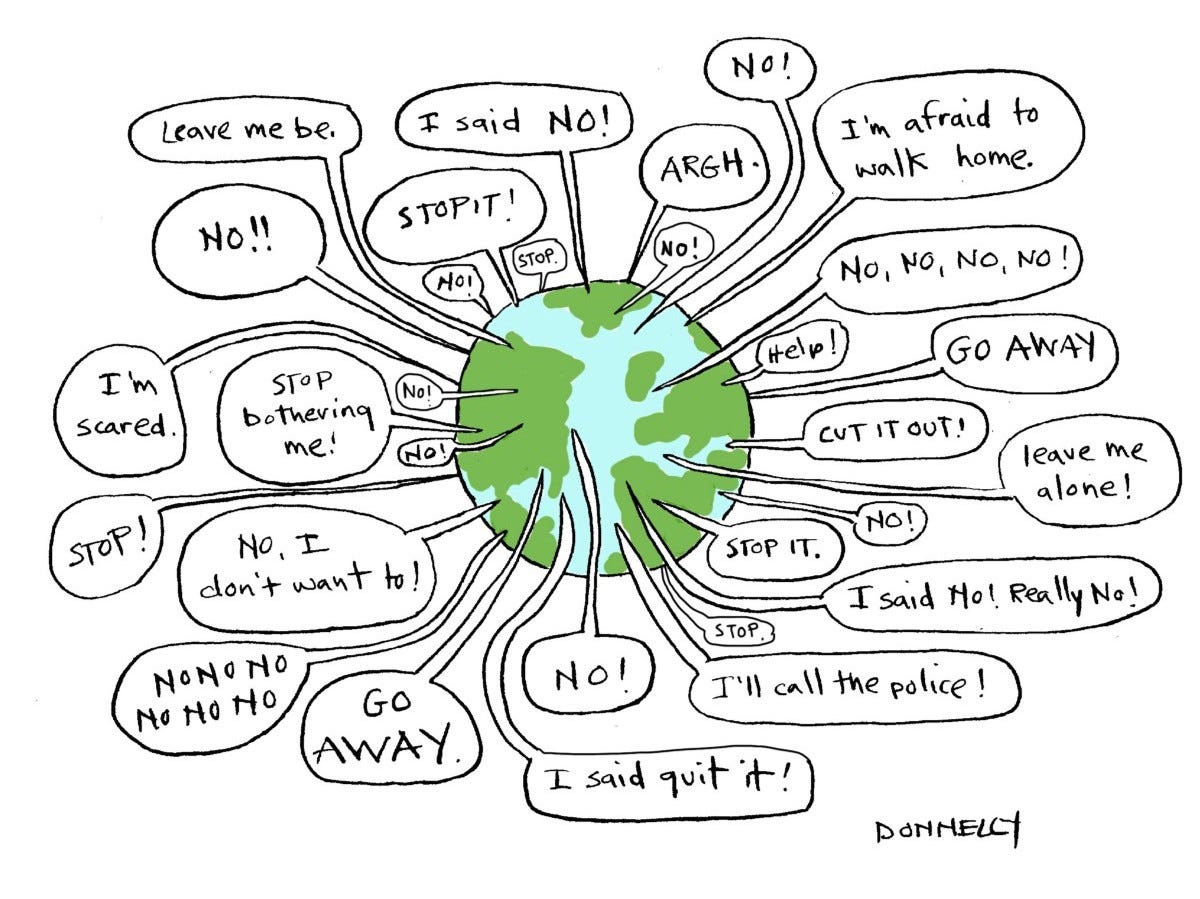
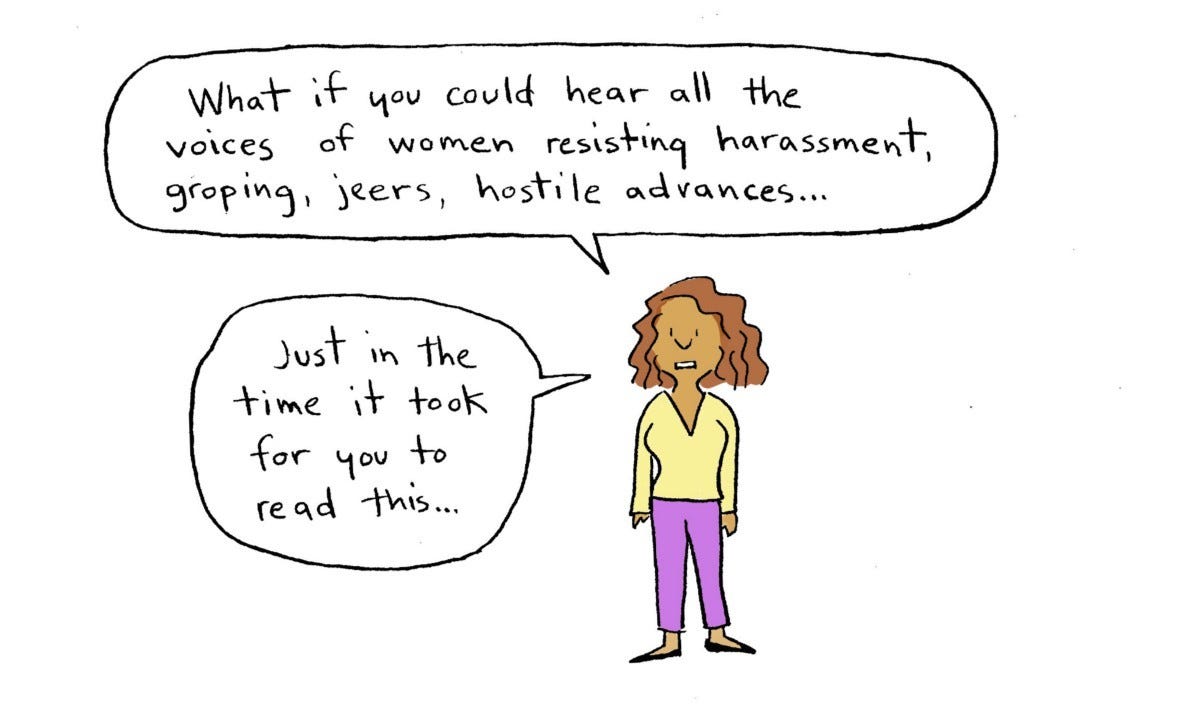
Liza Donnelly is a prolific cartoonist. Her latest cartoon, published on Medium’s The Nib today, is about street harassment, a topic she has addressed before. She gave me permission to share it here —

Thanks for using your talents to raise awareness about street harassment, Liza!

Share

Filed Under: Resources

Serbia: Street Harassment Survey Has an Impact

December 29, 2014 By Contributor

This post is from our Safe Public Spaces Team in Nis, Serbia. The SPSM projects are supported by SSH donors. If you would like to donate to support the 2015 mentees, we would greatly appreciate it!

“How is that street harassment when everyone does it?”

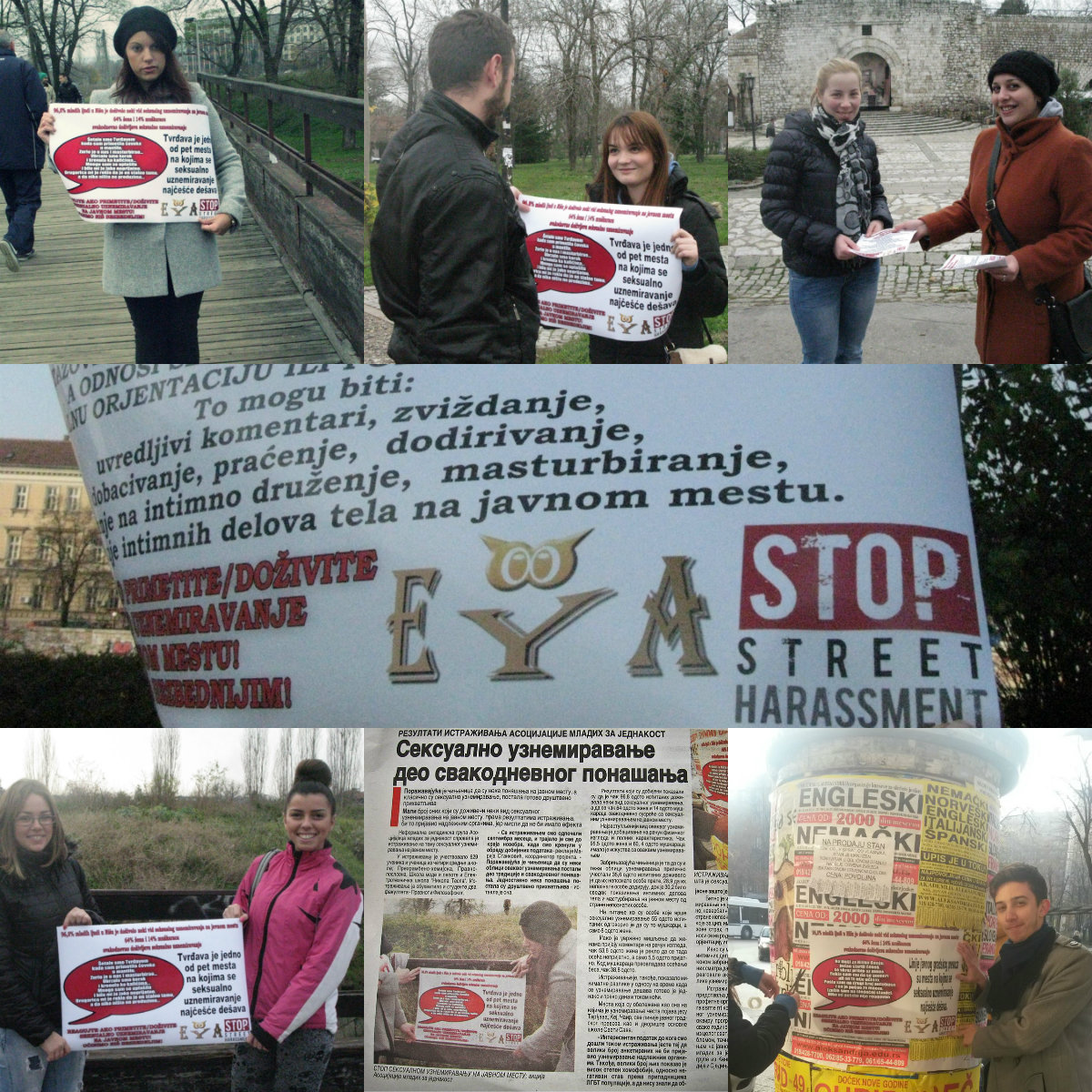
Equity Youth Association conducted a street harassment survey across three months with 629 youth participants from four secondary schools and two Faculties. Psychologist Sanja Cvejić helped us process the data. The findings are below the collage image. We also handed out a flyer with a basic explanation of what street harassment is and the most common forms and through that we were able to educate and raise awareness among even more people.

School psychologist were delighted that this issue is finally being addressed. They were so concerned with our statistics that they encouraged us to start a session of educational workshops on street harassment in the future.

After reading our report in local newspapers, members of the Board Commission for Gender Equality of the City of Nis decided to conduct another survey that will be focused on finding out where women of all ages feel unsafe the most and then developing a strategy for further securing of these parts of the city.

SURVEY FINDINGS:

The statistics were so shocking that we double-checked everything:

* 96.8% of participants experienced some form of sexual harassment at least once in their life.

* 64% of women and 14% of men said they experience harassment on a daily basis.

* The most common form of harassment cited were comments about people’s physical appearance: 84.2% of respondents have experienced this type of behavior, 95.5% of women and 60.4% of men.

* It doesn’t come as surprise that the most common form of harassment is not recognized as harassment at all. Only 18.5 % of respondents said yes that unwanted comments about physical appearance is sexual harassment. 48.9% said no, and furthermore, most of them added that this is compliment.

* What is also worrisome is the fact that 35.5% of girls and 16.6% of boys said they witnessed public masturbation and 33.8 % of girls and 23.1% of boys experienced inappropriate touching by unknown persons.

* We started from a neutral position where we assumed that gender makes no difference when it comes to street harassment. Of course, we were proven wrong. For every type of behavior, women face it more frequently than men.

* 55% of participants said that their harassers were men and only 8% that harassers were women.

* The most common feeling that participants had when they experienced harassment differed a lot between men and women: 53.6% of women feels uncomfortable, while 38.8 % felt angry.

* When it comes to positive feelings, 7.3% of men felt desirable as did only 3.4% of women. 6.2% of men felt flattered as did only 2.6% of women. 4.1% of men said it made them feel phenomenal while no woman selected this.

* Some people admitted to being harassers: 8.8 % of boys and 4.8 % of girls. Of them, 41.3 % of boys said they had made comments about physical appearance as did 18.2 % of girls.  24.5% of the admitted male harassers and only 8.2% of admitted girls harassers said they inappropriately touched (rubbed against) a person they don’t know in public.

* The most common reaction that participant had when they experienced harassment was to just get away from the harasser (37.7%). Only 3.1% of people screamed or asked for help.  It’s worrying that 65.6% of people believe that police wouldn’t react if they would address them. But, what worries even more is that people become so oblivious and used to street harassment that nobody is reacting not even to public masturbation.

 A female participants shared with us: “In the middle of the day in the pedestrian zone, in the city center man was masturbating. No one reacted. Everybody in our country should be ashamed of this.”

* 40.5% of respondent has experienced harassment in public transportation where reaction is lacking as well: “I felt that the older man is rubbing against me. I told him to back off and moved to the back of the bus. He came after me. None of the people in the bus reacted. I came down on the next station.”

* More than half of the harassed people (57.9%) said they first experienced harassment at age 13-17. The story of the girl who was only seven when she first experienced harassment left me speechless. “I was coming home from school when I noticed a car driving very slowly next to me. Inside was a man masturbating and staring at me.”

* What also took me by surprise is the reaction of a fellow law student: “Oh come on, catcalling is street harassment? But, everybody does it.” And indeed they do. According to our survey, harassment is happening everywhere. Elementary school yards, public parks with kids, coffee shops, clubs.

* And, it’s widely believed that women are the one to “blame”: 56.2% of participants believe that women who wear short skirts deserve catcalling on the street.

If there is any silver lining to these dreadful statistics that would be that many people are willing to change. We were pleasantly surprised by the media reaction. Our survey results were published in local newspapers, featured on website and announced on the radio. During our street action many people showed interest in topic and have supported our work. But, what gave us hope the most are school psychologists that have suggested us collaboration.

Hopefully, soon we were be able to come up with form of education on the topic of street harassment that could change the way young people think and act.

Marija Stanković, Equity Youth Association and the lead SSH Safe Public Spaces Mentee in Serbia. 

Share

Filed Under: Resources, SSH programs, street harassment

2014: The Year of the Tipping Point (Part 2)

December 29, 2014 By HKearl

This is Part 2. See Part 1.

EXAMPLES OF NEW CAMPAIGNS AND ACTIONS

Chile: The very active group Observatorio Contra el Acoso Callejero Chile (OCACC) launched.

Egypt: More women in Egypt began learning martial arts to combat street harassment. Also, “protesters took to the streets of Cairo to call for more protections against sexual harassment…The marchers’ demands included stricter punishment for sexual offenders, and an end to sexual violence as well as discrimination against women…The protest was sparked by the uploading of a video on YouTube which showed a mob of men surrounding a 19-year-old woman and gang raping her in Tahir Square where crowds had gathered to celebrate the election of the President Abdel Fattah al-Sisi. The protest movement is being spearheaded by Deena al-Shabba a student who set up the “Walk like an Egyptian Woman” campaign in response to the video.”

France: Osez le Féminisme (Dare Feminism) launched a campaign in the fall in support of women’s right to be un-harassed on public transportation in Paris.

India: Breakthrough launched a Board the Bus campaign for International Women’s Day to let women know that they have the right to occupy public places. They encouraged more women to ride buses in the hopes that having more women in public places can help reduce harassment

Iran: After at least 8 women were attacked by men throwing acid at them in Isfahan, Iran, in the fall, more than 2000 Iranians in the city protested, “denouncing Islamic extremism and calling on the authorities to end the attacks.”

Kenya: In November, after men harassed and stripped a woman naked who was walking down the street in a miniskirt in Nairobi, Kenya, women took to the streets in protest in November.

USA: Kara Crutcher founded the Courage Campaign: CTA in Chicago and their actions have included co-hosting a community discussion with A Long Walk Home and organizing a flash mob on the subway.

USA: UN Women’s Global Safe Cities Initiative expanded to the USA in November!

USA: SSH board member Lindsey launched the campaign Cards Against Harassment. Then she began recording herself confronting harassers.

USA: Ray and Adele, the co-directors of hu_MAN Up, in Lancaster, PA, fundraised and launched three electronic billboard messages near the Franklin & Marshall College campus including one about street harassment.

USA & UK: Hollaback! Bmore launched a Safer Spaces Campaign and Hollback! London expanded their Good Night Out Campaign.

USA: Feminist Public Works/Geeks for CONsent submitted a petition to Comic-Con International with 2,500 signatures calling on organizers to post signs in the convention halls detailing its anti-harassment policies. It also wants convention volunteers trained on how to respond to harassment incidents. Thanks to their efforts, Emerald City Comic Con in Seattle and Rose City Comic Con in Portland posted clear and beautiful signage throughout the convention center reminding attendees that “Costumes are not consent.”

Geeks for Consent handed out anti-sexual harassment information to attendees at several Comic Cons They also developed an anti-harassment training manual for convention use at Awesome Con which hosted shows in three major U.S. cities. Related, NYCC unveiled a new anti-harassment policy, created by geek girl blog The Mary Sue and a panel of geeky advocates.


USA: Collective Action for Safe Spaces launched RightRides DC on Halloween night.

USA: There were street harassment-related petitions against Snickers and Banjo Billy’s Bus Tours and open letters to Sam Pepper, a YouTuber whose videos of street harassment and assault have been viewed millions of times.


NEW SONGS, POEMS, FILMS, AND DOCUMENTARIES:

International:

“Young Afghan women Sadaf, Sahar and Nargis documented their life over a two year period – this 25 minute film sees them eating ice cream at a mall, fleeing from an attack, and getting some serious sexual harassment from groups of men. It’s compulsive viewing, trust us.”

In Chile, entertainment YouTube channel Woki Toki released a “social experiment” it called “La revancha de los agarrones” (Revenge of the touchers) [4.9 million views]

A woman in Egypt recorded harassers in Cairo with a hidden camera.

In the 10 minute French film Oppressed Majority (Majorité Opprimée) by Eléonore Pourriat gender roles are reversed. Women belittle, harass, assault and disbelieve the main character Pierre, in essence showing what everyday life IS actually like for women worldwide. [11.2 million views]

Natalia Málaga, a former volleyball player who now coaches the Peruvian national women’s team, is the face of the “Sílbale a tu madre” (Catcall your mother) campaign against street harassment, sponsored by the organization Paremos el acoso callejero (Let’s stop street harassment) and fitness and sporting goods company Everlast. [4.3 million views]

This short film about street harassment in Yemen received a UN award.


USA:

Transgender actress Laverne Cox gave a powerful speech about her experiences with street harassment, cissexism, sexism and racism as a trans woman of color.”

“Who has the right to self-defense? How do race, class, sexuality, and gender expression affect what our society sees as violent? In 75 minutes, new documentary Out in the Night challenges us to consider these questions. The film follows the case of Venice Brown, Terrain Dandridge, Renata Hill and Patreese Johnson, four women who became known as the New Jersey Four after they defended themselves against an assault on the streets of New York City’s West Village.”

Rob Bliss Creative, “10 Hours of Walking in NYC as a Woman” (the video inspired many copy-cat videos) [38.5 million views]


“Girl in a Country Song” became the #1 country song in the USA and in it, the teenage singers Maddie Marlow and Tae Dye call out harassers and men who disrespect women! [15.4 million views]

Vocativ, “Street Harassment: Sidewalk Sleazebags and Mero Molesters” [3.7 million views]

BuzzFeed, “What Men Are Really Saying When Catcalling Women” [1.5 million views]

Musician Damian Washington wrote a great song about street harassment, S T F U! (Anti-catcalling Anthem).

The film “I’m Not Your Girl” was made as part of the Girl Tech program in New Mexico. It was recently screened at the Media Literacy Project’s 20th anniversary party in Albuquerque.

In this rap about street harassment by Miss Eaves, Brooklyn ladies turn the tables and harass P. Kilmure, the music video producer.

Venessa Marco, a slam poet, wrote and performed the poem “Patriarchy” (it addresses street harassment) at the 2014 Women of the World Poetry Slam.

Calayah Heron, a participant of the New York City GirlsWriteNow wrote and performed a powerful poem about street harassment called “Cornerstorecandy.”

The Kats Meoww, “Street Harassment is an LGBTQ Issue”

George Washington University students Samantha LaFrance and Sarah Blugis created a documentary about street harassment for a class project this semester.

Dienna Howard made a documentary about street harassment in Washington, DC. She wrote about it on her blog.

Kara Lieff, a recent graduate of Temple University, produced a documentary about street harassment activism in Philadelphia, “Streets To Call Our Own.”

“If Catcalls were Compliments”


DISAPPOINTING NEWS:

And lest it seem like everything was positive, here are a few examples of disappointing and disturbing things that happened.

India: “A community panchayat has banned girls from wearing jeans and keeping mobile phones claiming that they were having a “bad” effect on them and were responsible for eve-teasing [street harassment] incidents.”

Saudi Arabia: “A Saudi survey has revealed that around 80 percent of people blame the rising incidents of sexual harassment in the country on the “deliberate flirtatious behaviour” of women.” Also, “A new law in Saudi Arabia banning ‘tempting eyes’ … states that women with alluring eyes will be forced to wear a full veil… Sheikh Motlab al Nabet, spokesman of the Saudi Arabian Committee for the Promotion of Virtue and the Prevention of Vice, said they ‘had the right’ to force women to cover their face.

Turkey: “One of the most senior members of the Turkish government sparked an outcry on Tuesday, after declaring that women should not laugh loudly in public. The deputy prime minister, Bülent Arinc, one of the co-founders of the ruling Islamic-rooted Justice and Development party (AKP), made the comment while lamenting the moral decline of modern society. His comments provoked a storm on social media [and women posted photos of themselves laughing in public spaces].”

USA: The NY Post and Fox News both said nothing is wrong with street harassment.

But overall, it was a year of tremendous attention and action around street harassment. Let’s keep the momentum going into 2015!

Share

Filed Under: News stories, Resources, street harassment, year end

« Previous Page
Next Page »

Share Your Story

Share your street harassment story for the blog. Donate Now

From the Blog

  • #MeToo 2024 Study Released Today
  • Join International Anti-Street Harassment Week 2022
  • Giving Tuesday – Fund the Hotline
  • Thank You – International Anti-Street Harassment Week 2021
  • Share Your Story – Safecity and Catcalls Collaboration

Buy the Book

  • Contact
  • Events
  • Join Us
  • Donate
  • Facebook
  • Instagram
  • Pinterest
  • Tumblr
  • Twitter
  • YouTube

Copyright © 2026 Stop Street Harassment · Website Design by Sarah Marie Lacy