In this rap about street harassment by Miss Eaves, Brooklyn ladies turn the tables and harass P. Kilmure, the music video producer. Love the reference to ‘Dirty Dancing.”

Making Public Spaces Safe and Welcoming
In this rap about street harassment by Miss Eaves, Brooklyn ladies turn the tables and harass P. Kilmure, the music video producer. Love the reference to ‘Dirty Dancing.”
Each day over the past several days there have been scores of articles about #streetharassment as well as critiques of the Hollaback! viral video released last week. Some people have said, where is the viral video about women of color?
Well, while none of these videos have gone viral yet, there are LOTS of existing videos that have been made by women of color or are about women of color’s experiences. Unfortunately, almost no one has mentioned them in the various articles I’ve read; it’s as if no videos on street harassment ever existed before the one released last week. But they do and they matter.
And wouldn’t it be great if some of these did go viral? You can help by watching and sharing them. And of course you can always make your own!
Girls for Gender Equity’s Hey… Shorty! documentary
Nuala Cabral’s video Walking Home that even has a discussion guide.
Nuala’s group FAAN Mail has done a few more videos, including this one with teenage girls about things men have said to them and people’s stories from their soapbox event in Philadelphia in April 2014 for International Anti-Street Harassment Week.
Tracey Rose’s Black Woman Walking
Charla Harlow’s short interviews about street harassment with persons of color
Sydnie Mosely’s work on street harassment through The Window Sex Project
Here are some of her dances.
Women in San Jose share their stories
Women in the Bronx share their stories.
The Saartjie Project’s street theater
Thee Kats Meoww’s video on street harassment
Back Up! Concrete Diaries by Nijla Mumin and Monique Hazeur
The Queer Women of Color Media Arts Project’s video “Hollering Back”
Safiya Washington and Kai Davis of the Philly Youth Poetry Movement perform their poem “Stares” in Philadelphia
The Chicago Free Spirit Media teen youth’s video
DC activist Dienna Howard speaking about her experiences of street harassment as a Black woman.
Earlier this year, Dienna made her own documentary about street harassment and activism in DC.
Two new reports/studies illustrate important points relating to street harassment.
1. Street harassment, like all forms of sexual harassment, is about power/control, not about attraction or someone just trying to be nice to someone else. A new study provides more evidence that this is true.
“Adolescent boys who bully peers and engage in homophobic teasing are more likely to perpetrate sexual harassment later on, suggests a new study of middle-school students conducted by researchers at the University of Illinois and the U.S. Centers for Disease Control and Prevention…
The association between bullying and sexual harassment may be indicative of a developmental pathway for some bullies and warrants greater prevention and intervention efforts in schools, said Dorothy L. Espelage, who is among the first researchers to investigate these problems in middle-school populations.
Primary prevention efforts may need to begin even earlier than middle school – in late elementary school – and focus on gender-based aggressive acts that precede sexual harassment perpetration, especially homophobic name-calling, Espelage said.”
The existence of a “bully-sexual violence pathway” among boys is shows that sexual harassment/street harassment is about power and itis behavior that can and should be prevented at a young age.
2. Street harassment reinforces and is a by-product of gender inequality.
The World Economic Forum released their annual Global Gender Gap Report a few days ago. Yet again, no country has achieved gender equality. Street harassment perpetrated by men against women is one more indicator and manifestation of this inequality. No country will ever achieve gender equality until street harassment ends and street harassment will not end as long as women are second-class citizens globally.
By Julie Mastrine
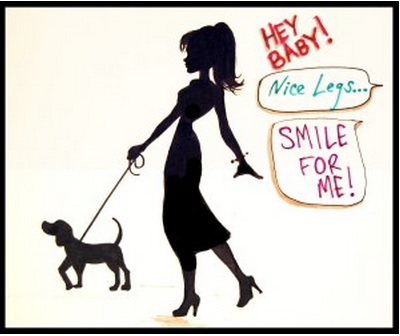 When I first became a social media volunteer for Stop Street Harassment, curating the Twitter and Facebook feeds for the nonprofit was tricky — I could find very few articles, blog posts, or tweets on the matter. Fast forward to 2 years later, and I can barely keep up with all the stories coming from women and LGBTQ folks exposing this cultural issue. The latest content to go viral is a video of a woman walking around New York City for 10 hours and being harassed more than 100 times.
Women have been taught street harassment is normal or even a compliment, but you can see from the video how sobering these incidents are when taken together over a few hours (now imagine them amassed over a lifetime).
And yet, many people take away a twisted message from calls to end street harassment. They assume ending street harassment means squashing all communication with strangers in public. They think women never want to be approached by people they don’t know. Usually the conversation goes like this:
Me: “We need to work to end street harassment.”
Opponent: “So you’re saying we should never approach anyone in public? What will that do to our communities!?”
This argument is a straw man. Feminists fighting street harassment are not trying to end all public interactions. We are simply asking that public interactions be respectful, mindful of personal space, free of unwanted sexual or objectifying remarks, and mutually desired.
Street harassment is rooted in a need to assert power, objectification of women’s bodies, and entitlement to women’s time and attention. But it is possible to have respectful street interactions — we just have to learn how to distinguish street harassment from street respect.
Street Harassment:
1. Saying (or yelling or shouting) sexual or objectifying comments. Some examples from stories women have submitted to Stop Street Harassment’s blog:
“Show me your tits!”
“Hi babe, would you like to touch my dick?”
“Have you got hair on it yet, love?” (said to a 15-year-old)
“That’s what I like, a woman on her knees.”
“Sluts!”
“Bitch!”
“I like your boobies!”
“Fine ass.”
“Take off your top!”
“Wanna f**k?”
Etcetera. Honestly, the examples of lewd comments go on and on and on.
2. Making sexual or objectifying gestures/disrespecting personal space:
Kissy noises
Following via car, bike or foot
Leering/staring
Pinching/groping
Blocking someone’s path
Taking photos up someone’s skirt or dress
Masturbating in public (do I really have to note this one? Apparently, yes.)
It should be pretty clear these actions and comments are disrespectful. So what constitutes street respect?
If you genuinely just want to make a new friend or are interested in speaking to someone who piques your interest on the street, you can absolutely go about it in a respectful way.
Street Respect:
1. Give compliments (but tread lightly).
* Steer clear of compliments that are actually just objectification of someone’s body or body parts.
* Try complimenting an actual object: “Great dress!” “I love the color of your shoes.” “Where did you get that awesome bag?”
2. Find common ground by asking questions.
* “I’ve read that book and really liked it. Are you enjoying it?”
* “Have you visited the bistro on 11th St.? I might go there for lunch and would love to hear an opinion.”
* “I used to have a beagle just like yours. Is he friendly?”
* “Do you use Lyft? I’m trying to get to Market St. and wondered if it’s worth installing the app.”
* “Can you recommend any good cafés nearby?”
3. Read body language. Take the following gestures to indicate someone is not interested in talking:
* Headphones in
* Walking briskly (like the woman in the aforementioned video!)
* Head down
* Lack of eye contact
* One-word answers
Too many women and LGBTQ folks live in fear of violence after a lifetime of being sexualized and approached aggressively in public. It’s absolutely possible to end street harassment while fostering respectful street interactions. Spread positivity on the streets, and exhibit genuine interest in and respect for those around you — don’t resort to harassing and intimidating others.
[Editor’s Note: Check out more of our resources on this subject.]
Julie Mastrine is a writer and feminist. She is the Social Media Manager at Care2 and is a social media volunteer for Stop Street Harassment. Follow Julie on Twitter and check out her e-book.
UPDATE: I posted this before I had a chance to watch it. After watching it and reading comments about it, two things come to mind:
1- I agree with some people who are saying that not everything depicted looked like harassment, but I think the point was to show the accumulation of how often men were speaking to her on the street, unsolicited, in a single day. I doubt they were all saying good morning and bless you to men walking by so in that sense, they are still treating her like public property that they can interrupt at any time.
2 – I am disappointed that the clip reinforces the stereotype that street harassment is men of color harassing white women when men of all races harass and women of all races are harassed… And some women harass and some men are harassed!! What would be more useful is a video that follows five different people of different backgrounds/identities in different parts of the country for a day to show the different types of harassment they each experience.
But that said, this video is getting a lot of views and attention and that is something this issue needs!
“God bless you, mami,”
“Hey baby.”
“DAMN.”
“You don’t wanna talk?”
Street harassment disproportionately impacts women, people of color, LGBTQ individuals, and young people, the group says on its website: “Although the degree to which Shoshana gets harassed is shocking, the reality is that the harassment that people of color and LGBTQ individuals face is oftentimes more severe and more likely to escalate into violence.”
Inspired by the experiences of his girlfriend, shooter Rob Bliss reached out to Hollaback! to partner on a PSA highlighting the impact of street harassment. For 10 hours, he walked with a camera in his backpack in front of volunteer Shoshana B. Roberts, who walked silently with two microphones in her hands.
The impact? You’ll have to see it for yourself.”