• About Us
    • What Is Street Harassment?
    • Why Stopping Street Harassment Matters
    • Meet the Team
      • Board of Directors
      • Past Board Members
    • In The Media
  • Our Work
    • National Street Harassment Hotline
    • International Anti-Street Harassment Week
    • Blog Correspondents
      • Past SSH Correspondents
    • Safe Public Spaces Mentoring Program
    • Publications
    • National Studies
    • Campaigns against Companies
    • Washington, D.C. Activism
  • Our Books
  • Donate
  • Store

Stop Street Harassment

Making Public Spaces Safe and Welcoming

  • Facebook
  • Instagram
  • Pinterest
  • Tumblr
  • Twitter
  • YouTube
  • Home
  • Blog
    • Harassment Stories
    • Blog Correspondents
    • Street Respect Stories
  • Help & Advice
    • National Street Harassment Hotline
    • Dealing With Harassers
      • Assertive Responses
      • Reporting Harassers
      • Bystander Responses
      • Creative Responses
    • What to Do Before or After Harassment
    • Street Harassment and the Law
  • Resources
    • Definitions
    • Statistics
    • Articles & Books
    • Anti-Harassment Groups & Campaigns
    • Male Allies
      • Educating Boys & Men
      • How to Talk to Women
      • Bystander Tips
    • Video Clips
    • Images & Flyers
  • Take Community Action
  • Contact

Video: “No mas puercas costumbres” (No more degrading customs)

September 15, 2014 By HKearl

Watch the video “No more degrading customs” (No mas puercas costumbres)

Film creator Paulina Romero shared the following about it with me for the SSH blog.

“Since my teenage years, I suffered street harassment in the streets of my country, Mexico. “No more degrading customs” came out from my personal need to denounce it. It’s a shortcut that exposes the patriarchal violence experienced by women in the streets of Mexico, aiming to help eliminate it.”

Paulina studied International Affairs, focusing in women studies and feminism. During her college years, she got involved in activism for women’s rights. Today, she is producing “El Arbol de Las Manzanas”, her first feature documentary about migrant women in New York City.


Share

Filed Under: Activist Interviews, Resources, street harassment

New Reports Show Sexual Violence is Common

September 7, 2014 By HKearl

This week there were two new reports released confirming the prevalence of sexual violence against children in the world and against women in the USA.

WORLD:

The UNICEF report “HIDDEN IN PLAIN SIGHT: A statistical analysis of violence against children” found that one in 10 girls worldwide have been forced into a sexual act, and six in 10 children ages 2 to 14 are regularly beaten by parents and caregivers. The report, drawing on data from 190 countries, paints a picture of endemic physical and emotional violence inflicted daily on children, mostly at home and in peacetime rather than on the streets or during war. Homicide is especially common in some of the Latin American countries from which children are fleeing by the tens of thousands into the United States.”

USA:

The Centers for Disease Control and Prevention released results from a 2011 survey. It found 19.3 percent of women have been raped. “Additionally, nearly 2 percent of men have been raped; nearly 44 percent of women and 23 percent of men have experienced some other form of sexual violence; and 15 percent of women and nearly 6 percent have men have been stalked…When it comes to who is committing these acts of violence, 99 percent of female rape victims and the vast majority of male rape victims — almost 80 percent — said they’ve only been raped by men.”

It’s hard for me to comprehend these numbers… but knowing how many of my friends, family, colleagues, former classmates, and activist friends are survivors helps conceptualize them a bit. This is a rampant huge and devastating problem. It’s overwhelming. But at least what each of us can do is to NOT be perpetrators ourselves, mentor youth/children to have empathy and respect for others, and help survivors heal, including ourselves (as relevant).

Share

Filed Under: News stories, Resources

Daily Show Knows Street Harassment is NOT Ok

September 3, 2014 By HKearl

If you watch The Daily Show, you probably love Jessica Williams — I know I do! And that love grew even more after her segment about street harassment last night.

The segment was in response to Fox News portraying street harassment as a compliment last week and one host even saying we should let “men be men.” During the segment, guest host and Fox contributor Arthur Aidala reenacted his personal signature “move” – aiming a slow round of applause at women on the street and said he has a 90% success rate because 90% of women smile at him.

Jessica broke down why this is flawed, namely that most women who smile at harassers on the street do so to try to end the interaction and because they don’t want to get called a Bitch or get followed or have trash thrown at them. She called street harassment creepy. And I also really liked this line: “Since going to work isn’t a performance, we aren’t looking for applause.”

Check out the full clip.

THANK YOU, Daily Show and Jessica Williams for this brilliant piece! Street harassment is not a compliment or joke nor is it okay. It needs to end.

Share

Filed Under: News stories, Resources, street harassment

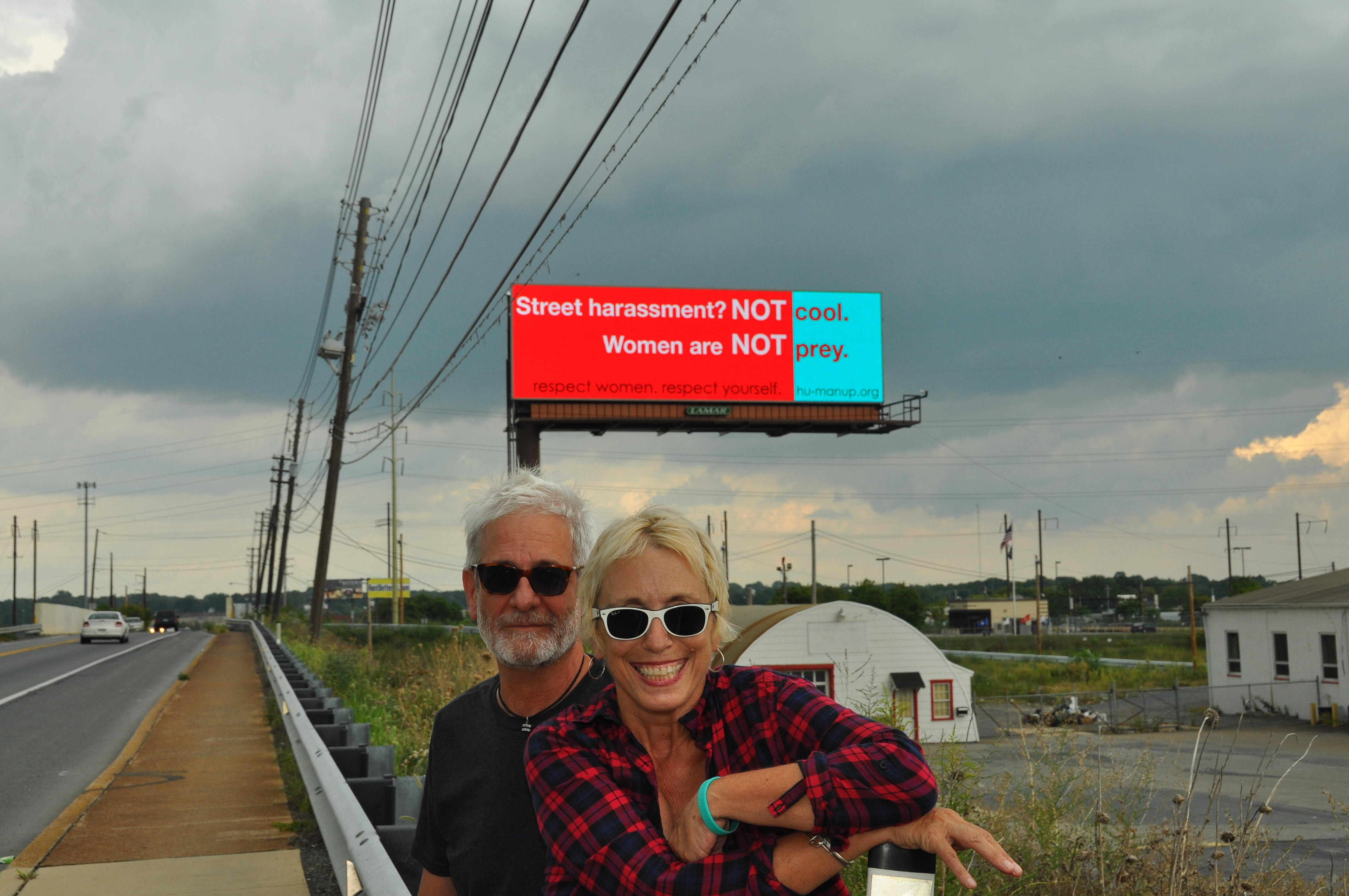
Billboards against Rape Culture in Lancaster, PA

September 1, 2014 By HKearl

Photo by Mark Hutchens

UPDATED: Here is the Ms Magazine article about the billboards. It was syndicated on Care2’s site.

Yesterday I had the privilege to meet Ray and Adele, the co-directors of hu_MAN Up, in Lancaster, PA. They’ve been involved in a number of efforts to challenge rape culture with their latest being three electronic billboard messages near the Franklin & Marshall campus. This is the one about street harassment. They’re determined to not just preach to the choir when it comes to these kinds of messages and hope that their billboard messages are reaching a lot of people who may not otherwise hear about rape culture or the need for consent and respect.

I’m writing an article about their billboards for Ms Magazine’s blog this week, so stay tuned.

They just received their 501c3 status and are fundraising to be able to do ads on buses and more billboard messages. Donate if you can!

Share

Filed Under: Activist Interviews, Resources, street harassment

USA: Decreasing harassment and increasing resiliency

September 1, 2014 By Correspondent

Kirstin Kelly, Monterey, California, USA, SSH Blog Correspondent

About a month ago, University of Tennessee researchers Dawn Syzmanski and Chandra Feltman published an article entitled “Helping Women Overcome the Anguish of Unwanted Sexual Advances.” The article professes that women who experience street harassment fall into two major categories: those who are resilient and those who are not. Immediately after publication, Syzmanski and Feltman faced backlash from people who felt the article was supporting victim-blaming mentalities by suggesting that people who are more resilient are better able to cope with the stress of unwanted sexual advances than people who are not.

Normally, I agree with people who caution against products or research that could perpetuate victim blaming because I, like most others, believe that pressuring those engaged in harassing behaviors is far more important than teaching would-be-victims to avoid responsibility. I fully agree that the onus of responsibility should be on the aggressors, not their victims. But this study is fundamentally different to me.

First, the idea of resiliency is widely accepted among psychologists as a way of understanding why certain people respond to stressors by using them as springboards while others experience overwhelming negativity as a result of the same type of occurrence.

Second, victim blaming usually refers to advice or products to help would-be-victims avoid situations that might lead to harassment or even assault. These are obviously problematic because they place the onus of responsibility on the victims to avoid situations in the first place, but ignore the reality that harassment and assault can happen to anyone at any time in any place under any circumstances.

Resiliency could be a useful tool in helping to combat the effects of street harassment because it helps survivors heal from trauma, which could include unwanted sexual advances, but it is victim blaming to suggest that people who lack resiliency will have a harder time. Similarly, since resiliency can be helpful in healing from a number of different traumas, it is not asking potential victims to alter their behavior in order to avoid negative situations.

There is nothing victims can do to keep themselves completely safe, but aggressors have the ability to stop their behavior. Social pressure definitely needs to be placed on the aggressors to stop the behavior, but in the meantime, research that helps us understand how victims can recover from their experiences is valuable. I think it’s helpful to encourage people to increase their resiliency regardless of their perceived susceptibility to aggressive behavior. Likewise, I think aggressors should be discouraged from continuing together.

Perhaps these two approaches work best when combined as a holistic approach to addressing rape culture and street harassment.

Kirstin is a Master’s Student in Nonproliferation and Terrorism Studies at the Monterey Institute of International Studies and a news editor at the Women’s International Perspective (The WIP). You can follower her on Twitter at @KirstinKelley1, where she regularly posts about human rights issues around the world.

Share

Filed Under: correspondents, Resources, street harassment

« Previous Page
Next Page »

Share Your Story

Share your street harassment story for the blog. Donate Now

From the Blog

  • #MeToo 2024 Study Released Today
  • Join International Anti-Street Harassment Week 2022
  • Giving Tuesday – Fund the Hotline
  • Thank You – International Anti-Street Harassment Week 2021
  • Share Your Story – Safecity and Catcalls Collaboration

Buy the Book

  • Contact
  • Events
  • Join Us
  • Donate
  • Facebook
  • Instagram
  • Pinterest
  • Tumblr
  • Twitter
  • YouTube

Copyright © 2026 Stop Street Harassment · Website Design by Sarah Marie Lacy