• About Us
    • What Is Street Harassment?
    • Why Stopping Street Harassment Matters
    • Meet the Team
      • Board of Directors
      • Past Board Members
    • In The Media
  • Our Work
    • National Street Harassment Hotline
    • International Anti-Street Harassment Week
    • Blog Correspondents
      • Past SSH Correspondents
    • Safe Public Spaces Mentoring Program
    • Publications
    • National Studies
    • Campaigns against Companies
    • Washington, D.C. Activism
  • Our Books
  • Donate
  • Store

Stop Street Harassment

Making Public Spaces Safe and Welcoming

  • Facebook
  • Instagram
  • Pinterest
  • Tumblr
  • Twitter
  • YouTube
  • Home
  • Blog
    • Harassment Stories
    • Blog Correspondents
    • Street Respect Stories
  • Help & Advice
    • National Street Harassment Hotline
    • Dealing With Harassers
      • Assertive Responses
      • Reporting Harassers
      • Bystander Responses
      • Creative Responses
    • What to Do Before or After Harassment
    • Street Harassment and the Law
  • Resources
    • Definitions
    • Statistics
    • Articles & Books
    • Anti-Harassment Groups & Campaigns
    • Male Allies
      • Educating Boys & Men
      • How to Talk to Women
      • Bystander Tips
    • Video Clips
    • Images & Flyers
  • Take Community Action
  • Contact

Video: Oppressed Majority

February 12, 2014 By HKearl

After many people sent it my way, I just watched the 10 minute film Oppressed Majority (Majorité Opprimée) by Eléonore Pourriat whose version with English subtitles has been watched over 2 million times in a week. In the film, roles are reversed and it’s a female-dominated society, and not in a nice way. They belittle, harass, assault and disbelieve the main character Pierre, in essence showing what every day life IS actually like for women worldwide.

An article in The Guardian provides background information —

“[Pourriat] says that the film “came from a personal experience. I was a woman. I was 30 years old. And my husband didn’t believe that I was – I was not assaulted, but I got remarked on in the street. Very often. He said, ‘Wow. That’s incredible.’ His surprise was the beginning of the idea for me. Sometimes men – it’s not their fault – they don’t imagine that women are assaulted even with words every day, with small, slight words. They can’t imagine that because they are not confronted with that themselves.”

SSH is working hard to reveal the every day street harassment women (and many men) experience worldwide. It’s part of our Everyday Sexism experiences. Don’t believe it, read our stories, read the stories on Everyday Sexism. This is a big problem and — if we care about girls and women at all — it needs to end now.


Share

Filed Under: News stories, Resources, street harassment

USA: Teen Dating Violence and Street Harassment

February 10, 2014 By Correspondent

Heather Frederick, USA, SSH Blog Correspondent

The month of February in the United States is Teen Dating Violence Awareness Month. Before making the link to street harassment, let’s start with a little education about the issue from LoveIsRespect.org:

* One in three adolescents in the U.S. is a victim of physical, sexual, emotional or verbal abuse from a dating partner, a figure that far exceeds rates of other types of youth violence.
* One in 10 high school students has been purposefully hit, slapped or physically hurt by a boyfriend or girlfriend.
* Approximately 70% of college students say they have been sexually coerced.
* Girls and young women between the ages of 16 and 24 experience the highest rate of intimate partner violence — almost triple the national average.
* Violent behavior typically begins between the ages of 12 and 18.
* Violent relationships in adolescence can have serious ramifications by putting the victims at higher risk for substance abuse, eating disorders, risky sexual behavior and further domestic violence.
* Being physically or sexually abused makes teen girls six times more likely to become pregnant and twice as likely to get a STI.
* Only 33% of teens who were in a violent relationship ever told anyone about the abuse.
* Eighty one percent of parents believe teen dating violence is not an issue or admit they don’t know if it’s an issue.
* A teen’s confusion about the law and their desire for confidentiality are two of the most significant barriers stopping young victims of abuse from seeking help.

As you can see from these shocking numbers, dating violence has a huge impact on youth culture in America.

The link between street harassment and intimate partner violence couldn’t be more glaring. Early on children are subjected to bullying, street harassment, and domestic violence. Even if they are not the ones being directly hurt by the words or actions, they are affected too.

Children can hear catcalls and see lewd gestures as easily as any other bystander, and for some women their personal experiences of being harassed in the streets start when they are still children. When kids of all genders grow up seeing and hearing such behaviors they become normalized and acceptable. Boys pull girls hair to show they like them and then we collectively wonder why grown women don’t feel they can go to the police when they are harassed, assaulted or abused.

We each have control over our own words and actions, so there is no excuse for violence. Whether in the form of street harassment or dating abuse, violence is always a choice.

Sometimes though things you experience aren’t so black and white, and it becomes difficult for people to distinguish whether or not something is abuse or harassment. The easiest rule for harassment is that if it makes you uncomfortable, it’s probably harassment. As for abuse, if it’s about power and control, it is abuse.

One thing that can help put a stop to this cultural cycle of violence is to teach children from a very early age about setting boundaries they are comfortable with, and teaching them that their bodies are their own, just as their friend’s body is his. Teaching every individual that if their boundaries are violated they have a right to seek help will not only empower those individuals to speak up for themselves, but will help all of us heal knowing that we’re in this together for a better future.

Want to get involved? There are so many fun things you can do to get involved in #TeenDVMonth! Are you wearing #Orange4Love? Post your pics on Twitter (@loveisrespect) and Instagram (@loveisrespectofficial) with #TeenDVMonth and #RespectWeek2014 or on Facebook at www.facebook.com/loveisrespectpage. You can also participate in the National Respect Announcement Thunderclap on Valentine’s Day, February 14th!

If you or someone you know is experiencing dating violence you can contact Love Is Respect 24/7 at 1-866-331-9474, by chatting at loveisrespect.org, or by texting “loveis” to 22522. No one ever deserves any kind of abuse.

Heather Frederick works a Supervisor for The National Dating Abuse Helpline, www.loveisrespect.org. Her passions include intersectional feminism, reproductive justice, languages, travel, blogging at www.FeministActivism.com (@FeministSNVA) and bringing an end to human rights abuses.

Share

Filed Under: correspondents, Resources, street harassment

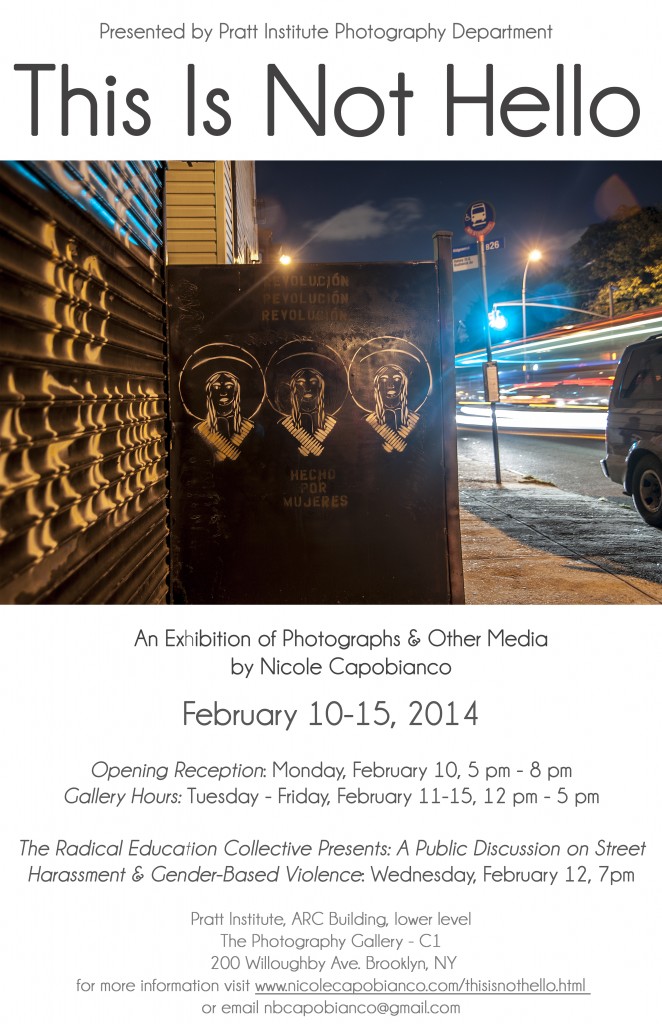
Art Exhibit: “This Is Not Hello”

February 7, 2014 By HKearl

Nicole Capobianco is hosting an exhibit of photography and other media focused on street harassment next week in Brooklyn, New York.

Here’s more information about it from Nicole, if you’re in the area, I hope you can attend!

“This Is Not Hello” examines street harassment through various street art applied by women. Too often our voices are silenced and dismissed as street harassment continues to be trivialized in our culture and in public policy. This work bridges the connection between public space and the female body, as this art is surfacing on city streets for a reason.

Our presence in public signifies our independence, and thus we are so often reduced to mere sexual objects when we enter it. The contradiction in street harassment lies with our bodies being treated as public property while the behavior simultaneously reinforces that public space is not a space we are allowed to occupy safely. I hope this project allows for men to learn what it means to be an ally to our struggle and how important it is that they too participate in dismantling these behaviors.

This is about finding our voice, and finding the strength in ourselves, alongside others, to speak out fearlessly against patriarchal belittlement and abuse in all aspects of our lives. We will resist your culture and produce another.

Share

Filed Under: Events, Resources, street harassment

Youth Film: “I’m Not Your Girl”

February 6, 2014 By HKearl

This film was made as part of the Girl Tech program in New Mexico. It was recently screened at the Media Literacy Project’s 20th anniversary party in Albuquerque.

See video

From the Media Literacy Project website:

“Set in Albuquerque, New Mexico, this short video gives us a brief glimpse into the life of a young woman and the street harassment she encounters one day while riding the bus. This film raises awareness on both street harassment and how one is more likely to encounter street harassment due to a reliance on public transportation. Directors: Mercedes Turner and Marina Oya.

Mercedes Turner is a graduate student of New Mexico Highlands University School with a degree from the School of Social Work and is currently pursuing her master’s degree in social work as well. Mercedes has worked with youth as a programs department intern with Mothers Against Drunk Driving and as an intern with the YWCA of New Mexico. She enjoys volunteering in the community, watching movies, and spending time with family and friends. She wants to continue working with nonprofit organizations who work with young people to help them pursue their dreams.

Marina Oyá is currently a junior at the Public Academy for Performing Art and will graduate in 2015. She loves filmmaking, dance, visual art, and working with kids. In the summer of 2013 she volunteered at Eugene Field Elementary School in Albuquerque working with students in their summer school program. She plans to study marine biology in college.”
Share

Filed Under: Activist Interviews, Resources, Stories, street harassment

Survey: Harassment Common in Public Spaces in Bangladesh

January 30, 2014 By HKearl

Here’s another study showing just how common street harassment is — this time in Bangladesh.

Via The Daily Star:

“Women almost regularly face sexual harassment in public places, mostly on streets, in markets and on public transport, according to a government survey.

About 43 percent of the 12,600 women surveyed recently have said public places are the most common spot where they are sexually harassed.

The survey, jointly done by the Bangladesh Bureau of Statistics and United Nations Population Fund, covered all the seven divisions of the country. The women were randomly chosen from city, urban and rural areas.

“I hardly know a woman who has not been verbally harassed or groped in the streets,” said Umme Nahar, an official of a private firm in the capital.
She claimed she was first groped at the age of twelve and that she is sexually harassed every day on the streets….

Asked for her comments, Ayesha Khanam, president of Bangladesh Mahila Parishad, said women’s attire was not the issue here. “Women wearing all types of clothing face sexual violence. It cannot be generalised that women wearing a certain kind of clothing face more sexual harassment,” she said.”

Share

Filed Under: News stories, Resources, street harassment

« Previous Page
Next Page »

Share Your Story

Share your street harassment story for the blog. Donate Now

From the Blog

  • #MeToo 2024 Study Released Today
  • Join International Anti-Street Harassment Week 2022
  • Giving Tuesday – Fund the Hotline
  • Thank You – International Anti-Street Harassment Week 2021
  • Share Your Story – Safecity and Catcalls Collaboration

Buy the Book

  • Contact
  • Events
  • Join Us
  • Donate
  • Facebook
  • Instagram
  • Pinterest
  • Tumblr
  • Twitter
  • YouTube

Copyright © 2026 Stop Street Harassment · Website Design by Sarah Marie Lacy