I love this PSA from UN Women’s Egyptian office.

Making Public Spaces Safe and Welcoming
I love this PSA from UN Women’s Egyptian office.
 Stop Street Harassment is pleased to announce the release of our newest publication and online resource Know Your Rights: Street Harassment and the Law.
We’ve spent the summer and fall surveying the laws in all 50 U.S. states and D.C. and we have good news: many common street harassment behaviors (such as groping, indecent exposure, and up-skirt photos) are illegal across the U.S. That means you can report street harassment to the police and hold a street harasser legally accountable for his or her actions (when you feel that’s appropriate).
Street harassment is not specifically criminalized the way sexual harassment in the workplace and schools is. However, state laws like Disorderly Conduct, Invasion of Privacy, and Sexual Misconduct prohibit many common street harassment behaviors. Each state has their own set of rules about public behavior and sexual harassment, so we’ve laid out what the relevant crimes are called in each state’s code and let you know exactly what’s legal and what isn’t.
As of today – Human Rights Day – you can find all of this information online or you can download a PDF of the complete toolkit.
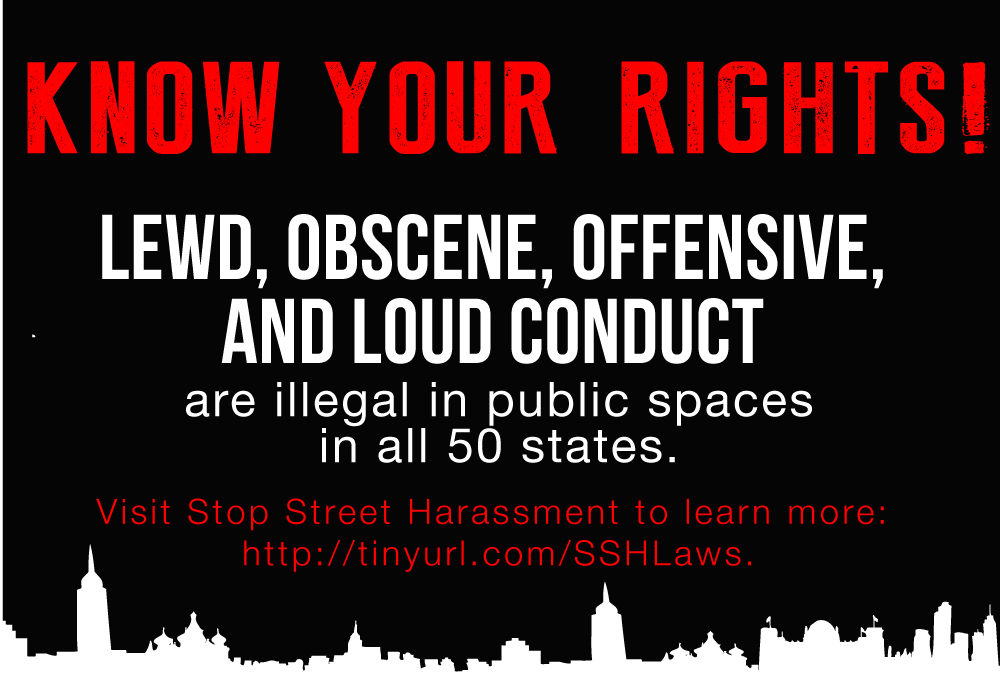 We think the Know Your Rights toolkit is a ground-breaking project in the fight against street harassment because, for the first time, all of the state-level criminal law that could be used to stop street harassment has been compiled, analyzed, and made accessible to anyone who needs them. In a society that says street harassment is a compliment, we want you to be able to say, “No, it’s disorderly conduct.”
We hope you will use this information to exercise your right to protection from the police when you experience illegal street harassment and to encourage your local lawmakers to further protect women, people of color, and members of the LGBTQ community in public spaces.
Of course, we know that reporting harassment to the police or criminalizing harassment are not the only ways to end street harassment. In some cases, these may not even be the best ways. Criminalizing behavior can be problematic when laws are disproportionately applied to low-income communities and communities of color. With that in mind, Stop Street Harassment encourages you to engage with your local law enforcement to ensure the law is always applied fairly and that your community handles street harassment in the most constructive way possible. We endeavor to provide you with information so that you can advocate for your rights to safe public spaces and to the other freedoms you are entitled to under the law, such as due process.
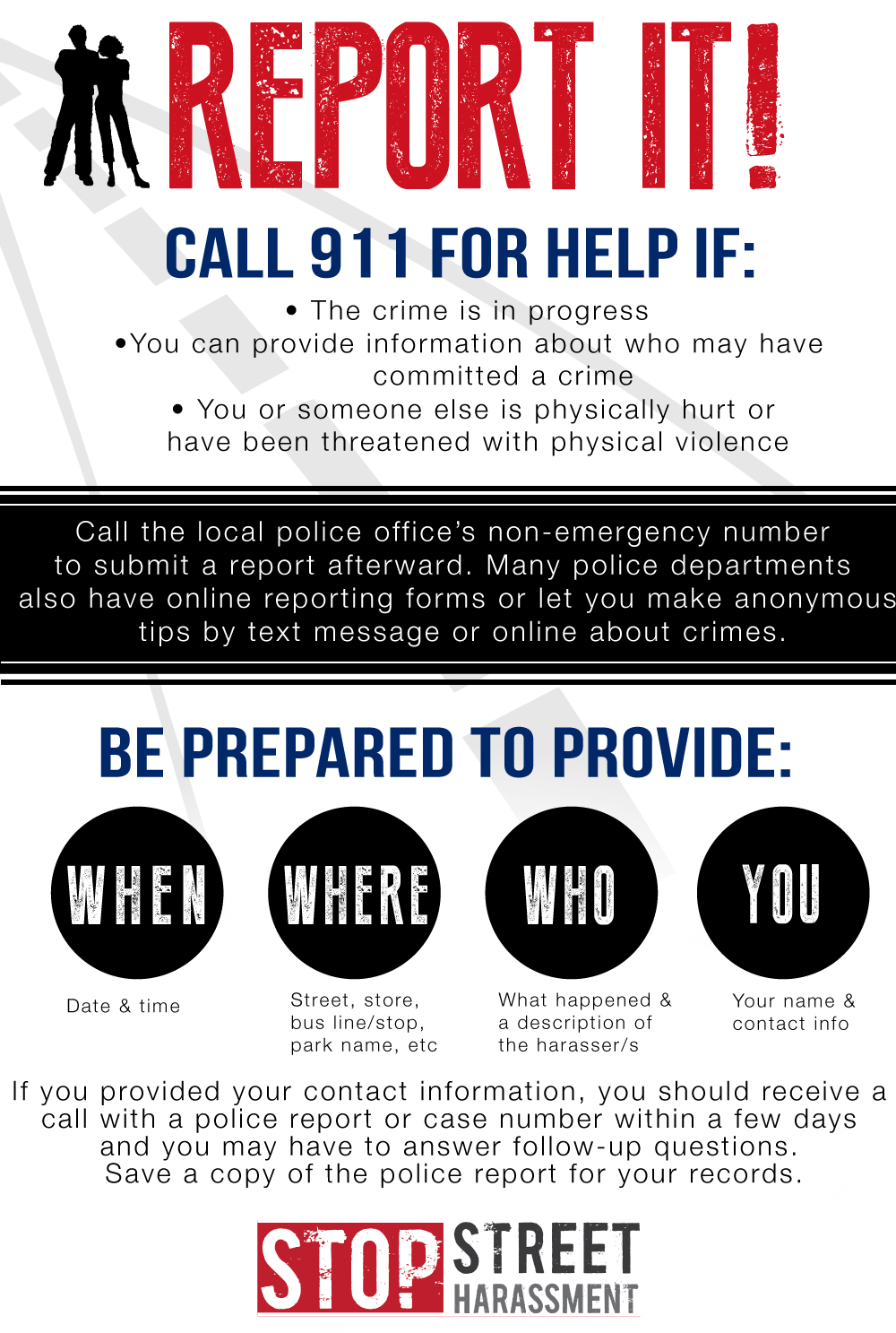 As we’ve said before, there is no best way to deal with street harassment – every person and situation differs. Ending street harassment for good will require a multi-pronged approach, including education, awareness campaigns, and engaging the legal system. If a street harasser does commit a crime against you, we want to equip you to make an informed decision. Armed with that knowledge, you can then decide whether or not to report harassers to law enforcement, especially for crimes like up-skirt photos, public masturbation, stalking, and groping.
Take a look at your state’s section of the toolkit to get an idea of the kinds of street harassment that are illegal – or to report a crime that has already happened. You’ll also find useful information in the Introduction, including what to expect when you report street harassment and how to deal with harassment from police officers themselves.
Finally, we’d like to add one important takeaway from our work on the project: in speaking with several police officers around the country, we learned that you can engage a police officer or call 911 any time you feel threatened, even before a crime has been committed. This seems obvious in retrospect, but 75% of women report they have been followed and yet few report it to the police. If you think someone is following you, or you feel otherwise scared, intimidated, or threatened, you have the right to help from the police.
They say knowledge is power, friends, so here’s a nation’s worth.
Have you reported street harassment to the police? What happened? What did you learn about your local laws from our toolkit? How do you plan to use this knowledge? Share your story in the comments
Talia Hagerty has been an intern with Stop Street Harassment since June 2013. She is also a peace economics consultant working on a variety of projects that ensure the equitable economic participation of all. She holds a B.A. in Economics from Eckerd College and an M.S. in Global Affairs with a concentration in Peacebuilding from New York University. Talia blogs about peacebuilding, human rights, economic development, and witty responses to street harassment. Follow her on Twitter: @taliahagerty.
 For many women, and some men, street harassment may be such a normal occurrence that they don’t even think of reporting it to police. Similarly, it’s not uncommon to be reluctant to report even serious incidents for fear that officers won’t take the report seriously, that they will engage in victim blaming, or that you will be subject to further harassment. (Unfortunately, this can be the case and we encourage you to file a complaint if this happens to you).
But Stop Street Harassment’s newest resource, Know Your Rights: Street Harassment and the Law, reveals that many common street harassment behaviors are in fact illegal across the U.S., giving you grounds to report an incident and seek help.
In preparation for the launch of our toolkit, I spoke to Officer Harris of the University of Washington Police Department about an incident of street harassment that he recently responded to.
The University of Washington Incident
The incident began as too many do: a female student was out for an evening run near the University of Washington campus when a man allegedly jumped out from around a corner, grabbed her by the arm, and said, “How are you doing tonight?”
As anyone who has experienced street harassment knows, a harasser’s language may be benign in itself but it usually comes with an intimidating interaction.
The student responded with a few choice words and crossed the street. (While SSH doesn’t recommend profanity or insults, an assertive response can help prevent sexual assault and/or feelings of disempowerment.)
After making sure the man hadn’t followed her – although he did leer in her direction – the young woman returned home and called University Police. Harris responded to the call, checked the area where the incident took place, and the young woman identified the man in question. He was arrested and charged with assault.
While it would be better if street harassment didn’t happen at all, the situation Harris described is ideal in terms of the young woman’s safety and the police response. I asked Officer Harris if he felt there was any room for discretion in determining whether or not to arrest the offender.
“No,” he said, “she was afraid for her safety and her well-being.” Given that it was after dark and “the guy grabbed her and really scared her,” he added, “I think most police officers would have taken that very seriously.”
Unfortunately, we know that not all officers see street harassment so clearly. But Officer Harris presented the perspective we hope all police officers will have and the standard that you should hold your community police to.
“Even if somebody made rude comments,” Harris said, “or made somebody feel unsafe, even if it wasn’t a crime yet, we would still go and talk to them.” Officer Harris stressed that no one should feel “unqualified” to call the police because what happened to her or him did not escalate to physical assault. It is appropriate, he told me, for an officer to have a “knock-it-off” conversation with someone even before an incident becomes criminal.
“A lot of very serious incidents start off as ‘it’s not that serious, it’s not a big deal.’ … But we’ll be glad to go investigate and keep things from escalating.”
In a society that says street harassment is a “compliment,” or “no big deal,” Harris’ perspective may sound too good to be true. But in fact, it may be a sign that advocacy efforts do work.
Notably, Victim’s Advocate Natalie Dolci provides the University of Washington officers with a variety of training and support to best address sexual assault, stalking, and gender-based violence.
I asked Harris what his main takeaways were from the training he has received and what advice he might have for other officers.
* He shared that he learned what a lasting impact sexual assault and sexual abuse can have on a person, and stressed that it’s important for officers to take every case very seriously.
* He included street harassment in that sentiment, noting that officers have a role to play in preventing street harassment from “becoming a habit” or escalating.
* He also added that his department works to have a positive relationship with the community and looks “for directions from the community on what problems they have or what they need help with.
Reach out to your department,” he said, “and let them know what you need.”
Have you reported street harassment to the police? What happened? What did officers in your community do well, or what would you like them to do differently? Leave your stories and ideas in the comments, and check out our new Know Your Rights toolkit to learn about the laws in your state.
Talia Hagerty has been a Stop Street Harassment intern since June 2013. She also is a peace economics consultant working on a variety of projects that ensure the equitable economic participation of all. She holds a B.A. in Economics from Eckerd College and an M.S. in Global Affairs with a concentration in Peacebuilding from New York University. Talia blogs about peacebuilding, human rights, economic development, and witty responses to street harassment. Follow her on Twitter: @taliahagerty.

** Sign up to receive a monthly e-newsletter from Stop Street Harassment ***
Street Harassment Stories:
Share your story! You can read street harassment stories on the Web at:
Collective Action for Safe Spaces
The Hollaback sites
Ramallah Street Watch in Palestine
Street Harassment in South Africa
Street Harassment In the News, on the Blogs:
* Washington Post, “How should bicyclists handle harassment? D.C. area groups teach empowerment tactics“
* Mother Jones, “Meet the Woman Who Waged an Artistic War Against Her Street Harassers“
* Clutch Magazine, “#FastTailedGirls Hashtag Examines Stereotypes Facing Young Girls“
* Newsworks, “Photographer turns lens on Philadelphia street harassment“
* Women’s News Network, “EGYPT: Bike riders campaign works to stop sexual harassment of women“
* The Jewish Daily Forward, “Who Harasses Women on the Street“
* PolicyMic, “Burt’s Bees Shouldn’t Joke About Street Harassment“
* The Massachusetts Daily Collegian, “Stand against street harassment“
* I Am Nirbhaya, “Bihar: Woman athlete assaulted for resisting harassment attempts“
* Prospect, “Sexism goes underground“
* Planetizen, “Tools to Protect Cyclists from Street Harassment“
* NYU Local, “Asking For It: NYU Local Explores Street Harassment“
Announcements:
New:
* We’re holding our holiday online auction Dec. 3-8. Check it out tomorrow!
* Our Safe Public Spaces Mentee in Cameroon, held a successful final event on Saturday with more than 20 youth.
* Our Safe Public Spaces Mentee in Chicago taped three dating commercial spoofs on street harassment.
* Holiday Shopping Guide Part 1
* We’re releasing our Know Your Rights Toolkit: Street Harassment and the Laws on Dec. 10 for International Human Rights Day.
* 5 Ways to Take Action during the 16 Days of Activism Against Gender Violence that runs Nov. 25 – Dec. 10.
* There’s a new UN report: Study on Ways and Methods to Eliminate Sexual Harassment in Egypt
Reminders:
* Donate to help fund the FIRST EVER national study on street harassment in the USA!
* Save the date — International Anti-Street Harassment Week is March 30 – April 5 in 2014!
* Read about the successful Philadelphia City Council Hearing on Street Harassment on Nov. 7!
* Buy a copy of the new book 50 Stories about Stopping Street Harassers! Here’s how to hold a book club fundraiser for SSH
10 Tweets from the Week
* @Sabali89 I figured out why men making the first move is an automatic turnoff- PTSD from too much street harassment. Sorry fellas. I’ll initiate.
* @CSRA_prsn It’s the first day of the meteorological winter. That means it is prime street harassment season in the South. #endSH
* @mujer_cita_MIA i told a male friend that a man had shouted “lemme lick it” to me in the street & he didn’t believe me #streetharassment
* @msbrandiebrown First experience with #streetharassment as a 9 year old in The Dot, 40 year old dude drives up next to me. Licking his lips #fasttailedgirls
* @DanTresOmi As men we can’t get mad at police when they harass us but give #streetharassment a pass – that’s hypocrisy
* @AwakeBlackWoman You’ve read the stories: 20, 30, 40+ years of dealing with street harassment, abuse, fending off creepers & rapists. But we #FastTailedGirls
* @AwkwardGirlLA Why is it that bc I’m wearing exercise clothes while riding my bike, men think its okay to yell at me from their car? Perv #streetharassment
* @ericadanielle89 Did I ask you if I had a cute ass? Then DON’T COMMENT ON IT. #streetharassment
* @wtsnia nearly every morning these shitheads feel the need to catcall at most of the women who walk by. why. why are you doing this.
* @emmavoight walked back from other side of campus, had four black guys in a car smelling of weed catcall at me on telegraph, feels like home berkeley
The new report “‘It’s Dangerous to be the First’: Security Barriers to Women’s Public Participation in Egypt, Libya, and Yemen” includes a portion about street harassment. Here is an excerpt:
“In all three countries, women perceived harassment to be on the rise, becoming both more frequent and more serious….
In the face of growing insecurity – as power continues to be renegotiated throughout the Middle East and North Africa – women activists in Egypt, Libya, and Yemen have established a wide variety of grassroots initiatives to protect themselves and others against threats. Such initiatives have been coupled with powerful outreach and media campaigns at the local, national, and regional level to raise awareness of women’s security concerns.
In Egypt and Yemen a number of initiatives were formed to document accounts of sexual assaults and violence targeting women. Egyptian initiatives such as ‘Harassmap’ and ‘Shoft Taharosh’ (‘I Witnessed Harassment’) are based on the idea that documenting harassment through online and mobile technologies can help raise awareness. Using detailed maps of local incidents of harassment, volunteers talk to people on the streets about sexual harassment, challenge stereotypes and myths, and try to convince communities and the public generally to speak up and act against sexual harassment.
In Yemen several similar initiatives have developed, some of them explicitly modelled on Egyptian approaches, others reacting independently to similar problems. Such initiatives have combined with ‘citizen journalist’ footage of individual instances of harassment and assault. Through film-making and journalistic initiatives they make harassment, sexual violence, and other forms of violence against both men and women visible in novel ways. Mosireen, a video collective, for instance, are documenting violence against male and female protestors on video, acting as an archive and repository for such footage and producing short documentaries.
The combination of visual representations and awareness-raising around the prevalence of harassment with video footage of particularly shocking instances has begun to break down the prevailing attitudes of denial and excuses of harassment as harmless or natural and has been central to raising the profile of this issue and encouraging public debates about it.”
I have so much admiration for the women and men in these countries who are working hard to make sure all women and girls are safe in public places, including safe as they participate in political rallies and events. It takes a lot of bravery.