• About Us
    • What Is Street Harassment?
    • Why Stopping Street Harassment Matters
    • Meet the Team
      • Board of Directors
      • Past Board Members
    • In The Media
  • Our Work
    • National Street Harassment Hotline
    • International Anti-Street Harassment Week
    • Blog Correspondents
      • Past SSH Correspondents
    • Safe Public Spaces Mentoring Program
    • Publications
    • National Studies
    • Campaigns against Companies
    • Washington, D.C. Activism
  • Our Books
  • Donate
  • Store

Stop Street Harassment

Making Public Spaces Safe and Welcoming

  • Facebook
  • Instagram
  • Pinterest
  • Tumblr
  • Twitter
  • YouTube
  • Home
  • Blog
    • Harassment Stories
    • Blog Correspondents
    • Street Respect Stories
  • Help & Advice
    • National Street Harassment Hotline
    • Dealing With Harassers
      • Assertive Responses
      • Reporting Harassers
      • Bystander Responses
      • Creative Responses
    • What to Do Before or After Harassment
    • Street Harassment and the Law
  • Resources
    • Definitions
    • Statistics
    • Articles & Books
    • Anti-Harassment Groups & Campaigns
    • Male Allies
      • Educating Boys & Men
      • How to Talk to Women
      • Bystander Tips
    • Video Clips
    • Images & Flyers
  • Take Community Action
  • Contact

How to Prevent Sexual Harassment?

November 5, 2013 By HKearl

More and more studies are showing that sexual harassment – including street harassment – is a widespread problem that negatively impacts the lives of harassed persons. But there is less information available about why sexual harassment happens and how to prevent it from occurring.

A reporter for the International Business Times covers what IS known:

“What are some of the causes of sexual harassment? Despite popular perceptions, it’s usually not about innocent flirtation. In one 2008 study published in the journal Sex Roles, researchers interviewed 80 men from the Arlington, Texas area. They found that a man was more likely to exhibit harassing behavior if he was also more likely to suspect that women were criticizing and rejecting him.

 “These findings also support recent speculation that men’s sexual harassment of women is related to aggression rather than seduction,” the authors wrote.

When you turn to the literature to try and find scientific evidence for what interventions actually work, there’s an incredible gap of scientific evidence. In his 2007 meta-analyses reviewing 8 studies from between 1995 and 2006, researcher Bruce Douglas found that diversity training tends to have only a small effect on attitudes or behavior. Other studies also report just marginal benefits from sexual harassment prevention training.

“The lack of quantitative studies on diversity training continues to be prevalent,” Douglas wrote.

So what is to be done? There may be another avenue to help the victim that doesn’t rely on educating the harasser: all the other people in the office. Bystanders – such as people who hear about sexual harassment through the office grapevine, or directly from the harassed colleague – can also be powerful tools in combating harassment in the workplace, according to a July 2012 report from the Australian Human Rights Commission.“

For suggestions on what to do as a bystander, visit our webpage, watch “Shit Men Say to Men who Say Shit to Women on the Streets” and read our new book 50 Stories about Stopping Street Harassers.

Our proposed national study on street harassment will survey both women and men and ask questions about if survey takers have ever been harassers and if so, why. This is sorely needed data! You can donate $10 or more today to help make this study, about the people and funded by the people, possible.

Share

Filed Under: News stories, Resources, SSH programs, street harassment

2013 Global Gender Gap Report

October 26, 2013 By HKearl

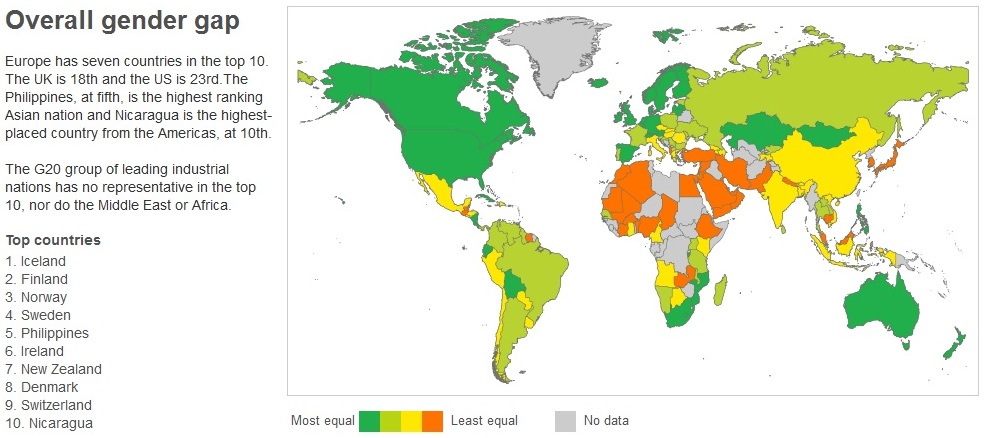
Every year, the World Economic Forum determines the global gender gap country by country, by analyzing different factors, such as women’s versus men’s education, political representation, and health.

This year, Iceland ranked number one in The Global Gender Gap Report and is followed by Finland, Norway and Sweden. This means women in these countries enjoy the most equal access to education and healthcare and they’re most likely to be able to participate fully in the country’s political and economic life.

BBC Reports:

“Overall, the gender gap narrowed slightly across the globe in 2013, as 86 of 133 countries showed improvements. However, “change is definitely slow”, says one of the report’s authors, Saadia Zahidi.”

Via BBC

The U.S. comes in at number 23. We’re pretty good on issues like education and health (e.g. very few women die at childbirth), but we’re very bad on political participation.

I often note that no country has achieved gender equality and this is always the report I have in mind when I say that. Year after year, this fact remains true. I see street harassment as a symptom of this inequality and a contributor to it — women are less likely to be in the workforce, receive an education, and be in politics if they face harassment simply trying to go to those venues.

Ending street harassment is one of many inter-related pieces we need to work to address before we can see true equality.


Share

Filed Under: News stories, Resources

USA: Hollaback! Boston Releases State of the Streets

September 30, 2013 By Correspondent

By: Delia Harrington, Massachusetts, USA, SSH Correspondent

“I Hollaback because I shouldn’t ride my bike in order to avoid harassment.” – Nai

Hollaback! Boston released their State of the Streets report today, based on data collected from over 500 Bostonians during the month of August.  A startling 88% of respondents had experienced street harassment, proving that there is absolutely a place in Boston for the work of organizations like Hollaback!, Everyday Feminism, and of course Stop Street Harassment.

As readers may know, Hollaback! was co-founded in New York City by Emily May, and has since become a worldwide movement.  The organization strives to end street harassment; conducting workshops and campaigns, and empowering those affected by street harassment by gathering and sharing their stories.

The Boston chapter was co-founded by current leaders Britni de la Cretaz and Kate Ziegler in 2011.  While each branch operates autonomously, they share strategies with one another.  According to today’s Report, the Boston branch was inspired by Hollaback! Ottawa’s own fact-finding.  Similarly, some recommendations mention the successes of other Hollaback! branches.

The report details how Bostonians define harassment, where and how often they experience it, how it makes them feel, as well as recommendations moving forward from Hollaback!  According to the report, Hollaback! Boston decided to collect information not only to see the scope of the issue in Boston, but also to educate others.  While the site leaders hear stories of street harassment often, many others don’t.  As they say in the report,

“We wanted to find a way to communicate this fact to people, especially people that may not think that street harassment is really a problem or people that don’t experience street harassment themselves. We wanted to put the reality of what we face when we walk out the doors and out onto the streets of Boston in black and white.”

Respondents to the survey were overwhelmingly women (86%) and  people in the LGBTQIA community (31%).    Of those respondents, 87% were female-identified,  90% were LGBTQIA-identified, 94% identified as a person of color, 96% identified as both LGBTQIA & POC,  and 90% identified as being a person with a disAbility, reported experiencing street harassment.  This supports the notion long held among those attempting to end street harassment that POC, LGBTQIA folks and those with a disAbility experience particularly high levels of street harassment.

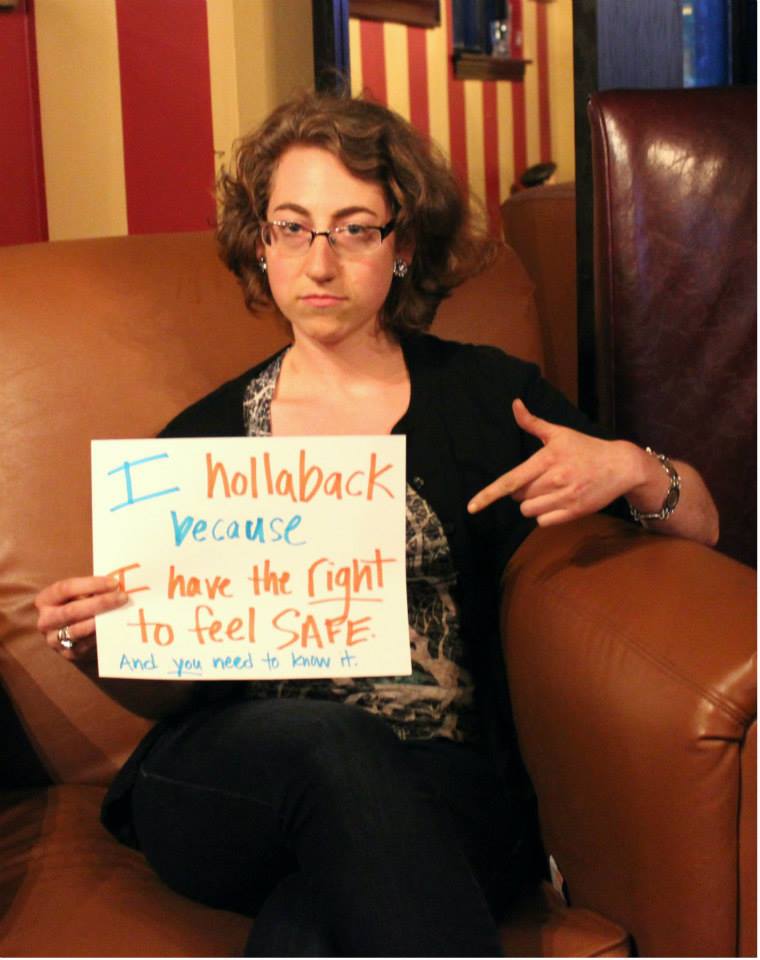
“I Hollaback because I have the right to feel safe. And you need to know it.” – Becca

Harassment is largely taking place on the street (97%), on the MBTA (63%),  in bars or clubs (37%),  in public parks (32%), and at  school (14%).  Not surprisingly, those respondents experiencing harassment said it made them feel angry (85%), nervous (80%) , annoyed (78%), disgusted  (72%) , and scared (64%).   And for  those who claim street harassment is enjoyable for the victim, or that it is not a big deal, only 14% of respondents said  they were ‘flattered’, and only4% said street harassment ‘didn’t bother’ them.  While the report refrained from editorializing, I’d like to note that while some respondents were flattered or not bothered, it is impossible to tell whether the person you’re seeing on the street will be nervous or flattered by the attention, so it’s best to err on the side of caution (and the numbers) and treat everyone as though they wouldn’t like it.

Like many working in this space, Hollaback! Boston sees bystander intervention as a key tool to combat street harassment.  Unfortunately, only 14% of respondents reported an instance of someone intervening on their behalf.   As a result, Hollaback! suggests the, “creation of a public education campaign that focuses on tangible ways that people can safely intervene.”

The data is likely unsurprising to readers of this site and fans of Hollaback’s work, but it is incredibly valuable to have hard statistics to show to potential partners moving forward.  For example, given that 63% of respondents reported feeling harassed on the MBTA, the report’s suggestion of an ad campaign (similar to that created by Hollaback! Philadelphia and run on SEPTA trains), training for MBTA employees on how to respond to street harassment, and an awareness campaign (à la “See Something, Say Something”) about available reporting mechanisms may all be seen as higher priorities by MBTA officials.  Moreover, while Hollaback! makes several suggestions moving forward, they are all constructive and include next steps for themselves as an organization.  Hopefully this approach will continue to be successful as they use their model of presenting a problem and a potential solution that includes their assistance at the same time.

I hope that other Hollaback! branches and similar organizations are able to conduct a similar survey in the future, so other cities can wield statistics that accurately reflect the unique picture of street harassment in their area.  I hope Hollaback! Boston continues to receive good local press coverage, which could pressure businesses and city officials to prioritize street harassment.  Congratulations to Hollaback! Boston, and we look forward to the implementation of the recommendations.

Delia Harrington is a recent graduate of Northeastern University and calls Boston home. In recent years, she has found herself studying, working, and volunteering in Egypt, Cuba, France, Benin, the Dominican Republic, Turkey, Germany, and Greece.  You can read more of her writing on her blog, or follow her on Facebook and Twitter, @deliamary.

Share

Filed Under: correspondents, News stories, Resources, Stories

Report: Street Harassment in Boston

September 30, 2013 By HKearl

Hollaback! Boston surveyed more than 500 people about street harassment. Check out their survey results.

Read more in the Metro. and via SSH Blog Correspondent Delia’s article.

Share

Filed Under: Resources, street harassment

One Week until the New Book is Out!

September 16, 2013 By HKearl

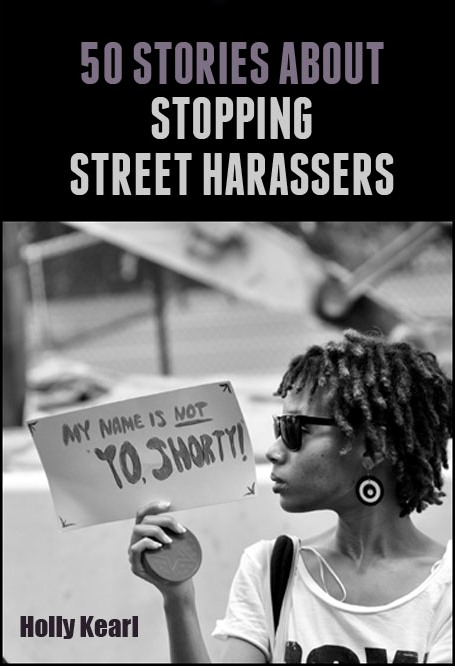
Here’s the book cover! The photograph of Dienna Howard was taken by Mark Hutchens. Cover design by moi.

WOOOO!!

Next Monday, Sept. 23, my second book about street harassment will be available on Amazon.com for a mere $10 (and 50% of the profits will go directly to SSH to fund our work).

From unwanted catcalls on the street to flashing on the subway and groping in bars: gender-based street harassment is a huge problem. Most people are unsure what to do or how to respond. I know I was, especially as a college student when I faced constant harassment each time I left my campus in northern California.

While there is no “best” way to deal with harassers, my new book 50 Stories about Stopping Street Harassers contains 50 one-page stories from people in 16 countries that offer creative, entertaining, and empowering techniques and strategies for readers to consider trying out when they feel safe. The people in the stories call out harassers, publicly shame them, demand apologies, report them, and stand up for other people being harassed.

All of the stories were either submitted to or featured right here on the SSH Blog!

The book also includes 20 photos of awesome people speaking out against this issue!

What is great about this book is how it approaches the serious topic in an entertaining and approachable way. It offers concrete examples and advice for what to do when faced with unwanted harassment in public spaces.

For journalists and bloggers out there:

I am happy to provide an excerpt of the book, do an interview, or just provide an embargoed PDF of the book manuscript if you want to write about it or mention it in a relevant article. Just contact me, hollykearl AT yahoo DOT com. Thanks!

Share

Filed Under: Resources, SSH programs

« Previous Page
Next Page »

Share Your Story

Share your street harassment story for the blog. Donate Now

From the Blog

  • #MeToo 2024 Study Released Today
  • Join International Anti-Street Harassment Week 2022
  • Giving Tuesday – Fund the Hotline
  • Thank You – International Anti-Street Harassment Week 2021
  • Share Your Story – Safecity and Catcalls Collaboration

Buy the Book

  • Contact
  • Events
  • Join Us
  • Donate
  • Facebook
  • Instagram
  • Pinterest
  • Tumblr
  • Twitter
  • YouTube

Copyright © 2026 Stop Street Harassment · Website Design by Sarah Marie Lacy