• About Us
    • What Is Street Harassment?
    • Why Stopping Street Harassment Matters
    • Meet the Team
      • Board of Directors
      • Past Board Members
    • In The Media
  • Our Work
    • National Street Harassment Hotline
    • International Anti-Street Harassment Week
    • Blog Correspondents
      • Past SSH Correspondents
    • Safe Public Spaces Mentoring Program
    • Publications
    • National Studies
    • Campaigns against Companies
    • Washington, D.C. Activism
  • Our Books
  • Donate
  • Store

Stop Street Harassment

Making Public Spaces Safe and Welcoming

  • Facebook
  • Instagram
  • Pinterest
  • Tumblr
  • Twitter
  • YouTube
  • Home
  • Blog
    • Harassment Stories
    • Blog Correspondents
    • Street Respect Stories
  • Help & Advice
    • National Street Harassment Hotline
    • Dealing With Harassers
      • Assertive Responses
      • Reporting Harassers
      • Bystander Responses
      • Creative Responses
    • What to Do Before or After Harassment
    • Street Harassment and the Law
  • Resources
    • Definitions
    • Statistics
    • Articles & Books
    • Anti-Harassment Groups & Campaigns
    • Male Allies
      • Educating Boys & Men
      • How to Talk to Women
      • Bystander Tips
    • Video Clips
    • Images & Flyers
  • Take Community Action
  • Contact

Women’s Equality Day: Share Your Story

August 26, 2013 By HKearl

Today is Women’s Equality Day and while we’ve come a long way since women gained the right to vote in the USA in 1920, there is still so far to go since sexism and gender violence are very real issues.

Help bring attention to the issue of street harassment by sharing your story with CNN via their iReport assignment.
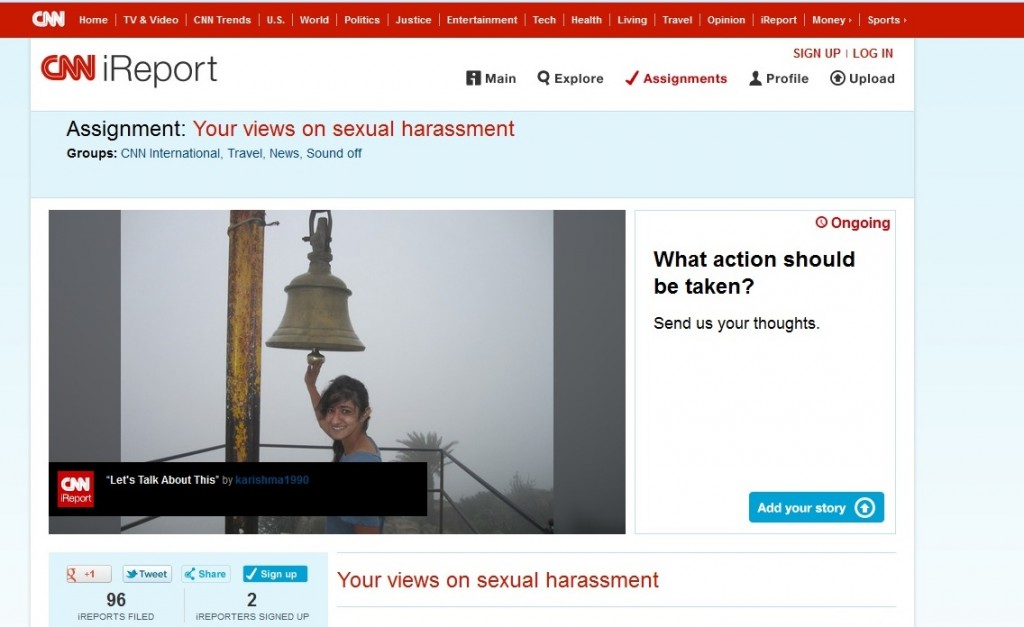
I shared mine and then linked my story and the issue to Women’s Equality Day.

Street harassment is a global problem. Studies show that more than 90% of women in countries like Egypt, India, Yemen, and the USA experience it. More than 80% do in Canada. A recent study in France found that 25% of women ages 18-29 feel scared when they walk down the streets. In London, 43% of women ages 18-34 had experienced street harassment just during the prior year.

If you add to that the thousands of stories women have shared on my blog Stop Street Harassment, on the Hollaback! sites, and through the The Everyday Sexism Project, as well as the stories they share on personal blogs, Tumblrs and other social media sites, you can see that this is a huge problem.

Repeated street harassment and severe forms of it cause many women emotional distress and significantly impact their lives, including prompting them to avoid going places alone, to change routes and routines, and even to move neighborhoods or quit jobs.

I’ve seen this over and over through the stories shared on my blog Stop Street Harassment. There was the woman in Kansas who considered dropping out of her PhD program because she was routinely harassed by men near her campus; a woman in Mississippi who quit her job at a retail store because male customers began following her to her car after her shift; and a woman in California who was harassed so many times while she waited for a bus to campus that she finally went home, feeling upset and powerless, and missed the class.

Most telling is how unsafe street harassment makes women feel. Gallup data from surveys conducted in 143 countries in 2011 show that in every single county, women are considerably more likely than men to say they feel unsafe walking alone at night in their communities. Women in low-income countries and high-income countries reported the same rate: 41% felt unsafe. In the USA, 38 percent of women felt unsafe, compared with 11 percent of men.

I also want to bring up the young age street harassment begins. For my book, I surveyed 811 women from 23 countries and 45 US states and nearly 1 in 4 had been harassed in public by men by age 12. That’s seventh grade. Nearly 90% had been harassed by age 19.

Some women even say that the first time they heard sexual comments from men on the street was the moment when they felt they transitioned from girlhood to womanhood. This is a sad statement about womanhood in our society.

In the USA, Monday is Women’s Equality Day. I argue that the USA – and no other country – will achieve women’s equality until street harassment ends. Until we can travel and study abroad, walk to the corner store, wait for a bus, and go to a park without fearing or experiencing sexual harassment, we are not equal.

What can we do?

If you’ve faced street harassment, share your stories, especially with men in your life. Make visible this too-often invisible problem. If someone shares a story with you, don’t dismiss it, don’t tell them it’s a compliment, don’t tell them it’s their fault because of what they’re wearing or that they shouldn’t have been there or out alone. Instead, believe them, offer them support, and tell them you’re sorry that happened.

If you have children, nieces/nephews, teach or mentor youth, talk to them about sexual harassment, about respect, and about how to get help. Let’s ensure that the next generation can be in public spaces safely.

 Most of all, don’t harass others, be respectful. Ask for consent before talking to someone. Never use sexual language on the street with someone you don’t know without permission to do so. Treat people how you would want someone you love to be treated.

 Let’s make public places free from sexual harassment.

Share

Filed Under: Resources, street harassment Tagged With: women's equality day

UN International Youth Day

August 12, 2013 By HKearl

Today is the UN International Youth Day and our partner Youth Leader Magazine is hosting a day-long webcast featuring 20 youth activists from across the country.

Zoneziwoh Mbondgulo, in Buea, Cameroon, and a SSH Safe Public Spaces Mentee is one of the speakers! Check out the webcast and find more info.

Share

Filed Under: Events, Resources, SSH programs, street harassment

Researchers to Map the Anti-Street Harassment Network

August 6, 2013 By HKearl

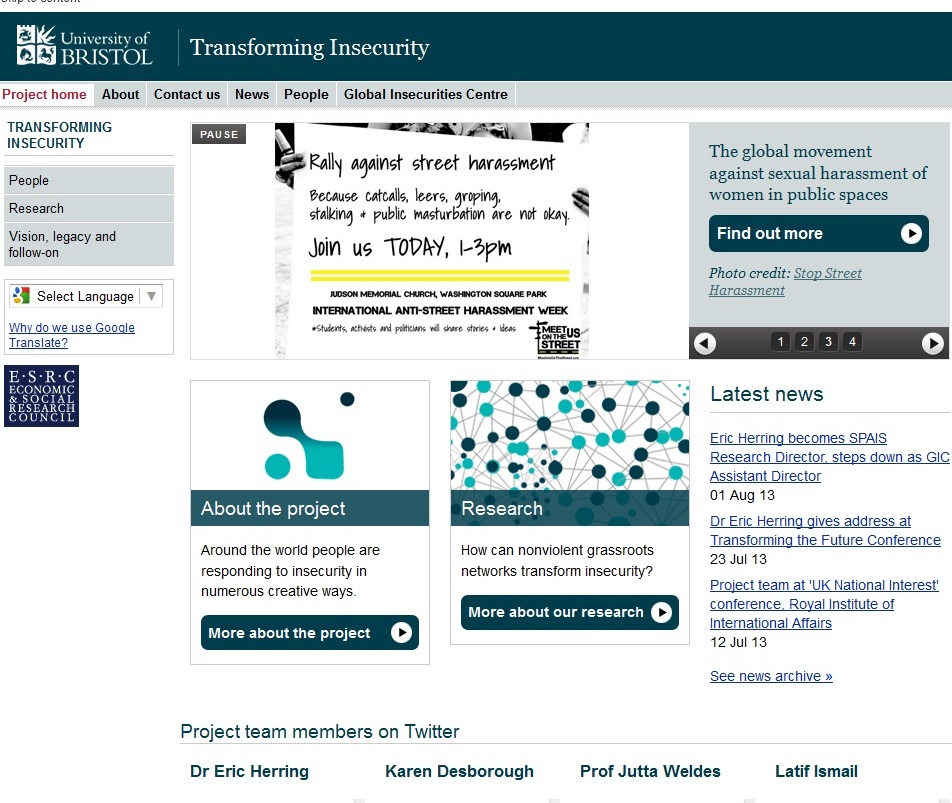
How can nonviolent grassroots networks – including the network to stop street harassment – transform insecurity?

This is a research question that a team at the University of Bristol will answer over the next 18 months thanks to the Economic and Social Research Council (ESRC) grant they were recently awarded. The team is led by Dr Eric Herring, Research Director of SPAIS (School of Sociology, Politics and International Studies).

Here’s a brief summary of the project:

“The project will explore how three existing networks — a neighborhood watch to prevent suicide bomb attacks in Somalia; projects to record every casualty of armed conflict in many countries in the global South; and projects to stop the street harassment of women in the global North and South — relate to the state, global governance and all actors that use and threaten violence. It will also explore these ideas in relation to grassroots security actors which are seeking to network with each other across issue areas.”

Visit the project’s website to learn more.

I’ve chatted twice with Eric and his colleague Karen Desborough and I’m excited to report that I am now a “Research Collaborator” for the street harassment-specific part of the project. So stay tuned for more information about the project and how it will help strengthen our network and efforts to stop street harassment!

Share

Filed Under: News stories, Resources, SSH programs

Video Interview with Tatyana Fazalizadeh

August 5, 2013 By HKearl

Here’s a great video interview from Quiet Lunch Magazine with artist Tatyana Fazlalizadeh, the person behind the amazing “Stop Telling Women to Smile” project. Don’t forget, you can now bring her art work to your community!

“The posters are directed toward men…but the posters are really for women. When they walk past it, I want them to feel like they have a voice, they have an advocate for them, they have somebody out there speaking up for them.” – Tatyana

After featuring her work on the Stop Street Harassment blog periodically since Oct. 2012, I’m excited to FINALLY meet her in person on Sunday to discuss possible collaboration!

Share

Filed Under: Activist Interviews, Resources, street harassment

Afghanistan Street Harassment Documentary

August 5, 2013 By HKearl

“Do Not Trust My Silence” is a powerful new short film about street harassment in Afghanistan (English subtitles), directed by Afghan filmmaker Sahar Fetrat. She won the first prize in Italy’s “Universocorto Elba Film Festival” for her “extreme courage of reporting the Afghan women’s condition in the streets of Kabul and for the technique of shooting with a hidden camera.”

She writes:

“‘Do Not Trust My Silence’ was my fourth film which was produced in April 2013 and it is one of my favorites. When I first joined the Afghan voice’s media training, I had the vision of making a documentary about street harassment. This documentary for me is more than just a 10-minute film, there is a lot in it. There is a big pain in it that all women, especially Afghan women, can feel. This documentary shows only a little of what we see, feel and experience every day.

When I made this film, I knew that both women and men should be my audience. For men to see and feel a part what we experience every day, and for women to say no to street harassment. I wanted to show that, as a young woman, I do not accept harassment as my destiny and other women should do the same.

While producing this film, I put myself as the main character and I filmed most of the parts with a small flip camera. It was not easy to film men while harassing me or other women, some of them were throwing small rocks towards us. But I did not stop my work because my aim was to show harassment and how destructive it is. I totally believe that we women are strong enough to not give up and fight against it and we have the power to stop it.”

H/T to SSH’s SPS Mentoring Program Mentee Masooma Maqsoodi

Share

Filed Under: Activist Interviews, News stories, Resources, street harassment Tagged With: Afghanistan, documentary

« Previous Page
Next Page »

Share Your Story

Share your street harassment story for the blog. Donate Now

From the Blog

  • #MeToo 2024 Study Released Today
  • Join International Anti-Street Harassment Week 2022
  • Giving Tuesday – Fund the Hotline
  • Thank You – International Anti-Street Harassment Week 2021
  • Share Your Story – Safecity and Catcalls Collaboration

Buy the Book

  • Contact
  • Events
  • Join Us
  • Donate
  • Facebook
  • Instagram
  • Pinterest
  • Tumblr
  • Twitter
  • YouTube

Copyright © 2026 Stop Street Harassment · Website Design by Sarah Marie Lacy