• About Us
    • What Is Street Harassment?
    • Why Stopping Street Harassment Matters
    • Meet the Team
      • Board of Directors
      • Past Board Members
    • In The Media
  • Our Work
    • National Street Harassment Hotline
    • International Anti-Street Harassment Week
    • Blog Correspondents
      • Past SSH Correspondents
    • Safe Public Spaces Mentoring Program
    • Publications
    • National Studies
    • Campaigns against Companies
    • Washington, D.C. Activism
  • Our Books
  • Donate
  • Store

Stop Street Harassment

Making Public Spaces Safe and Welcoming

  • Facebook
  • Instagram
  • Pinterest
  • Tumblr
  • Twitter
  • YouTube
  • Home
  • Blog
    • Harassment Stories
    • Blog Correspondents
    • Street Respect Stories
  • Help & Advice
    • National Street Harassment Hotline
    • Dealing With Harassers
      • Assertive Responses
      • Reporting Harassers
      • Bystander Responses
      • Creative Responses
    • What to Do Before or After Harassment
    • Street Harassment and the Law
  • Resources
    • Definitions
    • Statistics
    • Articles & Books
    • Anti-Harassment Groups & Campaigns
    • Male Allies
      • Educating Boys & Men
      • How to Talk to Women
      • Bystander Tips
    • Video Clips
    • Images & Flyers
  • Take Community Action
  • Contact

Call for Blog Correspondents: 2014 Cohort 1

December 23, 2013 By HKearl

Last year, Stop Street Harassment launched a Blog Correspondents Program with two cohorts. In 2014, we’re revising it a bit and will have three cohorts of correspondents. The members of each cohort will write four total posts, one per month (cohort 1: Jan. – April, cohort 2: May – Aug., cohort 3: Sept. – Dec.).

SSH is accepting applications for the first cohort. This is an unpaid, volunteer opportunity and is a great resume builder and chance to make a difference on an important global topic!  And your words will be read: the SSH blog has tens of thousands of readers each month.

Assignment:

From January to April, correspondents in the first cohort must commit to writing one blog post per month about street harassment issues in their community, region or country, four posts total. The topics could include incidents of street harassment, activism to stop it, and street harassment in popular culture, traditions or the news.

We aim to have geographic diversity among our cohort members.

Applying:

By January 6, 2014, please e-mail: 1) your name, 2) the region of the world or the USA where you’re from, 3) a writing sample of a blog post or article (in the range of 500-1000 words), and 4) a few sentences about why you want to be part of the Stop Street Harassment team.

If you prefer to write in a language other than English, please also indicate what language is most comfortable for you and you can send your writing sample in that language.

E-mail to: hkearl @ stopstreetharassment.org. Address to Holly.

Share

Filed Under: SSH programs, street harassment

USA: Empowering, Educational Event in Chicago

December 19, 2013 By Contributor

By Phaydra Babinchok, Chicago, IL, USA, SSH Safe Public Spaces Mentee

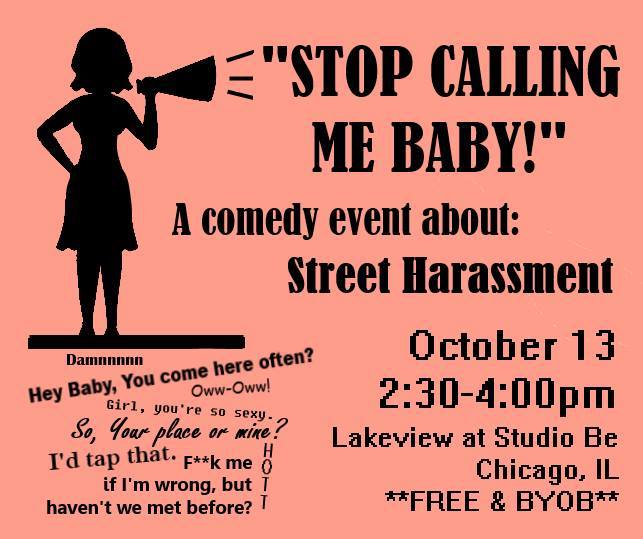
In addition to creating three short films as part of the Stop Street Harassment’s Safe Public Spaces Mentoring Program, we created a fun event for screening the films. With the $250 stipend provided I was able to book a performance space at Studio Be a nonprofit theatre. The screening was held on the afternoon of Sunday October 13.

I wanted to create a comedy event about street harassment. Because it is such a serious issue I feel it needed a light-hearted touch to make it a more approachable subject. My friend Alicia Sowisdral is a feminist comedian and host of Pop Goes Alicia a live monthly pop culture show about gender. I reached out to her and she gladly agreed to be the host for the event.

Stop Calling Me Baby, a comedy event about street harassment, still needed a few performers before it would be complete. The lineup was rounded out with two stand-up comedians and a spoken word performer. As I said before, I feel it is important to include men in the discussion so one of the stand-up comedians was a man.

The stand-up comedy was interspersed with a powerful spoken word performance. The performances ended with a hilarious stand-up set about street harassment by Marla Depew. Who knew street harassment could make one laugh so hard.

Then it was time to debut the films. They were projected onto a large screen and I stayed behind the curtain during the screening because I was nervous that the films wouldn’t go over well. I had anxiety that the films might possibly upset people because we are in a way making fun of a serious issue. However, my anxiety was quickly alleviated by the audience’s laughter.

Once the films were done screening Alicia led a Q&A with the audience and writers of the films. Again I was nervous that there would be a critical or judgmental question about the films, but the audience really liked them. We were able to talk with the audience about how street harassment is a daily issue that most women have to deal with. People in the audience shared personal stories of experiences of street harassment.

Overall, the event turned out exactly as I had wanted. It was empowering, educational, and fun for all.

Phaydra Babinchok is a feminist activist based in Chicago. She is the Director of SlutWalk Chicago and Chapter Leader of Chicago’s Women, Action, and the Media. She works at Sarah’s Circle, a program that helps homeless women.

Share

Filed Under: Events, SSH programs, street harassment

USA: Spoofing eHarmony Commercials

December 18, 2013 By Contributor

By Phaydra Babinchok, Chicago, IL, USA, SSH Safe Public Spaces Mentee

I was excited upon learning about Stop Street Harassment’s Safe Public Spaces Mentoring Program. I had wanted to do an activist project concerning street harassment and this seemed like the perfect opportunity. As an aspiring feminist filmmaker I knew I wanted to pitch a creative project involving film since I think it is the best medium for educating. Since the majority of films about street harassment are documentaries or have a serious tone I knew I wanted to do the complete opposite and approach street harassment from a comedic viewpoint.

Humor is one of our most powerful tools; it is subtle and doesn’t make people defensive. I initially pitched three short films. The first film was going to be a role reversal or satire of the sexes where a man was being catcalled by women. The second film was going to be a woman talking to the camera asking the questions from the catcaller questionnaire. The third film was going to show a street harasser getting escalating warnings for his behavior. For his first offense he was going to be sprayed with a spray bottle, for his second offense he was going to be squirted with a squirt gun, and then as his final warning he was going to be sprayed with a super soaker.

There were multiple meetings with varied groups to develop the films. There was a meeting with fellow feminists and during that meeting it was suggested that the third film idea of giving escalating warnings was trivializing street harassment. An alternative idea of creating “Shit Street Harassers Say” was suggested. During the meeting with feminists I kept emphasizing that the films were supposed to be funny and not serious, but this idea wasn’t really supported. I then held a meeting with community activists and we storyboarded the first film concept of reversing the roles. I sent the storyboard to Holly and Jaclyn Friedman and their feedback was that men aren’t afraid of women so was there any way to change it show real fear. I didn’t think that would be possible to do while still retaining a comedic viewpoint so the film was dropped.

There was a final meeting with comedians and this is when a whole new concept was developed. We decided to parody the E-Harmony dating site commercials. We wanted to develop one film about a couple who met and started dating because of street harassment.

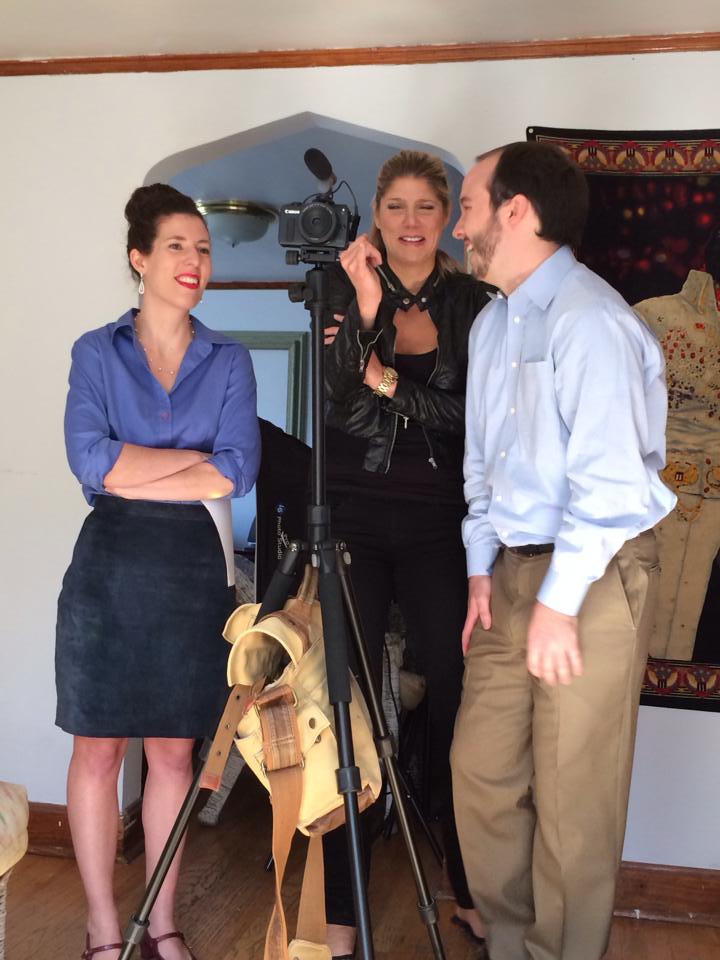
In the end we developed three videos each written by a different comedy writer, two of whom are men. I feel it is important to involve men in feminist issues instead of just merely lecturing to them. All the language in the films is deliberate. “When Fairies Attack” reverses the usual scenario of straight men street harassing gay men because of their sexuality. The term bitch is used to emphasize how demeaning street harassment is. “He’s Just Not Into That” was written because we didn’t want the men to feel left out and to acknowledge that men do get street harassed. I wrote “Damsel In Distress” to poke fun at the common belief that it is not safe for a woman to walk alone and that she needs a man a “good guy” to protect her.

They are available online – please share – and we showed them at an event in Chicago in October.

Phaydra Babinchok is a feminist activist based in Chicago. She is the Director of SlutWalk Chicago and Chapter Leader of Chicago’s Women, Action, and the Media. She works at Sarah’s Circle, a program that helps homeless women.

Share

Filed Under: SSH programs, street harassment

Cameroon: Workshop to Raise Awareness and Build Allies with Adolescents

December 14, 2013 By Contributor

By Zoneziwoh Mbondgulo, Buea, Cameroon, SSH Safe Public Spaces Mentee

It is estimated that about 1 in 3 women worldwide experience sexual or physical violence at least once in their lives.  And over 80 percent of women across the globe have also experienced at least one or two or several forms of street harassment from men they do not know, and Cameroon is no exception.

In Cameroon, street harassment is still an overlooked issue. It is common seeing men and even young boys feeling it’s ok to publicly abuse or harass a lady. This long age act on women and girls is more or less seen as a norm to a social issue that must be address.

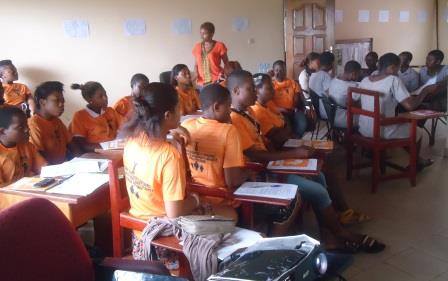
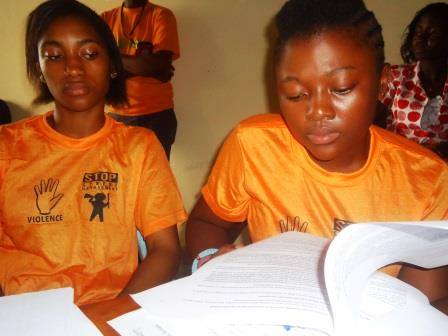
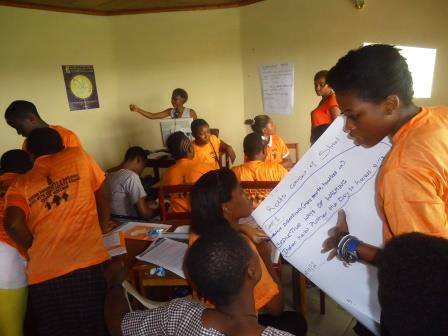
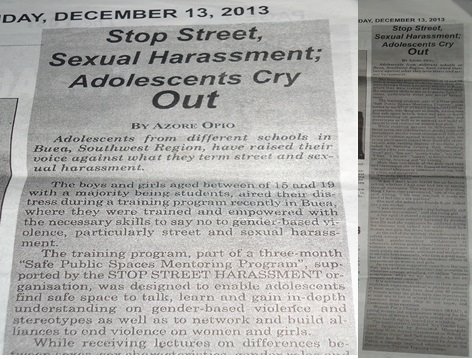
In Buea, Cameroon, on November 30, 2013, during the 16 Days of Activism Against Gender Violence, over 25 boys and girls within the ages of 15-19, the majority been students from different schools across Buea, were trained and empowered with the necessary skills to say no to gender-based violence, particularly, street and sexual harassment.

The training program which was part of 3 months, Safe Public Spaces Mentoring Program, supported by the STOP STREET HARASSMENT organization, was hosted by Women For A Change, Cameroon (WFAC), a young women-led organization working for the promotion of women and girls sexual and reproductive health rights.

Designed to enable adolescent girls and boys find safe space to talk, learn and gain in-depth understanding on gender based violence and stereotypes; as well as to network and build alliance to end violence on women and girls.

The training opened with participants asked to complete the sentence, connecting to the UN’s suggestion to wear orange to stand up against violence: #Iwearorangebecause….

Rocard, 18 years #Iwearorangebecause ” I am a boy and i stand for equality” #16DAYS #16DAYSOFACTIVISM

#Iwearorangebecause ‘I m a girl and i stand for equality” Fatima 17 years

“#Iwearorangebecause I have a voice and it should be heard” Gobina, 17years

Next, participants shared their fears and expectations from the training.  The majority feared that a day would not sufficient to gain enough knowledge and skills to effectively mentor peers, raise awareness, and/or educate the public, families and friends on the negative consequences of gender-based harassment of girls/women. One participant said, “I am always shy and often feel inferior to speak up. I need to take part in many more of such programs so I gain self-empowerment and boldness to speak up.”

Nonetheless, their expectations kept them hopeful that by the end of the day, they would have acquired the necessary tool to face some of their fears, and most importantly they would know how to use the skills gained and reach out to a wider population.

The training, which lasted for six hours, included three lecture seminars, a series of role play, debates, interactive sessions, and Q&A.

The first lecture seminar, facilitated by me, explained to  participants some KEY GENDER CONCEPTS – like differences between sex and gender; examples of sex characteristics and gender roles and stereotypes; what’s gender-based violence and different forms of violence against women and girls – with a particular focus on street and sexual harassment.

During the lecture seminar 1, a participant was nominated by the group to chair and moderate a group discussion, where everyone present was asked to take time to reflect on a situation where s/he thought they experienced / witnessed gender based violence – principally street and sexual harassment- and how they overcame / addressed it.

THE REFLECTIONS

More than 2/3 of the girls said they had experience one or two forms of harassment – be sexual advances or unwanted touch, both in public and on campus – and when this happens sometimes they just ignore or throw insult back at the harasser. The most common experiences were – whistling,  abusive jokes and comments like ‘African baby’,  ‘small girl’ ,’ fine ass’, ’ pretty butts’,  ‘ my size’,  ‘V boot’ ‘a say ehh’ ,’sssshh’ ,’ehhh’ ,  and at times forceful holding, catcalling, touching, ‘air-kiss’…

Two girls, aged 16 and 17, shared individual experiences with harassment online which include sexist comments and unwanted sexual attention. E.g, one said how a guy she doesn’t know texts her on Facebook asking whether she had ever had sex or sexting through messaging.  “This was the most disgusting thing I have ever experience” she explains. “I feel very insulted; it made me kind of feels like a sex-machine”

When it happened, she continues “I had to ask my friends if I looked like a sex worker”. “I was severely affected – psychologically and sometimes traumatized,” she added

One boy, aged 18 shared a negative experience of how he had once been sexually harassed by another man and how his experience with the lesson gathered at the training has helped him understand how women and girls feel when harassed.

Another participant aged 19 spoke of her experience face-to-face with sexism. She explains, “Last youth year, I practiced and rehearsed to perfection to act the role of the president for a drama my school was to perform. But, I was discriminated against by being given the role of a secretary. The teacher said to me that ‘a woman can’t be a president’, he even went on to ask me if the president of Cameroon was a woman.”

“I was bittered about the choice, and the fact that I was deny simply because I was a woman not based on competence”, she added, “Whereas the boy who took the role couldn’t deliver compared to me. Everyone knew I was good at my role and if allowed to act the role of the president, I was going to deliver so well”.  

“In my village,” another attendee said, “Education is meant only for boys. They say because boys inherit, so let more privilege be given to a boy. After my first school, I was asked to go to the market and sell and hope for the day where a man will get married to me. My dad preferred to sponsor my male siblings to boarding schools; he will send girls to day schools.

“At first, in our house,” another said, “Boys wouldn’t cook. Cooking was meant for girls only. But gradually, I used my position as a senior sister, to bring balance in the kitchen. Now at home the boys do cook.”

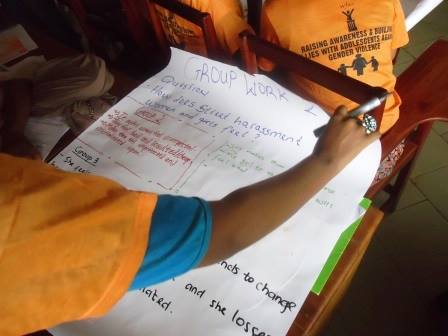
After the first lecture seminar, participants were assigned to group tasks. Each group expected to brainstorm and seek solutions towards combating street harassments and sexual gender based violence on women and girls. Solutions proposed were: government must establish gender-sensitive mechanisms to effectively address gender based harassment and violence on women and other minority groups as a security issue.  Participants also suggested that “more public awareness, seminars and workshops to educate boys especially, who form a great number of the harassers, on the secondary effects of harassment on women and girls”. An exceptional suggestion from the boys group that “girls and women shouldn’t pay attention to what ever strange whistling, catcalling”, “sometimes, when we are ignored, we feel extremely sad and useless!” the boys said.

The next lecture seminar followed shortly after the break and the topic was on Dealing With Sexual Harassment in School in Just Seven Steps. The session was very interactive, and also had group works.

The last lecture seminar of the day was facilitated by Ms. Amshatu Verbe, a visual impaired educationist at the Government Teachers Training College, Buea, and her presentation was focused on self-esteem as an effective tool and weapon adolescents must have while addressing gender based violence (street and sexual harassment)

In culmination, participants expressed satisfaction and attainment of their expectations. Since the training, many have joined our WFAC page on the social media, through which we continue to engaged and share knowledge on weekly basic, on best ways to increase public awareness on gender based harassment, get boys involved as allies and above all gained  empowerment as advocates against Violent on Women and Girls.

Updates on this project can be found at: Women for a Change- Cameroon, or via Twitter @zofem.

Share

Filed Under: 16 days, SSH programs, street harassment

Know Your Rights: Street Harassment and the Law

December 10, 2013 By SSHIntern

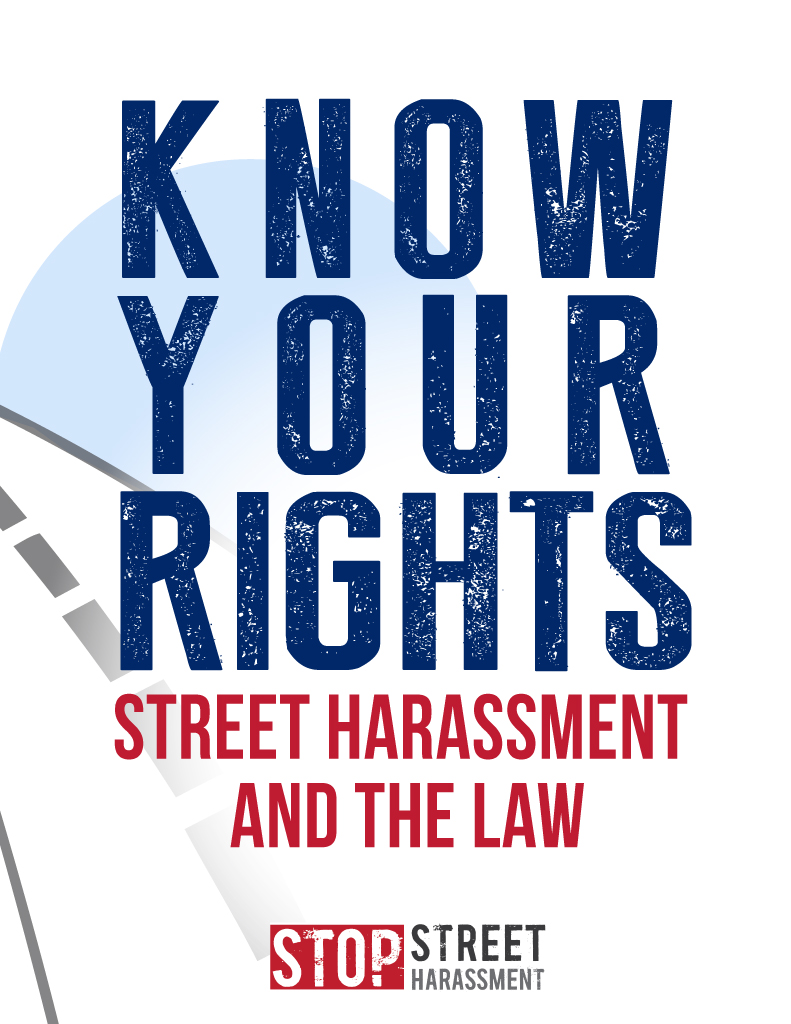
Stop Street Harassment is pleased to announce the release of our newest publication and online resource Know Your Rights: Street Harassment and the Law.

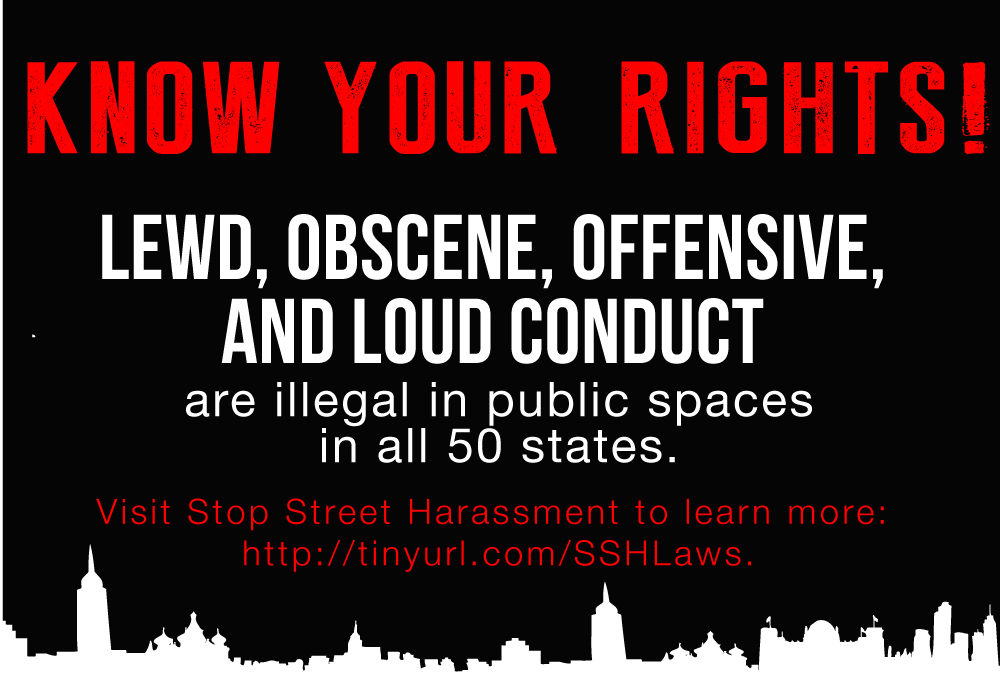
We’ve spent the summer and fall surveying the laws in all 50 U.S. states and D.C. and we have good news: many common street harassment behaviors (such as groping, indecent exposure, and up-skirt photos) are illegal across the U.S. That means you can report street harassment to the police and hold a street harasser legally accountable for his or her actions (when you feel that’s appropriate).

Street harassment is not specifically criminalized the way sexual harassment in the workplace and schools is. However, state laws like Disorderly Conduct, Invasion of Privacy, and Sexual Misconduct prohibit many common street harassment behaviors. Each state has their own set of rules about public behavior and sexual harassment, so we’ve laid out what the relevant crimes are called in each state’s code and let you know exactly what’s legal and what isn’t.

As of today – Human Rights Day – you can find all of this information online or you can download a PDF of the complete toolkit.

We think the Know Your Rights toolkit is a ground-breaking project in the fight against street harassment because, for the first time, all of the state-level criminal law that could be used to stop street harassment has been compiled, analyzed, and made accessible to anyone who needs them. In a society that says street harassment is a compliment, we want you to be able to say, “No, it’s disorderly conduct.”

We hope you will use this information to exercise your right to protection from the police when you experience illegal street harassment and to encourage your local lawmakers to further protect women, people of color, and members of the LGBTQ community in public spaces.

Of course, we know that reporting harassment to the police or criminalizing harassment are not the only ways to end street harassment. In some cases, these may not even be the best ways. Criminalizing behavior can be problematic when laws are disproportionately applied to low-income communities and communities of color. With that in mind, Stop Street Harassment encourages you to engage with your local law enforcement to ensure the law is always applied fairly and that your community handles street harassment in the most constructive way possible. We endeavor to provide you with information so that you can advocate for your rights to safe public spaces and to the other freedoms you are entitled to under the law, such as due process.

As we’ve said before, there is no best way to deal with street harassment – every person and situation differs. Ending street harassment for good will require a multi-pronged approach, including education, awareness campaigns, and engaging the legal system. If a street harasser does commit a crime against you, we want to equip you to make an informed decision. Armed with that knowledge, you can then decide whether or not to report harassers to law enforcement, especially for crimes like up-skirt photos, public masturbation, stalking, and groping.

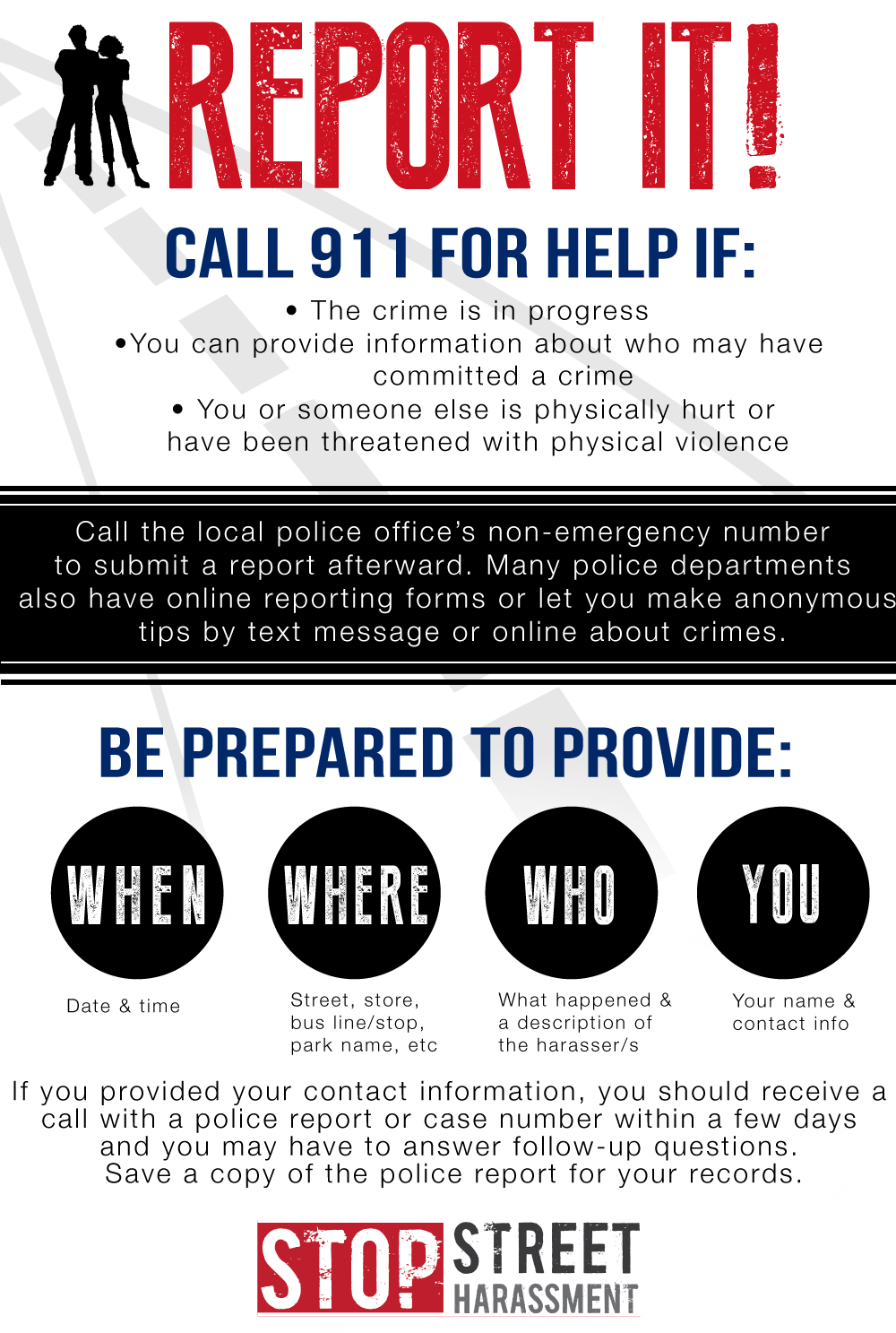
Take a look at your state’s section of the toolkit to get an idea of the kinds of street harassment that are illegal – or to report a crime that has already happened. You’ll also find useful information in the Introduction, including what to expect when you report street harassment and how to deal with harassment from police officers themselves.

Finally, we’d like to add one important takeaway from our work on the project: in speaking with several police officers around the country, we learned that you can engage a police officer or call 911 any time you feel threatened, even before a crime has been committed. This seems obvious in retrospect, but 75% of women report they have been followed and yet few report it to the police. If you think someone is following you, or you feel otherwise scared, intimidated, or threatened, you have the right to help from the police.

They say knowledge is power, friends, so here’s a nation’s worth.

Have you reported street harassment to the police? What happened? What did you learn about your local laws from our toolkit? How do you plan to use this knowledge? Share your story in the comments

Talia Hagerty has been an intern with Stop Street Harassment since June 2013. She is also a peace economics consultant working on a variety of projects that ensure the equitable economic participation of all. She holds a B.A. in Economics from Eckerd College and an M.S. in Global Affairs with a concentration in Peacebuilding from New York University. Talia blogs about peacebuilding, human rights, economic development, and witty responses to street harassment. Follow her on Twitter: @taliahagerty.

Share

Filed Under: Resources, SSH programs, street harassment

« Previous Page
Next Page »

Share Your Story

Share your street harassment story for the blog. Donate Now

From the Blog

  • #MeToo 2024 Study Released Today
  • Join International Anti-Street Harassment Week 2022
  • Giving Tuesday – Fund the Hotline
  • Thank You – International Anti-Street Harassment Week 2021
  • Share Your Story – Safecity and Catcalls Collaboration

Buy the Book

  • Contact
  • Events
  • Join Us
  • Donate
  • Facebook
  • Instagram
  • Pinterest
  • Tumblr
  • Twitter
  • YouTube

Copyright © 2026 Stop Street Harassment · Website Design by Sarah Marie Lacy