• About Us
    • What Is Street Harassment?
    • Why Stopping Street Harassment Matters
    • Meet the Team
      • Board of Directors
      • Past Board Members
    • In The Media
  • Our Work
    • National Street Harassment Hotline
    • International Anti-Street Harassment Week
    • Blog Correspondents
      • Past SSH Correspondents
    • Safe Public Spaces Mentoring Program
    • Publications
    • National Studies
    • Campaigns against Companies
    • Washington, D.C. Activism
  • Our Books
  • Donate
  • Store

Stop Street Harassment

Making Public Spaces Safe and Welcoming

  • Facebook
  • Instagram
  • Pinterest
  • Tumblr
  • Twitter
  • YouTube
  • Home
  • Blog
    • Harassment Stories
    • Blog Correspondents
    • Street Respect Stories
  • Help & Advice
    • National Street Harassment Hotline
    • Dealing With Harassers
      • Assertive Responses
      • Reporting Harassers
      • Bystander Responses
      • Creative Responses
    • What to Do Before or After Harassment
    • Street Harassment and the Law
  • Resources
    • Definitions
    • Statistics
    • Articles & Books
    • Anti-Harassment Groups & Campaigns
    • Male Allies
      • Educating Boys & Men
      • How to Talk to Women
      • Bystander Tips
    • Video Clips
    • Images & Flyers
  • Take Community Action
  • Contact

Brazil: “The ‘Forced Kiss’ Incident”

February 23, 2015 By Correspondent

Juliana Guarany, Brazil, Blog Correspondent

(In Portuguese)

So this happened: I was enjoying Carnaval in São Paulo, following a nice bloco down the street when I saw him stop and force a girl to kiss him. She was uncomfortably laughing, in an attempt to get rid of him without spoiling the fun of the party. He grabbed her and kissed her for less than 30 seconds and then he was gone, and she was back with her friends, probably telling herself that this is normal during this time of the year and she should just let it go. I had the same reaction as her. It was too fast and I knew that, if I intervened, things could get uglier, so I didn’t do anything at that time even though it upset me.

French kisses during Carnaval are a tradition. Even singer Claudia Leitte wrote a song about it and broke the record of couples kissing at one of her concerts. Unfortunately, forced kisses are also very common. I have heard stories from friends being kissed against their will on micaretas (out-of-season Carnaval parties) since I was 15 years old. I also heard stories of men’s tactics, like this guy who used to take a tube of lança-perfume (an illegal mixture of ethyl chloride that gives a quick sense of euphoria, but can cause arrhythmia) and hold the girls, forcing them to inhale it until they passed out so he could kiss them. I guess every stupid action has its extreme.

Right before Carnaval started this year, a man was charged with seven years in prison for forcing a kiss on a girl in Salvador, Bahia, in 2008, which was considered rape. He was arrested at the scene and spent one year in jail before getting the right to appeal.

The main TV channel in the region used the story to give us a great “why we need feminism” moment when they released a poll for their Internet users, asking if “the forced kiss during Carnaval should be prohibited” (SEE PHOTO).

Unlike me and the bloco I saw, people on social media did not let this go. They even remembered the famous forced kiss after the end of World War II and the glamour behind a scene of violence (the girl says she hates that image.)

This year is no different from 30 years of Carnaval… forced kisses are common. But at least the debate about forced kisses and harassment in general is rising. Let’s hope next year brings us an even better party, in which we will not hesitate to intervene when a forced kiss happens in front of us.

Juliana is a fellow from Alexander von Humboldt Foundation and, together with Hamburg University, in Germany, is creating a digital campaign to connect all feminist initiatives around the globe. Read her blog Whistleblower and follow her on Twitter, @juguarany.

Share

Filed Under: correspondents, Stories, street harassment

Iowa college student in hospital after intervening

February 21, 2015 By HKearl

Our thoughts are with this brave student…

Via Iowa Public Radio:

“A group of men were harassing a woman in Ames when bystander Cale Truhlsen of West Des Moines stepped in to try and stop it. Truhlsen was attacked by the group…and he’s still in the hospital after suffering a broken nose, a black eye, and a hole in his intestine that required surgery….

Alan Heisterkamp, Director of Mentors in Violence Prevention Leadership Institute and the Center for Violence Prevention at the University of Northern Iowa, says Truhlsen did the right thing by intervening….He says it’s important to know your boundaries and not step in when you don’t think you can make a difference on your own.

‘At the end of the day, why do men harass women, and why do men assault other men who challenge those sexist or disrespectful behaviors? We have to have a conversation with our young men about this. I had three of my daughters go to Iowa State. I would have hoped if something like this had happened to one of them that someone like him would have stepped in.'”

Share

Filed Under: News stories, Stories, street harassment

USA: Dear Men of New York

February 19, 2015 By Correspondent

Dr. Dena Simmons, New York City, USA, Blog Correspondent

Dear Men of New York City,

Please let me walk the streets without your sweet-nothings, your unwanted advances. I don’t care for the elaborate details of what you’d like to do to my body.

No, you cannot take a picture of my badankadonk,
lick my thighs,
suck my toes,
ravage me with your hard cock,
join me on my run,
have my number,
bang me silly.
No, no, no!

I am more than my body. I don’t owe you a smile, a thank you, or a hello. I am not a bitch for ignoring you. I don’t deserve your street-abuse just because I don’t give you my attention or affection.

Please, please, please let me walk down the streets without having to map out a route to avoid your verbal daggers. I don’t like the way you devour me with your eyes, the way you make me feel unsafe, the way you strip me of my humanity.

Your disrespect massacres me.

Please leave me alone. Please don’t touch me. Please let me walk in peace.

My body is not yours. I do not exist for your pleasure.  I exist for me.

Respectfully,
Dena

Dr. Dena Simmons serves as the Associate Director of Education and Training at Yale’s Center for Emotional Intelligence. She is a recent graduate of Teachers College, Columbia University, where her research focused on teacher preparedness to address bullying in the middle school setting.

Share

Filed Under: correspondents, Stories, street harassment

“I hope it doesn’t scar me forever.”

February 17, 2015 By Contributor

Today was the first time I was harassed. I just froze up. A group of boys who were younger than me were walking behind me and my friend. We were just walking to the subway, and they made loud comments about my body. I was disgusted, embarrassed, and scared. I could not believe an (about) 11 year old could do that. I tried to walk away but snow was on the ground. It has pretty much ruined my day. I just froze up. This has left me wishing I did more than freeze up. Apparently they thought it was funny. It’s not. I hope it doesn’t scar me forever.

– Anonymous

Location: On my way home

Share your street harassment story for the blog.
See the book 50 Stories about Stopping Street Harassers for more idea

Share

Filed Under: Stories, street harassment

USA: Street Harassment Disrupts Private Space

February 17, 2015 By Correspondent

Dylan Jane Manderlink, Arkansas, USA, SSH Blog Correspondent

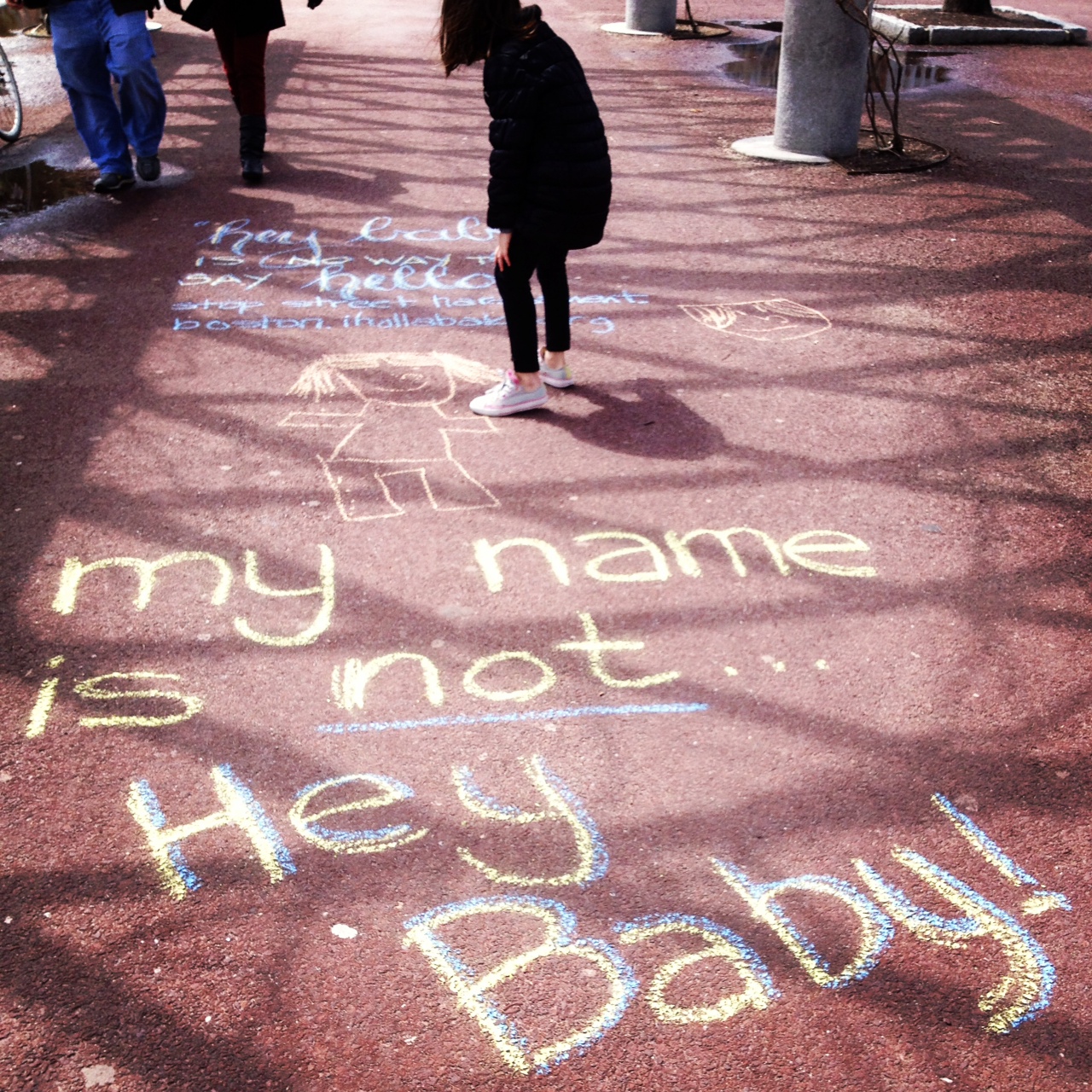
Anti-Street Harassment Week 2013 in Boston

A few nights ago, after being approached by a man on the street in Boston as she walked with a friend, Ellen R. replied, “Not tonight, thank you,” but the the man continued to follow her. She then turned around and said, “Please don’t follow us” and he yelled, “I’m not following you, bitch.”

Ellen told me, “This interaction upset me for so many reasons. Not only did I feel uncomfortable with the man’s initial comment, but when my friend and I tried to defend ourselves in the most polite way possible, the man only got more interested and more angry. I am already scared to walk down the street, so it’s even more frightening to know that even when I try to handle the situation in a calm manner, the man doing the harassing can go from 0 to 10 in a split second.”

Unfortunately Ellen’s street harassment experience is not uncommon. Despite responding with a polite remark, her street harasser met her with petulance, callousness, and an unforeseen temper. In many street harassment awareness and prevention blogs and articles I’ve read, I see the same message being revisited: Street harassment endangers the public space of individuals and disempowers their ability to walk through a public space safely, positively, and healthily. I certainly agree with that because I too, have felt that way when experiencing street harassment. But I would add that street harassment also communicates the message that your private space is no longer yours or never belonged to you.

As you navigate through a public space (a sidewalk, a city, a park, etc.), you also have your own private space within that. The way we personally view the environment we’re in is our private world…our thoughts, our bodies, the space between us and the people we pass on the street in close proximity…those all inform our private world. And when street harassers interfere with that personal, private, and intimate domain of ours, we can feel a different type of violation and discomfort. By understanding the threat we experience on both a private and public level, I believe we can better inform our awareness and advocacy efforts and the dialogues we promote through those modes.

Street harassment tells people that wherever they’re walking, wherever they’re living, whatever space they’re occupying – it’s not theirs. When we are catcalled, groped, eyed, followed, and yelled at the street harasser is claiming that space as theirs and communicating to us that we don’t belong in it. This needs to stop. This is not okay and people are really starting to take notice of how much street harassment is a detriment to our society and to people’s lives. We deserve better. Respecting our public and private space should not be optional, it should be the accepted and expected norm. As activists, the more we make noise and the more we create productive and cooperative pathways to empowerment and awareness, the more we can effect change.

As we approach International Anti-Street Harassment Week (#EndSHWeek) from April 12-18, let’s construct and promote a vigilant and sustainable conversation surrounding street harassment and the private and public spaces that are too often taken advantage of and threatened. I will no longer stand for our space being jeopardized, devalued, and disregarded. In the next couple months leading up to #EndSHWeek, let’s affirm the positive and inspiring efforts of fellow activists, bloggers, feminists, and community members. In doing so, I encourage you to open up meaningful channels of dialogue, spread awareness, and get involved with advocacy that helps make people’s private worlds a better place. Reclaim your space because it was yours to begin with and will always be. No one should be able to take that away from you.

Dylan is a recent graduate of Emerson College and currently teaches 8th, 10th, and 11th grade Digital Communications and Audio/Visual Technology in an Arkansas high school. You can visit her personal blog and follow her on Twitter @DylanManderlink.

Share

Filed Under: correspondents, Stories, street harassment

« Previous Page
Next Page »

Share Your Story

Share your street harassment story for the blog. Donate Now

From the Blog

  • #MeToo 2024 Study Released Today
  • Join International Anti-Street Harassment Week 2022
  • Giving Tuesday – Fund the Hotline
  • Thank You – International Anti-Street Harassment Week 2021
  • Share Your Story – Safecity and Catcalls Collaboration

Buy the Book

  • Contact
  • Events
  • Join Us
  • Donate
  • Facebook
  • Instagram
  • Pinterest
  • Tumblr
  • Twitter
  • YouTube

Copyright © 2026 Stop Street Harassment · Website Design by Sarah Marie Lacy