• About Us
    • What Is Street Harassment?
    • Why Stopping Street Harassment Matters
    • Meet the Team
      • Board of Directors
      • Past Board Members
    • In The Media
  • Our Work
    • National Street Harassment Hotline
    • International Anti-Street Harassment Week
    • Blog Correspondents
      • Past SSH Correspondents
    • Safe Public Spaces Mentoring Program
    • Publications
    • National Studies
    • Campaigns against Companies
    • Washington, D.C. Activism
  • Our Books
  • Donate
  • Store

Stop Street Harassment

Making Public Spaces Safe and Welcoming

  • Facebook
  • Instagram
  • Pinterest
  • Tumblr
  • Twitter
  • YouTube
  • Home
  • Blog
    • Harassment Stories
    • Blog Correspondents
    • Street Respect Stories
  • Help & Advice
    • National Street Harassment Hotline
    • Dealing With Harassers
      • Assertive Responses
      • Reporting Harassers
      • Bystander Responses
      • Creative Responses
    • What to Do Before or After Harassment
    • Street Harassment and the Law
  • Resources
    • Definitions
    • Statistics
    • Articles & Books
    • Anti-Harassment Groups & Campaigns
    • Male Allies
      • Educating Boys & Men
      • How to Talk to Women
      • Bystander Tips
    • Video Clips
    • Images & Flyers
  • Take Community Action
  • Contact

“How sad that reaching adolescence means getting harassed”

March 28, 2012 By Contributor

I am almost 62 years old and have been getting harassed by strangers in public since I was about 11. It has included men exposing their genitals, many times, as well as being spoken to by strangers and pressured to engage in conversation, yelling, whistling, and name-calling and insults if I didn’t respond. Most of these things have happened routinely to my daughters as well. We have been “ogled” in our cars at red lights by other drivers, been followed and had comments made about our various body parts, even while pregnant and in the presence of small children.

How sad that reaching adolescence means getting harassed and that old age is looked forward to so it will stop.

No place is safe, no place is comfortable. It changes who we are.

I have never understood why this is tolerated and not considered a crime, particularly a hate crime. When it was directed at one race by another, it is a hate crime. Why isn’t it a hate crime when it’s directed toward one gender by another??? All my life, I have spoken out about this and been treated like I was being ridiculous; thank you for taking this seriously. I am a psychotherapist and I can tell you it really affects females in very harmful ways.

– LG

Location: DC, Montgomery County, and PG County, in school, on the street, in public transportation, in stores, parking lots, my own car by other drivers, everywhere.

Share your street harassment story today and help raise awareness about the problem.
Find suggestions
for what YOU can do about this human rights issue.

Share

Filed Under: Stories, street harassment

Teachers: Address street harassment

March 27, 2012 By Contributor

Editor’s Note: This is cross-posted with permission from Feminist Teacher.

The success of last week’s International Anti-Street Harassment Week was astonishing. Organized by leading anti-street harassment activist Holly Kearl, founder of the well-known blog Stop Street Harassment, the week featured the work of the most cutting-edge activists in the field, including dance performances by Sydnie Mosley and her Window Sex Project and a viral video featuring Joe Samalin and other male allies telling men to just stop harassing women in both English and Spanish.

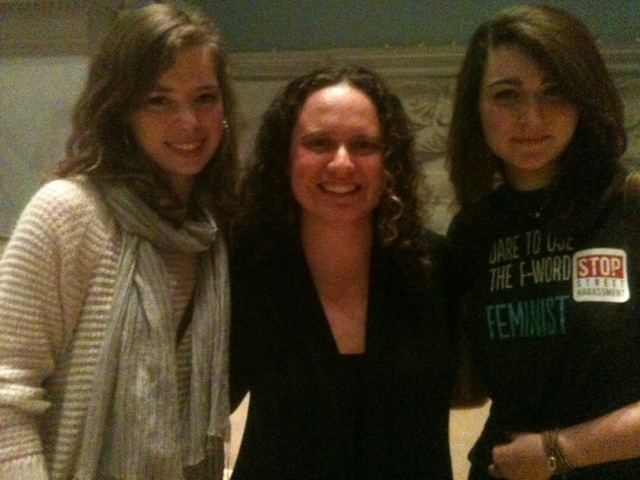
Grace, Ileana, and Emma

As part of the week’s events, two of my students, Grace and Emma, and I spoke at the Meet Us On the Street rally in New York. Grace shared a portion of the testimony that she read to last year’s New York City Council hearing on street harassment and Emma, who is also a SPARK blogger against the sexualization of girls and women in the media, shared her own vision for safer streets and communities not just for herself but also for her own sister.

I spoke about the importance of engaging teachers in the global movement against street harassment as an education and health issue for schools.

But the work doesn’t stop there. It’s important to show students that activism needs to be consistent, and not done in a flavor-of-the-month style. That’s why last fall, students in my high school feminism course partnered with other students at our school to create their own anti-street harassment public service announcement (PSA).  Their goal: to educate their peers about the gravity of street harassment in their daily lives.

As part of the background work to create the video, I invited activists from Girls for Gender Equity, Hollaback!, The Line Campaign, Men Can Stop Rape, and Right Rides to talk to my students. Activist Shelby Knox also visited to talk about her film, The Education of Shelby Knox. Each of them shared their expertise, provided students with materials, and ultimately inspired them to create their PSA.

You can create your own PSA with your students too. Start, as I did, with educating your students about the issue by inviting activists to your classroom. Then have students envision a PSA that would be relevant and engaging for your school community. Screen the PSA at an upcoming assembly. Then join the revolution.  See above for inspiration.

Ileana Jiménez has been a leader in the field of social justice education for 15 years. A 2010-11 recipient of the Distinguished Fulbright Award in Teaching, her research in Mexico City focused on creating safe schools for Mexican LGBT youth. Currently a teacher at the Little Red School House & Elisabeth Irwin High School (LREI) in New York, she offers courses on feminism, LGBT literature, Toni Morrison, and memoir writing. In addition to teaching at LREI, Ileana is also an associate faculty member at Bard College’s Institute for Writing and Thinking.

Share

Filed Under: anti-street harassment week, Stories, street harassment Tagged With: anti-street harassment week, Ileana Jiménez, NYC, spark summit, street harassment

MY STREET, MY BODY, MY RIGHT

March 27, 2012 By Contributor

(This article was submitted to the SSH blog and it’s also found on  Tumblr.)

I’m fourteen, running late for Global Studies. Breakfastless, I bolt out the door to catch the six. Instead of turning right as usual at Lexington Avenue, I take the shortcut to the station. They’re sitting at the front stoops again, right where the houses end and the deli begins. It’s humid, but I’ve put on my baggiest sweatpants and a long-sleeved shirt, so maybe today they won’t say anything. I look down at my feet and try to look preoccupied, or sad, or unapproachable, or something. And I walk faster. But they turn around and stare, all of them together, and don’t move, blocking the sidewalk. They make me push through them. I can feel them, bigger, older men, looking down at me as I approach. My entire body is tensing up, dreading an unwanted touch, a crude word. I want to crawl into a hole. “Hey, come back, China doll,” one says. Something in his voice makes my stomach turn. I wish I had simply woken up on time.

I’m fifteen and sweating under the June sun. The subway ride home was sweltering, and the ice cream truck beckons. Naturally, I order a vanilla milkshake. Then—a touch to my back, an ugly whisper: “you’re so sexy, baby.” I freeze. Was that someone’s breath on my ear, or just the heat? I turn around and see a fat, balding man strolling away into the crowd. As though he had done nothing wrong. My skin is crawling everywhere. Instinctively, uselessly, I am rubbing my ear, but I cannot get rid of his awful, lingering presence. He’s taking his time walking away, and I know that he knows I am watching him and that I am too scared to say anything. I hate myself for being a coward. I hate myself for being scared. Families around me chatter and laugh, enjoying the beautiful day. The ice cream truck lady leans out. “That’ll be $2.25.”

I’m seventeen and plastic bags of bai cai are killing my arms. My mom and I speed-hobble downstairs at the Flushing station, only to find that the train isn’t leaving for ten minutes. Dropping our groceries in an empty car, my mom pulls out the weekend World Journal and I turn to my copy of Life of Pi. A man boards and sits across from us. He immediately begins staring at me. Intently. Willing my mom not to notice, I read. And he stares. He stares and doesn’t stop and I’m trying to muster the courage just to look him in the eye, but I’m afraid. What if that encourages him to do something else? What if my mother sees? I wish that he would just look away, even for one second. But he doesn’t. After a few minutes, I put down my book and look up at his face. He is old, older than even my father. I expect him to put his hand on his crotch, to grin obscenely, or to lick his lips, or maybe all three. Instead he just stares. Should I be relieved? People start filtering into the car. Eventually, he looks away.

I’m eighteen and refreshed from an afternoon run in Central Park. I’m calling my boyfriend to let him know I’m coming over. The man walking across the street towards me is leering pointedly in my direction, but I figure he won’t say anything since I’m on the phone. I’m wrong. He makes a point of brushing past my arm and sneers: “I like the way you show off them legs.” For once, I react quickly. “No, it’s just hot.” I’m walking away as fast as I can, trying to put distance between us, when he yells, “fuck you, bitch.” I turn around. He looks angry, surprised, embarrassed. I should be angry also, but all I can feel is satisfaction, an unfamiliar and fervent satisfaction. “Say it louder!” I scream across the street. “I don’t give a fuck.” I’m aware of how stupid I look and everyone is staring at me, but it’s true.

Finally, I just don’t give a fuck anymore.

How many leers, how many unwanted comments and touches does it take to take away your right to walk on the same sidewalk, to ride the same subway, as anyone else? How many times must you watch the smile on a stranger’s face widen in perverse excitement at your revulsion? Once a month? A week? More? If my experiences were limited to the above encounters, perhaps I would know.

I was sexually harassed on a regular basis from the year I turned fourteen until the year I left for college. I tried so hard, every day, to ignore it. But I couldn’t. It changed me. The irrepressible nervousness when a stranger approached. Being afraid to look any man on the street in the eyes. Worrying I was being followed. Not wanting to leave my house unless I had to. Crying. Not crying until I got home, then crying. Hating myself for crying. Playing the faces of dozens of men back in my mind—I remember them all. Wondering what would have happened if I had bumped into them in a deserted area. The rape nightmares.

But the worst part was how it warped my own view of myself. Maybe it was my fault, I thought. Maybe I was asking for it. It was because I was small and weak, I thought. I hated myself for my own helplessness. Hated myself every time the snappy retort, the “leave me alone,” the “stop,” bubbled up furiously in my heart only to wilt in my throat. The tiny, illogical, and unshakable fear that no matter how hard I worked, I would never amount to anything more than a body. That my feelings—my disgust, the anger and loathing written all over my face—would deter no one because they simply did not matter. That it would only get worse as I grew older. That my only worth was sexual. That I was less than human. That I was nothing.

I have never shared my full experience with sexual harassment before. I didn’t tell my parents because I didn’t want to burden them. I didn’t tell my friends because I didn’t think they would understand. And I didn’t tell anyone else because I didn’t think they cared. As a result, I believed that I was alone in how I felt, that I was “overreacting” to normal, socially accepted behavior.

I am sharing my personal experiences now as part of the first-ever International Anti-Street Harassment Week in the hopes that it can inspire people I know, and people of my generation as a whole. As a child, I felt completely helpless about my own situation. I hope that today, I am at least able to encourage others to treat sexual harassment in public as a serious issue, and to take action to protect themselves and those around them.

If you are a woman, especially a young woman, who has had similar or worse experiences, know that you are not alone. Do not keep your problems to yourself. Reach out and talk to loved ones. There are many resources and organizations which offer better advice than I can; they are listed below. The movement to report, protest, and ultimately end sexual harassment in the public sphere is springing up all over the world.

If you are someone who is unfamiliar with this subject, thank you for reading. If you support safe streets for women and children, please share this link or comment below. I’d be happy if I could reach just one person with this message.

– Alice X

Location: New York City

Share your street harassment story today and help raise awareness about the problem.
Find suggestions
for what YOU can do about this human rights issue.
Share

Filed Under: Stories, street harassment

“Actually that’s not okay because what you just said is harassment.”

March 26, 2012 By Contributor

I just got home from an evening out with friends, but on my way out to my car is where this story starts.

I’m wearing jeans, sneakers, and a sleeved v-neck top. As I approach my car I see that I have a parking ticket, and so does a guy (We’ll call him DB) who decides to come up to me to “help.” When I found this spot, I was being flagged in by one of the guys that stands around and does that kind of thing, tipped him a couple bucks, and went to where I was going.

So anyway, the same guy who flagged me in walks by as DB is saying something to me, and I just asked the guy, “Hey man why didn’t you tell me I had to pay to park here, I tipped you…Never mind, I should have read the signs anyhow..”

When I said that I had tipped the man who flagged me in, this is where DB starts in:

Him: “Do I get a tip?”

Me: “No, what for?”

Him: “No, I mean I wanna see those tips.” pointing at my breasts

Me: “What?”

Him: “Just the tip?”

Me: “Um, no.”

I stop a moment and then decide to say, “Actually that’s not okay because what you just said is harassment.”

Him: “Woah no it’s not I was just flirting!”

Me: “No, that’s not flirting, because you just made me into a sexual object and that is not okay.”

He went on to say that we could have this “argument” and that he would win because he was “really good with words” and that he has “slept with women all his life”. He said he was from Massachusetts, came down for X Factor and they “really liked him”. He said he was trying to help and then he decided to flirt with me, but that he could have just come up and said I was hot.

I said “That still would have been harassment – just because I am a woman alone on the street doesn’t mean you can talk to me like that.” At which point he said, “Well if that’s how you’re going to look at this then I can’t win…”

I said, “That’s how I’m looking at it.” And finally got into my car and left.

– Anonymous

Location: Austin, Texas

Share your street harassment story today and help raise awareness about the problem.
Find suggestions
for what YOU can do about this human rights issue.


Share

Filed Under: Stories, street harassment

“When we discuss anything to do with race and gender we have to explore the importance of how both overlap and in turn the importance of intersectionality”

March 25, 2012 By Contributor

I should start this by saying my name is Saba, I am from Western Canada and a member of Black Feminist UK. It was when I moved from my tiny city to London that I was really introduced to the concept of Street Harassment.

In the area I was living in, I was catcalled and followed on almost a daily basis. I felt fear and annoyance almost daily basis on my way home from the tube stop to my flat. I was made to feel uncomfortable and threatened for walking out my door, because it was simply “what happens when you live in a big city”.

What made me the most upset was sounds men would make when I walked past, they wouldn’t want to engage me at all, they would just put me in my place.

We all know that Street Harassment is gendered, the type of harassment that men would receive is different from what women receive on the street. At the same time race is also a major part of street harassment. For example; stops and searches in London are a huge issue with young Black Men; and Street Harassment of Black women is different from those of other women. When we discuss anything to do with race and gender we have to explore the importance of how both overlap and in turn the importance of intersectionality.

I am a huge supporter of this whole movement because I believe that I should be able to walk down the street and feel safe. We need to be discussing all the things that need to change in order for that to happen.

@SabaEm

Share

Filed Under: Stories, street harassment

« Previous Page
Next Page »

Share Your Story

Share your street harassment story for the blog. Donate Now

From the Blog

  • #MeToo 2024 Study Released Today
  • Join International Anti-Street Harassment Week 2022
  • Giving Tuesday – Fund the Hotline
  • Thank You – International Anti-Street Harassment Week 2021
  • Share Your Story – Safecity and Catcalls Collaboration

Buy the Book

  • Contact
  • Events
  • Join Us
  • Donate
  • Facebook
  • Instagram
  • Pinterest
  • Tumblr
  • Twitter
  • YouTube

Copyright © 2026 Stop Street Harassment · Website Design by Sarah Marie Lacy