Grace Gageby, Dublin, Ireland, SSH Blog Correspondent
Trigger warning: Sexual assault
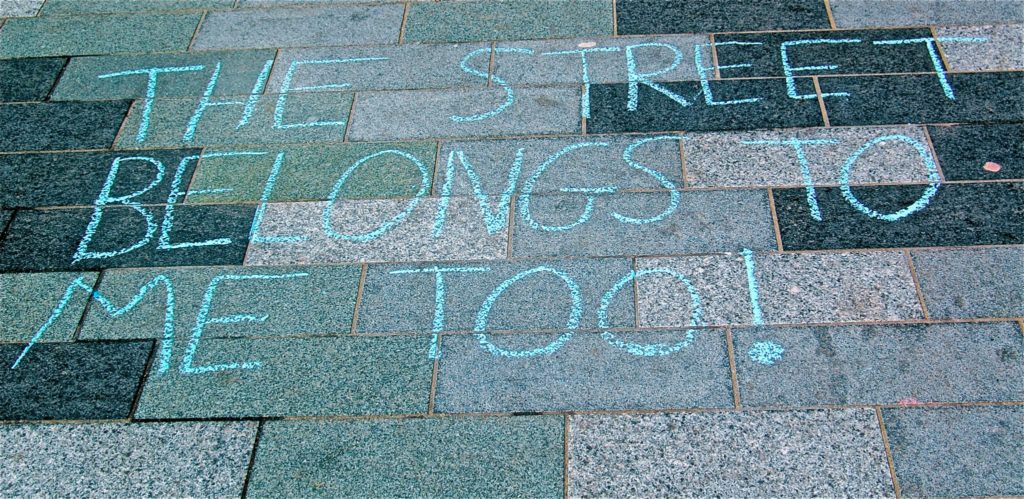 Street harassment is always an unpleasant experience. Catcalls, whistles, instances of being followed or grabbed in public places, inevitably leave victim feeling scared, threatened or embarrassed. What is perhaps even more disturbing is that most women experience street harassment for the first time as children. Young people often fall victim to a particularly malevolent form of harassment because of their increased vulnerability: they are more likely to be startled by a passing car screaming obscenities, more likely to be rattled by a sexist or degrading comment, and more likely to be coerced by a man who won’t take no for an answer.
Speaking to friends about their experiences of street harassment, a common theme appeared: the perpetrators did not care about the age of the girls they were bothering. All experiences detailed here, including my own, are from girls aged 16-17.
Dixie*: “I was on the bus, and a man aged around 50 was staring me up and down. I put earphones in and moved seats to avoid him. He ‘coincidentally’ got off at the same stop as me. He followed me, caught up to me and asked how old I was. He said he liked my hair, and I ignored him and crossed the road. He called me a bitch and threw a plastic bottle at me. I was 15 and wearing my school uniform. “
Ada: “I was standing at an ATM and two drunk men approached me asking for oral sex. I was eleven.”
Anne spoke of being harassed by four men in their thirties while she walked home with friends younger than herself. In her own words, “It was clear we were underage. One of the men shouted ‘green hoody!’ at me, in reference to what I was wearing. He started grinning at me in a weird manner, and we kept walking. We could hear him and his friends shouting at us, and we had to run down an unlit road only to find they had followed us.”
Polly was getting the bus home from school, when an older man aggressively demanded she smile for him. “The next time I saw him, he initiated a conversation. He asked me what I was doing after school the next day. The next time I saw him he honked at me from his vehicle.”
One of my own most recent experiences of street harassment happened at a train station. I was approached by a man 30 years my senior, who would not leave me alone, even when I made it clear I did not want to speak to him. He persisted with requests for a phone number, and details of my home address and school. Upon telling him I was 16, he replied, “I don’t care. I think when you like the look of someone, age is not important”. When I contradicted this, he laughed and said, “Maybe it is important for you.” He then pulled my arm, insisting I go “for a walk” with him. He did not leave me alone until my train came ten minutes later.
Clearly these harassers were deliberately targeting minors, not in spite of their age, but because of it. I think predatory men are more inclined to proposition people who lack the confidence to assert themselves. A pivotal part of tackling street harassment is empowering young women to stand up for themselves. This is difficult, as girls are socialized from a young age to be polite, to not make a fuss, and to set aside their comfort for the egos of men.
When I discuss street harassment with girls my own age, “not wanting to be rude” recurs as a reason for not defending ourselves, which may seem ridiculous to be people who have not been in our position. However, several factors in these situations prevent women from asserting themselves. First, small instances of harassment always come with the threat of escalation. I have read countless stories of women being assaulted, or even killed, for confronting harassers. Secondly, the anxiety harassment evokes causes many women to freeze up, and thirdly, while this may mystify many men for whom it seems the obvious solution, telling a cat caller to “f**k off” is not a magical solution to harassment. While this might feel very satisfying, at the end of the day, what does it actually accomplish? It does not prevent the man from bothering another woman. Swearing at him will not suddenly make him realise his behaviour is inappropriate, as he probably knows this, and is unconcerned with the negative toll his action takes on women.
I think part of tackling street harassment is to improve sex education. Where I live, in Ireland, most schools are run by the Catholic Church. Abstinence-only education is common, and issues of consent are not really discussed. Part of stopping street harassment should be challenging the sexist and entitled attitudes which go hand in hand with the topic of consent.
Rape culture is perpetuated not only by older men who bother young women on the street, but by teenage boys who spend 8 hours a day in school where (in my experience) sexual assault, harassment and misogyny are not only trivialized and normalized, but joked about. Again, I turned to my friends to ask about their experiences. When I shared one story of being groped and having incessant inappropriate comments directed at me for being the only girl doing running as a sports option, everybody had a similar story. The sheer quantity and normalization of harassment and assault was horrendous.
Dixie: “A boy repeatedly made fun of me for my weight and used the fact that I developed early as an insult”.
Anne tells a story of a girl being tackled to the ground, as a boy in her class tried to finger her. “We had been telling a teacher of the situation for ages, but she did absolutely nothing. She said she would have a ‘word’ with him, but the situation continued, and the same boy pulled the girl down a lane and tried to force himself on her. He would not take no for an answer.”
I was also told endless stories of drunk girls being assaulted at parties, as if these were normal and inevitable occurrences, and not criminal offences. “Slut-shaming” and other attempts to denigrate female sexuality seem to be an epidemic also. A large contributing factor to this behaviour is the trivialization of violence against women. Recently, a boy in my class shared a video on facebook of a woman falling to the ground after being punched hard in the face. The boy captioned the video “when she says she wants equal rights”. The video received many ‘likes’ and comments laughing at it, and at feminism in general.
Candice told me about a class discussion on feminism, in which the Brock Turner case was brought up. When the teacher remarked on his light jail sentence, one boy commented “fair play, my man!” (Irish slang for “well done” or “good job”).
Candice said “The teacher didn’t say anything. I was completely dumbfounded and the boys were all laughing”. This same boy is extremely vocal about his hatred of feminism, and has claimed “If women in Saudi Arabia don’t complain, why should women here?”
Recently a video of Emma Watson addressing the UN about campus sexual assault went viral.
This video received the comment “dykes” from another vocal misogynist I am in school with. This is the disturbing reality of using your voice to speak about violence and rape culture: you are subjected to slurs which are merely a pathetic attempt to silence women, to make women afraid to challenge a status quo of objectification and degradation.
To the boys who make schools an unsafe space for girls I say this: girls are in school to receive an education, and not one in how to bite their tongues when assaulted, because it’s “just a laugh”, not an education in how to smile and say nothing when a life-ruining rape is joked about, not an education in how to view being sexually assaulted while incapacitated with alcohol as normal.
And to the men who harass girls and women on the street: women deserve to walk through the world with the same security men have. Public spaces belong to all of us, and women don’t exist for your entertainment. What may seem like a “laugh” to you, seriously damages women’s confidence, makes them feel threatened, and essentially creates an environment where women are viewed as objects, with which you can do what you want. When you set this example to teenage boys, think of the vicious cycle you are perpetuating, and think of the women who have their lives destroyed by sexual assault. In essence, think before you speak.
*Names have been changed
Grace is a student. She writes regularly for her school newsletter and yearbook, and has been published in Inis Magazine. Grace is currently involved with the socialist feminist group ROSA (for Reproductive rights, against Oppression, Sexism & Austerity), and their campaign for abortion rights in Ireland.
