• About Us
    • What Is Street Harassment?
    • Why Stopping Street Harassment Matters
    • Meet the Team
      • Board of Directors
      • Past Board Members
    • In The Media
  • Our Work
    • National Street Harassment Hotline
    • International Anti-Street Harassment Week
    • Blog Correspondents
      • Past SSH Correspondents
    • Safe Public Spaces Mentoring Program
    • Publications
    • National Studies
    • Campaigns against Companies
    • Washington, D.C. Activism
  • Our Books
  • Donate
  • Store

Stop Street Harassment

Making Public Spaces Safe and Welcoming

  • Facebook
  • Instagram
  • Pinterest
  • Tumblr
  • Twitter
  • YouTube
  • Home
  • Blog
    • Harassment Stories
    • Blog Correspondents
    • Street Respect Stories
  • Help & Advice
    • National Street Harassment Hotline
    • Dealing With Harassers
      • Assertive Responses
      • Reporting Harassers
      • Bystander Responses
      • Creative Responses
    • What to Do Before or After Harassment
    • Street Harassment and the Law
  • Resources
    • Definitions
    • Statistics
    • Articles & Books
    • Anti-Harassment Groups & Campaigns
    • Male Allies
      • Educating Boys & Men
      • How to Talk to Women
      • Bystander Tips
    • Video Clips
    • Images & Flyers
  • Take Community Action
  • Contact

“College-aged men inside began shouting rudely”

April 17, 2016 By Contributor

Walking back from a church service with my friend an SUV had it’s windows rolled down and college-aged men inside began shouting rudely.

– Anonymous

Location: West Lane Avenue, Columbus Ohio, 43210

Share your street harassment story for the blog.
See the book 50 Stories about Stopping Street Harassers for more idea
.

Share

Filed Under: Stories

Watch: “I Smile Politely”

April 16, 2016 By HKearl

Newly released this week, check out Ness Lyon’s spoken word piece “I Smile Politely,” performed by actress April Hughes. Director of Photography & Editor: Luke Bartlett.

Ness wrote about the back story for The Pool, here is an excerpt:

“I’d been harassed in the street personally as a young woman, and professionally I’d handled sexual harassment cases as an employment solicitor, but it wasn’t until I experienced street harassment in my role as a mother that I felt compelled to publicly speak out.

Last year, on a family holiday in Southeast Asia, the part of the world I grew up in and which I adore, a man in the street made a sexual remark to my 10-year-old daughter that left her feeling terrified. I asked her how she reacted to the man’s comment and she answered, ‘I just smiled politely and quickly walked away.’ I felt a surge of anger: how dare that man make my child feel she had to respond to being sexualised with a polite smile. I told her that if someone made her feel uncomfortable, she shouldn’t feel she had to smile. But then I hesitated, remembering the times in my teens and twenties when I’d been subjected to humiliating, provocative and threatening comments by strangers. Sure, sometimes I’d sworn or glared in response. And on one memorable occasion, merely responded with a look of pure disbelief when a man shouted at me to “smile love for God’s sake, it might never happen’…. when I was in a hospital. ON CRUTCHES.  But a lot of the time, I too had simply smiled politely, not wanting to offend….

I wanted to explore this issue the best way I knew how: by writing about it. I started by having lots of conversations with a diverse group of women, hearing about the various ways they all ‘smile politely’.

I wrote a spoken word piece about it, performed by actress April Hughes (at WOW Festival and in a video to mark Anti-Street Harassment Week)….

My daughter’s phrase of ‘I smiled politely’ was a refrain echoed by nearly every woman I spoke to about street harassment. I want us to change that conversation: why, when we talk about politeness in these situations, is the word usually in relation to the woman in the scenario, and not the man? Instead of expecting us to simply smile, men need to learn to ‘speak politely’.

Share

Filed Under: anti-street harassment week, Resources, Stories, street harassment Tagged With: spoken word, UK, young age

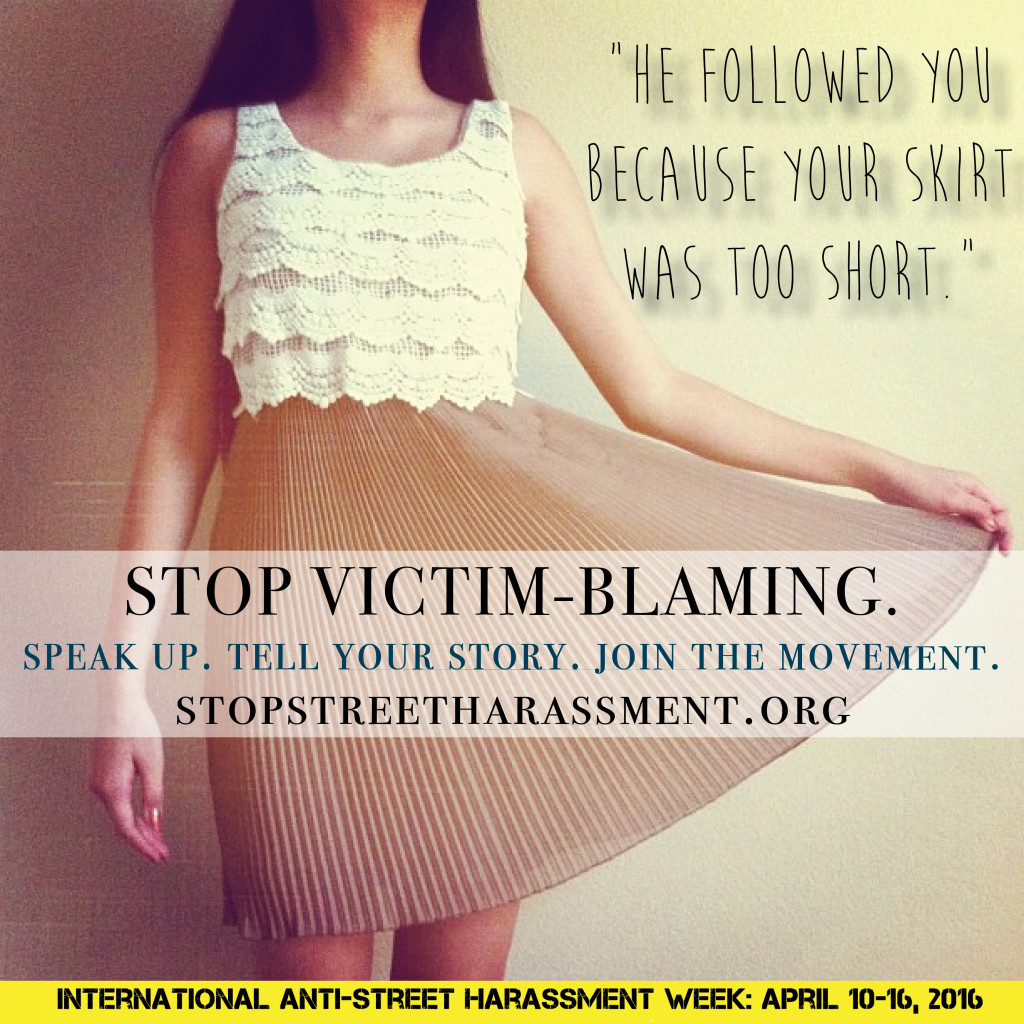
Because I wore a skirt that day

April 15, 2016 By Contributor

Image gy
Image by Jill Santos

I still get a nervous feeling in the pit of my stomach at gas stations when I’m alone. I would pull over constantly months after the occurrence while driving, in fear I was being followed again. I stopped wearing dresses and skirts for a while, my favorite things to wear. I was blamed for what had happened to me…

A man watched me at a gas station. I paid no attention, pumped gas in my car, and left as quickly as possible. I thought I was being my usual worry-wart self when I sensed he was following me. Through stoplights, unexpected turns, and neighborhood streets all the way to my then college campus I could see that man in his car in my mirror still lingering behind. After calling 911 and luckily having a faculty member help me, he sped away. Once when recounting this experience, it was suggested to me that this occurred because I was wearing a skirt that day and that is why he followed me after spotting me at the gas station.

So when I am out running in jogging pants and a sweater, I am getting whistled at because of what I am wearing? When I am in the grocery store parking lot in winter clothes and a scarf and getting inappropriate comments yelled my way, it is because of what I am wearing? When friends and I are hollered at when walking in the dark, it is because of what we are wearing?

He harassed me that day because of a skirt?

Street harassment is a learned behavior. How can it be addressed when we are focusing on the victim instead of the harasser?

Street harassment continues its prevalence towards anyone, wearing anything, anywhere. I cannot count the number of times I have been catcalled in my 21 years and it is disgusting at how frequent this occurs to myself and those around me. Hearing “smile, beautiful” or a whistle or “it was a compliment” just makes me cringe. Street harassment has become a social norm among cultures where this behavior is considered tolerable. Victims are the ones left to alter their actions and behaviors expecting these interactions to occur.

Although I think back often to that experience any time I feel anxiety creeping up or may feel even the slightest hesitation leaving the house in a skirt, I know now that I was the victim. I know I am not alone in the world with people experiencing street harassment daily. It may be difficult to think about your experience, let alone write it for others to read- but someone who reads it could relate it to their own experience and think “there’s nothing I could have done to prevent it from happening, it wasn’t my fault, and it wasn’t because of the way I was dressed.” At least I try to remind myself that and sharing your story could remind others too.

Jill Santos is a 21-year-old college senior, a califoregon girl. Follow her on Instagram @jiillionaire

Share

Filed Under: anti-street harassment week, Stories, street harassment

Healing after Assault Abroad

April 14, 2016 By Contributor

This article is cross-posted from Wanderful with permission from the author for International Anti-Street Harassment Week.

Trigger Warning: Assault

As non-male travelers, we live uniquely gendered experiences. No matter where we are, women’s safety is an ever-relevant topic. Thanks to technology, we are more connected to information about traveling to different parts of the world.

From deciding to go to Israel to attending protests abroad, safety matters to all of us. But how do we prevent or avoid smaller, more targeted crimes, like assault or petty thefts?

I had never been assaulted until I came to Nicaragua, the safest country in Central America.

I have traveled to several different countries and put myself in much riskier situations, so I did not expect to be assaulted at knife point in the morning as I ran up the huge hill.

I was wearing headphones, as I do on my typical morning runs, but I had no electronics with me. I wear headphones to avoid catcalls, so men will think I can’t hear their sexual and lewd comments.

trail-660x440Image by Unsplash user Paul Jarvis.

My attacker pulled out a knife and felt through my pockets. He knocked me to the ground and kept searching them, hoping to walk away with an iPhone. Ten seconds later he realized I had nothing of material value on me. He walked away with nothing, and I was physically fine, but I had the emotional consequences to deal with.

As soon as I came home, I felt extremely unsafe. Instead of my post-run feeling of accomplishment, I was petrified. I didn’t know what to expect after an event like I had just experienced.

Still, I vowed not to let this experience stop me from living and exploring this beautiful country. Just as I didn’t expect to be assaulted in a country where I feel relatively safe, I didn’t expect to recover immediately.

I did realize the importance of taking steps to heal, so I learned what to do after an experience like mine.

Here are the steps I took to help me recover from the assault:

1. Report the crime.

After being assaulted, I immediately called my Peace Corps Security manager and reported the crime. The hardest part of it all was admitting what had happened. I have never said the words,

I was assaulted at knife point.

I described the attacker as much as I could, and after reporting the assault, it was easier to process what happened.

If you find yourself the victim of an assault, reporting the attack to the police is also a good option. Even if the assailant is never caught, reporting helps others become aware of safety issues.

2. Write about it.

As soon as I reported the crime, I wrote down exactly what happened, to further acknowledge it. Writing has always been a form of therapy for me. After a few days, I wrote a powerful letter to my attacker in order to quell the thoughts of what I should have or could have done.

I don’t really believe in the concept of full closure, but psychologically engaging my attacker in a final dialogue and forcing him to listen to me made me feel as if I was able to process everything that happened to me and to gain some form of closure.

3. Don’t do it alone.

As an introvert, I usually thrive on alone time, but not after an assault.

I immediately called my friends, who came right away to keep me company. I told them that I felt like I’d gone through a break-up, and they reassured me that I was feeling as if I’d broken up with my feeling of safety. They had undergone worse attacks than I had in their lives, and we talked about things that we wouldn’t have normally broached in conversation. I was so reassured because I wasn’t alone.

A few of the people who supported me did so from afar. I reached out immediately to a few people with connections to Wanderful for online articles and resources. One of those was Leanna. I felt comfortable reaching out to her because she had been assaulted and was not afraid to write about this personal issue so publicly. She inspired me to be open about healing and to let others know they are not alone.

Delia reminded me that, although I wasn’t physically harmed, this was a traumatic experience and that I am more than worthy of self-care.

4. Be okay with your recovery time.

The first day was the worst. I had an insane amount of flashbacks. My mind kept replaying every little thing that had happened and how I felt in those 10 eternal seconds of my attack. I didn’t know when the flashbacks would stop, but I decided to be okay with it. I was also okay with crying at random times because I knew it would pass. I knew I needed to give myself the time I needed to process what had happened.

5. Talk to a therapist.

After my assault, I spoke to a therapist every day for three days. She helped me to come to terms with what happened and to process it further. I don’t usually seek out therapy, but I knew I couldn’t do this alone and that I needed to have a better idea of what to expect. Calling a therapist is still awkward for me, but I know that it is worth it. I don’t enjoy appearing weak, but I know that the short-term discomfort of reaching out for help far outweighs feeling too ashamed to reach out in the first place.

My therapist let me know that my flashbacks were a normal, bodily response and that, with time, they would decrease.

If you can’t afford a therapist, there may be a therapist in your area that offers their services on a sliding-scale. There are also online therapy options and help that you can find in books.

6. Be vulnerable.

Avoid listening to social stigmas of feeling “ashamed” that this happened to you. It wasn’t easy for me to write a descriptive blog post about my experience. The hardest part was clicking “publish,” but it was worth it.

I broke the silence about assault. Friends and acquaintances reached out to me, offering words of solidarity and comfort. I reminded myself that vulnerability is not weakness. We fear being vulnerable because we fear rejection, but I have learned to push past this fear and embrace my vulnerability.

Hopefully, you will never need to heal yourself after an assault. But you may encounter a friend who could really benefit from your support. If you do need this list, know that what you experienced is not your fault. Repeat that a hundred times to yourself if you need to.

Further Resources:
Post-Harassment Self-Care by Autostraddle
Traveling Is Healing for Me, a story by male PTSD survivor C. David Moody
Traveling with PTSD Discussion Forum

Do you have any other advice for fellow travelers about recovering from an assault? Share them in the comments.

Char Stoever was born in Mexico and grew up in Moses Lake, Washington. While at Wellesley College, she gravitated toward learning French and enjoyed being in language classrooms the most. After studying abroad and traveling in France, she realized how empowering it was to be a woman traveler. After graduating, she tutored at-risk high schoolers in San Antonio, Texas. She then taught at Brooke Charter School in Boston. In August 2014 she began her 27-month Peace Corps Nicaragua service as a TEFL Teacher Trainer. As the LGBTQ volunteer coordinator, she has led safe space trainings for Peace Corps Staff. She does social media marketing for the Peace Corps Nicaragua Gender and Development Committee,  and is an editor of Va Pué, the volunteer-run magazine. She also does social media work for Soma Surf Resort Nicaragua.

Share

Filed Under: anti-street harassment week, Stories Tagged With: assault, Nicaragua, running, traveling

“Mostly I felt objectified”

April 13, 2016 By Contributor

I was walking through a shopping center parking lot. I wanted to cross to the sidewalk, and a car slowed to let me pass. An elderly man with a guitar case shouted to me, “Come on girl, come on girl!” as if to hurry me along, and he sounded and looked amused. It felt very demeaning, as if he was talking to a dog. I hurried past and kept walking fast, and I crossed another street and took a route through a housing development because I noticed he seemed to be going in the same direction as me. I was not necessarily afraid of being molested, but it did make me nervous. Mostly I felt objectified, and that made me resentful.

By the way, I was wearing ripped-up but not revealing jeans, a loose black T-shirt, my hair was very plain and I had no makeup on.

Optional: What’s one way you think we can make public places safer for everyone?

I don’t have a good solution; but I think the older generation should be taught somehow that talking to random women disrespectfully is not okay. Maybe it was in their younger days, but times have changed.

– Anonymous

Location: Ventura, CA

Share your street harassment story for the blog.
See the book 50 Stories about Stopping Street Harassers for more idea
.

Share

Filed Under: Stories, street harassment

« Previous Page
Next Page »

Share Your Story

Share your street harassment story for the blog. Donate Now

From the Blog

  • #MeToo 2024 Study Released Today
  • Join International Anti-Street Harassment Week 2022
  • Giving Tuesday – Fund the Hotline
  • Thank You – International Anti-Street Harassment Week 2021
  • Share Your Story – Safecity and Catcalls Collaboration

Buy the Book

  • Contact
  • Events
  • Join Us
  • Donate
  • Facebook
  • Instagram
  • Pinterest
  • Tumblr
  • Twitter
  • YouTube

Copyright © 2026 Stop Street Harassment · Website Design by Sarah Marie Lacy