• About Us
    • What Is Street Harassment?
    • Why Stopping Street Harassment Matters
    • Meet the Team
      • Board of Directors
      • Past Board Members
    • In The Media
  • Our Work
    • National Street Harassment Hotline
    • International Anti-Street Harassment Week
    • Blog Correspondents
      • Past SSH Correspondents
    • Safe Public Spaces Mentoring Program
    • Publications
    • National Studies
    • Campaigns against Companies
    • Washington, D.C. Activism
  • Our Books
  • Donate
  • Store

Stop Street Harassment

Making Public Spaces Safe and Welcoming

  • Facebook
  • Instagram
  • Pinterest
  • Tumblr
  • Twitter
  • YouTube
  • Home
  • Blog
    • Harassment Stories
    • Blog Correspondents
    • Street Respect Stories
  • Help & Advice
    • National Street Harassment Hotline
    • Dealing With Harassers
      • Assertive Responses
      • Reporting Harassers
      • Bystander Responses
      • Creative Responses
    • What to Do Before or After Harassment
    • Street Harassment and the Law
  • Resources
    • Definitions
    • Statistics
    • Articles & Books
    • Anti-Harassment Groups & Campaigns
    • Male Allies
      • Educating Boys & Men
      • How to Talk to Women
      • Bystander Tips
    • Video Clips
    • Images & Flyers
  • Take Community Action
  • Contact

“He followed me at a distance, for around ten minutes”

September 3, 2015 By Contributor

I was walking home from downtown Durham and I’m new to the area so I took a wrong turn. I was uneasy. As I was walking, a man yelled to me. He asked me how old I was or whether I could hear him and some other things I couldn’t understand. I kept walking. He followed me at a distance, for around ten minutes. I was in a neighborhood. I started crying and jogging and trying to flag down cars. I know that’s a stupid thing to do, especially in what appears to be a really bad neighborhood. I can’t tell my family this because I know how stupid it is but I was so fu**ing scared and I got in this couple’s car and they took me to about a block within my house.

– DC

Location: South Street, Durham, North Carolina

Share your street harassment story for the blog.
See the book 50 Stories about Stopping Street Harassers for more idea
.

Share

Filed Under: Stories, street harassment

USA: Dealing with Street Harassment is Emotional Labor — And I Quit

September 1, 2015 By Correspondent

Michelle Marie Ryder, USA, SSH Blog Correspondent

A sex-obsessed Harry Block in the film Deconstructing Harry asks the prostitute he’s just slept with if she likes her job. Still under the sheets, she replies “It’s okay, it beats the hell out of waitressing.”

“That’s funny,” Harry laughs, “every hooker I ever speak to tells me that it beats the hell out of waitressing. Waitressing’s gotta be the worst fucking job in the world!”

Perhaps not THE worst job, waitressing is without a doubt ONE of the worst jobs. I’ve toiled away, overworked and underpaid, in a number of unenviable trades, including as a janitor hauling trash and scrubbing toilets, but what made waitressing so unbearable was that thing that often separates men’s work from women’s work: emotional labor.

In her book, The Managed Heart: The Commercialization of Human Feeling, noted sociologist Arlie Hochschild defined emotional labor in the workplace as “the management of feeling to create a publicly observable facial and bodily display… sold for a wage.”

Emotional labor is a kind of mandatory fakeness, a display of affected emotion, usually warmth and enthusiasm, in order to manage the expectations of the customer. It commonly entails displays of deference from those who “occupy disadvantaged structural positions within society,” and as a result, is strongly associated with occupations dismissed as women’s work, such as waitressing, nursing, teaching, childcare, social work and sex work. Not surprisingly, emotional labor contributes to occupational segregation and the gender pay gap.

In highly sexualized industries like the restaurant business, emotional labor makes substantial psychological demands on the individual. Attesting to this, after just a few months on the job I had to make a promise to myself daily not to burn the place down.

The power differential between customer and server meant male customers felt entitled to my company, my time and even my body. My hospitality was often mistaken for flirtation, and in a culture of sexism and male entitlement, this “mandatory fakeness” served as justification for sexual objectification and harassment.

The last straw for me was when a male patron asked if he could take professional photographs of me. He was puzzled when I declined his offer, confident I desired nothing more than to be the privileged object of his gaze. He was double my age and it was hard to miss his “Lolita Complex.” I could see Nabokovian fantasies flowering between his eyes every time I looked at him.

The thought of being fetish fuel for this man’s erotic preoccupations – and to have it all captured on film – pushed me to my breaking point. That night I walked out with no intention of returning.

I felt liberated. The air never tasted so sweet and I managed a few lungfuls of it before a stranger at the bus stop demanding my attention and asking me questions like what I did for a living (oh the irony!) tried to grope me. That’s when I realized a woman’s work is never done, only now there was no paycheck or Title VII protections.

Freshly unemployed, I couldn’t escape the burden of emotional labor. It was still my job to make creeps feel at home. Either I defer to the male ego on the street or I reject its advances and disrupt a sense of entitlement so draconian I risk my own safety. The threat of violence is always there, ominous, circling, ready to unleash its attacking power because gender-based street harassment is nothing less than an expression of power in a society heavily invested in minimizing and normalizing violence against women.

The type of emotional labor women are expected to perform in public is exhausting and requires split-second decision making that is shaped by our socialization to be open, kind, friendly and forgiving.

This means that despite years of calling out harassers, I still struggle to break the logic of this system. Often, before my sympathetic nervous system can determine “fight or flight,” an even deeper level of social programming kicks into gear and pulls the “polite” lever instinctively. It’s an opening harassers exploit to escalate the situation because anything other than unapologetic hostility is interpreted as an invitation. This is what happened at the bus stop.

Women are raised from birth to please others. It’s why over half of the female workforce ends up in jobs that require them to display friendliness and defer to the emotional demands of others. It’s why a woman walking down the street (or waiting tables) is viewed as sexually available and existing solely to satisfy men.

It’s why we are told to smile wherever we go.

Emotional labor is a double standard that makes public space a playground for men and a battleground for women. And it is work I am increasingly refusing to do. Consider slam poet Venessa Marco’s masterful poem “Patriarchy” my long overdue resignation speech.

Because I quit.

Michelle is a freelance writer and community activist. She has written for Infita7.com, Bluestockings Magazine, and The New Verse News on a range of social justice issues, and shares her poetry regularly at poetrywho.blogspot.com.

Share

Filed Under: correspondents, Stories, street harassment

“It ruined my entire day”

August 31, 2015 By Contributor

I walked out of the restroom at the mall after having a wonderful day with my mom. Walking to the elevator to the parking garage, I hear a wolf whistle from the middle aged men I passed on the upper floor. I’m 14 years old, and it ruined my entire day.

– Anonymous

Share your street harassment story for the blog.
See the book 50 Stories about Stopping Street Harassers for more idea

Share

Filed Under: Stories, street harassment

“No one asked if I was ok”

August 23, 2015 By Contributor

I was walking along the street yesterday afternoon. A man walking towards me catcalled me (hello beautiful, sexy etc etc). I felt angry and (not very eloquently) responded with ‘shut up, wanker’. I had assumed he was alone but he then called out to his girlfriend/wife/whatever declaring that I’d called him a wanker. I kept walking and tried to get on the bus, she followed me grabbed me by the hair and then knocked me to the ground yelling ‘you f***ing slag’ at me. I stood up and went towards the bus, they both continued to yell at me, again calling me a ‘slag’ and asking why I was calling him a wanker and asserting that ‘He was giving me a compliment’ and ‘who did I think I was?’ There was an entire bus of people watching. No one asked if I was ok.

Optional: What’s one way you think we can make public places safer for everyone?

Educate boys and men about why catcalling is unacceptable

– Anonymous

Location: London, UK

Share your street harassment story for the blog.
See the book 50 Stories about Stopping Street Harassers for more idea

Share

Filed Under: Stories, street harassment

USA: When Does Street Harassment Begin?

August 22, 2015 By Correspondent

Liz Merino, Massachusetts, USA, SSH Blog Correspondent

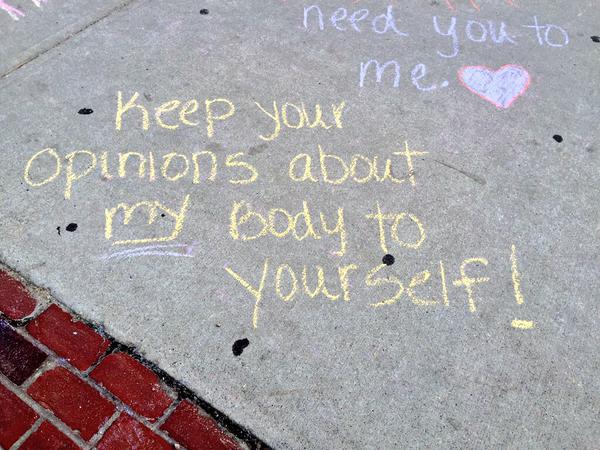
Boston chalking for International Anti-Street Harassment Week 2015

When does street harassment begin? I asked myself this the other day. When can I remember instances throughout my life that someone has sexualized my body without my consent?

There are really too many too count.

The news does capture some of it. Blips and glances, reels of one rape case or harassment of another, slowly turning, always changing, lighting up the television screen until something more repulsing replaces it.

Between sexist school dress codes, elite school rape cases and the systematic rape-based theology of Yazidi women carried out by of ISIS soldiers; I can’t help but feel helpless.

When does the sexualization of a woman begin? When does it really end?

Street harassment occurs every day. It happens on busy sidewalk streets during the morning hours when the sun is just slinking over the horizon. It happens on poorly lit streets after a night out with friends, causing some women to wonder if they will even make it home to see their loved ones again.

It happens on public transportation, city sidewalks and country back roads. Sexual harassment happens in the hallways of our schools and in the corners of our office spaces.

Sexual harassment doesn’t need an actual street to happen. It just needs a man with a sense of entitlement that reaches far beyond a normal scope of perception.

Don’t draw attention to yourself, but be sure people know you are there and carry your keys for protection, but don’t let them jingle or they will hear that too. Pull the top of your shirt up if you don’t want the attention, but stop, not every man is looking, not everyone is a predator. But cover your drink and watch your back just in case, because if they get you it’s always your fault. But you’re probably lying anyways, right?

Street harassment hurts. It creates a world in which men believe that a woman is their property simply for being in a public space.

If men can call you a slut on the street, take upskirt pictures of you in a grocery store or ask you to suck their dick from behind a car window, what will they really do to you when they get you all alone?

Priyanka, 23, a resident of New York City recounted her first experience of street harassment:

“The first place that I can truly remember it occurring was in the Middle East in one of the nicer malls. There would always be guys standing in a row near the theatre, just staring at you walking by and whistling or following you eventually. It was creepy and I didn’t appreciate the attention. I didn’t like feeling like a piece of meat.”

Having a vagina and a set of breasts is not a welcome mat upon which to lay your comments or your opinion or your crass approval of my body.

Street harassment is not a compliment. The oversexualization of women has never been “something nice” or “just something to do.” Funny how a woman can go from “sexy “and “honey” to stark raving mad, like a feral dog, when she rebuffs a man’s advances responds with how she really feels.

A woman is not a prude, stuck up cunt just because she doesn’t want you to grope her on the subway.

Jade, 21, a California resident echoed the same sentiment as Priyanka:

“I remember driving with an older guy friend, who was like my brother. He thought it was so funny to catcall women and he said, ‘If I see something I like I want to tell them.’ I tried to explain how uncomfortable it makes girls feel and he just didn’t understand that women are not here for his viewing pleasure. I don’t understand what men think they will get out of it. I am not going to hop in your car and I’m definitely not going to give you my number because you honked at me and said I have a nice ass. You are someone that I would make sure to stay far away from.”

Compared to a lot of other things I wrote in this article, the following incident isn’t that big of a deal. Or maybe in comparison, there are other bigger, more important things happening that people should care more about.

The one incident that has been popping into my mind happened during my freshman year of high school. I was wearing a tank top and a cardigan with a pair of sweatpants. I was 15.

As I was walking to class a teacher pulled me aside, a woman at that, and told me to pull up my shirt because it was “too low” and “I shouldn’t have worn it to school.”

I was embarrassed, mortified, I wanted to crawl into a hole and die. So I pulled up my shirt and hid my barely there boobs as a 15-year-old because I was “distracting,” “improper” “not appropriate.”

I hid my body because it was not deemed to be appropriate.

That line of thinking followed me into my sophomore year of college. During a sociology class discussion of street harassment, I finally realized that my body, my visible breasts and butt, thighs and flesh, the rough patches on my elbows and the bits of my baby toes were mine. Mine.

My body was not improper, but the way people view it and think about it is.

During this class I recounted a story of how my roommate and I were spending the day in NYC. It was hot, and my roommate had worn a beautiful sequin skirt, shiny and incandescent in the sunshine. We walked along laughing and smiling, taking in the city sights on our way to the Metropolitan Museum.

Street by street though, men called out to her. “Motherf***ing gorgeous,” “legs for days,” “hey sexy, come over here.” I watched as my roommate, a tall brunette with a wide smile and a contagious kindness folded into herself, hunching over and staring at the sidewalk, embarrassed by the attention she had drawn.

Before we got to the museum, she changed into a pair of pants she had in her bag. She covered herself to shield us both from the men old enough to be her father lusting after her.

She too felt her body was inappropriate, too much, asking for it. It killed me to watch it happen, and it kills me to see it now.

The only person a body belongs to is the one who can feel its heart beating from the inside. A woman is not a walking vagina, here for your pleasure only. She has two eyes, a nose and lungs, she breathes and loves and walks and thinks just like you.

And she feels.

Street harassment is not a compliment. Sexualizing women constantly is not acceptable. We know better. We can do better.

If you don’t believe street harassment, or the plight women suffer every day is actually an issue please educate yourself. If after reading and researching the topic you still don’t see the problem, rest assured we all do for you, because you are a part of it.

Liz is a recent graduate of Hofstra University with a Bachelor of Arts Journalism degree. She is currently a staff writer for a marketing agency in Boston. Follow her on Twitter @slizmerino and Instagram @elizabethmerino93.

Share

Filed Under: correspondents, Stories, street harassment

« Previous Page
Next Page »

Share Your Story

Share your street harassment story for the blog. Donate Now

From the Blog

  • #MeToo 2024 Study Released Today
  • Join International Anti-Street Harassment Week 2022
  • Giving Tuesday – Fund the Hotline
  • Thank You – International Anti-Street Harassment Week 2021
  • Share Your Story – Safecity and Catcalls Collaboration

Buy the Book

  • Contact
  • Events
  • Join Us
  • Donate
  • Facebook
  • Instagram
  • Pinterest
  • Tumblr
  • Twitter
  • YouTube

Copyright © 2026 Stop Street Harassment · Website Design by Sarah Marie Lacy