• About Us
    • What Is Street Harassment?
    • Why Stopping Street Harassment Matters
    • Meet the Team
      • Board of Directors
      • Past Board Members
    • In The Media
  • Our Work
    • National Street Harassment Hotline
    • International Anti-Street Harassment Week
    • Blog Correspondents
      • Past SSH Correspondents
    • Safe Public Spaces Mentoring Program
    • Publications
    • National Studies
    • Campaigns against Companies
    • Washington, D.C. Activism
  • Our Books
  • Donate
  • Store

Stop Street Harassment

Making Public Spaces Safe and Welcoming

  • Facebook
  • Instagram
  • Pinterest
  • Tumblr
  • Twitter
  • YouTube
  • Home
  • Blog
    • Harassment Stories
    • Blog Correspondents
    • Street Respect Stories
  • Help & Advice
    • National Street Harassment Hotline
    • Dealing With Harassers
      • Assertive Responses
      • Reporting Harassers
      • Bystander Responses
      • Creative Responses
    • What to Do Before or After Harassment
    • Street Harassment and the Law
  • Resources
    • Definitions
    • Statistics
    • Articles & Books
    • Anti-Harassment Groups & Campaigns
    • Male Allies
      • Educating Boys & Men
      • How to Talk to Women
      • Bystander Tips
    • Video Clips
    • Images & Flyers
  • Take Community Action
  • Contact

Street Signs in Canada and the USA

April 21, 2015 By HKearl

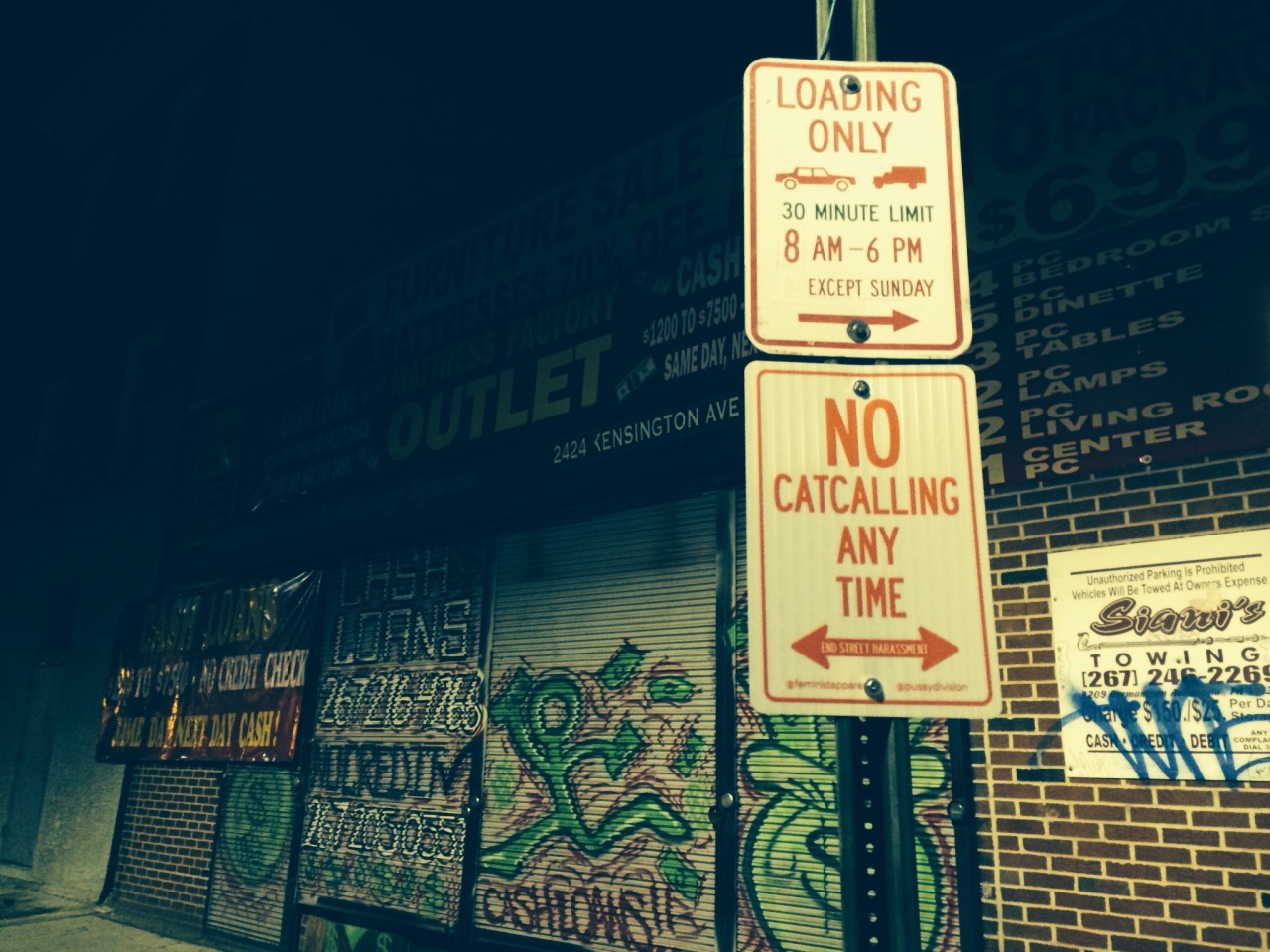
Innovative street signs went up in Toronto, New York City and Philadelphia during International Anti-Street Harassment Week last week.

Toronto (via blogTO):

4.17.15 Torontoi“A new public art project in Kensington Market kindly asks catcallers to STFU. Dubbed the The Street Talk Project, the artistic intervention involves street signs that admonish sexual harassment on Toronto streets and that support equal rights for women and trans* people.

“Using humour and subversive advertising, The Street Talk Project [brings] attention to the ways in which public space is navigated differently by different people,” reads the organizers’ description of the project. It also addresses “how sexism is felt viscerally on a day-to-day basis” and promotes “solidarity for the safety of women and trans* people.”

The project debuted yesterday and also involves an exhibition at Whippersnapper Gallery. There are seven signs in total, which have been installed around the Market. The idea was to place them in a highly trafficked area to generate as much discussion as possible.”

New York City and Philadelphia (via my article at Feministing.com):

4.13.15 Feminist Apparel and Pussy Division signs NYC Philly“Members of Feminist Apparel and Pussy Division put up 25 street signs against catcalling in Philadelphia and New York City. They worked with a street sign manufacturer to produce them and released them specifically for International Anti-Street Harassment Week.  Their goal was to create ‘further dialogue surrounding the issue of street harassment,’ Alan Martofel, production coordinator for Feminist Apparel, told me.

Since it is a form of guerrilla activism, they did not gain permission from the city to post the signs and they are unsure how long they will be up. But they say that already they are having an impact.

One of the members of Pussy Division, a group based in Philadelphia who has done other street art activism, such as posting “stop rape” stickers and spray painting anti-harassment messages on sidewalks around the city, told me, ‘We’ve had so much positive feedback. A lot of people will share harassment that just happened to them and say they are happy to see the sign and feel less alone.’

For her, the goals of the project are to spread the message that street harassment is an important issue everywhere and to help survivors. ‘We would like people who deal with street harassment every day to look at it and feel validated about their feelings of really hating going through it and feeling objectified.’ She continued, ‘We are taught — especially women — that this is part of life and that we should deal with it and be happy about it. But we’re not happy about it. It’s important for harassed people to hear from other people who are on the same page as them.’

Share

Filed Under: anti-street harassment week, Resources, street harassment Tagged With: street signs

Romania: Anti-Street Harassment Week in Bucharest

April 21, 2015 By Correspondent

Simona-Maria Chirciu, Bucharest, Romania, SSH Blog Correspondent
11167666_879511048761694_6696537207933721063_n
We had a week full of events for International Anti-Street Harassment Week in Romania. Activists and feminists were very active in raising awareness about this problem by posting online testimonials about street harassment experiences, sharing international events, participating in flashmobs and distributing fliers.

FILIA NGO and volunteers posted testimonials all week on Facebook and other activists Tweeted about street harassment. These kinds of online posting and discussions with people about street harassment is important. For example, some young women commented on our testimonials, opening up about their own experiences. Is vital for us to start talking more and more about this problem, in online but also in public spaces.

IMG_4730When it comes to street harassment in Romania, people tend to ignore it, to minimize the gravity of it. They excuse the harassers and blame the victims, so for this year’s International Anti-Street Harassment Week, three feminist NGOs from Bucharest — FILIA, FRONT and AnA: Society for Feminist Analyses — organized a public action in a park in Bucharest.

We gathered in a large park on Saturday, 18 April, to raise awareness about victim-blaming and the importance of bystanders intervention. How did we do that? We begun with writing chalk messages against street harassment like: “My skirt doesn’t concerns you!”, “I was harassed HERE”, “I don’t harass women”, “The public space must be safe for all of us”, “Take action against street harassment”, “Brave against street harassment”, “STOP street harassment”, “Harassment is violence”, “Respect women”.

IMG_4766 Many people in the park took a moment to stop and read or asked us what are we doing, what is street harassment or just stopped to congratulate us on our work. After the chalking, we made a flashmob – an artistic dance to symbolize the “relation” between the aggressor and the harassed woman, a relation of dominance and submission, a power relation. A powerful woman, an actress and activist on Roma rights – Mihaela Dragan – recited testimonials about street harassment to go with the dance. It was great! Then, the other participants made a circle, surrounding the dancers with banners and placards with messages against street harassment, for the people to see them.

IMG_4667 At the end of the activity we shared fliers with this simple message:

“When was it the last time you saw a girl or a woman catcalled, whistled, groped on the street, bus or park? What was your reaction? Street harassment is a daily problem for girls and women worldwide. Whistles, honking, leers, groping, sexual commentaries about women’s body, stalking, flashing, masturbation in public, threats with rape or physical aggression and other behaviours of street harassment in public space are making girls and women to feel unsafe. Street harassment has nothing to do with sexual attraction or what a woman is wearing. Is about the need of the harassers to demonstrate their power on their targets, the women who are seen just like sexual objects, walking down the street to please the men. Is time to get over stereotypes and stop blaming the women, but their aggressors. Say STOP to street harassment! Women have the right to a safe space too! Take attitude if you see a harassed women on the street!”

I was very glad that so many women and men in Bucharest got involved in this amazing week and I hope will be that way and something more in 2016 too!

Simona is the Vice President of a feminist NGO – FILIA Center and a PhD student in Political Sciences, working on a thesis on street harassment in Bucharest. You can follow her on Facebook.

Photos by Ana-Maria Popa.

Share

Filed Under: anti-street harassment week, correspondents, street harassment

Afghanistan: 22 Years of Being a Woman

April 19, 2015 By Contributor

Eventually, I persuaded myself that what I experienced did not happen but was only in my head.

Guest Blog Post for International Anti-Street Harassment Week 2015

The first time I experienced harassment was when I was eight. I was standing by the bakery with my brother, who was also little. I was lost in my childish world when I felt a hand on my butthole. I looked back in shock and all I saw was a number of men, each pretending to be busy with their own work. I was too young to understand what had happened. The whole day, I was anxious and worried. Eventually, I persuaded myself that what I experienced did not happen but was only in my head.

The next day, I had gone back into my world of childhood, but until today, 22 years later, I feel a dark shadow on my heart every time I think about that day. In the past 22 years, I have experienced similar things many many more times. Every time, I have felt humiliated and weak. Every time, I have felt guilty and blamed myself. Every time, I have felt hatred for the men around me, for my life. I began to cover myself more. I stopped wearing makeup. I walked around with a frown on my face as to not give anyone the impression that I was interested in it. But none of these things have protected me from the harassment and violation of my body that me and thousands of women around me face every day.

Constant experiences of street harassment made me feel angry towards men. I began to equate masculinity with rape and violence and I felt that I must always protect myself from men. This is a side effect of street harassment on men. It prevents them from gaining our trust and our love.

In addition, like most women, I also experienced that street harassment had negative impacts on my self-respect and confidence. We cannot dismiss street harassment. It is a serious issue in our communities and we need to do things to stop it before another generation of girls grows up with the hatred, fear, and lack of self-confidence that my generation grew up with. We need to teach our boys to respect women and girls and we need to give our daughters the skills to defend themselves if it comes to that.

Hiding women inside the homes, covering them up in layers and layers of clothing, and preventing them from going out will not end street harassment. In contrast, preventing girls from being active in society contributes to a system that dominates women by keeping them weak in the society and giving them the smallest venues of influence power, if any at all. We must allow our daughters to go outside. Play. Learn. Work. And when they face issues, we must protect them and support them so that harassers and other predators don’t think that their actions will go by unnoticed and unpunished.

By Tamana Azaad, cross-posted from Dukhtarane Rabia (Daughters of Rabia): A blog on social justice in Afghanistan

Share

Filed Under: anti-street harassment week, street harassment

Afghanistan: No excuse for street harassment

April 18, 2015 By Contributor

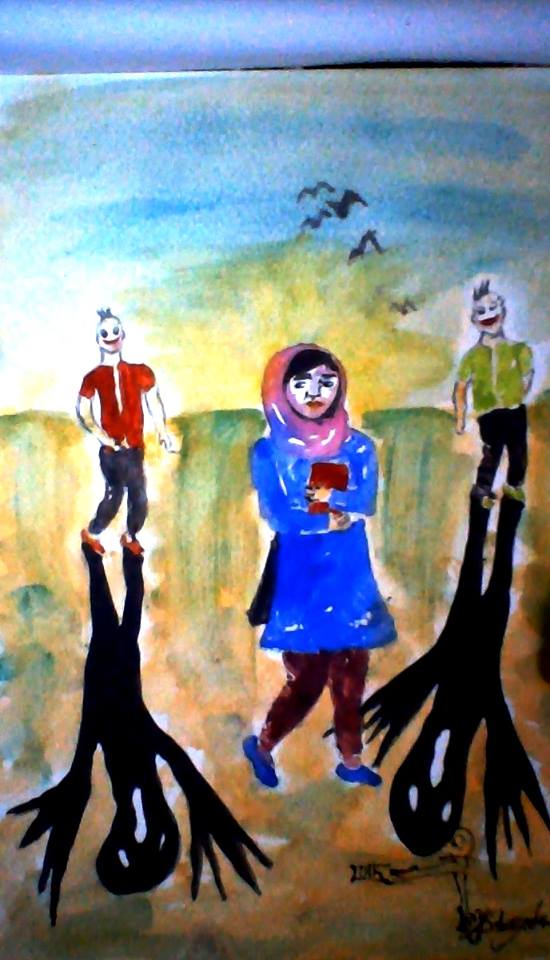
Painting by Roya Saberzada, 16

Guest Blog Post for International Anti-Street Harassment Week 2015

To be honest, I didn’t understand Afghan women’s problems till I got engaged. Before that, I was living in a family of men. I have three brothers and no biological sisters living with us. My mother is a traditional woman who believes that in-order to go to heaven; she HAS TO obey my father. It is the belief of so many other Afghan women I have met too.

Before, although I knew something is wrong here, but I couldn’t understand or feel it, till I fell in love with Fereshta. I saw the first street harassment to the girl I loved just in the second day of our engagement, and during an interval of two months I had seen at least a dozen instances of street harassments against her.

Sometimes the harassment seemed small and included men at her, but other times, we would be abused because she was driving and I was sitting next to her. It became obvious to me what most Afghans think about women driving. In their eyes, I am an honor-less man who lets his wife drive the car while he is in the car.

Many times I couldn’t control myself and fought back, sometimes even physically, because I love my fiancé and I couldn’t watch people harm her. Harassment makes women angry, but it should also make men who claim to love women angry.

I knew my fiancé was harassed when I wasn’t around, but what made me even angrier was that sometimes they harassed my fiancé even when I was with her. This was their way to denying my masculinity and her respect. The harassers thought that by doing so, they were taking the ownership of her body from me, as if I owned her body. I am not talking about the times that we were in the car and someone started shouting at us. They harassed and touched her even when I was walking right beside her in the bazaar. Most of the times, when confronted they denied the harassment claiming that it was an accident and sometimes they escaped. Other times, in the worse cases, they stood against us and fought back. They even defended her behavior.

After experiencing these instances with Freshta, I was assured that the harassment of women doesn’t have anything to do with women. I knew that it absolutely isn’t women’s fault. Sometimes we hear that some radical Mullahs say: “If women don’t go out alone, it won’t happen to them. It is the consequence of those who go out without a man.” But what about those days when I was with Fereshta and she was harassed in the streets of Kabul?

Some of them say: “The way women dress, grabs the attention of men.” I always think about this and say to myself: “OK, for a moment let’s consider that they are right. Let’s say that it is all because of the way the women dress. But does it mean it is right to harass women in the streets?”

And of course I am not talking specifically about Fereshta.  There are women who are harassed even with Chadori, the most conservative attire in Afghanistan. What excuses their harassment?

So, I can surely say that harassment won’t stop unless men rethink their behaviors.

By Omid Haqbin, cross-posted from Dukhtarane Rabia (Daughters of Rabia): A blog on social justice in Afghanistan.

Share

Filed Under: anti-street harassment week, male perspective, Stories, street harassment

Los Angeles Metro Commits To Fighting Sexual Harassment

April 16, 2015 By BPurdy

(Photo by Juliet Bennett Rylah/LAist)

Great news out of Los Angeles! The LA Metro has launched a new campaign called “Its Off Limits” to dissuade harassment on trains and buses and encourage victims to report.

The campaign follows a recent survey that found that while approximately 20% of LA Metro’s 22,604 riders have experienced sexual harassment during their commute, only 99 people reported this behavior in the past year.

With the new campaign, victims can report harassment either using a special hotline or a phone app.

The campaign officially launches tomorrow with a press release at 11am at Union Station, though the posters are up today!

Share

Filed Under: News stories, public harassment, Resources, street harassment

« Previous Page
Next Page »

Share Your Story

Share your street harassment story for the blog. Donate Now

From the Blog

  • #MeToo 2024 Study Released Today
  • Join International Anti-Street Harassment Week 2022
  • Giving Tuesday – Fund the Hotline
  • Thank You – International Anti-Street Harassment Week 2021
  • Share Your Story – Safecity and Catcalls Collaboration

Buy the Book

  • Contact
  • Events
  • Join Us
  • Donate
  • Facebook
  • Instagram
  • Pinterest
  • Tumblr
  • Twitter
  • YouTube

Copyright © 2026 Stop Street Harassment · Website Design by Sarah Marie Lacy