• About Us
    • What Is Street Harassment?
    • Why Stopping Street Harassment Matters
    • Meet the Team
      • Board of Directors
      • Past Board Members
    • In The Media
  • Our Work
    • National Street Harassment Hotline
    • International Anti-Street Harassment Week
    • Blog Correspondents
      • Past SSH Correspondents
    • Safe Public Spaces Mentoring Program
    • Publications
    • National Studies
    • Campaigns against Companies
    • Washington, D.C. Activism
  • Our Books
  • Donate
  • Store

Stop Street Harassment

Making Public Spaces Safe and Welcoming

  • Facebook
  • Instagram
  • Pinterest
  • Tumblr
  • Twitter
  • YouTube
  • Home
  • Blog
    • Harassment Stories
    • Blog Correspondents
    • Street Respect Stories
  • Help & Advice
    • National Street Harassment Hotline
    • Dealing With Harassers
      • Assertive Responses
      • Reporting Harassers
      • Bystander Responses
      • Creative Responses
    • What to Do Before or After Harassment
    • Street Harassment and the Law
  • Resources
    • Definitions
    • Statistics
    • Articles & Books
    • Anti-Harassment Groups & Campaigns
    • Male Allies
      • Educating Boys & Men
      • How to Talk to Women
      • Bystander Tips
    • Video Clips
    • Images & Flyers
  • Take Community Action
  • Contact

“Evidently I was a terrible woman because I was bending him to my will”

July 17, 2014 By Contributor

I was walking casually downtown with a male friend of mine who came to visit the area and his family. We were walking along in a section along 4th Street and between Pike & Pine I believe and this man who looked like a drug addict walked towards us and stood within hearing distance and then started grumbling and practically hissing (I don’t remember his exact wording) that my male friend was a lesser man because he was walking with his woman who was clearly making him subservient to herself. Evidently I was a terrible woman because I was bending him to my will and he was a terrible man because I was crushing him with my feminine magical powers and he didn’t have the balls to put me in my place…. Or something.

He was ANGRY for no damn reason other than a man was walking with a woman. His stance and tone were so aggressive I was bracing for him to get physical with us.

I don’t know if he was trying to harass me or my male friend or both. I don’t walk in that area any longer. The number of streets downtown that I can usually reliably walk on without getting harassed … are becoming scarce.

– Anonymous

Location: Seattle, WA

Share your street harassment story for the blog.
See the book 50 Stories about Stopping Street Harassers for more ideas

Share

Filed Under: Stories, street harassment

USA: Anti-women trolls try to hijack #YouOkSis Twitter discussion

July 17, 2014 By Correspondent

Brittany Oliver, Baltimore, MD, USA, SSH Blog Correspondent

Fighting street harassment was never an easy job.

In case you missed it, Feminista Jones, a popular blogger, Black feminist and creator of the #YouOkSis hashtag, faced harsh backlash from Internet trolls for starting a discussion on how Black men should support Black women to combat street harassment. As motivating as this sounds, some people just couldn’t handle women speaking out and it took a turn for the worst.

With what was supposed to be a virtual space to express our frustrations to create dialogue, men immediately attacked Black women and their allies. At some point, I decided to join in on the conversation and the same thing happened to me.

How bad was it? You be the judge.

In defense of the movement, I tweeted back at trolls and was called an “angry Black feminist” who was on a mission to help organizations like Stop Street Harassment (SSH) put Black men in jail.

Really? Is that the best they could come up with? The work I do during the day consists of upholding racial equality and combating racism in all forms, especially within the criminal justice system. And believe me, the LAST thing I want is for the prison population to increase. That made absolutely no sense and is a cop out from the real problem: men not taking responsibilities for their actions.

This debate made me think about a film I saw in college called “Tough Guise: Violence, Media & the Crisis in Masculinity,” which is headlined by activist and educator Jackson Katz. Katz argues that the epidemic of male violence that plagues American society needs to be understood and addressed as part of a much larger cultural crisis in masculinity and I couldn’t agree more.

We live in a society that tells women and girls to dress a certain way to avoid unwanted attention and abuse. It blames victims first and asks questions later. It teaches men that they are entitled to women’s bodies and showing aggression is the “American” way.

Because the hashtag #YouOkSis wasn’t about the trolls, they were determined to ruin a time of solidarity. What people need to realize is that Stop Street Harassment has given me more support than any man ever has. Now, let that sink in for a minute.

If street harassment didn’t exist, why are organizations like SSH and Hollaback! Baltimore doing work on these issues? Why is visual artist Tatyana Fazlalizadeh traveling around the country to wheat paste portraits quoting things women want to say to their harassers? Street harassment is not an illusion and these are real issues and challenges we face every day.

In 2014, SSH commissioned a 2,000-person national survey in the USA and found that 65% of all women had experienced street harassment, while 25% of men were harassed. With all of the research it took to get these results, why would anybody make this stuff up?

Instead of Black men supporting Black women on this issue, sadly some of them let us down once again. When was the last time you heard a woman deny a man’s experience of being stop and frisked by the police? Most likely never.

And although anti-women trolls hijacked the #YouOkSis hashtag, they proved exactly why the fight to ending street harassment continues.

So, what’s next? Continue to stress the importance of ending street harassment among your family, friends and allies in your community because as you can clearly see, the work is far from over.

Brittany Oliver is a recent graduate of Towson University and works in the non-profit communications sector and supports local anti-street harassment advocacy through Hollaback! Baltimore. She blogs at http://btiarao.wordpress.comand publicly rants on Twitter, @btiarao.

Share

Filed Under: correspondents, Stories, street harassment

“They are the reason women’s rights continue to be an unresolved issue”

July 15, 2014 By Contributor

As the daughter of a single working mother and father consumed with the highs and lows of owning a business, I was highly dependent upon public transportation while growing up. Needless to say, I have become all too familiar with the unwanted staring, suggestive comments, gestures, honking and whistling that come with traveling alone as a girl in the Maryland suburban outskirts of DC. My mother would constantly advise me to “ugly up” before going out in public; skip the makeup, trade the jeans for sweatpants, cover up as much skin as humanly possible, all to avoid attention from men of all ages and counteract what far too many people classify as a their “innate urges.”

The more I grow up, however, the more I realize that I am not unique in my experiences with people my mother classifies as “creepers,” and nor is she in her good intentioned advice. Cases as benign as staring and gesturing and as severe as rape have become increasingly frowned upon by society and censured by the media. The question of how to put an end to society’s age old rape culture has become more pressing as such news and statistics become more readily available to the public.

Many, like my mother, argue that women should dress more modestly to avoid unwanted attention and potential aggression in public. Rape culture and street harassment have become an everyday reality for women across the nation. As a result, many advise girls from a young age to take steps to avoid the unwanted attention and potential abuse.

This perspective, however, fails to solve the true cause of the problem. By telling our daughters and younger sisters to dress decently to avoid unwanted attention and potential abuse, we accept rape and the degradation of women as a norm, and thereby, perpetuate rape culture rather than move toward ending it. Telling girls to take active measures to avoid rape is inadequate and counterintuitive solution to a problem that women have faced for centuries and by doing so, we are moving away from progress and clinging to the patriarchal values that activists have worked so hard overcome.

It is the duty of the free and modern world to promote not only proactive counter measures against abuse in our girls, but also instill self-control in boys and nurture the idea of respecting for women from the beginning. We must continue to deny the idea that men cannot control themselves in the presence of a woman; we must castigate all those who continue to hold these parochial beliefs in the twenty first century, because they are the reason women’s rights continue to be an unresolved issue; and we must no longer make excuses for their behavior by saying ‘well, boys will be boys’ because by doing so, society is accomplishing nothing but allowing their behavior to continue.

If I ever have a son, I will instill in him respect for women from a young age and stop the cycle of excuse-making and victim-blaming. If I ever have a daughter, I will most likely take a different approach than the one my mother did; I will clearly explain the realities of society and the fact that dressing provocatively can bring about unwanted attention, but I will never force her to conform by suggesting that she dress in a certain way for men. Hopefully, by the time I have a son or daughter, though, sexual violence will be less of an issue than it was while I was growing up.

– Shiran Zecharya

Share your street harassment story for the blog.
See the book 50 Stories about Stopping Street Harassers for more ideas
Share

Filed Under: Stories, street harassment

To clarify what SSH is about

July 14, 2014 By HKearl

Ever since the #YouOkSis tweet chat on Thursday focused on Black women’s experiences with #streetharassment, a bunch of people on twitter have been attacking me, saying I started the hashtag (@FeministaJones did) and the whole movement against street harassment (yeah right, women have been organizing against this issue for 100+ years) in order to push my “agenda” to jail Black men. They have also targeted the Black woman who led the campaign and many other women who participated during the chat.

Of course I have dealt with criticism (constructive and vicious) but this is a new level of willful misinformation and hate. People have been calling me Jim Crow, saying I dupe Black women, saying I have an agenda to jail all Black men, and a few men have said sexually explicit things about me. Some men have also photoshopped my head onto images like one of me crushing a Black woman in a chair with her underneath me. Yes, this is all upsetting.

I have followed the guidance of the woman who started the hashtag and not engaged with them. I wasn’t going to mention it on this blog, even.

However, I just received an email from a presumably white man saying he whole-heartedly agrees with my campaign to jail Black men and called them racial slurs and says he wants to contribute money to my campaign. That is disgusting and unacceptable and I emailed him back to tell him so. I don’t know if it’s a joke or not, but it’s unacceptable regardless.

But it makes me realize I can’t not say something publicly about this. Misinformation spreads fast.  So ENOUGH.

Let me be clear: I do not have an agenda to jail anyone.

What do I want? I want everyone to be safe and unharassed in public spaces. I want interactions in public spaces to be respectful and full of consent.

Street harasser does not mean Black men. Far from it.

Men across all backgrounds are harassers (and some are harassed, primarily in the LGBT community).

On the flip side, women across all backgrounds experience street harassment (and a small number are harassers).

I have collected thousands of stories, done two online surveys, commissioned a nationally representative survey, and conducted 10 focus groups. I’ve given 125 talks where I’ve heard stories. I’ve written two books, a master’s thesis and 50 articles. I don’t know everything about street harassment, but I know a hell of a lot.

And here’s the thing. Street harassment is a societal and global problem. Street harassment does not happen in a vacuum. Sexual harassment is a problem in our schools and workplaces. Rape is a problem on our campuses and in our military. Domestic violence and teen dating violence are problems as is incest. Street harassment is one component of the sexual harassment/sexual violence/domestic violence spectrum and grouping — and it happens in every country.

I’ve been speaking out for years specifically on street harassment because so few others have been.

And so this is my agenda: bring attention to this problem, provide a place for people to share stories, and help create a culture where everyone has the right to be safe and unharassed in public spaces. Read about SSH’s work here.

Share

Filed Under: street harassment

USA: #YouOkSis Street Harassment Tweet Chat

July 14, 2014 By Correspondent

Kirstin Kelly, Monterey, California, USA, SSH Blog Correspondent

As an editor for The Women’s International Perspective, I often find myself involved in Twitter chats and campaigns that deal with social issues, especially issues pertaining to the treatment of women around the world.  On July 11, I participated in one such chat using #YouOKSis (here is the recap). It quickly became clear that this was not your ordinary Twitter chat.

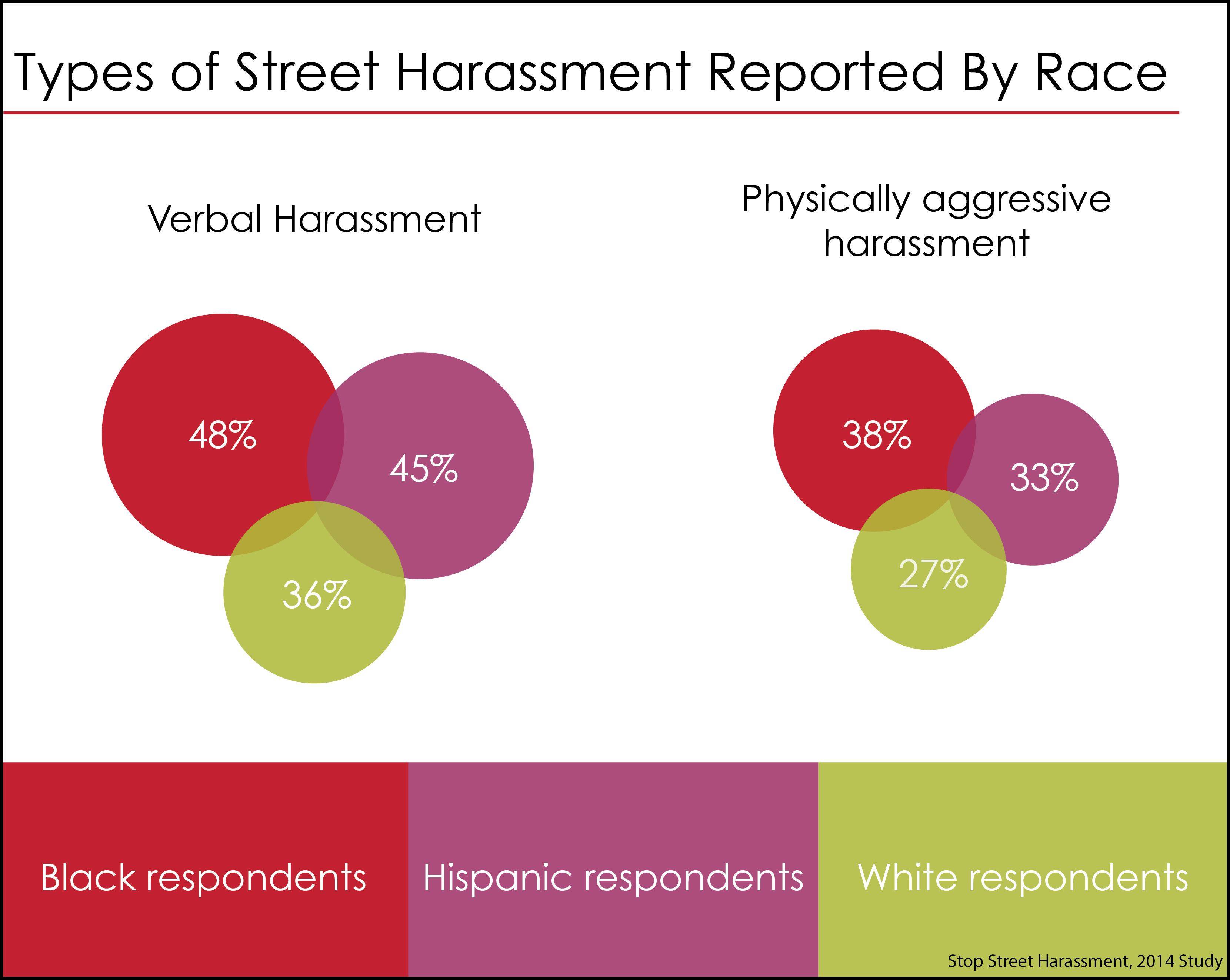
The sheer numbers of trolls and naysayers making themselves heard was truly astounding.  The #YouOKSis chat was intended to be a discussion about street harassment faced by Black women.  In particular, it called for men of color to engage in bystander intervention when they witness women of color being harassed.  These kinds of conversations are important.  Stop Street Harassment’s recent National Street Harassment Report demonstrated that persons of color face harassment at higher rates than their white counterparts and that overwhelmingly it is men who do the harassing, regardless of the victims’ gender.

The #YouOKSis chat aimed to address this problem on two fronts.  It first and foremost provided a space for women of color to share their experiences.  #YesAllWomen, a campaign in which I also took part, similarly invited women to share their experiences.  However, it did not address how race plays a role in a person’s experience with street harassment the way #YouOKSis did.  The second critical component of the #YouOKSis chat which is largely absent from other similar conversations is that it attempted to educate men on how they can actively become part of the solution by intervening on behalf of people facing harassment.

Participating in both of these conversations provided me with a tiny window into the complexities of issues that are both racial and gendered.  #YouOKSis drew a level of harassment I could not have expected.  Not only were people complaining in the usual manner that women sharing their experiences were creating problems where previously there hadn’t been any, being whiny, or failing to recognize that not everyone is guilty of harassment, but many of them were critiquing participants for turning on their own race.

The viciousness of these attacks is exactly why campaigns like #YouOKSis are important.  We need to do more to create safe spaces for people to share their stories about how race, sexism, and classism affect their lives because without fostering a better dialogue, any attempt made to solve these problems will be limited by the experiences of the organizers.

Furthermore, a lot of the criticism was coming from men who felt attacked, pointing out that not all men are guilty.  To me, it seemed the larger point of the conversation was not to hate on men for harassing women, but rather to help educate men that are not allies yet and to further empower those that already are by giving them more to go on than simply “don’t harass people.”  For social issues that are gendered, engaging the entire population, those with group identities most common to aggressors is critical.  Male allies are just as important to changing the norms of acceptable behavior as women; they do make up half the population after all!

My guess is that allies both from within and outside of racial groups are similarly critical in creating the changes that are so desperately needed.

Kirstin is a Master’s Student in Nonproliferation and Terrorism Studies at the Monterey Institute of International Studies and a news editor at the Women’s International Perspective (The WIP). You can follower her on Twitter at @KirstinKelley1, where she regularly posts about human rights issues around the world.

Share

Filed Under: correspondents, Stories, street harassment

« Previous Page
Next Page »

Share Your Story

Share your street harassment story for the blog. Donate Now

From the Blog

  • #MeToo 2024 Study Released Today
  • Join International Anti-Street Harassment Week 2022
  • Giving Tuesday – Fund the Hotline
  • Thank You – International Anti-Street Harassment Week 2021
  • Share Your Story – Safecity and Catcalls Collaboration

Buy the Book

  • Contact
  • Events
  • Join Us
  • Donate
  • Facebook
  • Instagram
  • Pinterest
  • Tumblr
  • Twitter
  • YouTube

Copyright © 2026 Stop Street Harassment · Website Design by Sarah Marie Lacy