• About Us
    • What Is Street Harassment?
    • Why Stopping Street Harassment Matters
    • Meet the Team
      • Board of Directors
      • Past Board Members
    • In The Media
  • Our Work
    • National Street Harassment Hotline
    • International Anti-Street Harassment Week
    • Blog Correspondents
      • Past SSH Correspondents
    • Safe Public Spaces Mentoring Program
    • Publications
    • National Studies
    • Campaigns against Companies
    • Washington, D.C. Activism
  • Our Books
  • Donate
  • Store

Stop Street Harassment

Making Public Spaces Safe and Welcoming

  • Facebook
  • Instagram
  • Pinterest
  • Tumblr
  • Twitter
  • YouTube
  • Home
  • Blog
    • Harassment Stories
    • Blog Correspondents
    • Street Respect Stories
  • Help & Advice
    • National Street Harassment Hotline
    • Dealing With Harassers
      • Assertive Responses
      • Reporting Harassers
      • Bystander Responses
      • Creative Responses
    • What to Do Before or After Harassment
    • Street Harassment and the Law
  • Resources
    • Definitions
    • Statistics
    • Articles & Books
    • Anti-Harassment Groups & Campaigns
    • Male Allies
      • Educating Boys & Men
      • How to Talk to Women
      • Bystander Tips
    • Video Clips
    • Images & Flyers
  • Take Community Action
  • Contact

10 Things To Know for Anti-Street Harassment Week

March 30, 2014 By HKearl

Safe public spaces. Freedom from harassment. The right to go where you want, when you want, wearing what you want.

This marks the start of the fourth annual International Anti-Street Harassment Week when people and groups worldwide work together to bring local and global attention to street harassment and when we collectively call for it to end. Together our voices grow stronger.

10 Things You Need to Know:

1. There are at least 150 groups in 23 countries that are participating + there will be thousands of individuals joining us.

2. Here are our events. If your action is not listed, please send me info/link as soon as possible, hkearl @stopstreetharassment.org

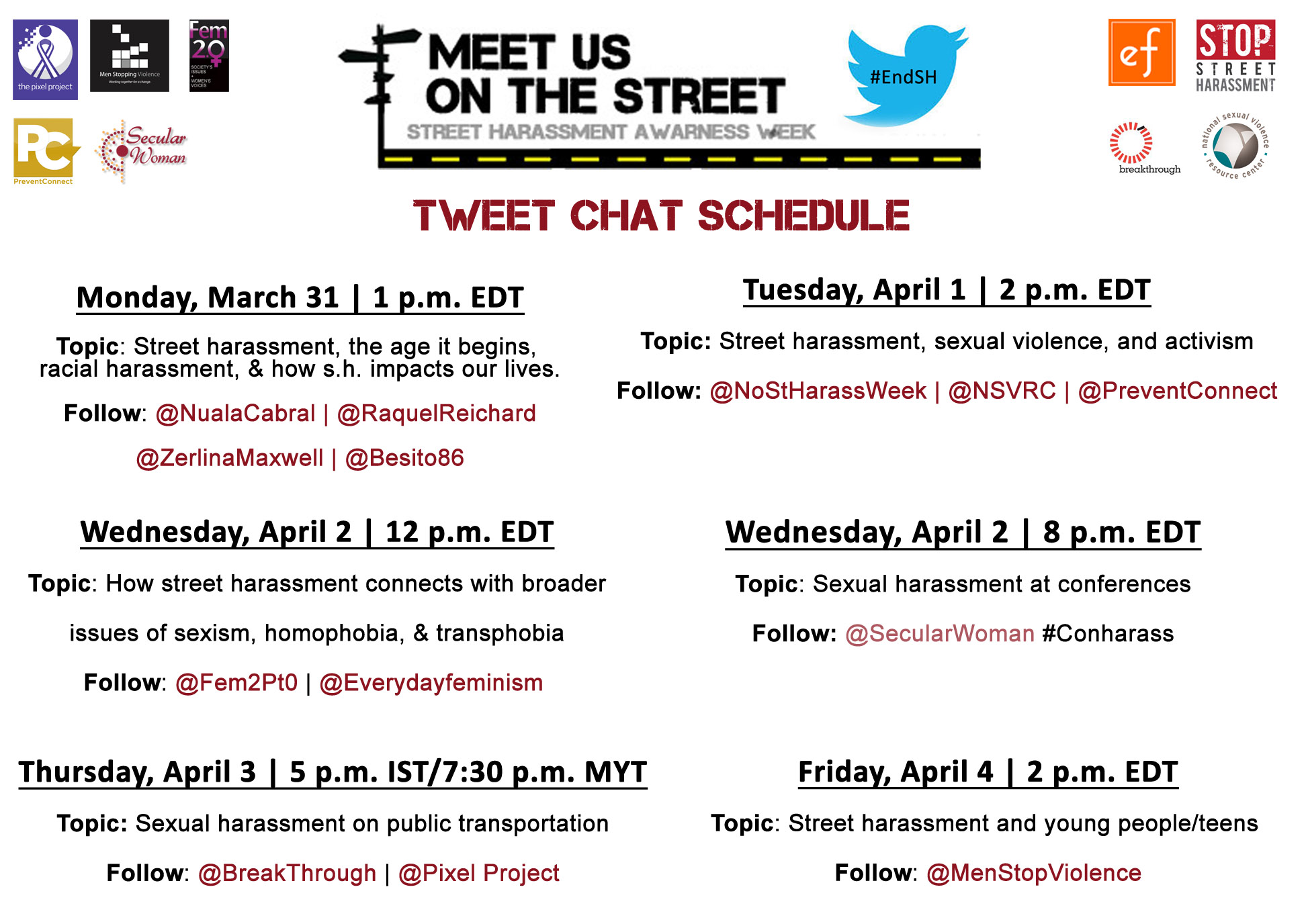
3. Here are ideas for action, including how to download the Stop Telling Women to Smile poster, info about a free phone app called Safetipin and details about our six Tweet Chats.

4. The tools page has updated logos in several languages and more flyers and shareable images you can use.

(Facebook cover)

5. Do you want to guest blog or have a blog post cross-posted on Stop Street Harassment during the week? Let me know, hkearl @stopstreetharassment.org.

6. We’ve started to get media coverage. If your action is covered in the news or if you write an op-ed or blog post, please send me the link and I’ll add it to the list and the wrap-up report.

7. Here is the 2014 photo album. Please send photos, or links to photo albums, to me as soon as they’re taken/posted and I’ll update the album in real time. Let’s be virtually part of and celebrate each other’s events!

8.Here’s the report form where you can say how your action went (no matter how big or small). This information will be used for the annual wrap-up report and potentially for articles about the week.

9. The week kicks off in a few hours with this virtual event:

30 March: Pixel Project, based in Malaysia, is hosting a Google+ hangout discussion about street harassment at 8:30 a.m. EDT with Ursula Singh, Executive at YUWA (Nepal), Hanna Lena Krüger, a ProChange Member (Germany) & me. There will be plenty of time for Q&A!

YouTube: http://is.gd/ISHWPixel
Google+: http://is.gd/ISHWPixelG

10. My thanks for your hard work to prepare events and actions so that this week we can join forces and demand public places that are free from harassment!!

Share

Filed Under: anti-street harassment week, Resources, street harassment

USA: 29 Things Men Can Do (and Not Do) to Challenge Street Harassment

March 28, 2014 By Correspondent

Joe Samalin, New York City, NY, USA, SSH Blog Correspondent

March 30th – April 5th is Anti-Street Harassment Week so come out and Meet Us On The Street!

Can’t make it? Don’t know anything about street harassment? Don’t know what to do? Not sure how to make a difference?  There are limitless ways to make a difference. Here are just a few to start us off…

1. Learn how often street harassment actually happens (spoiler alert: it happens a lot. Informal studies and more formal research show that the overwhelming majority of girls and women experience it often.)

2. If research and numbers are not your thing, try this. Ask three women in your life (three women you trust and who trust you) about their experiences being harassed in public. If they don’t mind sharing you can ask where it happens and how often, what is said or done, how they react (if they do), and how the harassers react back. Ask them how this affects them, and how they feel about it. But don’t forget to…

3. Listen to their answers, without judging, disagreeing, or arguing. Just listen.

4. If you do not get harassed regularly, think about what that means for you. Recognize that as a privilege we have. And then choose something else on this list and do something about it.

5. Challenge myths about street harassment.

6. For example, don’t bring up your one female friend who likes street harassment to show that it is ok to harass women. It is a slap in the face to the millions of women who don’t like it. And you can’t tell who might like it by looking at them anyway, so it’s kind of a moot point to begin with.

7. And ask that friend who likes it if they always like it, or if it depends on context.

8. Talk to (male) friends who don’t harass women. Ask them if they ever notice it, and what they think about it. Ask them what they do or can do to challenge it. And what you can all do together! Remember to challenge myths (see #5 above) and don’t defend it (#27 below).

9. Understand that street harassment and other forms of violence in public are common against gay, lesbian, bisexual and transgendered people and people of color, as well as women and girls. And understand too that all those categories are not mutually exclusive.

10. Support organizations like Girls For Gender Equity, Incite! Women of Color Against Violence, Stop Street Harassment, Hollaback, Center for Anti-Violence Education, Anti-Violence Project, RightRides, and others working to support those affected by street harassment and other related forms of violence.

11. Safely and respectfully intervene when you see harassment in public. Be creative!

12. Practice practice practice what you can say to friends, co-workers, teammates, classmates, and family members when they harass women:
“Cut that out, it really makes me uncomfortable.”
“Don’t do that in front of me….or at all. It’s not right.”
“You really shouldn’t do that. It’s disrespectful and it is called harassment.”
“(Insert witty line here.)”

13. Practice what you can say to strangers when they harass women
“Hey man I heard what you said to those women and it’s really not ok.”
“Don’t do that around here.”
“Can you please cut that out? People are just trying to get through their day and you are bothering them.”
“It’s not a compliment.”
“Don’t tell women to smile – they can feel however they want to feel.”
“(Insert another witty line here.)”

14. Print up tee-shirts with messages like ‘her name isn’t baby’, ‘it isn’t a compliment, it’s harassment’, ‘respect women and girls in public’, and more. Give them to men you know. Or sell them and give the profit to organizations addressing violence against women.

15. Join/support/get trained by agencies promoting healthy non-violent masculinity – Men Can Stop Rape, A Call To Men, Men Stopping Violence, Coach For America, White Ribbon Campaign, and others.

16. Contact men in leadership positions (coaches, politicians, business owners, teachers, etc.) and get them to make public statements against street harassment.

17. Figure out fun creative ways to interrupt street harassment on your block and in your neighborhood.

18. Practice your ‘hell no’ look for when other men turn to you in public and try and get you to harass women and girls with them, or to have your back when they get called out for it.

19. Film and release your own hometown video about men challenging street harassment to try and match the coolness of NYC, California, Northern Azerbaijan, and Egypt.

20. Use art, theater, music, or whatever else you are good at and enjoy doing to raise a little awareness about men challenging street harassment.

21. Join us for anti-street harassment week this year and every year.

22. Actually, make every week anti-street harassment week.

23. Think of one thing you can do today that would challenge street harassment, and then…

24. Do that thing, and then…

25. Share that thing you did with others, so they can try it too.

26. Add to this list and share it with others – at home, at work, at school, at church, at practice, everywhere.

27. Don’t defend it.

28. Don’t ignore it

29. Don’t do it.
 

Copyright: Joseph Samalin. All rights reserved. Reprints or reposts with the permission of the author and Stop Street Harassment.

Joe Samalin has been addressing gender-based violence for over 15 years, including as the Training and Technical Assistance Coordinator for Men Can Stop Rape. He is currently the Outreach and Training Manager for the Disaster Distress Helpline and is examining among other things gender-based violence in the aftermath of disasters. Follow him on Twitter, @joesamalin.

Share

Filed Under: street harassment

Snickers: Men are not naturally harassers & women don’t owe men their attention

March 26, 2014 By HKearl

UPDATE: Please sign the Care2 & Stop Street Harassment Petition!

Have you seen any of Snickers’ “You’re not you when you’re hungry” campaign? They show someone doing something out of character — until they eat a Snickers and then return to their normal self.

They have a new commercial in this campaign that was filmed in Australia that caught my attention.

In it, construction workers who are hungry and thus “not themselves” yell “empowering” things to women on the streets.

“I’d like to show you the respect you deserve!”

“A woman’s place is where she chooses!”

“You know what I’d like to see? A society in which the objectification of women makes way for gender-neutral interaction free from assumptions and expectations.”

Since Snickers is saying they are saying these things while they are not themselves, it suggests that when they are their normal selves they, what, yell crude and harassing things to women? Ummm, why would we ever feed them, then?

Also, holy crap — this is the answer to our problem — we can solve street harassment by starving men!

HA.

In all seriousness, there are two main reasons why this commercial is problematic:

1 – The trope that street harassment is only perpetrated by construction workers is OLD. Yet, companies and media continue to love to use it, with recent examples being SNL and Lego. In reality, men of all social classes, races, and professions street harass and there are many construction workers who do NOT street harass. Let’s try to at least be accurate in the representation of street harassers.

2 – Even though the construction workers are saying positive, non-harassing things, they are actually still engaging in behavior we do not support. They are singling women out and demanding their time and attention as they yell at them. Men are able to walk by the site and go about their business and keep thinking their thoughts, but the same is not true for women. They are interrupted, their attention is demanded. That is not equality. If you wouldn’t yell it at a man, you probably shouldn’t yell it at a woman. Remember: women do not owe you their time or attention!

You can contact Snickers to let them know why you’re #NotBuyingIt!

Also, a few suggested tweets:

@SNICKERS the way to stop #streetharassment isn’t to starve men. it’s to leave women alone on the streets!

@SNICKERS not all construction workers are street harassers when they “are themselves.” stop promoting that tired trope

@SNICKERS women do not own anyone their attention, whether it’s for “positive” or harassing attention

Share

Filed Under: News stories, offensive ads, street harassment Tagged With: snickers

Harassment in the Headlines

March 25, 2014 By SSHIntern

By Kendra Corbin, SSH Intern

March has proven to be an exciting month in the fight against street harassment! This global issue has recently made the headlines in several countries:

Jordan:

In recent years, traditional gender values in Jordan have been struggling to merge with modern lifestyle choices. Many women now work outside of the home and reject having male escorts while out in public. However, street harassment has steadily risen alongside this new-found independence. Jordanian women often find themselves choosing to either endure harassment or risking their family’s fragile reputation if they choose to report their crimes.

Social media is now becoming an imperative tool in the fight against street harassment. Organizations such as HarassMap in Egypt and Uprising of Women in the Arab World use social media outlets to raise awareness and encourage societal change. While women are grateful for the effort, many activists admit that in order to eliminate street harassment, real change needs to take place within the government and its laws.

Nepal:

On March 18, activists in Kathmandu, Nepal, organized the Safe City Campaign. Their main goal is to raise awareness about street harassment and ultimately make Nepal streets safer for women. Along with providing possible solutions to the issue, activists and volunteers dispensed 2,000 flyers around public spaces. These flyers highlighted that street harassment is intolerable behavior. Campaign members acknowledge that encouraging people to talk about the issue is an important step in eliminating street harassment.

Belgium:

Expected to begin in April, sexual harassment in Belgium will be punishable by either hefty fines or up to one year in prison. The new law will extend to sexual harassment that takes place on the streets, in the workplace, or on social media sites. Deputy Prime Minister Joelle Milquet claims that while the law’s main objective is to protect women from violence and sexism, it will also protect men from demeaning sexist comments.

Street harassment in Belgium began gaining attention following Sofie Peeter’s documentary Femme de la Rue. The documentary consisted of footage from a hidden camera depicting the overt sexual harassment that women endure in public and interviews with women about their own experiences.

As of 2011, countries such as Italy, Germany, United Kingdom, Denmark, and Belgium signed a pledge vowing to take legal action in order to eliminate violence against women. Belgium has clearly stayed true to its promise.

Kendra Corbin is senior at Shenandoah University. She is majoring in Mass Communications and minoring in Women’s Studies.

Share

Filed Under: News stories, street harassment

Men: Speak out against street harassment, March 30 – April 5 (and always)

March 25, 2014 By HKearl

International Anti-Street Harassment Week starts in just 5 days!!
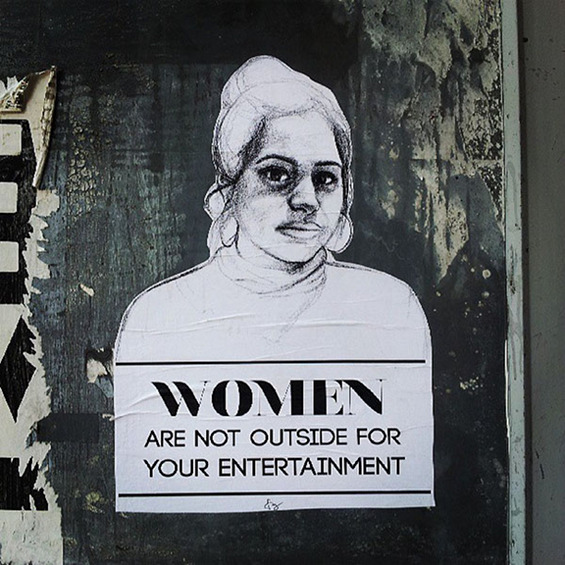
While women are the main targets of street harassment, entire families and communities are impacted by it — when women aren’t as safe in public spaces, everyone suffers. And so it’s in men’s best interest to get involved in challenging street harassment, and, as the main perpetrators of street harassment, they are in the best position to stop it.

Many men get this and will be involved in International Anti-Street Harassment Week this year, including male-led initiatives like:

* Hey Baby Art Against Sexual Violence (they’re hosting an event/rally at a high school in Tucson, AZ)

* London Tae Kwon Do School (they’re talking about street harassment during all of their classes that week)

* Masculinity U (they’ll be posting information on social media about street harassment)

* Men Stopping Violence (they’re hosting the April 4 Tweet Chat at 2 p.m. EDT, #EndSH).

Individual men will be involved too, like Mark Webster in Virginia who will donate his photography skills to photograph a sidewalk chalking event in Washington, D.C. on Sunday; Joe Samalin, a SSH blog correspondent who will speak at the NYC rally against street harassment on April 5; and Alan Kearl, my dad and HUGE SSH supporter who will join my mom in putting up flyers in South Beach, FL, this weekend.

Men: the best way you can get involved is to talk to other men about this issue. Tell them why it’s not cool to harass. Speak up when you see harassment happening. Join us in any way you can. We need you!

Share

Filed Under: anti-street harassment week, male perspective, street harassment

« Previous Page
Next Page »

Share Your Story

Share your street harassment story for the blog. Donate Now

From the Blog

  • #MeToo 2024 Study Released Today
  • Join International Anti-Street Harassment Week 2022
  • Giving Tuesday – Fund the Hotline
  • Thank You – International Anti-Street Harassment Week 2021
  • Share Your Story – Safecity and Catcalls Collaboration

Buy the Book

  • Contact
  • Events
  • Join Us
  • Donate
  • Facebook
  • Instagram
  • Pinterest
  • Tumblr
  • Twitter
  • YouTube

Copyright © 2026 Stop Street Harassment · Website Design by Sarah Marie Lacy