• About Us
    • What Is Street Harassment?
    • Why Stopping Street Harassment Matters
    • Meet the Team
      • Board of Directors
      • Past Board Members
    • In The Media
  • Our Work
    • National Street Harassment Hotline
    • International Anti-Street Harassment Week
    • Blog Correspondents
      • Past SSH Correspondents
    • Safe Public Spaces Mentoring Program
    • Publications
    • National Studies
    • Campaigns against Companies
    • Washington, D.C. Activism
  • Our Books
  • Donate
  • Store

Stop Street Harassment

Making Public Spaces Safe and Welcoming

  • Facebook
  • Instagram
  • Pinterest
  • Tumblr
  • Twitter
  • YouTube
  • Home
  • Blog
    • Harassment Stories
    • Blog Correspondents
    • Street Respect Stories
  • Help & Advice
    • National Street Harassment Hotline
    • Dealing With Harassers
      • Assertive Responses
      • Reporting Harassers
      • Bystander Responses
      • Creative Responses
    • What to Do Before or After Harassment
    • Street Harassment and the Law
  • Resources
    • Definitions
    • Statistics
    • Articles & Books
    • Anti-Harassment Groups & Campaigns
    • Male Allies
      • Educating Boys & Men
      • How to Talk to Women
      • Bystander Tips
    • Video Clips
    • Images & Flyers
  • Take Community Action
  • Contact

Digest of Street Harassment News: March 3, 2014

March 3, 2014 By SSHIntern

** Sign up to receive a monthly e-newsletter from Stop Street Harassment **

Street Harassment Stories:

Share your story! You can read street harassment stories on the Web at:

Stop Street Harassment Blog

Bijoya in Bangladesh

Collective Action for Safe Spaces

Everyday Sexism

HarassMap in Egypt

The Hollaback Sites

Ramallah Street Watch in Palestine

Resist Harassment in Lebanon

Safe City India

Safe Streets in Yemen

Street Harassment in South Africa

Street Harassment in the News, on the Blogs:

* New Age Online, “Metro cop accused of harassment“

* New York Times Blog, “Share Your Stories of Street Harassment in New York City“

* Telegraph, “Stop telling women to ‘smile’: New York street art says it how it is“

* Frontier Post, “India’s incessant Pak bashing“

* AsiaOne, “HK survey: 1 in 3 air stewardesses sexually harassed last year“

* Sexual Assault Prevention & Response Services, “Ignoring the reality of street harassment“

* Business Standard, “Women eve-teased, three family members injured“

* Emirates 24/7, “Kangana on a mission: Talks rape, eve teasing and gender bias“

* New Indian Express, “Mint Area Tense After Eve Teasing Row“

* Philadelphia Magazine, “In Philly, in the Dead of Winter, Men Will Still Catcall You“

* Daily Nexus, “Take Back the Night Begins Week-Long Campaign“

* Philly.com, “Those catcalls aren’t cute. They’re harassment“

* The Guardian, “Women should not accept street harassment as ‘just a compliment’“

* Fusion, “Fighting Street-Harassment with Art“

Announcements:

Reminders:

* Stop Street Harassment is moving forward with the national street harassment study but we still need to raise a bit more money to cover the costs of producing the report. Please consider donating $10 or more to make this happen.

* If your group, organization, or campus plans to participate in International Anti-Street Harassment Week, please contact Holly (hkearl @ stopstreetharassment.org) and we can add you to the list of participating co-sponsors.

10 Tweets from the Week:

* @vampishly: street harassment is my number one reason for not wanting to go outside :/

* @reemelhussainy: Street harassment is no more about compliments than rape is about sex.

* @bikemamadelphia:@katebikemom @StopStHarassmnt my friend was recounting why she stopped riding so much. Guy slapped her ass from car in center city

* @bonesauce94: Day 7254 of being a girl: I discover that applying even the dullest of Chapstick is somehow erotic, and a warrant for catcalls. Fascinating

* @MonaBassel: 15 year old boy verbally harassed so I shouted and told him to come so he ran, slipped, and fell. Goes to show how harassers are cowards! #EndSH

* @anniebiggins: It must be spring. Outside for 4 minutes and already enjoying some fantastic street harassment!!!

* @Vidyut: Speak with 1o maids in your area. Ask them what is the most difficult about being a woman in India. Count how many say street harassment.

* @scarriewhite: nothing like starting by day by getting disgusting catcalls yelled at me in my walk to the subway

* @tangomangooo: someone pls explain to me why I can’t go anywhere without hearing catcalls or being whistled at

* @KHolmMN: Yo dudebros. You do realize that catcalling (esp. during the middle of the night on city streets) is generally terrifying and won’t work?

Share

Filed Under: street harassment

Chile Combats Harassment

March 3, 2014 By SSHIntern

By Kendra Corbin, SSH Intern

Prior to becoming involved with Stop Street Harassment, I was under the impression that harassment on and off the streets was an isolated issue that took place in the United States. I now have a global perspective as it relates to street harassment. This disheartening issue impacts the lives of women and girls around the globe. Recently, I had the privilege to reach out to a new group dedicated to fighting street harassment in Chile. The Observatorio Contra el Acoso Callejero Chile (OCACC) was gracious enough to consent to answering a few of Stop Street Harassment’s questions in order to spread the word to our global readers.

SSH: Can you briefly describe OCACC?

OCACC: OCAC Chile is the first non-profit organization in the country aimed at stopping street harassment. Our main objective is to raise awareness and understanding about this issue, so that it can be clearly understood as a form of gender-based violence. We intend to achieve this through cultural and educational activities.

SSH: What does your organization hope to accomplish?

OCACC: Our long-term goal is to create legislation to end street harassment. However, we first need to help society understand what constitutes street harassment, and that this is a form of gender-based violence. We want to promote social reform not only through new legislation, but at a cultural level.

SSH: What kind of feedback has OCACC encountered from society?

OCACC: Since we started back in November, we have received a tremendous amount of support and encouragement, particularly once we were featured on several media outlets. So much so, that our current activities run solely through the support and goodwill of our adherents. At the moment we don’t have any kind of financial backing, so the contribution from our supporters cannot be understated; they keep us motivated to push harder than before.

It all started with the idea of providing a space through which to bring consciousness about street harassment, to help people understand that this is a social problem that needs to be reformed. Initially we did photo shoots and posted anonymous stories from women willing to tell us about the harassment they suffered. As we garnered support, psychologists, lawyers, artists, illustrators, musicians and others willing to help us joined our cause, which has allowed us to expand the scope and reach of our activities.

SSH: In what ways do you feel society allows continued violence against women, including street harassment?

OCACC: Just as in most of South America, there is much to be desired in the way that Chile has managed gender equality policies. As a country we have a very limited view as to what constitutes gender-based violence: femicide, rape, and domestic violence are the commonly accepted interpretations. Chilean society as a whole has been unable to take accountability for many of the forms of gender-based violence that exist to this day, since this severely restricted perspective has allowed many other facets of this type of violence to remain unchallenged. Our country promotes a sexist culture, from our media (TV, radios, newspapers and publicities) down to our education system, which is why it’s hardly surprising that so many different aspects of gender inequality and violence remain unquestioned to this day. About a month ago we were invited to talk about street harassment on several media outlets, and even though it allowed us to introduce this topic to the public eye – to promote the idea that women were in fact not fond of being harassed out on the streets – it was disheartening to engage with many interviewers, most of whom showed a complete lack of understanding and maturity when discussing this topic.

This type of violence keeps recurring because we are not yet capable of recognizing the many facets of gender-based violence. In Chile, street calling – as well as making out-of-place comments – is seen as cultural heritage, and we must challenge this perspective to bring to light the fact that women do not want to suffer and be subject to this type of treatment. That we as a society can change.

SSH: Can you offer any advice to men about how to approach women in a healthy, safe manner?

OCACC: It’s important to note that street harassment is not a way to approach a woman (such as when cat-calling or making clearly lewd comments). There is no desire in the harasser to establish any type of relationship with a woman; a man that does this is doing so with a specific intent to exert violence through a socially accepted ritual. Men who want to approach women with an honest intention have nothing to worry about – flirting and harassing are not the same. We sincerely believe that men and women are capable of creating beautiful and healthy relationships with each other if they both have respect and consent from each other.

Kendra Corbin is senior at Shenandoah University. She is majoring in Mass Communications and minoring in Women’s Studies.

Share

Filed Under: Activist Interviews, street harassment

USA: Hollaback! Baltimore Launches The Safer Space Campaign

March 2, 2014 By Correspondent

Brittany Oliver, Baltimore, MD, USA, SSH Blog Correspondent

As activists across the nation work to end street harassment in their cities, there is one organization that is doing some serious work in making our streets safer: Hollaback! Baltimore. As a non-profit, Hollaback! Baltimore is currently on a mission to building a network of supportive non-threatening environments in Baltimore City.

This month Hollaback! Baltimore are encouraging local businesses in Baltimore City to sign the Safer Space Campaign Pledge, which declares their commitment to ending street harassment against women and LGBTQUIA people. This pledge would require staff to take complaints seriously, deal with the harasser, and offer support resources as needed.

By signing the pledge, each venue is given a packet of resources to assist them with keeping their space safer for guests. The packet includes a background on the issue, simple things to do and not do, the official Hollaback! Employer’s Guide to Ending Street Harassment, and a poster to hang publicly so guests will know what won’t be tolerated.

Poster Design: Kristen Argenio at Ideal Design Co

According to Hollaback! Baltimore, this campaign began in March 2013 when Hollaback! London formed a partnership with Fabric, a local club that was fed up with hearing that women were being harassed in their venue. The complaints they received motivated the club to make a difference, so they partnered with Hollaback! London to develop a campaign that would work directly with venues to ensure their current employees and security policies are effective. After hearing about their success with the campaign, Hollback! Baltimore felt Baltimore City needed a similar campaign. This is what they created:

THE PLEDGE:

By signing this pledge, we the undersigned do hereby agree to:

* Post the “Safer Space” poster provided by Hollaback! Baltimore in a prominent place for all employees/staff/volunteers and attendees/customers to see
* Take complaints of harassment, discrimination, and violence against customers or staff seriously
* Remove any offending parties from our space
* Ensure our staff, particularly those responsible for security, are aware of our policies
* Use the resources given to us by Hollaback! Baltimore to better understand the issues at hand as well as the best methods for dealing with them
* Inform victims of their right to share their story publicly and anonymously on Hollaback! (via the website or free phone app) by handing out informational postcards

I believe this campaign will not only help to make streets safer, but it will hold venue owners accountable for what goes on during business hours. You shouldn’t have to be an activist to want to make a difference. Whether you’re a teacher, police officer, business owner, janitor, or student, all members of the community should be willing to make our streets safer for everyone.

Ending street harassment has to be a team effort if we want to get the message across that harassment is NOT OKAY. Through this campaign, local businesses can now become effective agents of change by making their establishments harassment free for everyone.

To learn more Hollaback! Baltimore and the Safer Space Campaign, visit http://bmore.ihollaback.org/

Brittany Oliver is a recent graduate of Towson University and works in the non-profit communications sector and supports local anti-street harassment advocacy through Hollaback! Baltimore. She blogs at brittuniverse.wordpress.com and publicly rants on Twitter, @btiara3.

Share

Filed Under: Activist Interviews, street harassment

USA: Reflections on a Women Bike PHL Street Harassment Focus Group

March 1, 2014 By Correspondent

Katie Monroe, Philadelphia, PA, USA, SSH Blog Correspondent

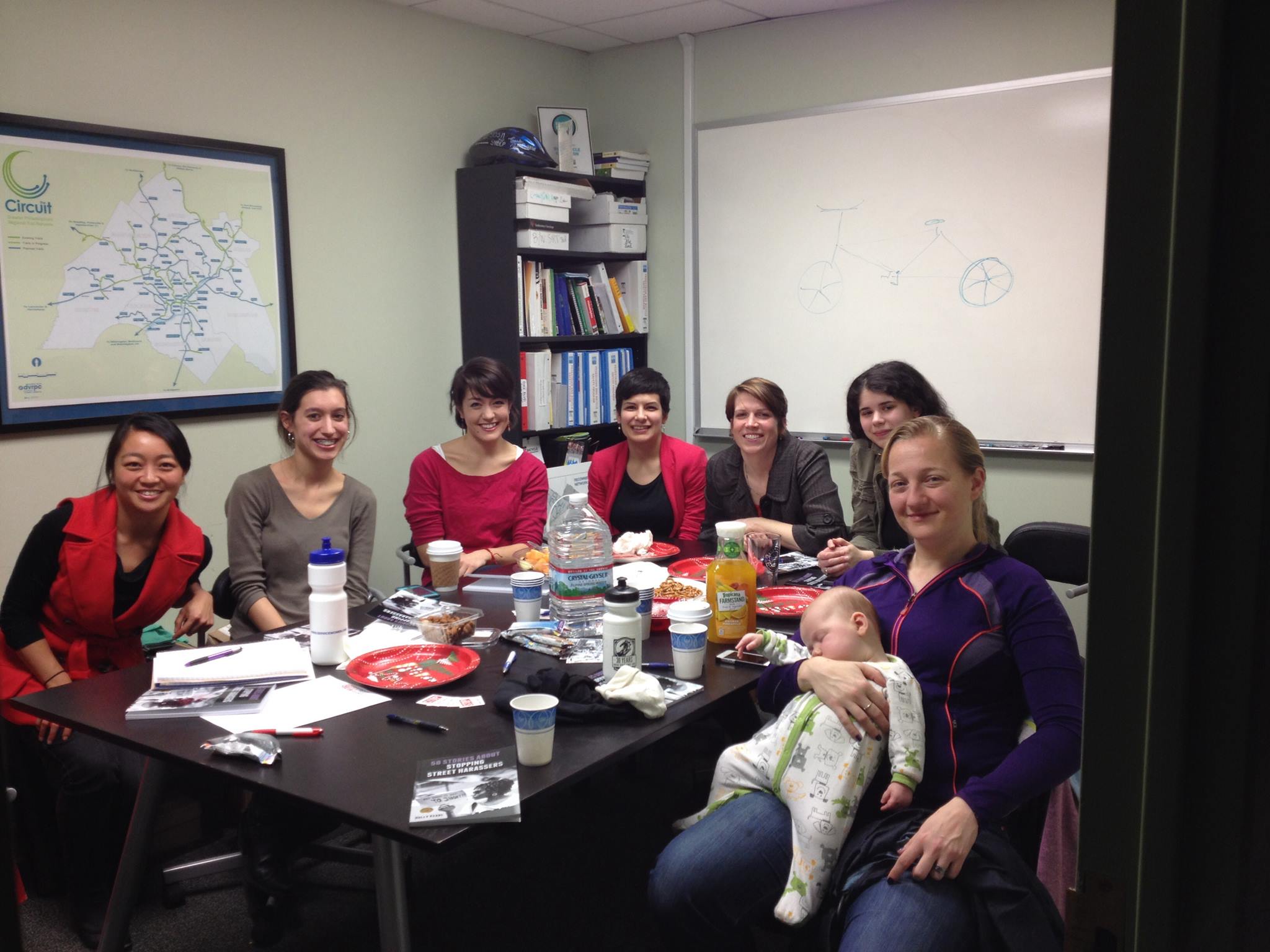
Philly focus group. 2.25.14

This past week I had the opportunity to help orchestrate a focus group for the national study on street harassment currently being conducted by Stop Street Harassment. When Holly asked if I thought Philly bicyclists might make a good “group” for her study, I wasn’t completely sure if I could pull enough interested folks together on short notice. But I sent out a quick email to a small group of women bicyclists I know through Women Bike PHL (the women’s bicycling program I run at the BCGP) – and got an overwhelming response. At 6 p.m. this past Tuesday, almost everyone I emailed showed up to the Bicycle Coalition of Greater Philadelphia office to take part in the focus group – the first of its kind, as far as I am aware. The hour that followed was full of insights that are still bouncing around on my brain, but here are three reflections I felt most compelled to share:

1) While I took care to distinguish between gender-based and transportation-based harassment in my last post, the focus group reintroduced some gray areas to my thinking. Car-on-bike harassment can and does certainly take place with every combination of genders of driver and cyclist, and there can be situations of car-on-bike harassment that simply involve an assertion of power over lane space and nothing more. However, I got the sense in the focus group that for women, harassment because they’re riding a bike can often become increasingly gendered as a situation escalates – for instance, getting called a cunt or bitch by an aggressive driver was a common theme. In addition, it was pointed out that while there may be important distinctions between the two types of harassment, the “gut feeling” women get from being sexually street harassed is a very similar “gut feeling” to the one they get from an aggressive driver. Good food for thought.

2) A great point resurfaced in the focus group that I remember a few women mentioning in the Women Bike PHL Facebook page last fall. That is, the fact that harassment is a reason that people (particularly women) might choose to run a red light rather than waiting for the green at an intersection, even if they generally abide by traffic laws. When we talk in the bike community about following the rules, I don’t think we often acknowledge the different ways that folks of different gender and sexual presentations experience being still versus in motion on our streets and sidewalks. A woman standing with her bicycle waiting for a green light is a sitting duck when it comes to harassment – and when the choice is between standing and taking it or looking both ways and pedaling through the red, it’s hardly surprising that some women would choose to pedal on! I think this aspect of the experience of biking isn’t always understood widely within the bike and bike advocacy community, and it seems important to me.

3) In that vein, the whole conversation just made me realize even more deeply how much street harassment and transportation choices are fundamentally linked. I saw a lot of light bulb moments happen during the focus group – for me and for the rest of the attendees. It was fascinating to hear the stories of how bicyclists – who have made a very particular and still relatively rare transportation choice, to ride a bicycle – perceive their experiences of street harassment. A few of the varied perspectives: biking as a means to escape the harassment that walking entails, biking creating safer ways to interact with strangers because of increased speed, or biking entailing sacrificing the opportunity to tell off street harassers in a satisfying manner. And I’m sure that’s only the beginning!

I’m excited to read the report and hear what resonated with Holly about our discussions on Tuesday, and to read the report as a whole with questions of transportation in mind. I’m so glad I could contribute to this study in my own way and so grateful to the group who came out to discuss this topic – thank you!

Katie Monroe founded the Women Bike PHL campaign at the Bicycle Coalition of Greater Philadelphia and she works at the Philly nonprofit Gearing Up, which gives some of Philadelphia’s most marginalized women – those in transition from incarceration, addiction, and/or abuse – the opportunity to ride bicycles for exercise, transportation, and personal growth. Follow her on Twitter, @cmon_roe.

Share

Filed Under: correspondents, SSH programs, Stories, street harassment

Nepal: “Public transportation, a hesitation to women”

February 26, 2014 By Correspondent

Kriti Khatri, Nepal, SSH Blog Correspondent

Street safety and its relation to women’s independence is connected, from the perspective of women’s mobility. However, rarely has there been an effort to create Safe Streets precisely from the perspective of concerns about women’s mobility. Our street is symbolic of free spirit and freedom itself, but for women the street remains a place to get victimized from various kinds of harassment activities and women have to go through traumatizing experiences of sexual and emotional harassment. A woman being more vulnerable towards various kinds of harassing activities their safety during travel is important.

While we raise voices against street harassment, one important aspect to concentrate on is harassment activities on public transportation. Reports showcase that harassment on public transportation on buses, trains, etc is more frequent for women than on the streets.

Horrendous acts of physically and mentally harassing women via gesture, touch, grabbing, verbal abuses or even constant gazes make taking public transportation a big hesitation for women. In thickly stuffed buses or other means of transportation like trains and metros, women get easily victimized from physical touching, grabbing etc. And since the crowd is a good excuse, it rarely get noticed or exposed. Sexual harassment activities make women feel emotionally left out and drained. As a consequence, women can develop negative attitudes towards their relationships with their male partners and family ties as well. Psychologists says harassment activities not only make women feel raged with the male genre, but also go through mental irritation concerning their body image and social behavior which in the long run can cause depression and other emotional issues.

A report conducted by Astitwa foundation shows that about 90 % of women has been suffered from street  harassment activities among which harassment in public vehicles is the most encountered in Kathmandu. Such harassment activities have been found occurring on school buses, by bus staff, public buses and other travel means. As per the report, most women have been found to experience uncomfortable touching and sexually explicit behavior. While women share their stories of harassment activities, in terms of response, most of them seemed silent. Respondents to the topic of harassment in public vehicles were hesitant about reacting to such activities. Many women seem to remain quiet about this issue by either adjusting in the crowd or dropping in nearby bus stop as their immediate self protection act.

“As for talking we can say I will take immediate action but when such incident happens, we go through emotional hold back, I felt raged but helpless and disgusted when the fellow passenger make uncomfortable gestured towards me, here I can say I wanted to slap him but at that time all I wanted was to get out of the bus.” — a 25 year old school teacher from Kathmandu.

Sexual harassment in public vehicles has been an issue raised by many social organizations in international level. With ever raising incident of harassment activities which has even lead to cases like gang rape and murder of women in public vehicles, this issue has been a concerned area in relation to women safe mobility and independence.

Concerned with the growing number of harassment activities, Nepal Police has initiated strict monitoring of the public transportation system. As per the Nepal police, travel safety of citizen and especially women is on their top priority after getting multiple reports filed against sexual harassment in public bus. According to the information of the Nepal Police, cases regarding public bus harassment are registered more than any other kinds of street harassment cases. As of now, women police are allocated in various bus stations to check inside bus which at least give a chance for victim to complain or make people aware of their act. In future Nepal police aims to monitor bus activities via closed caption cameras. There has also been initiation from nongovernmental sectors to make legal reformation against harassment activities collectively under violence against women in which there should essentially be strict provisions regarding street harassment.

Apart from the legal provisions, effort should also be from bus-driver, conductors and fellow passengers to discourage such activities in the vehicles.  Their effort can demoralize the doer, at the same time make women feel safe and comfortable.

“I was standing on the bus and a guy happen to stand right beside me with his hand around my shoulder from backside, the bus driver saw that and ask the conductor to make him step out of the bus saying that such cheap activities won’t be tolerated in his vehicle, It really felt so nice to find  bus drivers with such attitude towards activities going on his vehicles.” — 23 old employee who make 14 km of bus travel every day for her job in Kathmandu

The act of harassment and violence against women is more of a moral matter than legal. Unless individual understands that harassment activities against women are immoral, eliminating such acts won’t be easy with just legal threats. Women free conduct in the street or elsewhere is only possible when there is assurance of Safe travel and such safety can only be assured in morally governed society and justice run state system.

Kriti Khatri is student of MSc chemistry. She is engaged in different social organization in Nepal and currently she is working on anti-street harassment issues with the Astitwa Foundation. Find more of her writing on her blog.

Share

Filed Under: correspondents, Stories, street harassment

« Previous Page
Next Page »

Share Your Story

Share your street harassment story for the blog. Donate Now

From the Blog

  • #MeToo 2024 Study Released Today
  • Join International Anti-Street Harassment Week 2022
  • Giving Tuesday – Fund the Hotline
  • Thank You – International Anti-Street Harassment Week 2021
  • Share Your Story – Safecity and Catcalls Collaboration

Buy the Book

  • Contact
  • Events
  • Join Us
  • Donate
  • Facebook
  • Instagram
  • Pinterest
  • Tumblr
  • Twitter
  • YouTube

Copyright © 2026 Stop Street Harassment · Website Design by Sarah Marie Lacy