• About Us
    • What Is Street Harassment?
    • Why Stopping Street Harassment Matters
    • Meet the Team
      • Board of Directors
      • Past Board Members
    • In The Media
  • Our Work
    • National Street Harassment Hotline
    • International Anti-Street Harassment Week
    • Blog Correspondents
      • Past SSH Correspondents
    • Safe Public Spaces Mentoring Program
    • Publications
    • National Studies
    • Campaigns against Companies
    • Washington, D.C. Activism
  • Our Books
  • Donate
  • Store

Stop Street Harassment

Making Public Spaces Safe and Welcoming

  • Facebook
  • Instagram
  • Pinterest
  • Tumblr
  • Twitter
  • YouTube
  • Home
  • Blog
    • Harassment Stories
    • Blog Correspondents
    • Street Respect Stories
  • Help & Advice
    • National Street Harassment Hotline
    • Dealing With Harassers
      • Assertive Responses
      • Reporting Harassers
      • Bystander Responses
      • Creative Responses
    • What to Do Before or After Harassment
    • Street Harassment and the Law
  • Resources
    • Definitions
    • Statistics
    • Articles & Books
    • Anti-Harassment Groups & Campaigns
    • Male Allies
      • Educating Boys & Men
      • How to Talk to Women
      • Bystander Tips
    • Video Clips
    • Images & Flyers
  • Take Community Action
  • Contact

USA: “I reclaimed the street by reclaiming my feelings”

October 29, 2013 By Correspondent

By: Molly Redding, San Francisco, CA, USA, SSH Correspondent

I love Saturday mornings. No alarm, no obligations, and 48 hours of freedom to look forward to. After a large cup of coffee and some quality time with the San Francisco Chronicle online, I head outside to walk to my favorite yoga class.

I started walking to this class awhile back since other transportation options didn’t work, but now I’ve come to really enjoy it. After 8 years of residency I still love San Francisco as much as the day I moved, and this walk allows me to experience different neighborhoods and the richness of diversity that exists in this city.

But not this morning. As I made my way down to the gym, I walked down a street that isn’t part of my normal route, and spotted two men talking to one another. I feel like as a woman sometimes you sense these things are going to happen before they do. It must be a look or something you get that you just know, the next 30 seconds or so are just going to suck. You might take a second to hope you’re wrong, only to be proven right. Here’s what they said to one another as they leered at me:

“Hold on a second. I want to check out this pretty thing walking by.”

“Mmmmhmmm. That is nice.”

“Yes, those pants fit her WELL!”

They literally stopped their conversation so they could watch me walk by and comment. Their opinion of my body, my body,  was so pressing that they had to stop what they were doing just to express it. As I walked past and knew they were staring at my ass, I felt completely naked. I had an urge to cover my butt with my hands so they couldn’t stare at it, even though I knew that wouldn’t help.

In a flash, I felt the heat of shame rising to my face. At being leered at yes, but also at my reaction. I just kept walking. I’ve written an entire dissertation about street harassment., I write a monthly blog post, and I didn’t have a good comeback or witty comment? I know the dangers of taking action against harassers, but this was a bright Saturday morning with tons of people milling about. I felt like I had let everyone down, by not reacting quick enough, by not trying to stop it. If I, an anti-street harassment activist, can’t even react the right way when I get harassed in my own neighborhood, how can I preach to others to do the same?

As I crossed the street and made my way to the gym, I realized that by putting pressure on myself, I was only making the situation worse. Harassment is designed (whether harassers know it or not) to make the victim feel exposed, on display, ashamed. I could choose to feel that way, or I could choose to acknowledge my feelings of shame, anger and frustration,  recognize that we still have a lot of work to do, and go on my way. And so I did. I reclaimed the street by reclaiming my feelings, by not letting anyone monopolize what I think and how I feel.

I realize this won’t work in every situation. Trust me, I’m still disturbed by the guy who exposed himself to me outside my apartment as I was coming home from a wonderful night at my best friend’s wedding. Harassment is a form of trauma that can stay with us for a long time.

Luckily, I know I have a community that will share their stories and support me no matter how I react to a harasser. Writing my story helps, but so does just telling people around me – my roommate, coworkers, family. Sharing stories will not only help us heal, it will help the rest of the world know we won’t tolerate this behavior anymore. So keep sharing your stories!

Molly received a graduate degree in International Development and Gender from the London School of Economics in 2011, where her dissertation focused on websites allowing victims of harassment to post about their experiences. She has worked in the non-profit sector for over 10 years. You can follow her on Twitter, @perfeminist.

Share

Filed Under: correspondents, Stories, street harassment

South Africa: Perspectives on How Men Should Approach Women in the Street

October 28, 2013 By Correspondent

By: Gcobani Qambela, South Africa, SSH Correspondent

Via The Huffington Post

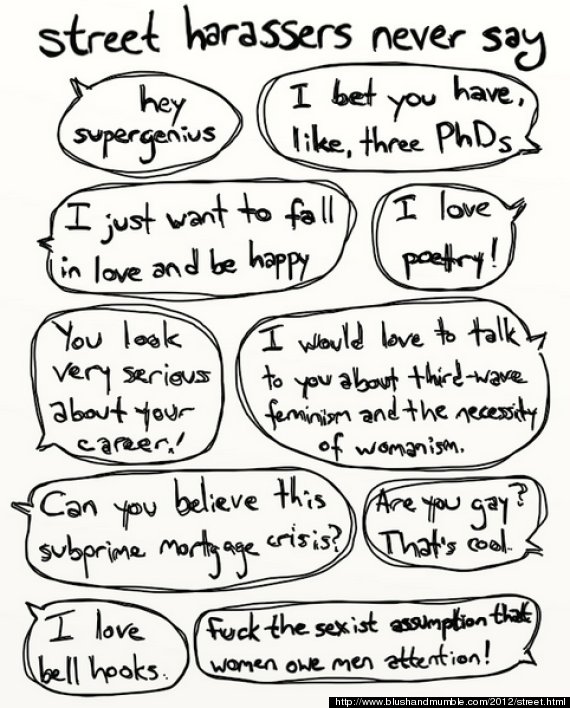
I recently read an interesting article in The Huffington Post titled “What We Wish People Would Say To Us On The Street”. The article covers the illustration by Norma Krautmeyer “which observes what people never say to women on the street.” This month I decided to talk to a small number of South Africans from across genders in various provinces in South Africa about the different ways they would like people to approach them in the street.

I believe street harassment in any form is unacceptable, but where necessary, how can men be better prepared to approach women in respectful and dignified ways in the street? What are the best ways to start a conversation with strangers across genders in a non-threatening way in the streets?

I spoke to gender activist and researcher, Rethabile Mashale, in Cape Town, in the Western Cape province of South Africa. She tells me that she has had her fair share of being subject to “catcalling and harassment” in the street. So what approach does she prefer when strangers, especially men approach her in the street? She says she has devised five basic alternatives. “The first is that a decent and genuine ‘hello’ and ‘how are you?’ which are followed by a genuine concern for whatever happens next” always work she says. Secondly she says “never lick your lips, or do a once over, over my body.

The person, thirdly, must look me in the eye instead of my tits” she continues. Fourthly she says while a clever joke can work, pick up lines are generally also unacceptable. She says lastly and mostly importantly “lead with getting my PERMISSION to engage in conversation, in fact, I would say that is the most important one” to get permission to talk and engage a person and quietly accept should she decline.

I also spoke to Amanda* in the province of KwaZulu-Natal. She told me she feels like street harassment is very degrading and that there is always a very “thin-line” between a stranger cracking a conversation and also at the same time harassing you. However the important distinction she made is that “Harassment is when I say ‘no’ and he doesn’t stop or if he feels the need to touch or say derogatory things to me.”

Tandokazi Mbopa, a university student in Port Elizabeth, in the Eastern Cape province, told me that she just does not want strangers approaching her in the street at all. This, she said, was born out of a horrible experience of being persistently harassed in the street. She told me that last year, she was walking and running late to school and a guy in a car kept hooting at her even though she ignored him. “He really didn’t get the hint ‘because he was driving next to me saying: ‘Oh, where are you going? Do you want a lift?’ as if I was going to get into that car after that hooting” she tells me.

Despite her declination to get into the car she says he refused to take a hint and kept driving slowly next to her saying, “Ooh, baby you’re hot. Baby you’re hot.”

“I felt like meat. The way he was looking at me. I was wearing track pants and a vest down to cover my butt… I wanted to change whatever was making him look at me like that and call me ‘sexy’” she tells me. “I don’t respect any guy approaching me on the street. I never will, unless if I’ve met you before – just not in the streets,” she concludes.

While these are only three interviews that I have included here, what emerged clearly from all the women I spoke to is that the key is consent and permission to approach and talk to women or anyone else in the street should be garnered clearly from the person who is being approached. If the women do not want to speak or engage then one should politely accept that. While Krautmeye’s illustration is encouraging, it is also important to remember that there are people with painful experiences like Tandokazi of dealing with harassers in the street even though the harassers probably thought they were saying something ‘nice’ to her. It is important therefore to treat even what appears to be ‘nice’ harassment with caution for it can also be traumatic for those on the receiving end. Consent and acceptance of a woman’s choice is thus critical in all cases, even if it appears that the guy is saying something that the woman would appreciate.

*The interviewee wished to remain anonymous.

Gcobani is completing his Masters in Medical Anthropology through Rhodes University, Grahamstown, South Africa. His research centres around issues of risk, responsibility and vulnerability amongst Xhosa men (and women) in a rural town in South Africa living in the context of HIV/AIDS. Follow him on Twitter, @GcobaniQambela.

Share

Filed Under: correspondents, Stories, street harassment

“So gross, and so disturbing.”

October 27, 2013 By Contributor

I was walking to our local corner market in the middle of the day when a man driving by stopped and rolled down his window. He asked me where the 210 Freeway was, and when I told him, “No, sorry,” and kept walking he proceeded to pull out his dick (in his Nursing scrubs, I might add) and started to jerk off. He then told me, “He knew I wanted to suck his dick” and became increasingly aggressive/excited. I told him to “Get the f*** out of here” and I walked back a block where I had seen a couple standing.

He then sped off. So gross, and so disturbing.

– Anonymous

Location: Marmion Way and 53rd, Los Angeles, CA

Share your street harassment story for the blog.

Share

Filed Under: Stories, street harassment

USA: Halloween costumes can be clever, not just “sexy”

October 25, 2013 By Correspondent

By: Taylor Kuether, Minnesota, USA, SSH Blog Correspondent

“Sexy” Hamburger, Image via Yandy.com

While it is one of my favorite holidays, Halloween is also hard. As a feminist against street harassment, I think women should be able to wear whatever they want and not be harassed for it, but as a feminist against cultural appropriation and heteronormativity, I think there are some costumes that are hurtful, degrading, and demeaning.

Consider the popular skeleton costume with a tape measure around the waist, “playfully” called “Anna Rexia.” Such a costume trivializes a real disease that hurts thousands of people. Or what about dressing up as sexualized Disney princesses, which both infantilizes women by dressing them up in costumes traditionally reserved for very young girls and hurts said young girls by showing them highly sexualized versions of otherwise innocent children’s characters. And how many countless costumes are there that – literally – objectify women by turning them into objects? Sexy USB Port (with matching USB Stick for your boyfriend…)? Sexy Brick House (and, of course, Brick Layer for the guy…how clever…)? And of course, Sexy Hamburger, which literally turns a woman into a piece of meat.

Yes, these costumes are harmful, reducing women to sexualized objects. Even worse, though, are costumes that make fun of other cultures. Halloween is a time to dress up and pretend to be someone you’re not – but why do we need to try on other races and nationalities for size? Some examples include Native American, Mexican, and Asian “costumes,” all shown here. Commodifying an entire culture to dress up in it for Halloween devalues the richness and history of that culture.

So just don’t do it. Pick something else, please.

I value creative, clever, or funny Halloween costumes. I value Halloween costumes that allow you to dress up as someone you admire (Audrey Hepburn in Breakfast at Tiffany’s, anyone?). And I especially appreciate costumes that bend gender binaries – rather than the predictable presentation of Paul Bunyan and Babe the Blue Ox, characters from one of my favorite American folk tales, last year it was I who dressed as Paul Bunyan (faux-beard and all!) and my then-boyfriend went as Babe. This year, I’m excited to dress up as Tobias Funke from the popular TV series “Arrested Development,” and one of my gal pals is going as his wife Lindsey. It’ll be fun and funny, and I know we’ll have a great time and make some people laugh.

That’s what Halloween should be about. It’s a holiday that’s meant to be fun – for children, that means trick-or-treating, for adults, that means dressing up and handing out candy or attending a Halloween party. It’s not meant to be serious or stuffy, but that doesn’t mean we shouldn’t carefully consider our costume choices.

This Halloween, I implore you to pick the funny, clever costume over the “sexy” one. Try it; you’ll probably end up having a blast.

Taylor Kuether is a senior journalism student at University of Wisconsin-Eau Claire in northwestern Wisconsin. She has previously written for The Washington Post and Minneapolis’ Star Tribune, worked as a reporter at her city’s daily newspaper, The Leader-Telegram, and its arts and culture publication, VolumeOne, hosted a local-music centered radio show on Wisconsin Public Radio, and worked as Editor-in-Chief at her student newspaper, where she enjoyed writing biting, slightly rant-y columns about feminist issues.

Share

Filed Under: correspondents, street harassment Tagged With: Costumes, halloween

UNiTE to Make Public Places Safer!

October 25, 2013 By HKearl

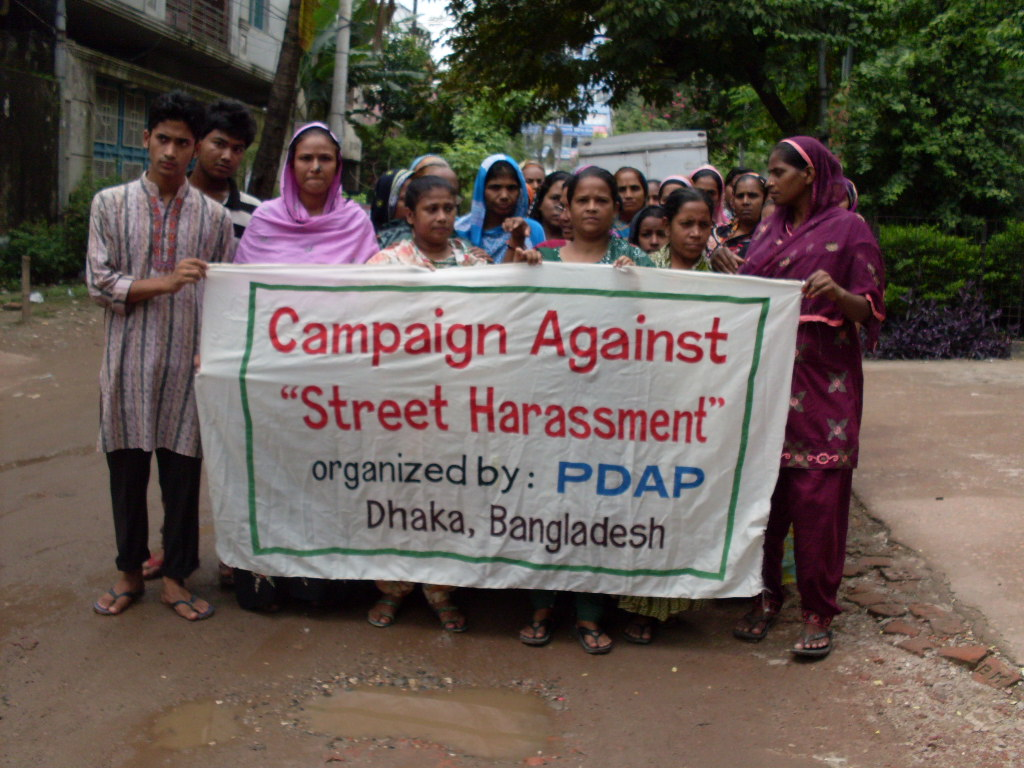
Community Members in Bangladesh recently met to discuss how to make their public places safer for girls & women.

On the 25th of every month, the UNiTE to End Violence against Women campaign focuses on different types of violence against women and girls. Today they are focusing on harassment and violence in public places and how we can make those spaces safer for women and girls. This is something we at Stop Street Harassment strive to do every day and we are happy to support the campaign!

From the UNiTE’s website:

“Violence and the fear of violence reduces women’s freedom of movement and rights to access education, work, recreation, and essential services, and can restrict their participation in political life. It also negatively affects their health and well-being. Despite these wide-ranging consequences, violence against women and girls in public spaces remains a neglected area, with few laws or policies in place to prevent and address it.

At the 57th Session on the Commission of the Status of Women, governments made specific commitments directed towards making public spaces safer for women and girls.

For the first time the Commission on the Status of Women, the highest global normative body on women’s rights, during its 57th Session specifically included several clauses in its Agreed Conclusions document devoted to safety of women and girls in public spaces, and particularly, in the cities.  It expressed “deep concern about violence against women and girls in public spaces, including sexual harassment, especially when it is being used to intimidate women and girls who are exercising any of their human rights and fundamental freedoms.”  (23, p4)

It called on the States “to increase measures to protect women and girls from violence and harassment, including sexual harassment and bullying, in both public and private spaces, to address security and safety, through awareness-raising, involvement of local communities, crime prevention laws, policies, programmes such as the Safe Cities Initiative of the United Nations. (ZZ, p13)“

What YOU can Do:

1. Learn more about the issue, why it matters, and what you can do about it. Here is an article I wrote for Ms. Magazine’s blog about how street harassment can escalate to assault – and three ideas for what we can do to change our culture so street harassment is no longer acceptable.

2. Join the Tweet chat throughout the day, led by UN Women and UN Habitat (#OrangeDay). Our friends at the Huairou Commission are hosting it at 10 a.m. EDT.

3. Donate to Stop Street Harassment — we’re working to fund the first-ever national study on street harassment. This data is sorely needed before we can adequately tackle the problem. We also do a lot of other work that is solely funded by donations.

 Update: Read what groups around the world did to speak out in support of space public spaces for women and girls!

Share

Filed Under: SSH programs, Stories, street harassment

« Previous Page
Next Page »

Share Your Story

Share your street harassment story for the blog. Donate Now

From the Blog

  • #MeToo 2024 Study Released Today
  • Join International Anti-Street Harassment Week 2022
  • Giving Tuesday – Fund the Hotline
  • Thank You – International Anti-Street Harassment Week 2021
  • Share Your Story – Safecity and Catcalls Collaboration

Buy the Book

  • Contact
  • Events
  • Join Us
  • Donate
  • Facebook
  • Instagram
  • Pinterest
  • Tumblr
  • Twitter
  • YouTube

Copyright © 2026 Stop Street Harassment · Website Design by Sarah Marie Lacy