• About Us
    • What Is Street Harassment?
    • Why Stopping Street Harassment Matters
    • Meet the Team
      • Board of Directors
      • Past Board Members
    • In The Media
  • Our Work
    • National Street Harassment Hotline
    • International Anti-Street Harassment Week
    • Blog Correspondents
      • Past SSH Correspondents
    • Safe Public Spaces Mentoring Program
    • Publications
    • National Studies
    • Campaigns against Companies
    • Washington, D.C. Activism
  • Our Books
  • Donate
  • Store

Stop Street Harassment

Making Public Spaces Safe and Welcoming

  • Facebook
  • Instagram
  • Pinterest
  • Tumblr
  • Twitter
  • YouTube
  • Home
  • Blog
    • Harassment Stories
    • Blog Correspondents
    • Street Respect Stories
  • Help & Advice
    • National Street Harassment Hotline
    • Dealing With Harassers
      • Assertive Responses
      • Reporting Harassers
      • Bystander Responses
      • Creative Responses
    • What to Do Before or After Harassment
    • Street Harassment and the Law
  • Resources
    • Definitions
    • Statistics
    • Articles & Books
    • Anti-Harassment Groups & Campaigns
    • Male Allies
      • Educating Boys & Men
      • How to Talk to Women
      • Bystander Tips
    • Video Clips
    • Images & Flyers
  • Take Community Action
  • Contact

Attacked on Holi

March 5, 2018 By Contributor

This year I experienced the Holi Festival in Udaipur – it is the festival of colors… and sexual harassment. People on the street wish a “Happy Holi,” and then smash colors in your face.

In the morning, everything starts quite nicely and polite, and it’s fun exchanging colors and watching your face design change every other second. But there was a moment when I asked my travel friend, if he also gets hugged by all the guys. He said none of the young Indian men tried to hug him.

By midday my ass had been grabbed several times and young men that wanted to take selfies had touched me on several spots of my body including ass and boobs. I wanted to get out of the crowd and find a quiet place somewhere. This mission happened to be a mission impossible as there were groups of guys everywhere – rushing through the streets on motorbikes or gathering on the street – that seemed to have lost complete control and had a very aggressive straight forward attitude.

I got slapped in the face by one of three guys passing us on a motorcycle and hit by several water bombs thrown at my neck. Then one guy asked me if he can kiss me, I said no and lied about my friend being my husband… which didn’t change anything at all, as I had to jump up cause he just tried to kiss me.

By that time (maybe 2pm), I could only see young men on the streets, and for the first time while I was in India, I didn’t feel safe anymore. Not even a male company seemed to impress those guys. To get me out of target zone we walked towards a restaurant with a rooftop terrace we already knew.

Therefore we had to pass a pathway between a river and a house. I could already see maybe six or seven guys play fighting on this path and stopped, but as they said it’s just fun and opened the way for me to pass, I thought I’m good (although I didn’t really like the idea of walking between them with the only chance to move forward or backward). When I passed they kind of jumped on me, at least three of them and hugged me, touched me and tried to kiss me, with my back against the wall. I think the others separated my friend from me. I somehow managed to push through them out of the sexual harassment zone, whereas they tried to follow.

My friend said he pushed one of them aside. I couldn’t see anything, it all happened too fast. I just knew that it was not safe anymore. We waited for two hours at the restaurant before getting back to the accommodation. I spent a lot of time thinking about the incidents and my friend read an article about women in India and that actually smiling at a man, not to mention physical contact of any kind (even shaking hands), uncovered shoulders, hugs and selfies should be avoided. So it’s all on the women’s side again?!?

I feel angry and upset towards myself, that I always evaluate my behavior before I react. And as a woman, I always think I might overreact to a situation. And then again I’m angry that I’m angry with myself. That makes no sense at all. Cause it’s men’s misbehavior.

I want to fight against this social fact that women always have to defend their behavior whereas men so many times just get away with it. If a man gets touched by another man, there is an immediate direct reaction. They would never think about the possibility of overreacting. Never. They just react how they feel. It really pisses me off, that it’s so hard for me to just do the same. To say, no it’s not okay to stare at me, no I don’t like you touching me (even if it might be without any sexual motive… which my friend points out never happens… there is always a hidden motive if a man touches a woman).

I hate being a target and I hate the men that make us women feel odd when we draw the line, giving us the impression we overreact. No we don’t. We have the right to say if we don’t like what’s going on. And we need support by all the men that see it the same way. Stand up for our rights!

– Cornelia

Location: Holi Festival/ Udaipur/ India

Need support? Call the toll-free National Street Harassment hotline: 855-897-5910

Share your street harassment story for the blog.
See the book 
50 Stories about Stopping Street Harassers for ideas.

Share

Filed Under: street harassment

February 2018 News Round-Up

February 28, 2018 By HKearl

Here are some of the news stories on my radar this month:

“It’s not fun to ‘taunt’ women in the street, it is a crime.” COURTESY SAMAN SALIMIAN

Muslim women globally shared their stories of sexual harassment with the hashtag #MosqueMeToo.

A TV reporter in Australia was sexually threatened on the street and then told it wasn’t a crime.

Men raped 21 women on public transport in Bangladesh.

A poster campaign against street harassment went viral in Iran.

New research came out about sexual harassment and children in Pakistan.

A Palestinian-American brought #MeToo to the West Bank.

Women spoke out about sexual harassment during Hajj in Saudi Arabia.

If you’re in the UK, share your views on SH with a government entity by March 5.

The Alabama Senate passed a bill to criminalize non-consensual upskirt photos.

New research is out about how US women respond to and cope with catcalling.

Why I’m teaching my daughters to be rude.

How first-generation New Yorkers deal with street harassment.

Cities are designed around men. It’s time for equality in city planning.

Share

Filed Under: News stories, street harassment, weekly round up

“He has an audience for his choices”

February 27, 2018 By Contributor

I began noticing that I was receiving unwanted male attention when I was a teenager. It made me feel dirty, taken advantage of, wrong, ashamed, and angry. I am surprised to find that at 30 years old, as a confident, empowered woman, it still makes me feel the same things.

The other day, I was wearing a sheer maxi skirt over shorts, waiting alone at a crosswalk. A turning truck featured a young man hanging out the window of his car gawking at me for a solid seven seconds. I went from enjoying a summer day to feeling exposed, horrified, and livid. I wished I had my boyfriend with me, and then thought, in 2018, I can’t believe that a woman would still want male accompaniment for protection.

I glared back at the young man, but it wasn’t enough. In street harassment exchanges, I always feel like they have the upper hand. What can I do to react quickly enough to make a statement to him and others that THIS IS NOT OKAY? To fight back and not feel powerless?

The very next day, I was walking back to our car from a nice restaurant, arm in arm with my boyfriend. My skirt was mid thigh and I wore low heels. A car pulled in from the road and a man honked at me and shouted, “Hey, you!”

I flipped him the bird and kept walking. Now I feel that I can’t wear what I want, what makes me feel stylish and beautiful, because of men. Not only do I not make myself pretty for men, I must make myself ugly because of them?

I am a tango dancer, but that night at class, I couldn’t dance with anyone. It affected my life, my passion, my hobbies, all because I felt so powerless. That my male friends would not understand. That my female friends would say “that’s life,” and “don’t wear short skirts.” I downloaded a wallpaper on my phone that says “F**K OFF!” that I can quickly flash at strangers. I don’t know how, but men need to be called on this shit.

Optional: What’s one way you think we can make public places safer for everyone?

React – negatively. Let the offender know that he has upset you. Let the people around you know that he has misbehaved and you are not going to be quiet about it. Keep your eyes open and stand up for other women. If I so much as see a man checking out a lady, I will ostentatiously watch him. He needs to know he has an audience for his choices.

– Elizabeth M

Location: Dunwoody, Georgia

Need support? Call the toll-free National Street Harassment hotline: 855-897-5910

Share your street harassment story for the blog.
See the book 
50 Stories about Stopping Street Harassers for ideas.

Share

Filed Under: Stories, street harassment

USA: Breaking the News about Street Harassment

February 26, 2018 By Correspondent

Elizabeth Kuster, Brooklyn, NY, USA, SSH Blog Correspondent

Like most women, I’m out and about in public a lot — going to work, running errands, meeting friends downtown. And like most women, I get attention from men — young and old; white, black, Hispanic; well dressed and not — as I go about my daily routine. I’ve been whistled at and pinched. I’ve received thousands of “Hey, sexy”s and “Wanna f*ck?”s. I’ve been stared at. I’ve been followed. I’ve had my hair, breasts and behind stroked.

It has happened to me so often that I started to get used to it, told myself it was normal.

             “It’s just the city,” I said.

             “It’s what I was wearing,” I said.

             It’s no big deal,” I said.

I was wrong. It’s street harassment, and I’m not alone. It happens to millions of women every day. And it’s time we do something about it.

So began “Don’t ‘Hey, Baby’ Me: How To Fight Street Harassment,” the first-ever mainstream-media article on the subject, which I pitched and wrote for Glamour magazine in 1992. Since no studies about street harassment had been conducted at that time, I had to break up the subject into its various components and tackle each one individually. I covered aspects such as improper touch. Sexual profanities. Objectifying language. Physically intimidating behaviors such as staring and stalking. And I delved into how each of those male behaviors changed the way women behaved when they went out in public.

To get a chorus of women’s voices, I sent a shout-out to Glamour staffers and contacted friends, family and stringers in other states. I had 10 of them keep street-harassment diaries for seven days, listing every single comment, look or gesture they received. To debunk the myth that what you wear invites harassment, I and several other women from Glamour were photographed on the street in our regular clothes, after which each of us set off alone for a different New York City neighborhood, where we, too, detailed the incidents of street harassment we received.

I called the NYPD press office, told them what I was working on, and was forwarded to a male police officer — who proved to be so patronizing that I didn’t even quote him in my article. Incredulous at being interviewed by someone from Glamour in the first place, he literally laughed at my questions and said — and this I did quote in the piece — “Street comments are not a serious problem.”

I interviewed Naomi Wolf, feminist author of The Beauty Myth. “Our taxes go for the upkeep of parks and streets, but women do not own full use of them because of street harassment,” she said.

I interviewed Callie Khouri, the screenwriter who’d taken the world by storm with her Oscar-winning script for the feminist blockbuster Thelma & Louise. “A woman who enjoys being yelled at on the street is a woman who has been socialized to think that she is valued and defined by her sexuality,” she said.

I interviewed Carol Brooks Gardner, a professor of sociology and women’s studies and author of the book Passing By: Gender and Public Harassment. “I’ve talked to [many] women who complained to police officers who were right there and saw what happened, yet they didn’t do anything,” she said.

I interviewed D.C. police officer Patricia Harman, author of the newly published book The Danger Zone: How You Can Protect Yourself from Rape, Robbery and Assault. “[Harassers] have watched their fathers do it, their brothers do it. The only way we’re going to get a handle on it is if we start with the next generation,” she said.

And I interviewed Cheris Kramarae, a professor of speech communication and sociology. “Organized anger will eventually make a difference,” she said.

You can read my article in its entirety via my online portfolio. I’m still proud of it. At the time, it received critical acclaim — and a respectable landslide of reader mail, mostly from women who had their own street-harassment stories to tell. They were grateful, at long last, to finally have a name for the discrete and difficult-to-describe form of sexual abuse they’d been enduring out in public all their lives.

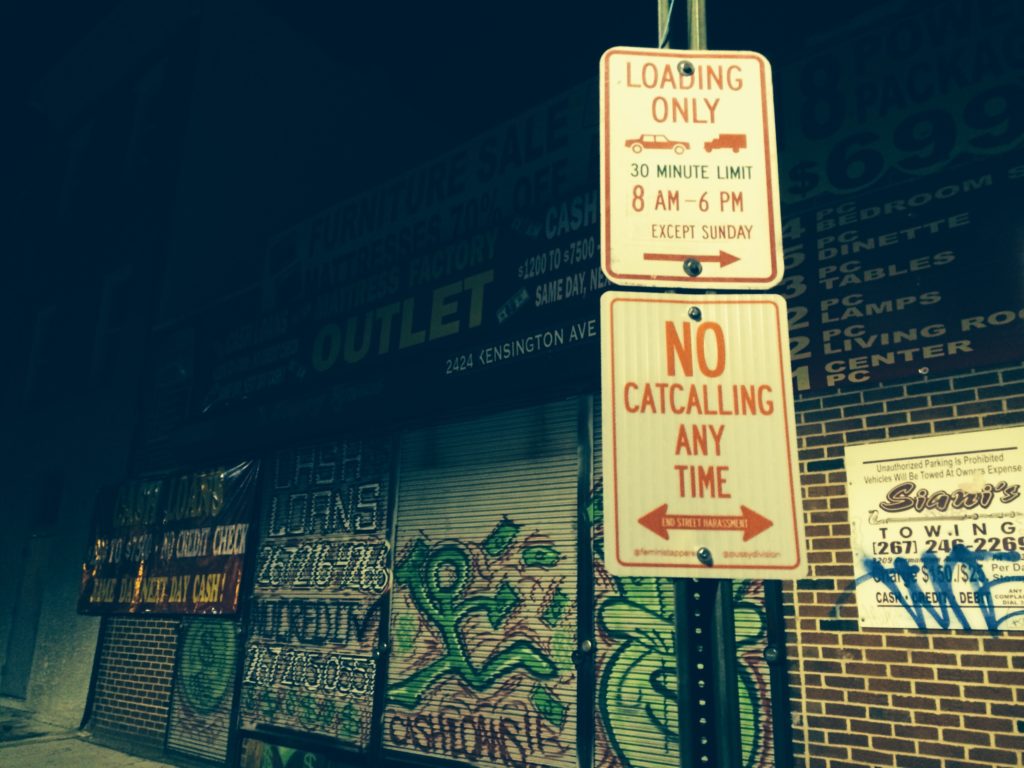
Feminist Apparel and Pussy Division sign in NYC, 2015

Oh, how I wish social media had existed at the time! Had I been able to start a #StopStreetHarassment initiative back then, we might not still be dealing with the issue today.

Elizabeth pitched and wrote the very first mainstream-media article about street harassment. She has held full-time editorial positions at publications such as Glamour, Seventeen and The Huffington Post and is author of the self-help/humor book Exorcising Your Ex. You can follow Elizabeth on Twitter at @bethmonster.

Share

Filed Under: correspondents, SH History, Stories, street harassment

“I rerouted my way home”

February 24, 2018 By Contributor

I was walking home from school (only a few blocks) and was whistled at… it made me feel uncomfortable and I was so close to being in front of my house that I rerouted my way home so that this person wouldn’t know where I lived. It made me feel unsafe and very angry. It made me sad for anyone else who has had a similar experience.

Optional: What’s one way you think we can make public places safer for everyone?

Support each other. Spread awareness that this behavior is totally unacceptable and should NOT be normalized.

– Anonymous

Location: Salt Lake City, UT

Need support? Call the toll-free National Street Harassment hotline: 855-897-5910

Share your street harassment story for the blog.
See the book 
50 Stories about Stopping Street Harassers for ideas.
Share

Filed Under: Stories, street harassment

« Previous Page
Next Page »

Share Your Story

Share your street harassment story for the blog. Donate Now

From the Blog

  • #MeToo 2024 Study Released Today
  • Join International Anti-Street Harassment Week 2022
  • Giving Tuesday – Fund the Hotline
  • Thank You – International Anti-Street Harassment Week 2021
  • Share Your Story – Safecity and Catcalls Collaboration

Buy the Book

  • Contact
  • Events
  • Join Us
  • Donate
  • Facebook
  • Instagram
  • Pinterest
  • Tumblr
  • Twitter
  • YouTube

Copyright © 2026 Stop Street Harassment · Website Design by Sarah Marie Lacy