• About Us
    • What Is Street Harassment?
    • Why Stopping Street Harassment Matters
    • Meet the Team
      • Board of Directors
      • Past Board Members
    • In The Media
  • Our Work
    • National Street Harassment Hotline
    • International Anti-Street Harassment Week
    • Blog Correspondents
      • Past SSH Correspondents
    • Safe Public Spaces Mentoring Program
    • Publications
    • National Studies
    • Campaigns against Companies
    • Washington, D.C. Activism
  • Our Books
  • Donate
  • Store

Stop Street Harassment

Making Public Spaces Safe and Welcoming

  • Facebook
  • Instagram
  • Pinterest
  • Tumblr
  • Twitter
  • YouTube
  • Home
  • Blog
    • Harassment Stories
    • Blog Correspondents
    • Street Respect Stories
  • Help & Advice
    • National Street Harassment Hotline
    • Dealing With Harassers
      • Assertive Responses
      • Reporting Harassers
      • Bystander Responses
      • Creative Responses
    • What to Do Before or After Harassment
    • Street Harassment and the Law
  • Resources
    • Definitions
    • Statistics
    • Articles & Books
    • Anti-Harassment Groups & Campaigns
    • Male Allies
      • Educating Boys & Men
      • How to Talk to Women
      • Bystander Tips
    • Video Clips
    • Images & Flyers
  • Take Community Action
  • Contact

Women’s Equality Day: Share Your Story

August 26, 2013 By HKearl

Today is Women’s Equality Day and while we’ve come a long way since women gained the right to vote in the USA in 1920, there is still so far to go since sexism and gender violence are very real issues.

Help bring attention to the issue of street harassment by sharing your story with CNN via their iReport assignment.
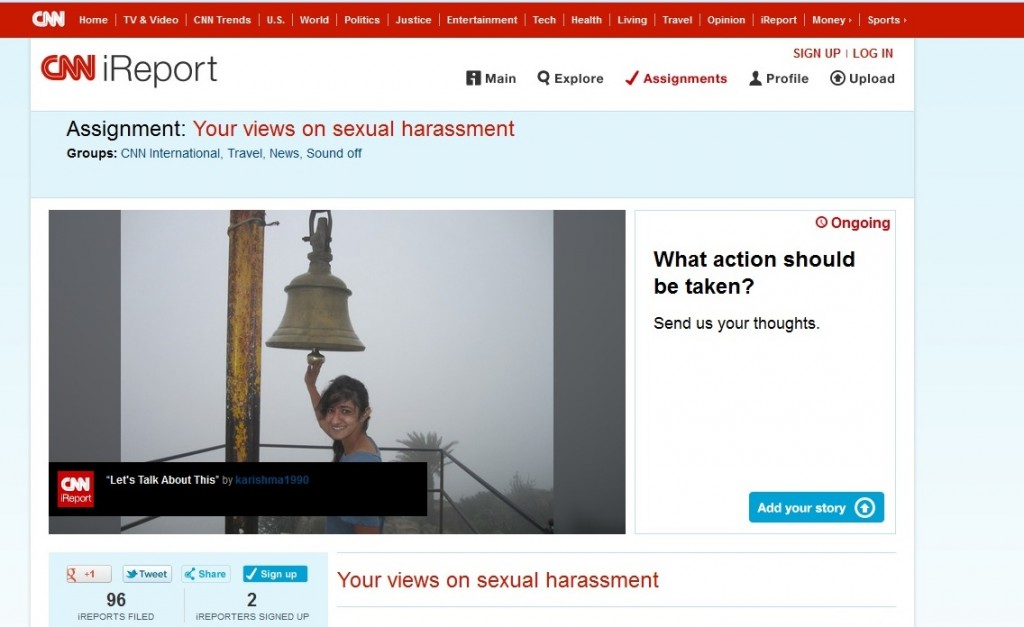
I shared mine and then linked my story and the issue to Women’s Equality Day.

Street harassment is a global problem. Studies show that more than 90% of women in countries like Egypt, India, Yemen, and the USA experience it. More than 80% do in Canada. A recent study in France found that 25% of women ages 18-29 feel scared when they walk down the streets. In London, 43% of women ages 18-34 had experienced street harassment just during the prior year.

If you add to that the thousands of stories women have shared on my blog Stop Street Harassment, on the Hollaback! sites, and through the The Everyday Sexism Project, as well as the stories they share on personal blogs, Tumblrs and other social media sites, you can see that this is a huge problem.

Repeated street harassment and severe forms of it cause many women emotional distress and significantly impact their lives, including prompting them to avoid going places alone, to change routes and routines, and even to move neighborhoods or quit jobs.

I’ve seen this over and over through the stories shared on my blog Stop Street Harassment. There was the woman in Kansas who considered dropping out of her PhD program because she was routinely harassed by men near her campus; a woman in Mississippi who quit her job at a retail store because male customers began following her to her car after her shift; and a woman in California who was harassed so many times while she waited for a bus to campus that she finally went home, feeling upset and powerless, and missed the class.

Most telling is how unsafe street harassment makes women feel. Gallup data from surveys conducted in 143 countries in 2011 show that in every single county, women are considerably more likely than men to say they feel unsafe walking alone at night in their communities. Women in low-income countries and high-income countries reported the same rate: 41% felt unsafe. In the USA, 38 percent of women felt unsafe, compared with 11 percent of men.

I also want to bring up the young age street harassment begins. For my book, I surveyed 811 women from 23 countries and 45 US states and nearly 1 in 4 had been harassed in public by men by age 12. That’s seventh grade. Nearly 90% had been harassed by age 19.

Some women even say that the first time they heard sexual comments from men on the street was the moment when they felt they transitioned from girlhood to womanhood. This is a sad statement about womanhood in our society.

In the USA, Monday is Women’s Equality Day. I argue that the USA – and no other country – will achieve women’s equality until street harassment ends. Until we can travel and study abroad, walk to the corner store, wait for a bus, and go to a park without fearing or experiencing sexual harassment, we are not equal.

What can we do?

If you’ve faced street harassment, share your stories, especially with men in your life. Make visible this too-often invisible problem. If someone shares a story with you, don’t dismiss it, don’t tell them it’s a compliment, don’t tell them it’s their fault because of what they’re wearing or that they shouldn’t have been there or out alone. Instead, believe them, offer them support, and tell them you’re sorry that happened.

If you have children, nieces/nephews, teach or mentor youth, talk to them about sexual harassment, about respect, and about how to get help. Let’s ensure that the next generation can be in public spaces safely.

 Most of all, don’t harass others, be respectful. Ask for consent before talking to someone. Never use sexual language on the street with someone you don’t know without permission to do so. Treat people how you would want someone you love to be treated.

 Let’s make public places free from sexual harassment.

Share

Filed Under: Resources, street harassment Tagged With: women's equality day

USA: The Act of Cultural Imposition Through Street Harassment

August 25, 2013 By Correspondent

By Nikoletta Gjoni, Maryland, USA, SSH Correspondent

When I recently read about an American woman’s street harassment experiences in India and the negative impact they had on her, I couldn’t help but think about how a) it vaguely reminded me of stories and experiences from my native country of Albania and b) how unsurprised I felt overall reading about RoseChasm’s experiences in a foreign country. Not to say that sexual harassment and lewd behavior doesn’t occur in the good old U.S. of A, but there’s a distinctly different discomfort and fear that courses through you when it occurs in a new place you are unfamiliar with.

People who think street harassment is a form of a compliment driven by attraction are wrong. Street harassment, not unlike rape, is about control. It’s about men claiming their dominance over women and feeling that essential right to comment on or act upon whatever they want. Because boys will be boys.

This can come across as more muted in countries like the U.S. where it is essentially known that no, you cannot just scream out sexually explicit phrases to a passerby or touch someone without their permission. Though today this is general knowledge (or should be general knowledge) in most places a person may live in or visit, the lines become blurred when a society is historically patriarchal to the core, and while women may be respected, they are also kept at a safe distance from men. Just in case.

My country, Albania is steeped in rich tradition, old history, and vast contradictions. Traditionally a patriarchal society with “the man is the head of the house” cliché, it is a country that both honors its women but can easily shame them. Catcalling and whistling is the norm. Being followed for a few blocks by a gaggle of boys is the norm. Being singled out because of your accent is the norm. Most is harmless and amounts to nothing in the end, but sometimes you get the occasional stranger that makes you pick up your step a little bit.

A good family friend of mine (also Albanian) was visiting a few years ago. Out with her mom, aunts, and cousins, she was ahead of the group with one or two other girls. What essentially started out as the “typical” come on (whatever that is) turned into a more frightening experience with the man threatening to take her around the corner and “really show her what he could do to her.” Why? Because she retaliated when he grabbed her while walking by. His ego was bruised and he was humiliated in public.

Forget her humiliation. Forget the fact that she was minding her own business. Forget the fact that had she even noticed him in the first place or made eye contact, grabbing her would still have been a highly inappropriate way to reach out.  Forget the fact that he wasn’t even really interested in her as an individual. Forget everything but the fact that he asserted his dominance over a young woman walking down the street and then became verbally abusive when she reacted negatively instead of just walking on.

Is this experience special to Albania? Of course not. One of the first things my friend told me after sharing the story was: “I wished then I had my pepper spray with me.” She’s Albanian, as am I. But we haven’t been raised there. We didn’t grow up with the casual mentality that “girls ask for it” when they dress a certain way, speak a certain way, or act a certain way. And when they don’t—well—just keep on walking and don’t give the perpetrator ammo.

It was a little jarring to see just how often I would get hassled, for one absurd reason or another. And the fact that I didn’t know just how to respond (or whether to respond at all) was what added to the frustration. I am Albanian by blood, traditions, and rearing, but I was a stranger to the minute details that made someone quintessentially from there. And all I could think about was how this kind of behavior just doesn’t happen in the States—a common misconception about the sleek ‘modern’ world vs. everything else that’s old.

But it does happen in the States and it certainly does happen in Washington, D.C. Maybe not to me, not all the time, but to others it does.  What we have going for us here is that there is a cultural awareness slowly growing. There are programs, sites, people, and places one can refer to for help. We are becoming better at practicing bystander intervention. RoseChasm didn’t have that luxury in India and there are still so many places in the world that don’t understand the damage caused by victim blaming.

Albania, too is slowly getting there, though it is stuck in a crevice found between tradition and modernity. For all its collective machismo and testosterone driven decision making, it is a beautiful country with much to learn from. I just hope next time I go there will be one less car slowing down on the street just so heads can come out of the windows to whistle and gawk.

Nikoletta Gjoni graduated from UMBC in 2009 with a B.A. in English Literature. After graduation, she did almost four years of freelance work in a D.C. broadcast station, in addition to having worked as a literacy and linguistics assessor for pre-k classrooms in D.C.’s charter schools.  To get to know her better, she can be tracked on both her creative blog and Twitter, @nikigjoni.

Share

Filed Under: correspondents, Stories, street harassment

Share your Street Harassment Story with CNN!

August 24, 2013 By HKearl

Via CNN –

“An iReport by University of Chicago student Michaela Cross, in which she says she experienced relentless sexual harassment during a study abroad trip in India last year, has sparked huge debate online and become the most viewed iReport of all time.

Much of the reaction has been from India, with both men and women apologizing to Cross and in many cases relating their own experiences of harassment.

Others, however, have pointed out that the problem is not confined to India’s borders and warned against singling out one country when the problem is faced by women worldwide.

We want to hear your thoughts on Cross’ iReport and the reaction it’s generated. What do you think men and women should do to combat sexual harassment, both in India and where you live? Have you had personal experiences with sexual harassment?

Send us your thoughts in a personal essay or short video and you could help shape CNN’s coverage of the issue.”

I shared my story. Share yours too!

(Here are some stories by women in India about the harassment they face daily.)

Share

Filed Under: News stories, street harassment

“Not something you should say to women.”

August 23, 2013 By Contributor

Yesterday as I was walking home, I stopped at a corner, and a man came up and said something to me. I had my earbuds in and I live in a big city where sometimes folks ask directions on my street, so I took them out and said, “Sorry?” He repeated what he’d said, which was, “Would you call the cops if I said you’re beautiful?” (UGHHHHH.) I used to just say, “Thanks,” or whatever to these comments but I was just in no mood.

I tried to be nice. I said, “No… But that’s probably not something you should be saying to women.”

IMMEDIATELY he launched into how “f***ed up” I am, and why couldn’t I just “take a compliment because you ARE beautiful”…  I just had to put my earbuds back in, turn it up, and keep walking.

How should I have responded? I don’t know if I handled it correctly, but I’m glad I let him know that it wasn’t welcome, and I walked the rest of the way home feeling anxious and angry. Major creep.

– Anonymous

Location: San Francisco, CA

Share your street harassment story for the blog.

Share

Filed Under: Stories, street harassment

USA: Interview with Burlesque Dancer Fancy Feast (Part 1)

August 23, 2013 By Correspondent

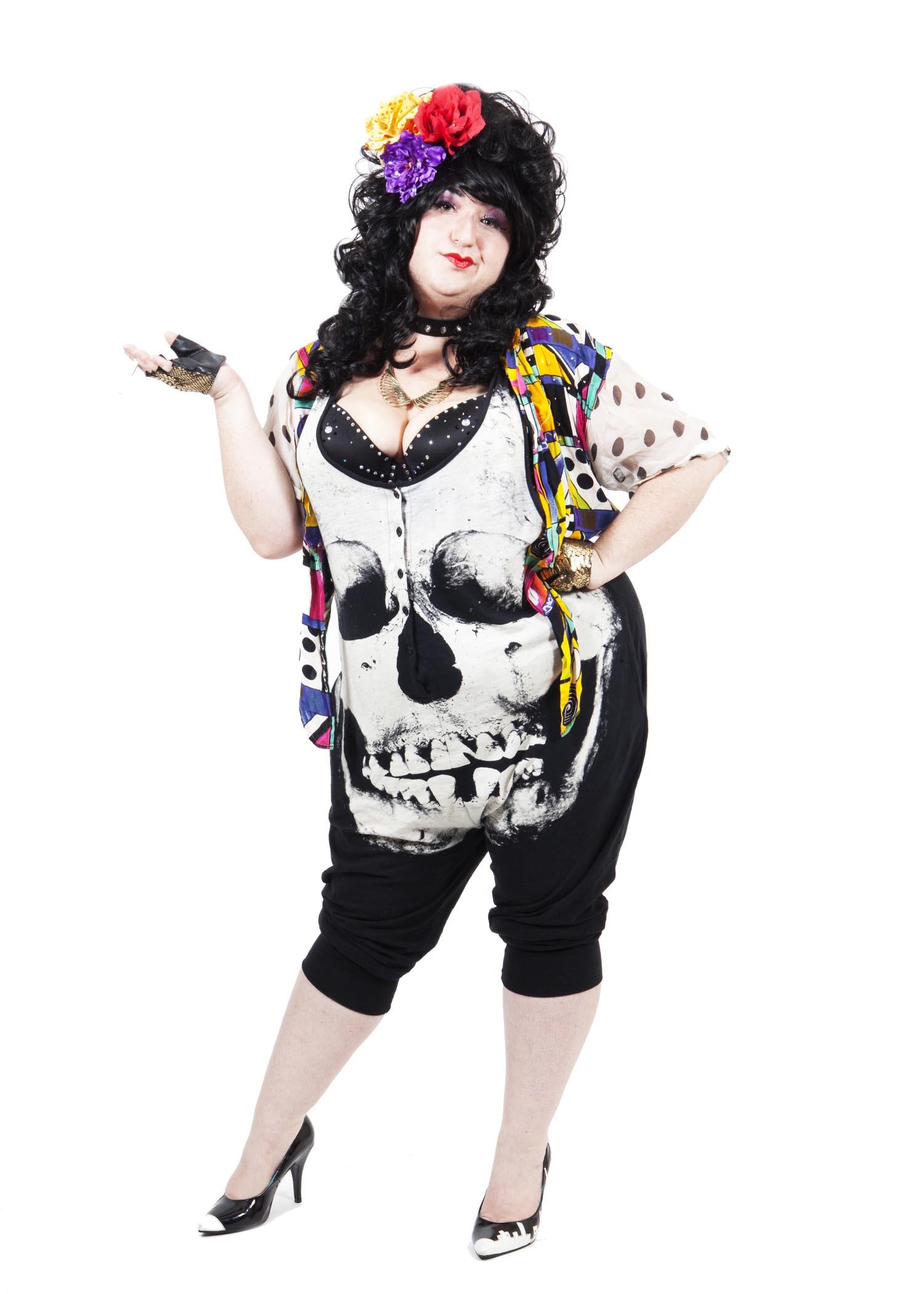
Fancy Feast. Photo by Andrew Levengood.

By: Maggie Freleng, NYC, USA, SSH Correspondent

Sunday night at Murray Hill’s annual Miss Lez Pageant, an alternative beauty pageant for queer womyn, something caught my attention. It wasn’t the contestant with a vintage vagina puppet or the plethora of boob tassels or even the contestant in the Winnie the Pooh outfit doing a strip tease pouring honey on her body. No, it was the one contestant in a bondage harness whose pageant platform was on a serious topic — street harassment.

“In my personal life it is something that I am very deeply and seriously passionate about. I am very concerned about it,” Fancy Feast, a burlesque dancer, told me.

Fancy Feast caught my attention when she took the stage with her extravagant beehive wig, kitten heels and form-fitting mini dress and told the audience that in her daily life every time she is street harassed she puts a nickel aside to be donated to shelters and abuse programs for women and LGBTQ folk.

“My performance is sexual and big and public,” Fancy Feast told me, who explained that people tell her she should expect to be harassed because she has such a sexualized performance. “But there are a different set of expectations when I’m in control of my image when I’m performing and presenting sexuality than when I am trying to get to work and get a smoothie.”

“Some people feel like every contact should be a level playing field and I should expect the same attention doing burlesque and taking the subway. To me its one of those ludicrous things…there is a separation.”

She said the differentiation comes when she is wearing no makeup and going home sick from work and minding her own business to when she is wearing makeup and a wig on stage where she is intending to be in control and powerful.

“When people are harassed on the street they have a lack of control. Someone is dictating how you should feel about your body walking down the street.”

“I tend to get harassed a lot when I have my stage makeup on when I am coming home after my gigs. It doesn’t matter if the makeup is really over the top or grotesque, or if I have fake bruises (I have a fake black eye for one of my acts) — I get harassed way, way more, especially if I look disheveled. It sometimes feels like I’m getting attention more for the performance of femininity, the artifice, as well as a perceived weakness,” she told me in a follow up email.

“It’s in those moments when people take advantage of perceived weakness that does not show up in my performances.”

Burlesque allows her to dictate how she feels about herself and her body, and she says the reaction is always positive.

Fancy Feast, who is also a sex educator in her day job, says she has never gotten harassed during one of her performances. She has found the burlesque scene to be very body positive and accepting.

While she does not always make her performances about her personal politics, Fancy Feast was excited she had the space to do at Miss Lez.

“My job to make sure people are having a good time and being entertained and taken care of,” she told me. “I don’t always intend to use that space to talk about personal politics. Often times it is not the right atmosphere.”

However, if she does have a moment with the mic she will try to make jokes and add satire to the serious issue, to aware people and get the message out while also keeping the audience entertained. For example, at a performance she told the audience her leather harness was made from the last guy who told her to smile on the subway.

When I asked Fancy Feast about her nickel idea that initially caught my attention she told me, “The nickel thing came from being in SoHo a few months ago and this guy started making comments about my body, his son was 8 or 9 and he encouraged his son to yell things too. I got so upset thinking about how many times I get harassed a year. These experiences happen so quickly and then they just pass.”

The nickel idea was a way for her to mark these fleeting occasions and make sure something good can come from these horrible moments that happen far too frequently and make a difference in something so many of us feel powerless against.

This piece is a part one of two on Fancy Feast. Burlesque dancers reactions to sexual harassment and the rest of the nickel story (which made its way into a letter for NPR) to come in part two.

Maggie is a Brooklyn based freelance writer and photographer focusing on social justice and women’s issues. She currently writes for Vitamin W. Maggie graduated with a B.A in Journalism and English from the University of Massachusetts, Amherst in 2011, concentrating on dystopian literature. You can read more of her writing on her blog or follow her on Twitter, @dixiy89.

Share

Filed Under: Activist Interviews, Stories, street harassment

« Previous Page
Next Page »

Share Your Story

Share your street harassment story for the blog. Donate Now

From the Blog

  • #MeToo 2024 Study Released Today
  • Join International Anti-Street Harassment Week 2022
  • Giving Tuesday – Fund the Hotline
  • Thank You – International Anti-Street Harassment Week 2021
  • Share Your Story – Safecity and Catcalls Collaboration

Buy the Book

  • Contact
  • Events
  • Join Us
  • Donate
  • Facebook
  • Instagram
  • Pinterest
  • Tumblr
  • Twitter
  • YouTube

Copyright © 2026 Stop Street Harassment · Website Design by Sarah Marie Lacy