• About Us
    • What Is Street Harassment?
    • Why Stopping Street Harassment Matters
    • Meet the Team
      • Board of Directors
      • Past Board Members
    • In The Media
  • Our Work
    • National Street Harassment Hotline
    • International Anti-Street Harassment Week
    • Blog Correspondents
      • Past SSH Correspondents
    • Safe Public Spaces Mentoring Program
    • Publications
    • National Studies
    • Campaigns against Companies
    • Washington, D.C. Activism
  • Our Books
  • Donate
  • Store

Stop Street Harassment

Making Public Spaces Safe and Welcoming

  • Facebook
  • Instagram
  • Pinterest
  • Tumblr
  • Twitter
  • YouTube
  • Home
  • Blog
    • Harassment Stories
    • Blog Correspondents
    • Street Respect Stories
  • Help & Advice
    • National Street Harassment Hotline
    • Dealing With Harassers
      • Assertive Responses
      • Reporting Harassers
      • Bystander Responses
      • Creative Responses
    • What to Do Before or After Harassment
    • Street Harassment and the Law
  • Resources
    • Definitions
    • Statistics
    • Articles & Books
    • Anti-Harassment Groups & Campaigns
    • Male Allies
      • Educating Boys & Men
      • How to Talk to Women
      • Bystander Tips
    • Video Clips
    • Images & Flyers
  • Take Community Action
  • Contact

Brazil: ”A few small nips” and the devaluation of women’s lives

August 29, 2017 By Correspondent

Trigger warning – mentions of rape and homicide

Yasmin Curzi, Rio de Janeiro, Brazil, SSH Blog Correspondent
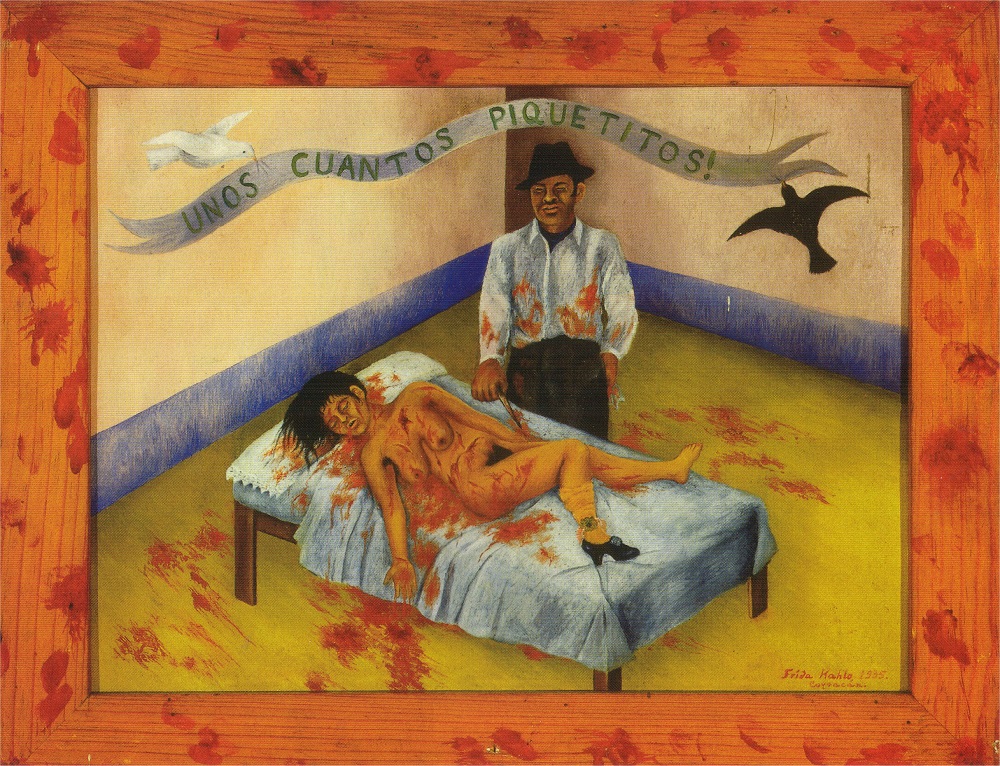
The painting is by Frida Kahlo. Sofia Mandelert aptly described in this article , “Painted in 1935, it’s inspired in a news report about a bloody homicide. A drunk man that stabbed his girlfriend twenty times on a bed and, when interrogated by the police, said that there were only “a few small nips”. The painting is crude and impactating, retracting the crime scene: the woman’s body lies naked over a bloody bed, while the man faces her in an apathetic way, with the crime weapon in his hands. The woman had her body covered with open wounds (…) To complete the aggressiveness of the scene, as a result of the bestial attack, the woman’s blood sprays all over the frame. However, not everything is death and grief in the scene. (…) Sneakily, the horrifying scenario is transformed into a caricature with the presence of bucolic elements, as the delicate silk pillowcase and the walls are painted with a happy combination of pink and blue. The joke is finished with a romantic pennant held by two doves, one white and one black, where the title of the work can be seen.”

Maré’s Favela (Rio de Janeiro/RJ): Valdina de Souza Araújo, 44 years old, street vendor. Constantly assaulted by her partner, the taxi-driver Eduardo Martim da Silva, one day she went missing. Her clothes were found covered with blood in his house.

Mickey’s Community (Niterói/RJ): Michelle Ferreira Ventura, 30 years old, maid. After being constantly harassed by her neighbored, Leonardo Bretas Vieira, Michelle stood up to him. He beat her until she lost consciousness. After four months in the hospital, she died.

São Paulo: Clara Averbuck, writer and feminist activists. She was raped by an Uber driver but did not report it to the authorities knowing how the system operates against women’s dignity and she didn’t want to be violated again by the State. In order to give voice to victims of this type of violence, she started a campaign entitled “#myharasserdriver/ #myabuserdriver”.

Recently released information from Women’s Dossier[1] shows the dimension of the dramatic scenario of violence against women in Rio de Janeiro. In the last three months of 2016, 42 attempts of murder of women were qualified as gendered crimes, signifying 27,3% of the total. A woman’s life was threatened, simply for being a women, every two days. The notifications of rape shows that 39,8% of the aggressors were somehow related with the victims (8,9% her partner or ex-partner). In addition, 55,5% of the victims were young girls, under 14 years old.

The stories of Valdina and Michelle, selected among thousands, show us that neither public spaces nor the domestic sphere are safe for women. Violence against women is the norm in this society.

It’s usual to associate the male protagonists of cruelty crimes against women as psychopaths, monsters, or mentally ill men that, by their nature, are “inherently violent”. This type of discourse intends to dissociate those who commit a violent act from the rest of the society. We can apply penalties toward them. We can exclude them from our social lives.

Except that, in fact, these men are ordinary men. They are men that live with these women who have regular lives, regular jobs and regular social relations. Thus, it’s a much more complex scenario, one that, maybe, people don’t want to face. It’s easier not to think about the changes that society really needs to make. In other words, to realize that these men are ordinary men implies that it’s not the individual behavior that is the real cause of the violence against women, but instead it’s the whole mindset that permeates our society that makes this violence possible. There are no “bad apples” needing to be removed from a barrel of pretty apples. The whole barrel is putrefied. It is a whole culture funded in the disrespect of women and a whole history of deprivation of equal value informing all of our relations.

Devaluation of women starts in the very first years of their lives: boys are more wanted than girls in some religions and societies. Then, usually parents raise their girls without the same freedoms that are given to boys and socialize them with the idea that they are fragile or incapable of doing things on their own. They are also forced to do housekeeping, while boys aren’t. Often, teachers opt to hear boys instead of girls in schools. So girls are more silenced. Media and propaganda leads them to think that they are never good enough – not pretty enough, nor smart enough. All of these are types of psychological violences which cause several traumas in women’s lives. Young girls are also the very first victims of trafficking of persons for sexual exploitation, domestic abuse and rape. Women are disrespected in the work sphere – in Brazil, black women are the main group in the informal market. Also, women are generally not recognized by their attributions in the formal market, suffering from sexual harassment, inequality of payment, demission after giving birth, etc.

Both private and public sphere are unsafe for women because they are not protected from abuse, rape, homicide and others types of violences.

My intention in this article is to show that violence against women, in all its forms, is a symptom of a mindset that constitutes the structure of our society. And this mindset is the fundamental root of that putrified barrel. All violence is connected by disrespect and by the devaluation of women that makes them a second-class group in our society.

In order to put an end to violence against women we must face this structure, change the way women are perceived at a much more profound level. This involves discussing education, intimate relations, media, democracy and public institutions. This involves the true recognition of women as human beings.

[1]  Dossiê Mulher 2017 / Instituto de Segurança Pública; Organizadores: Andréia Soares Pinto, Flávia Vastano, Orlinda Claudia R. Moraes. – Rio de Janeiro: Instituto de Segurança Pública, 2016.

Yasmin is a Research Assistant at the Center for Research on Law and Economics at FGV-Rio. She has a BA in Social Sciences from FGV-Rio and a Master Degree in Social Sciences from PUC-Rio, where she wrote her thesis on street harassment and feminists’ struggles for recognition.

Share

Filed Under: correspondents, street harassment

“I was harassed with sexually explicit slurs”

August 28, 2017 By HKearl

I was harassed with sexually explicit slurs near the PATCO train station.

– Anonymous

Location: Haddonfield, NJ

Need support? Call the toll-free National Street Harassment hotline: 855-897-5910

Share your street harassment story for the blog.
See the book 50 Stories about Stopping Street Harassers for idea
s.

Share

Filed Under: Stories, street harassment

Needed: Research participants in California

August 28, 2017 By HKearl

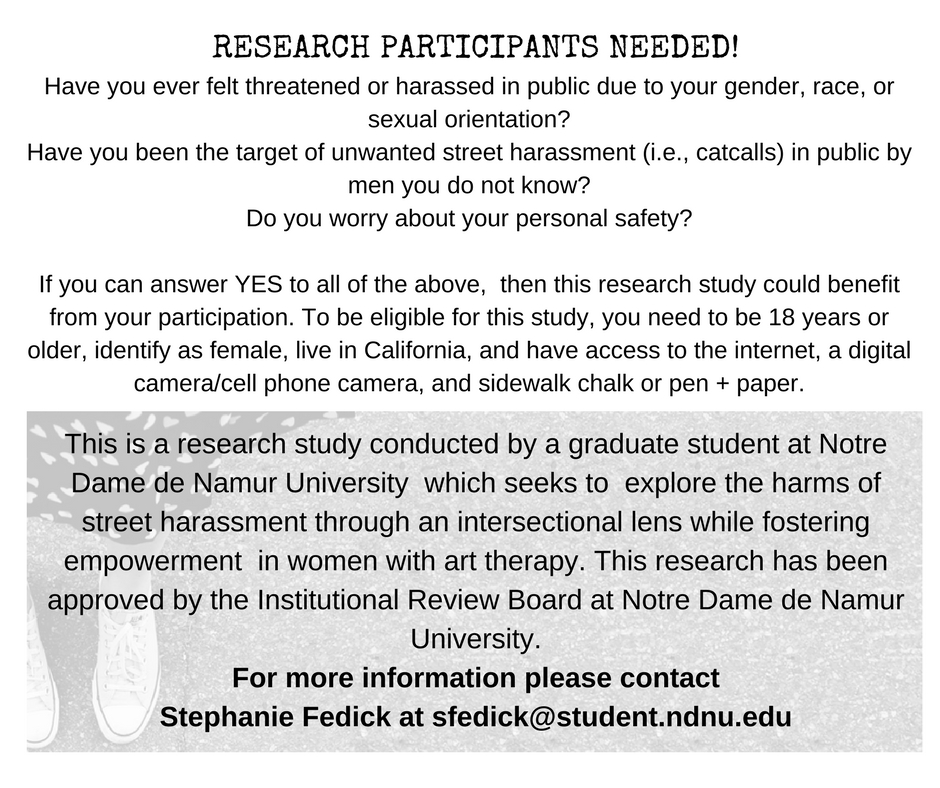
A graduate student in California studying Art Therapy is recruiting individuals to take part in her project — they must be between the ages of 18-64, live in California, identify as female and have experiences with street harassment. Part of her research includes a brief art directive in the form of sidewalk chalking and she’s looking for people to help! Here is more information.


Share

Filed Under: street harassment

“Is that all I’m worth?”

August 26, 2017 By Contributor

As a runner, I cannot even begin to count the number of times that I have been cat-called, shouted at, or otherwise bothered while training. And it doesn’t matter what I’m wearing – I’ve been shouted at while wearing a sports bra in the summer and while wearing piles of warm clothes in the winter. Regardless of the context, each and every call diminishes the sense of empowerment I get from running … is that all I’m worth?

Optional: What’s one way you think we can make public places safer for everyone?

Step one is is to stop normalizing this behavior.

– AB

Location: Country roads

Need support? Call the toll-free National Street Harassment hotline: 855-897-5910

Share your street harassment story for the blog.
See the book 50 Stories about Stopping Street Harassers for idea
s.

Share

Filed Under: Stories, street harassment

“They said maybe I should just do the world a favour and kill myself”

August 20, 2017 By Contributor

Trigger Warning – Suicidal thoughts

National Suicide Prevention Lifeline ‘1-800-273-TALK (8255)’: https://suicidepreventionlifeline.org/

I’ve been getting made fun of since I was 12 years old for my looks. I am now 31. I am very well aware that I am an ugly woman. Yet it seems maybe people seem to think I don’t know this. Why else do they need to keep reminding me of it?

I am someone who just keeps to myself. I am too nervous to get close to someone. Anyone I’ve been close to in the past always talked about how ugly I am to my face and behind my back. My own family has also always called me ugly. My mom has always been angry that I ended up looking more like my dad. They had a bad marriage. My sister often throws it in my face that I am ugly if we fight. So why get close to people if no one is willing to get past how hideously ugly my face is?

I’ve never had a boyfriend either, but I’ve never seen the point in trying. I am so ugly and any guy I’ve ever liked would probably hate me. Once when I did admit to it; the guy laughed in my face. He was a friend of mine and then he hated me for it. He was upset that someone as ugly as me would dare think I had a chance with him.

So I spend all my time on my own. Despite all of that, I’ve tried living my life as I should. I have a good job, I make good money, I have cats I love, I just bought my first house. Everything I have in my life, I’ve done all on my own. I’ve never asked for help. What’s the point? No one would probably want to help someone so ugly anyway.

I don’t bug anyone. I keep quiet but I love walking and hiking. I love exercise. I love being outside. I love summer. So today as usual, I went for one of my long walks. I was crossing the cross walk when I had the right of way and a car full of guys drove through and almost hit me.

They called me an ugly bitch as they went.

I managed to get across the road and they were in the parking lot at the Wendy’s. The guys came over to me and told me they’d be doing the world a favour if they hit me. No one would have to see my ugly face anymore. They said maybe I should just do the world a favour and kill myself. They said I am nothing but a pathetic loser who is a waste of skin.

I actually found this site to see how common this stuff is. It happens to me a lot, but I wanted to see if I could find people to relate to. I just don’t get why people have to be so mean to me.

Like I said, I don’t bug people. I keep to myself. I don’t force myself on anyone. I try to hide my face behind my hair. I do everything I can not to draw attention to myself but attention always finds me no matter what. I hate myself and I wish I could kill myself. I am still alive because despite the way my mom and sister have treated me, I don’t want to hurt them. I also have my two cats who I love and who need me to stay for them.

So every time an incident like this happens, I think of my family and my cats. However, I don’t know how much longer I can hold out. I should be able to walk down the street.

I’ve always been nothing but a good person. Sometimes I think maybe I was a bad person in my past life and so maybe I am being punished. Maybe I do deserve to be treated this way. Maybe I am actually a bad person. I think I am a good person but since it’s me, maybe I am being biased about myself. Maybe I am actually a horrible person and so my face makes up for my personality since I am the most hideous looking person. All I ever feel is contaminated for having an ugly face.

– Ashley

Location: Wendy’s in London, Ontario, Canada

Need support? Call the toll-free National Street Harassment hotline: 855-897-5910

Share your street harassment story for the blog.
See the book 50 Stories about Stopping Street Harassers for idea
s.

Share

Filed Under: Stories, street harassment

« Previous Page
Next Page »

Share Your Story

Share your street harassment story for the blog. Donate Now

From the Blog

  • #MeToo 2024 Study Released Today
  • Join International Anti-Street Harassment Week 2022
  • Giving Tuesday – Fund the Hotline
  • Thank You – International Anti-Street Harassment Week 2021
  • Share Your Story – Safecity and Catcalls Collaboration

Buy the Book

  • Contact
  • Events
  • Join Us
  • Donate
  • Facebook
  • Instagram
  • Pinterest
  • Tumblr
  • Twitter
  • YouTube

Copyright © 2026 Stop Street Harassment · Website Design by Sarah Marie Lacy