• About Us
    • What Is Street Harassment?
    • Why Stopping Street Harassment Matters
    • Meet the Team
      • Board of Directors
      • Past Board Members
    • In The Media
  • Our Work
    • National Street Harassment Hotline
    • International Anti-Street Harassment Week
    • Blog Correspondents
      • Past SSH Correspondents
    • Safe Public Spaces Mentoring Program
    • Publications
    • National Studies
    • Campaigns against Companies
    • Washington, D.C. Activism
  • Our Books
  • Donate
  • Store

Stop Street Harassment

Making Public Spaces Safe and Welcoming

  • Facebook
  • Instagram
  • Pinterest
  • Tumblr
  • Twitter
  • YouTube
  • Home
  • Blog
    • Harassment Stories
    • Blog Correspondents
    • Street Respect Stories
  • Help & Advice
    • National Street Harassment Hotline
    • Dealing With Harassers
      • Assertive Responses
      • Reporting Harassers
      • Bystander Responses
      • Creative Responses
    • What to Do Before or After Harassment
    • Street Harassment and the Law
  • Resources
    • Definitions
    • Statistics
    • Articles & Books
    • Anti-Harassment Groups & Campaigns
    • Male Allies
      • Educating Boys & Men
      • How to Talk to Women
      • Bystander Tips
    • Video Clips
    • Images & Flyers
  • Take Community Action
  • Contact

Groping: The Sex Crime No One Talks About

February 8, 2012 By HKearl

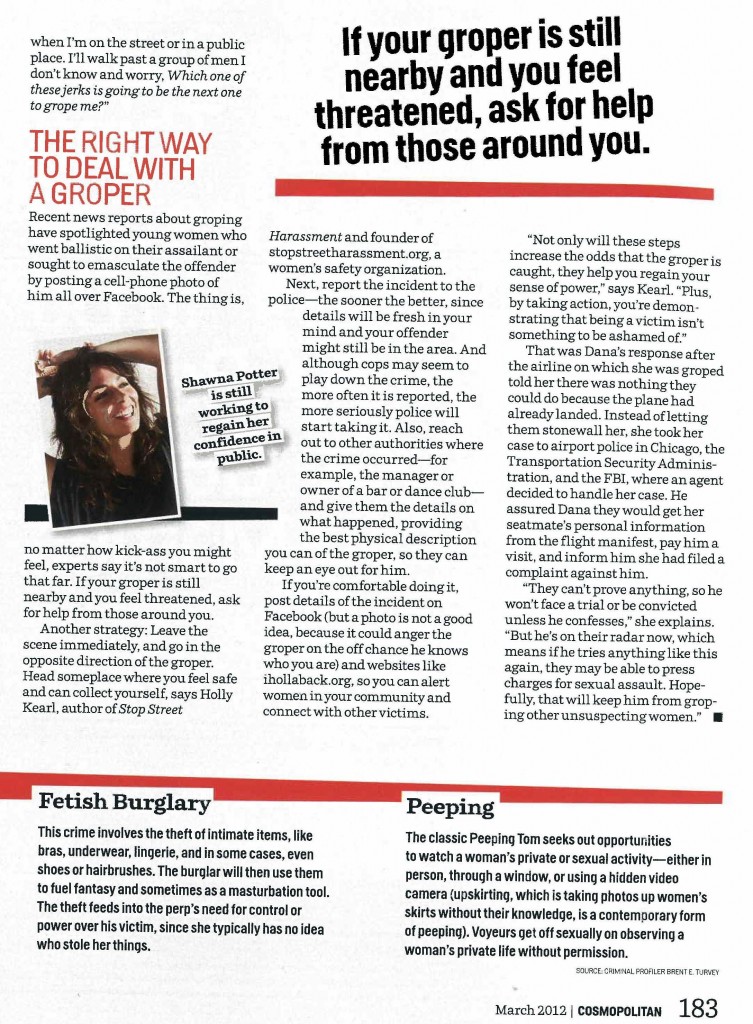
If you pick up the March 2012 issue of Cosmopolitan magazine, which just hit newsstands today, and turn to page 180, you can find a four-page article about the problem of men groping women in public places. (And I know some men have been groped too, but the article focused on men groping women.)

I’m glad to see Cosmo take on this under-reported and under-acknowledged, but widespread problem. When I conducted a survey of 816 women for my book Stop Street Harassment, over half of the women, including me, had been groped by a stranger on the street at least once. Cosmo said that 77 percent of respondents in a survey they did reported being the target of this behavior.

I did an interview for the article author, Stephanie Booth, and shared my advice for how to respond if that happens to you. Given the article length and how long my responses were, only some of my advice made the cut. I’m including my longer responses below in case they’re useful to readers. Feel free to share your own advice in the comments.

1. Stephanie Booth (SB): What is the best way for a woman to respond to a groping incident?

Holly Kearl (HK): Every situation is different so there is no one perfect response that will work in all scenarios. A primary piece of advice is to assess the situation quickly and decide how safe you are before choosing a response. If you feel safe (e.g. there are people around, it’s daylight, you’re in a familiar area, and you’re with friends or family), telling the harasser to stop or to back off, shouting out to bystanders about what just happened, demanding some kind of apology or accountability from the harasser are all good options. If you are quick on your feet, using humor can also be effective. This is one of my favorite stories, included in my book, about how a woman handled her harasser after the slapped her backside:

Living in France, I often felt harassed and didn’t know how to deal with the harasser/language and culture barrier. One night while walking home, a group of young men who often whistled at me or called at me began their usual routine. I usually ignored them, but this time the ringleader slapped my butt as I walked by. I turned around and in French said to him, “Congratulations. Is that the first time you’ve touched a woman?” I turned around and walked away while his friends laughed at him. I felt that I had really turned their game against them, and they never bothered me again.

If you feel unsafe, leave the situation as quickly as possible and get someplace where you do feel safe.

Regardless of how you respond in the moment, if someone has groped, grabbed, or slapped you, that is assault and it can be reported to the police, and/to transportation authorities, and/or to business owners/managers (depending on where the harassment happened and what outcome you hope to see). A lot of harassers are repeat harassers so reporting them to ensure they face some kind of penalty for their behavior can hopefully help deter them from harassing someone else.

2. SB: Of course, police should take such a complaint seriously, but is it there a chance it will get blown off? Are there certain “buzz words” a woman should use when she calls police to get them to pay attention?

HK: Yes, based on feedback from women who have reported harassers, there is a chance that police will not take the report seriously. But many police officers do, so it’s worth trying (if people have the time/energy to do so).

I haven’t heard of any buzz words women should use, but looking up their city’s laws and then citing the specific law that was violated may help. For example, in Washington, DC, “misdemeanor sexual abuse” is defined as engaging “in a sexual act or sexual contact with another person . . .  without that other person’s permission,” where “sexual contact” is “the touching with any clothed or unclothed body part or any object, either directly or through the clothing, of the genitalia, anus, groin, breast, inner thigh, or buttocks of any person.”

So a person who is groped in Washington, DC, can call the police to report a case of “misdemeanor sexual abuse.” There’s no guarantee that describing it in those terms will make the police pay more attention than if the person called it “groping,” but it’s worth a try.

3. SB: Is it ever smart to verbally confront a man who is groping you? (Like a woman recently did in the NY subway?) What do you say?

HK: Yes, if you feel safe, it can be very impactful to verbally confront a groper or any type of harasser. People grope and harass because they think they can get away with it and if you’re silent after being groped or harassed (which is sometimes necessary for safety reasons) that often lets them continue to get away with it. Calling them out lets them know you won’t stand by and let them abuse you and calling them out can inspire others around you to help stop the harasser or groper and to stand up to their own harassers or gropers.

If gropers/harassers can no longer grope and harass and then carry on their merry way because suddenly they are being confronted by their target, they will hopefully be less inclined to harass or grope again.

Additionally, as the former Executive Director of the Washington, D.C. Rape Crisis Center, Martha Langelan, teaches in her sexual harassment seminars, there are a few men out there who use street harassment, including groping, as a rape test. They may attempt rape depending on how a woman responds to street harassment. If she is assertive and forceful, they will leave her alone, but if she cowers, freezes, or humors them, they may escalate the harassment to rape.

4.  SB: Should you ever snap his photo with your cell phone and post to a hollaback website?

HK: Yes, you can snap a photo, but if you do, it’s usually more productive to submit it with a police report than to post it on a website. Since harassers are strangers, snapping a photo can help police identify the harasser. Very few police check the Hollaback sites (although last year Holla Back DC! did have a case where a photo of an upskirter posted on their site led to his arrest because a police officer visited their site and saw the photo). Since probably no harassers go on the site either, it’s not a very effective way to deter them from harassing again. A better deterrent may be to print his photo on a flier and post it all around the place where the harassment occurred. He may often pass by that area and see it or someone he knows may walk by and see it.

But sharing one’s story on the Hollaback sites or my site Stop Street Harassment with or without a photo is important because it helps document the problem and it often makes women feel empowered to share what happened with a supportive audience.

Share

Filed Under: Advice, News stories, street harassment Tagged With: cosmo, groping, street harassment

Plumbing company street harassers

February 8, 2012 By Contributor

I was harassed by this man (nearest to the camera) this morning. He works for a plumbing company in Manhattan. The employee had commented on my body as I was on my way to a meeting. Do I really need to hear that my legs look good?

I called the company to complain and the owner was very nice and receptive, apologized and promised to “talk to the person in a very serious way.”

It helped to take a picture because even though he was looking away on purpose, I was able to describe him to the owner.

I know that it doesn’t matter and they shouldn’t harass anyone no matter what, but I was dressed in a sober manner. It’s so intrusive and disgusting, and I told the man that this really impacts a woman’s quality of life, and this is not 1935…let’s evolve!

– Toby

Location: New York City, USA

Share your street harassment story today and help raise awareness about the problem.
Find suggestions
for what YOU can do about this human rights issue.

Share

Filed Under: Stories, street harassment

Be a fake friend to stop street harassers (capes optional)

February 7, 2012 By Contributor

Editors Note: This is cross-posted with permission from the blog Lauren Bravo is My Real Name. Her bystander intervention technique was simple but effective and it started off by checking in to see if the person wanted help so it was not dis-empowering. Her tactic is one that any one of us can do. So keep that in mind when you witness harassment and you’re not sure what to do.  Pull the fake friend card and step on in!

I did a good deed the other week. On the scale between replacing the loo roll when you’ve finished it and pulling a child out of the way of a speeding bus shouting “Little Jimmy, nooooo!” then I’ll concede it’s closer to the Andrex end, but still, I felt proud.

My deed was this: I saw a woman, on a busy Euston Road at 6pm, being hounded by a man. He wasn’t being outwardly aggressive, but he was sliming round her like a slug in an overcoat, asking questions and ignoring all clear signals (headphones in, one-word answers, refusal to make eye contact) that she wasn’t interested.

I caught the girl’s eye and mouthed, “Are you ok?” to which she shook her head. So then I had a decision to make, quickly. To barge in like the Green Cross Code Man and say, “STOP, letch! She doesn’t want to talk to you. RETREAT,” before blasting him with a sonic ray gun, or the alternative; pretend to be her mate.  “There you are!” I cried, launching myself on her (for if I’m going to do a good deed I may as well get a hug out of it). “Hi!” she faked, as I dragged her away. Then we stood together on the pavement miming friendly chat like a couple of am-dram actors, while Slug Man stared, lingered, and eventually slithered off back to his cabbage patch.

She was pretty grateful, or at least acted like she was. “I always attract the weirdos too,” I told her, in what I thought at the time was a reassuring manner. Then I disappeared off into the night, swishing my imaginary cape and feeling proud.

Why don’t more people do this? Seriously? There must have been 20 people within view and earshot standing nearby, yet nobody else paid the slightest attention. I assume for the same reasons more strangers don’t tell you when you have food on your face – because we are all really hermit crabs, and unprecedented human contact is more often than not a big ol’ faff.

There’s the worry that you’re going to get ‘involved in something’, of course, and I can appreciate that. But nobody’s saying you have to leap in with your handbag swinging. Even a stern glance or a calm, disapproving presence could help. A well-timed ‘tut’ might still go some way to helping these lowlifes learn that harassing us for the simple crime of possessing ovaries is Not Ok.

This isn’t necessarily about sisterhood, either. I stopped and rescued her because I’ve been in her place enough times to know it’s awful, and because it makes my blood boil that street harassment is still so commonplace when it ought to have gone the way of the permed mullet. But a bloke could likewise have stopped and rescued her because he’s a decent person, and it makes HIS blood boil that street harassment is still so commonplace it ought to have gone the way of the permed mullet.

So let’s make this a new thing – street harassment crusaders! Operation Creep-Be-Gone! Bolshy builders, drunk leerers at bus stops, creepy guys who hang around asking you your name at train stations – all beware! For before you know it, a Fake Friend might leap out of the shadows and stop you in your tracks. Who’s with me?

(Capes optional)

– Lauren Bravo, by day, Senior Writer for Channel 4 Food and columnist for the Worthing Herald series. By night, London-lover, glutton and grump.

Share

Filed Under: Stories, street harassment Tagged With: bystander, fake friend, Lauren Bravo, street harassment

Interview with Yemen Safe Streets Campaign Founder

February 7, 2012 By HKearl

Ghaida'a AlAbsi

Ghaidaa al-Absi is an anti-street harassment activist from Yemen and she founded the Safe Streets Campaign. She identifies as a feminist and gender activist, and her passion is helping women. One of her projects has been to empower Yemeni women in new media. She also authored a booklet about stories of women revolutionaries who participated in the Current revolution.

Via e-mail she answered several questions about street harassment in Yemen and her campaign.

Stop Street Harassment (SSH): What inspired you to start the Safe Streets campaign?

Ghaidaa al-Absi (GA): Every day I walk in the streets, and every day I face  sexual harassment. Unfortunately, it becomes daily life, and we women are forced to adapt to it either by being silent or yelling at the harassers. One day, something happened to me, and that made me found Safe Streets campaign. I am always facing harassment, but what happened in that day affected me.

After visiting my friend, I went back to my home. While I was walking in the street a man came to me from behind, and tried to touch me. I hit him with my bag, but I felt very depressed at that moment because he deserved more.

My friends and I talked about what happens to us in the street. I told myself to stop complaining, and to do something instead. So I proposed the campaign to Tacticaltech, and they funded it.

SSH: What does the campaign entail?

GA: There’s an electronic map where women have space to report what happened to them in the streets, and where happened. Through this map we aim to detect the hot spot streets, and to have some data, because this information will help us in the future for two main reasons. First, we are planning to extend the campaign and start cooperating with police officers to distribute more moral patrols in these hot spot areas. Second, this kind of information will show how this problem is serious, and then we can put a pressure on the decision makers to form a law to punish the harassers.

The campaign also hosted an exhibition of local artists work on the subject of street harassment and produced a video to bring attention to the issue.

SSH: What is your goal/s for the campaign? What do you think it can achieve?

GA: Actually we have two goals. First, we want women to speak out about what is happening to them in the streets instead of keeping this behind closed doors. Second, we want to mobilize people, decision makers, and police officers to form a law so the harasser can be punished.

SSH: How is the campaign being received by the general public?

GA: So far we are getting many interactions from people. Of course some people still deny that there is sexual harassment in the streets in Yemen and keep telling us there many important issues in Yemen we should care about instead. As you know this campaign was born during the Yemeni revolution, so all people are concerned about the political, economical issues in Yemen more than anything else. Thus, women’s rights issues are not a priority for some men and women. However, in the middle of this, there are many people interacting with the campaign. As you can see on the Facebook page there are more than 1600 likes, and the viewers of the movie of the campaign more than 3,000.

SSH: I know ATHAR Foundation undertook a street harassment survey and campaign in Yemen a few years ago, do you think it paved the way for people to be more willing to discuss street harassment?

GA: Athar foundation was the first NGO to talk about sexual harassment in the streets in Yemen. We appreciate the survey they have done, because they gave us a rate of sexual harassment, which is 90 percent of women are suffering from this serious problem. Because of their survey, we can bring people’s attention to this issue.

SSH: Do you have any advice you have for people who want to start their own campaign in their community?

GA: The first step is the hardest, and it takes a long time before you can go to the next step. Second, you might not find support or a response at the start of your campaign, especially if it is touching sensitive issues. Just Be Patient.

SSH: Anything else you would like to add?

GA: This campaign would never come to life without the help and the support of my husband Fathi Al-Dhafri. Personally I thank every one who worked for this campaign because they believed in the cause, and never waited to be paid. They are heroes and heroines.

SSH: Thank you!

Share

Filed Under: Activist Interviews, street harassment Tagged With: ghaidaa al absi, safe streets campaign, street harassment, Yemen

Interview: Photographing street harassers

February 6, 2012 By Contributor

Image from the "City of Brotherly Love" exhibit

In her photo series “City of Brotherly Love,” photographer Hannah Price responds to experiences with street harassment in Philadelphia. She described the images as “a response to my subjects looking at me, and myself as an artist looking back.”

Her series was displayed in a recent exhibit at the Philadelphia Museum of Art. Upon visiting the exhibit with street harassment activist Holly Kearl, I was instantly moved and left with questions about who this photographer is and what made her “click.” I had the pleasure of meeting with the talented Hannah Price soon after. Here’s what she had to say:

Nuala Cabral (NC): What inspired you to create a photo exhibit that brings attention to street harassment?

Hannah Price (HP): The only thing that allowed me to create this type of work, are the men who harass me on the street everyday. It was a basic response with my camera to turn the attention away from me.  Like I said before being harassed by men is a part of my everyday life and this project is a documentation of my life as a black woman in Philadelphia with a background from suburbia Colorado.

Hannah Price

NC: What are your hopes and expectations for this project?

HP: My only hope is to help people understand how uncomfortable overtly expressing oneself sexually to another person can be.  There are other ways of communicating an interest with another person.

NC: How did men react when you took their picture?

HP: Most of the men were surprised I responded because the typical response is avoidance.  After confronting and taking their photograph they respected my disinterest.

NC: How have people responded to your photo exhibit?

HP: Most responses to my project have been quite positive.  No one has yet expressed any backlash.  Most people are interested in the process and experience of photographing men in a unpleasant, semi-dangerous situation.

NC: What did you learn in the process of creating and displaying this project?

HP: I have learned that the only way we can stop sexual harassment is by getting rid of the certain sexual media that children have access to at such a young age.

NC: What are your thoughts about the movement to end street harassment?

HP: I think this movement is inevitably necessary, especially if society still respects their own human decency.

Nuala Cabral is an award-winning filmmaker, educator and activist in the Philadelphia-area.

Share

Filed Under: Activist Interviews, street harassment Tagged With: art exhibit, art museum, Hannah Price, Nuala Cabral, philadelphia, street harassment

« Previous Page
Next Page »

Share Your Story

Share your street harassment story for the blog. Donate Now

From the Blog

  • #MeToo 2024 Study Released Today
  • Join International Anti-Street Harassment Week 2022
  • Giving Tuesday – Fund the Hotline
  • Thank You – International Anti-Street Harassment Week 2021
  • Share Your Story – Safecity and Catcalls Collaboration

Buy the Book

  • Contact
  • Events
  • Join Us
  • Donate
  • Facebook
  • Instagram
  • Pinterest
  • Tumblr
  • Twitter
  • YouTube

Copyright © 2026 Stop Street Harassment · Website Design by Sarah Marie Lacy