• About Us
    • What Is Street Harassment?
    • Why Stopping Street Harassment Matters
    • Meet the Team
      • Board of Directors
      • Past Board Members
    • In The Media
  • Our Work
    • National Street Harassment Hotline
    • International Anti-Street Harassment Week
    • Blog Correspondents
      • Past SSH Correspondents
    • Safe Public Spaces Mentoring Program
    • Publications
    • National Studies
    • Campaigns against Companies
    • Washington, D.C. Activism
  • Our Books
  • Donate
  • Store

Stop Street Harassment

Making Public Spaces Safe and Welcoming

  • Facebook
  • Instagram
  • Pinterest
  • Tumblr
  • Twitter
  • YouTube
  • Home
  • Blog
    • Harassment Stories
    • Blog Correspondents
    • Street Respect Stories
  • Help & Advice
    • National Street Harassment Hotline
    • Dealing With Harassers
      • Assertive Responses
      • Reporting Harassers
      • Bystander Responses
      • Creative Responses
    • What to Do Before or After Harassment
    • Street Harassment and the Law
  • Resources
    • Definitions
    • Statistics
    • Articles & Books
    • Anti-Harassment Groups & Campaigns
    • Male Allies
      • Educating Boys & Men
      • How to Talk to Women
      • Bystander Tips
    • Video Clips
    • Images & Flyers
  • Take Community Action
  • Contact

“When he finally stopped I got the hell out of there”

July 28, 2017 By Contributor

When he finally stopped I got the hell out of there.I had just left the store and was walking to my car. As I got close to my car this other vehicle pulled up very quickly next to mine. I jumped a little because it was really close to me. The driver rolled down his window and said, “Don’t worry baby, I wouldn’t hit you”.

I ignored it and got into my car. I turned my car on and heard him tapping his fist on my window. He was looking in my car, saw I had my change in the cup holder and shouted, “CAN I HAVE A DOLLAR” ? and kept tapping my window. When he finally stopped I got the hell out of there.

– Anonymous

Location: Pennsylvania

Need support? Call the toll-free National Street Harassment hotline: 855-897-5910

Share your street harassment story for the blog.
See the book 50 Stories about Stopping Street Harassers for idea
s.

Share

Filed Under: Stories, street harassment

Kenya: Death Penalty Ruling in Stripping Case

July 24, 2017 By Contributor

By: Naomi Mwaura

In November 2014, hundreds of people joined the #MyDressMyChoice protest in Kenya after three men (including the bus driver and bus conductor) robbed, stripped and sexually assaulted a woman in September in an empty public bus at the Millennium petrol station in Githurai 44, Nairobi county. They video recorded the attack and the video subsequently went viral, sparking outrage.

Since 2013, Flone Initiative has been working to create safe commuter spaces and professionalism in the public transport industry in Kenya. To advance this mission, I was among the lead organizers of the 2014 protest. Our goal was to stop the increased number of cases of stripping of women and girls in public transport vehicles and terminals.

Now, nearly three years later, on July 19th 2017, the three men involved in the Sept. 2014 incident have been sentenced to death as well as to 25 years each in prison. This is one of the two landmark cases in court involving the sexual assault and robbery of women in the public transport industry. The other case being held in Makadara law court involves a woman hawker who was robbed, stripped and sexually assaulted in Kayole.

No executions have been carried out in Kenya since 1987, when Hezekiah Ochuka and Pancras Oteyo Okumu were hanged for treason. In 2009, Kenya commuted all death sentences to life imprisonment, impacting over 4,000 death row inmates. Despite the lack of executions, death sentences are still passed in Kenya.

I believe that life is precious. Hence, I feel uncomfortable with the possibility of loss of life. However, I can not ignore the heinous acts that the accused committed, the scars and trauma that the victim has to live with and the dangers that the accused pose to public transport users (especially women who make up the majority of public transport users).

Public silence and judicial inertia have ensured that rates of violence against women are often vastly under-reported and that offenders often go unpunished. This ruling changes the norm and, as such, plays an important symbolic role, by indicating that such behavior is socially unacceptable and will not go unpunished. This sentence serves a deterrence function to perpetrators and encourages victims to report. I commend the judicial system for being responsive to the victim by providing protection and handling the case with appropriate sensitivity. The ruling may be appealed but it is our hope that the judicial system will not falter. We look forward to a similar ruling in the Kayole case.

As the magistrate in this current case noted, “What you (the accused) thought was a joke should not be taken lightly, as a woman’s privacy and decency should be respected at all times.” This ruling is the strong message needed to criminalize violence against women and reaffirm the rights of women to live free of violence in public spaces, especially the transport industry, which has been plagued with various forms of violence against women.

I feel honoured to have supported the cause and, most importantly, to see justice in my lifetime.

As the rule of law takes it’s course, Flone Initiative will continue addressing the underlying norms and behaviours associated with violence against women in the transport system by training PSV operators on customer service, prevention of sexual violence and professional development, as well as working to increase the number of women employed in the industry.

Let’s make a toast: To Justice! It’s been over three years of waiting but it’s been worth the wait. Cheers!

Sending a life free of violence and love your way,

Naomi Mwaura
Founding Director, Flone Initiative

Share

Filed Under: News stories, street harassment Tagged With: court case, kenya, sexual assault, stripping

New Research, Campaign & Photo Project

July 23, 2017 By HKearl

Research conducted by experts at the University of Melbourne in Australia demonstrates how common sexual harassment is in the lives of women and documents the possible impact this can have on how women think about themselves. The full results were published in the British Journal of Social Psychology.

Two key findings are:

1. Women reported being the target of a sexually objectifying event once every two days.

2. Both being personally targeted or witnessing others being objectified was associated with a “substantial increase” in “self-objectification”, proving that instances of sexual harassment can have a negative impact on the way women think about themselves.

____________________

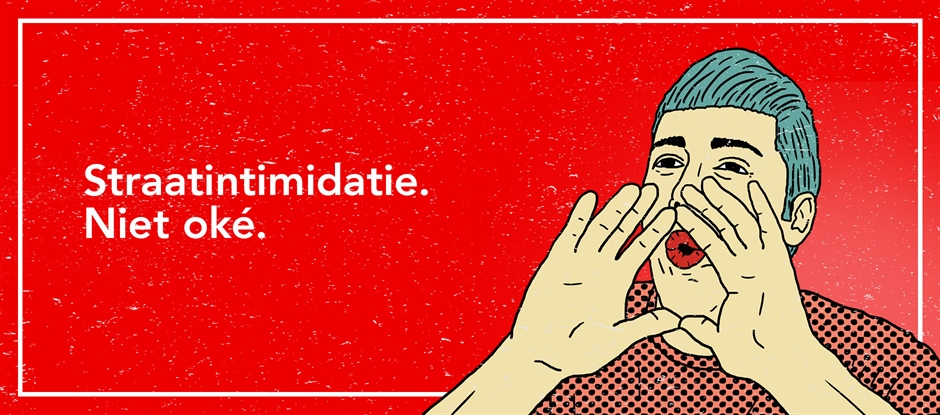
In the Netherlands, Stop Straatintimidatie launched a new campaign against street harassment. Campaign founder Gaya Branderhorst shared, “The message to the public is clear: everyone should be able to walk the streets without harassment,” and “street harassment will be fined in Amsterdam and Rotterdam from 2018 onwards, and other cities are planning to follow soon.” Great!

____________________

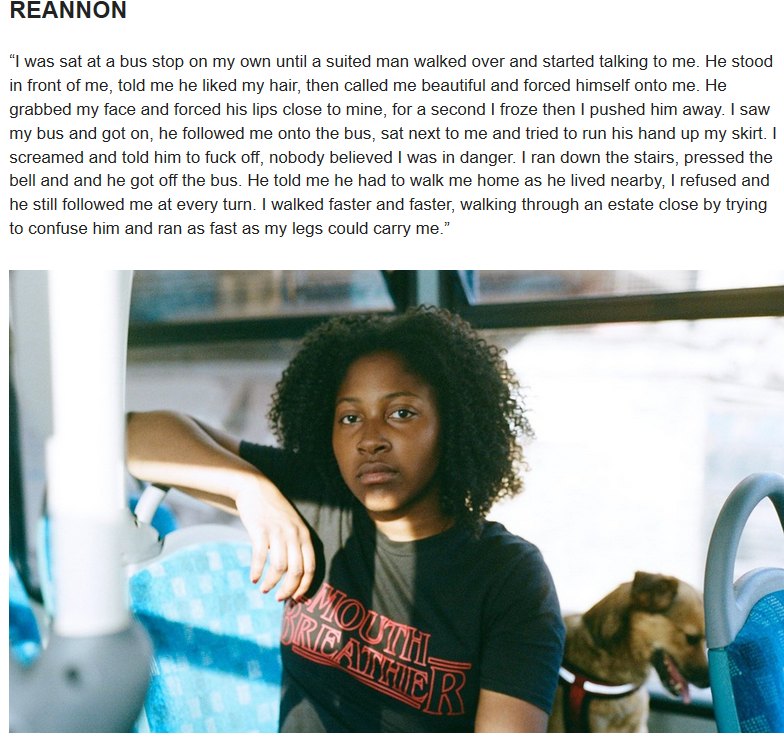
In the UK, photojournalist Eliza Hatch created a new photo series called Cheer Up Luv to raise awareness about street harassment. An article for the Guardian states, “Hatch found her female friends had all experienced harassment regularly, while her male friends were shocked by how frequently it occurred. Her photographs often feature women in environments in which they have been harassed, alongside their accounts. ‘I really wanted to capture the woman in her surroundings,’ says Hatch. ‘Instead of it being somewhere where she felt vulnerable, I wanted to make it a stage for her to speak out from. And I wanted you to actually look into her eyes as you’re hearing her story.'”

See more at: instagram.com/cheerupluv


Share

Filed Under: Activist Interviews, Resources, Stories, street harassment Tagged With: Amsterdam, art, Australia, campaign, netherlands, photography, research, UK

“I don’t want people to be scared of walking alone”

July 22, 2017 By Contributor

I was only minutes away from my home when two boys (one on a bike) walked not too far behind me and started shouting things like “fat a**” and loudly saying to each other “look at it jiggle!” and more rude comments. Bear in mind that I am a 14 year old girl and the two boys looked around 16 or 17 years old. The experience made me feel really uncomfortable and embarrassed. When I ignored them they started getting violent and shouting things like “don’t f****** ignore me” and “you ginger c***” (I’m not even ginger, I’m a brunette).

They followed me all the way from where I was to my local shop (which is about 5 minutes away from where they started following me). I should’ve gone into the shop and told someone and asked if I could stay there for a little while but in the heat of the moment, I was scared and took a quick turn, running down a familiar street and trying to get away from them. I luckily lost them before they got too violent.

I was so shocked and scared that I just kept walking an alternative route back home and called my mam. I was so scared and I don’t think I’ll be walking alone again for a little while, I’m just glad that they didn’t follow me further. This happened about two hours ago.

I feel better now and I have stopped shaking but my boyfriend isn’t too happy about it. I want catcalling to stop and I don’t want people to be scared of walking alone like I am now. I’m only 14 for god sake and just think how bad it could’ve been if they were older men. Catcalling and following needs to stop because it did not make me feel good about myself or confident or anything else that people might try to convince you, it was scary, embarrassing and made me feel frustrated.

It’s ridiculous that people like me can’t just walk around and have freedom without feeling scared of other people.

Optional: What’s one way you think we can make public places safer for everyone?

Educate young people on how catcalling can be dangerous and make people extremely uncomfortable, also educate people on how to intervene with catcalling.

– Anonymous

Location: Newcastle, United Kingdom

Need support? Call the toll-free National Street Harassment hotline: 855-897-5910

Share your street harassment story for the blog.
See the book 50 Stories about Stopping Street Harassers for idea
s.

Share

Filed Under: Stories, street harassment

SSH Condemns Deeply Troubling Remarks by Education Department Official

July 20, 2017 By HKearl

The acting head of the Office for Civil Rights (OCR) at the U.S. Department of Education, Candice Jackson, made headlines last week for her dangerous remarks about college sexual assault. Jackson was quoted in The New York Times as saying, “Rather, the accusations — 90 percent of them — fall into the category of, ‘We were both drunk, we broke up, and six months later I found myself under a Title IX investigation because she just decided that our last sleeping together was not quite right.'”

Those words are appalling, and Stop Street Harassment strongly condemns them.

As a national nonprofit organization working to end gender-based street harassment worldwide, we’re keenly aware that the public sexual harassment that we’ve documented for years doesn’t happen in a vacuum: It is part of a broader rape culture that minimizes and perpetuates sexual violence, including on college campuses.

At its core, street harassment is about exerting power over someone else, disrespecting them, and in most cases sexually objectifying a person without consent. It is on the same spectrum of behavior as sexual assault and rape. Indeed, our societal acceptance of street harassment – often regarded as the price women and LGBTQ people pay for being women and/or LGBTQ – reflects a culture that normalizes disrespect, accepts unsolicited comments about another person’s body, and tells perpetrators that their actions, however unconscionable, are okay.

Despite what people like Jackson claim, sexual harassment and violence aren’t okay, made-up, or the victim’s fault – not when we’re talking about street harassment, and certainly not when we’re talking about college sexual assault. We demand better from our nation’s public officials and will continue to speak out when they make such damaging statements.

Signed,

The Stop Street Harassment Board of Directors

(Thanks to our board member Patrick McNeil for drafting this!)

Share

Filed Under: News stories, street harassment

« Previous Page
Next Page »

Share Your Story

Share your street harassment story for the blog. Donate Now

From the Blog

  • #MeToo 2024 Study Released Today
  • Join International Anti-Street Harassment Week 2022
  • Giving Tuesday – Fund the Hotline
  • Thank You – International Anti-Street Harassment Week 2021
  • Share Your Story – Safecity and Catcalls Collaboration

Buy the Book

  • Contact
  • Events
  • Join Us
  • Donate
  • Facebook
  • Instagram
  • Pinterest
  • Tumblr
  • Twitter
  • YouTube

Copyright © 2026 Stop Street Harassment · Website Design by Sarah Marie Lacy