• About Us
    • What Is Street Harassment?
    • Why Stopping Street Harassment Matters
    • Meet the Team
      • Board of Directors
      • Past Board Members
    • In The Media
  • Our Work
    • National Street Harassment Hotline
    • International Anti-Street Harassment Week
    • Blog Correspondents
      • Past SSH Correspondents
    • Safe Public Spaces Mentoring Program
    • Publications
    • National Studies
    • Campaigns against Companies
    • Washington, D.C. Activism
  • Our Books
  • Donate
  • Store

Stop Street Harassment

Making Public Spaces Safe and Welcoming

  • Facebook
  • Instagram
  • Pinterest
  • Tumblr
  • Twitter
  • YouTube
  • Home
  • Blog
    • Harassment Stories
    • Blog Correspondents
    • Street Respect Stories
  • Help & Advice
    • National Street Harassment Hotline
    • Dealing With Harassers
      • Assertive Responses
      • Reporting Harassers
      • Bystander Responses
      • Creative Responses
    • What to Do Before or After Harassment
    • Street Harassment and the Law
  • Resources
    • Definitions
    • Statistics
    • Articles & Books
    • Anti-Harassment Groups & Campaigns
    • Male Allies
      • Educating Boys & Men
      • How to Talk to Women
      • Bystander Tips
    • Video Clips
    • Images & Flyers
  • Take Community Action
  • Contact

Poem: Street Harassment Simplified

August 15, 2011 By Contributor

This poem is by Niz (@NotASquib), a 21-year-old vegetarian university student studying French, from England. It was originally posted at DeviantArt and she’s given me permission to post it here.

Street Harassment Simplified

Woah, stop,
get your hands off me.
I am not your property.

The way I dress,
the things I say,
how I move,
if I pay,
or the makeup on my face
doesn’t mean it’s ok.
You don’t have the right
to do just whatever you like
so

hey, stop
where do you get off
justifying treating me
like I’m your damn property.

I am my own person,
I am free,
without your authorisation,
to just be me.

I can dress in my own clothes,
I can dye my hair,
I can wear a skirt
without worrying you’ll stare.
Your own behaviour
is your responsibility

so stop trying to blame
your harassment on me!

If you like something about me
then hey that’s fantastic
but instead of shouting it out
maybe try another tactic:
just smile once, look away,
don’t get up in my face,
keep your comments to yourself
and out of my personal space.

You don’t know my background,
my worries or fears

so think that your actions
could bring me to tears.
Just keep your cool
and treat me like a human being
and then maybe you’ll see
something worth seeing…

my value is not
based on my face
or if I’m ‘hot’
or on my race,
or anything you
try to judge me by
so please don’t try
to make this situation all about you,
you forget who you are talking to;

I am a person with feelings as well
and if you don’t respect that
then go to hell.

please remember I could be easily scared
and those ‘compliments’ you think of
don’t always need to be shared.

If I do not know you
then I don’t know your intentions,
so listen up please,
just pay some attention:

I am not a piece of meat
for you to pass judgment on.
My sexuality is my own,
there is nothing that is wrong
in being my own person,
in just being me.
I don’t need your acceptance,
I’m free.

Share

Filed Under: street harassment Tagged With: deviant art, poems, street harassment

Why I Participated in SlutWalk DC

August 13, 2011 By HKearl

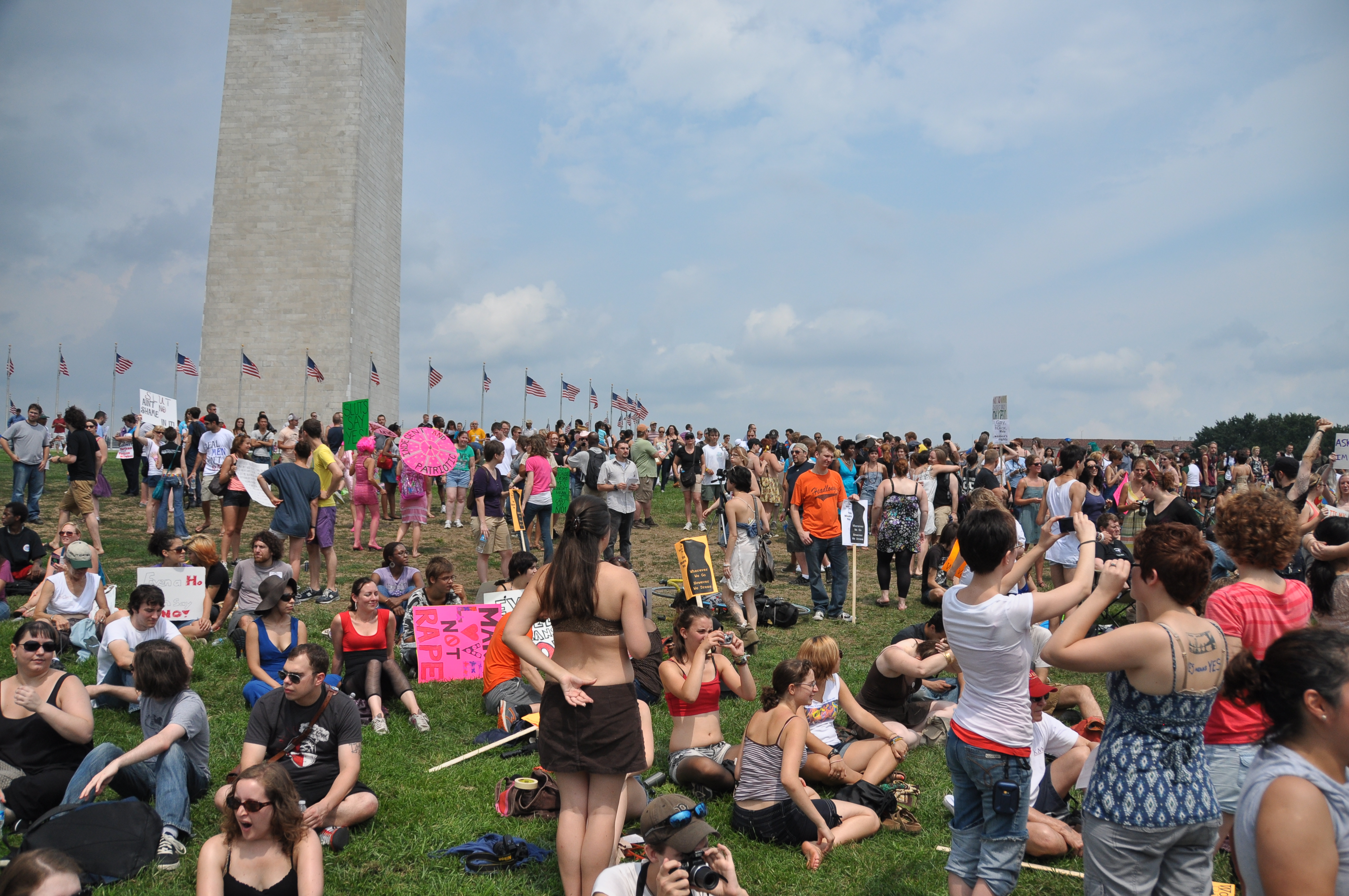
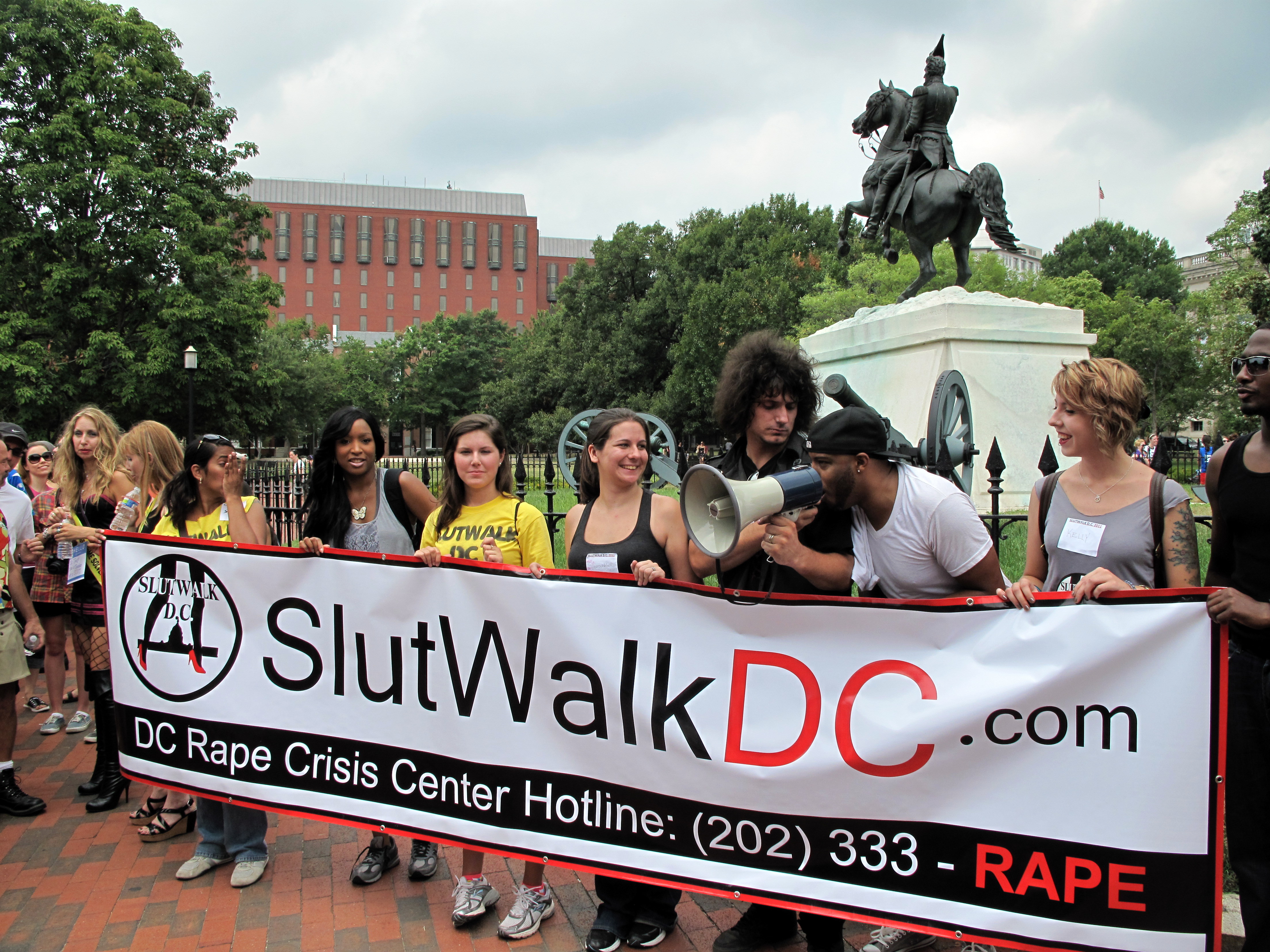
Getting ready to start marching

Today, more than one thousand people walked together down 15th Street in Washington, DC, from the white house to the Washington Monument, many were holding anti-rape, anti-victim-blaming signs. I was one of them. Tourists lined the sidewalks taking photos of us, many cheering and encouraging us as we walked.

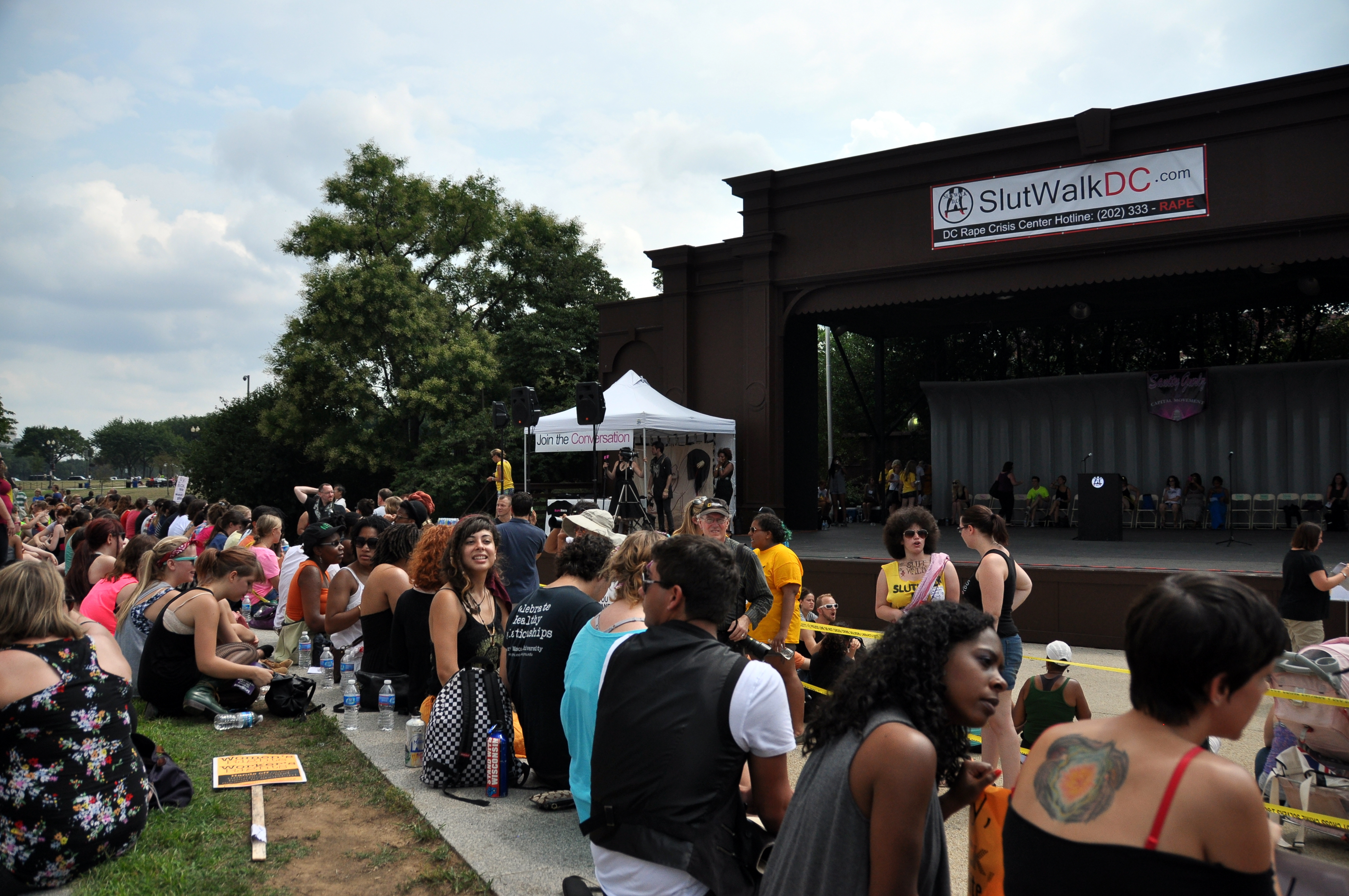
After the walk ended at National Sylvan Theater, hundreds of people gathered on the lawn, with the Washington Monument as the backdrop, to listen to talks by 22 different survivors and activists. I was amazed at the dedication of the audience when a downpour began just moments after the first speaker took the stage. Most members of the audience stood their ground and stayed to listen despite the dark clouds, thunder, and rain. Throughout the talks, the audience was so supportive of everyone, clapping and cheering encouragement and then booing when people mentioned the victim-blaming they have faced.

Most speakers were survivors and they shared stories about how, after the assault(s), they faced blame from family members, police officers, and friends. Or, many of them said they never reported what happened for fear of being blamed. One speaker made a point of wearing the same outfit today that she wore when a former friend sexually assaulted her. When she reported the crime to the police, they asked her multiple times to describe what she was wearing.

Different speakers shared what sexual abuse means for them as women of color and/or as lesbians, as a man, or as a survivor of multiple rapists. Some speakers shared poems they wrote and a few speakers visibly struggled with their emotions while sharing their very personal story with strangers on the national mall. I was touched by how honestly each survivor shared their pain and also by how their unbreakable, resilient spirit shone through.

Activists who spoke shared resources and information to help people connect and find help. For example, Sasha Ponappa, the executive director of the Deaf Abused Women’s Network (DAWN), told us (through an ASL interpreter) that during the three years since she’s been at DAWN, they’ve helped 400 survivors in the deaf community. She noted that victimization is high and anyone who needs help could visit their booth to get more information and get connected to resources. Lauren Taylor, founder of Defend Yourself, gave a mini verbal and physical self-defense demonstration during her talk and invited people to attend future self defense trainings. Later in the afternoon she gave a free self-defense demonstration at her booth.

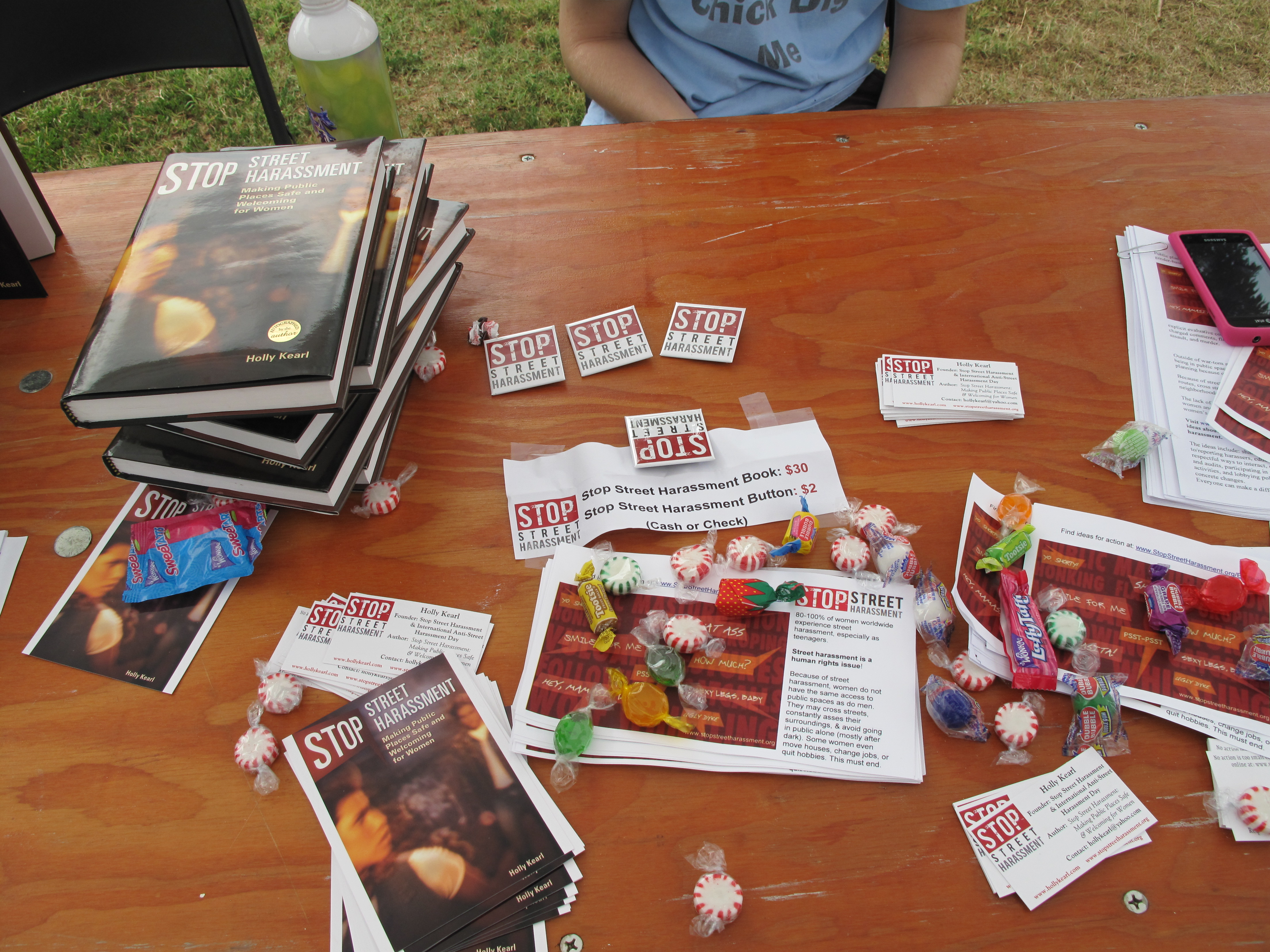
Stop Street Harassment booth

Around the corner from the stage, 20 booths lined the sidewalk, offering people ways to connect with anti-sexual assault, anti-harassment, and pro-consent organizations in the DC area. The DC Rape Crisis Center had a prominent booth and all donations made during SlutWalk DC were given to them. I really appreciated that this SlutWalk allowed people to connect with their local organizations and help them take that “next step” in activism and community organizing.

At the Stop Street Harassment booth, I offered information about what street harassment is, “7 ways to respond to harassers,” and information about accessing this website so people can find resources and ideas for action. I had wonderful staffing help from my very supportive partner, and also from two of my AAUW colleagues Dawn Aldrich and Liz Bolton and one of my former GWU graduate school classmates Helen Luryi (Liz is also a former GWU classmate). During the time I was at the table, it was energizing to talk to people about the issue, hear their stories, and even reconnect with a few people who had heard me speak before. Several people gave me their info so they can get involved the next time there’s a community safety audit in DC.

I am so glad I had the opportunity to participate in SlutWalk DC and I’m grateful to Samantha and Shawn Wright for organizing it. They have never organized an activism event like this before but they felt very passionately about the issue and in all of my interactions with them, their sincerity has shown through. I feel like the day was a healing, empowering, and rejuvenating experience for so many survivors and friends and family of survivors and it helped connect a lot of people to community resources and organizations. I also think that the media attention SlutWalk DC received is a very important piece for helping to change the culture of victim-blaming that continues to exist in our society.

For more on why I participated in SlutWalk DC, here is the transcript of my talk. (Note: I went off script a bit, so not every part is word-for-word what I said, but most of it is.)

Good afternoon, DC!  This SlutWalk is so incredibly inspiring. I’m energized to join you in demanding an end to victim-blaming and slut-shaming. As soon as I learned there would be a SlutWalk DC, I wanted to participate for two reasons.

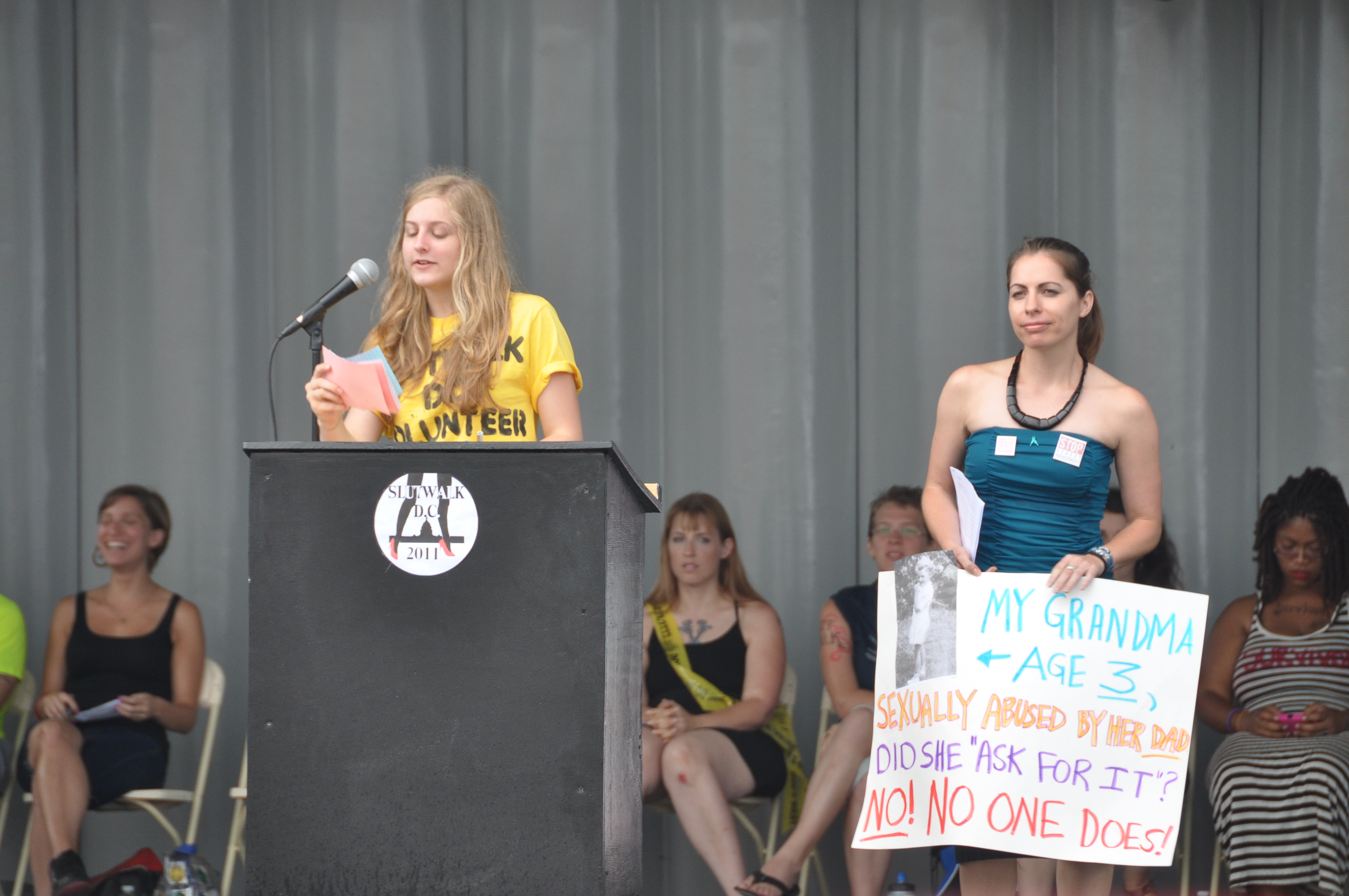
The first reason, and why I know many of you are here, too, is to honor of the survivors of sexual violence that I know and love. In particular, I am here because of my grandmother. In this photo she is 3 years old. Her father was already sexually abusing her. At age 12, a lifeguard raped her. Then as a young teenager, she told her Mormon Church leader about the abuse, and he sexually assaulted her instead of helping her.

Getting ready to speak, holding a poster about my grandma

For decades after that she was silenced by shame and the fear of blame. Its negative effect on her life is still apparent today. Recently she wrote the book The Illness that Healed Me about her healing process with the hopes of being able to help other survivors. Because she talks about the abuse by her father, some of her siblings won’t speak to her.  She, like all rape survivors, never “asked for it.” They should never be blamed or shamed.

The second reason why I’m here is because the mission of SlutWalks relates to the work I do around street harassment. Just as blaming a sexual assault or rape survivor is never okay, it’s never okay when it comes to street harassment.

For those unfamiliar with the term, street harassment ranges from whistling and “catcalls” to sexual comments, flashing, stalking, groping and assault. Since middle school, most of these have been my experiences and studies show it’s the experience of more than 80 percent of women, especially when they are young.

Street harassment is a form of gender violence; just like with sexual assault, it involves a power imbalance and disrespect for the target. When street harassment occurs, it may remind the target, especially women, that they are vulnerable to rape. To rape survivors it can feel retriggering. And for some people, street harassment actually escalates into sexual assault or rape.

It’s also a gender equality and human rights issue because it limits women’s access to public places. In my research I found that some women have changed jobs, moved neighborhoods, and quit hobbies because of harassers. More commonly, women may feel they have to constantly assess their surroundings when they’re in public alone and they may wear headphones and sunglasses to deter harassers.

Despite its documented prevalence and negative impact, too often people say street harassment is a just a minor annoyance, it’s a compliment, or it’s the fault of the harassed individuals because of the way they dress. But focusing on women’s clothing misplaces the blame for the harassment and it doesn’t make sense.

In Egypt and Yemen, where women are modestly dressed and often veiled in public, more than 80% and 90% of women, respectively, face street harassment. Last month, women in Afghanistan organized the first ever anti-street harassment march in Kabul and, wearing their hijabs, demanded an end to the daily harassment they face on the streets simply for being female. Women who share street harassment stories on my website StopStreetHarassment.org often note what they were wearing when harassed: winter jackets, school uniforms, and business suits as well as skirts and dresses.

For me, it’s running clothes. Since 8th grade, I’ve run almost daily, on school teams and alone and I ran my first marathon at age 14. I’ve faced harassment from hundreds of men I do not know. Whistling, honking, comments including, “I like the way your tits bounce when you run,” and even stalking. Just last week when I was on vacation in Montana, two men verbally harassed me during my run. Harassers don’t care if you’re on vacation.

When I run, I’m usually red and sweaty! Just like with other forms of gender violence, street harassment is not about what we wear or how we look. It’s about disrespect and it’s an abuse of power.

But we are taking back that power with our activism, with our SlutWalks and by refusing to be silent. We are creating power by being here today and walking and speaking out together. We must continue to use this power. Let’s demand that our leaders and peers stop telling us to change the way we dress and instead focus more energy and resources on prevention programs!

To conclude, fellow SlutWalkers, keep raising your voices, dressing as you like, and helping to create the changes you want to see. Thank you.

Share

Filed Under: street harassment Tagged With: slut walk dc

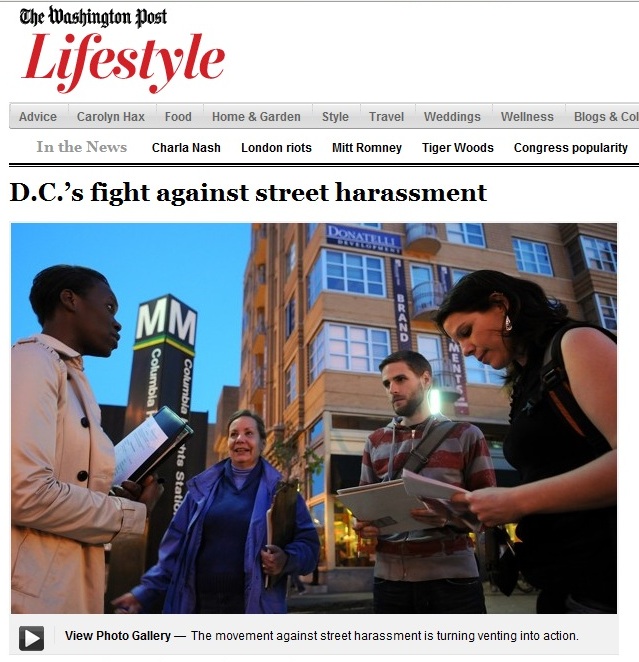
Washington Post covers anti-street harassment efforts

August 11, 2011 By HKearl

I’m happy to share another “the tide is turning” moment in our work to raise awareness about street harassment.

On Sunday, the Washington Post Magazine is running a major article on anti-street harassment efforts in Washington, DC. The important work of Holla Back DC! and anti-harassment guru Marty Langelan (author of Back Off! How to Confront and Stop Sexual Harassment and Harassers) is featured.

The article went online today.

It’s huge that such a major publication would dedicate so much space (five pages!) to anti-street harassment work. More and more people and institutions are recognizing that street harassment is a serious problem, worthy of their attention, and they’re recognizing that we’re not stopping or shutting up. We’re speaking out, taking action, and making sure this issue is acknowledged and then addressed/prevented all over the world.

Let’s keep it up!

I also want to note that the DC community safety audits I helped organize with Holla Back DC! (Langelan was one of the audit team leaders) is featured throughout the article, which is very exciting! For the audits, around 50 volunteers helped us observe more than 10 neighborhoods around DC to look for potentially unsafe areas and to observe any areas with harassers. We went out into neighborhoods for International Anti-Street Harassment Day on March 20 and in the evening of May 5.

A big thanks to METRAC in Toronto for their pioneering work in designing the community safety audit and for their support as we implemented our adapted version in DC, and thanks to the 50 volunteers who gave us their time and passion.

You can catch Holla Back DC! co-founders Chai Shenoy and Shannon Lynberg on the Washington Post’s livechat tomorrow at 1 p.m. EST, discussing their anti-street harassment work further.

Share

Filed Under: hollaback, News stories, street harassment Tagged With: marty langelan, METRAC, safety audits, sexual harassment, street harassment

Hollaback spreads to 13 new cities

August 10, 2011 By HKearl

The anti-street harassment organization Hollaback launches new websites in 13 new cities today. From their press release:

“Today fifty activists from thirteen cities around the world are bringing the movement to end street harassment to their communities in:

Birmingham, UK
Bristol, UK
Chandigarh, India
Chicago, IL
Des Moines, IA
Lawrence, KS
Istanbul, Turkey
Puerto Rico
Queretaro, Mexico
Richmond, VA
Tegus, Honduras
Wellington, NZ
West Yorkshire, UK

“Hollaback! isn’t just an app or a map — it’s a movement,” said Hollaback! Board Chair and co-founder, Samuel Carter. We are now in 37 cities and 15 countries [many of them aren’t active anymore], with leaders speaking more than eight different languages.

“The growth of the movement demonstrates the pervasive nature of street harassment globally,” said Hollaback! International Movement Coordinator, Veronica Pinto. “At the same time, the response of activists around the world is incredible as we see the determination of folks who are fighting for their safety, fighting for their streets, and fighting for the right to be who they are.”

Local Hollaback! site leaders run their local blog and organize their communities through advocacy, community partnerships, and direct action. Site leaders are as diverse in their backgrounds as they are in their experiences of harassment.  Hollaback! reports that 44% lesbian, gay, bisexual, and queer, 26% identify as people of color, 76% are under the age of 30, and 90% are women.

“If I have my way, these won’t just be the leaders of the movement to end street harassment.  These will be the next leaders of the world,” said Hollaback! Executive Director Emily May.

Although most of them are less than six months old, Hollaback! international sites are already having a big impact.  In Bristol, UK, the team is working on an anti-street harassment task force with local officials.  In Atlanta, the team did a community safety audit, and in Buenos Aires, Tegus, and Mexico City, the teams helped to coordinate their cities’ first SlutWalks, which were designed to bring awareness to women’s right to feel safe in public space.

We are currently recruiting activists for the next launch in November.  If you’d like to bring Hollaback home, email us at holla AT ihollaback.org today.

Until then, please congratulate our new sites at ihollaback.org.”

Share

Filed Under: hollaback, street harassment Tagged With: hollaback, street harassment

Police arrest suspected groper

August 9, 2011 By HKearl


Via ABC News

Police have finally arrested a suspect in the Upper East Side groping case in New York City.

Via NBC news:

“Sources say Jose Hernandez, an 18-year-old restaurant worker at Antonucci Cafe on East 81st Street, was taken into custody overnight at his Queens home after police got a tip.

He stopped showing up for work about 10 days ago, near when the time police released an image of his face captured on surveillance video. Police believe the groper is responsible for as many as a dozen groping incidents...

He would come up behind women and grab them in the groin, breasts or rear end. He often reached up their skirts.

In recent days, the suspect has moved away from buildings, striking on a No. 6 train at 68th Street and Lexington Avenue last week, and inside Central Park on Friday.

The police tip came from a man who works in the Upper East Side building that houses the restaurant where Hernandez was employed.”

Hopefully they’ve caught the right man and his groping days will end. Because the commonality for all of his targets was their sex, it wasn’t just the 12 targets who’ve been impacted by this. A woman-hating crime spree like this can make all women living in the area wary and on edge.

Though for too many women in New York City who face daily harassment, knowing a groper was out there probably wasn’t any different from their regular life. They’re always wary. In my research, I found that more than 50 percent of women have been groped by men in public places and a lot of my respondents came from New York City. Men who aren’t labeled “groper” like this suspect are still out there freely groping…

One thing about this story that stood out to me is the importance of reporting our harassers, especially if they touch us. Most women don’t report their gropers (I didn’t when a man groped me near my college campus when I was 18). They may be too stunned, second-guess themselves, blame themselves, or believe that nothing will be done by reporting it.

And you know what, those are reasonable concerns, especially the latter. Nothing may be done initially because of one report. But, what we have to consider is, if our report is the second or third one describing the same type of behavior in the same area, or if later on a second or third person reports something similar to what you said, then the police may do something.

So keep that in mind if someone ever gropes, grabs, or inappropriately rubs up against you, or if they expose themselves. Consider taking the time to report it…your report may be the key that prompts an investigation and action.

Share

Filed Under: News stories, street harassment Tagged With: groping, NYC, sexual assault, street harassment, UES groper

« Previous Page
Next Page »

Share Your Story

Share your street harassment story for the blog. Donate Now

From the Blog

  • #MeToo 2024 Study Released Today
  • Join International Anti-Street Harassment Week 2022
  • Giving Tuesday – Fund the Hotline
  • Thank You – International Anti-Street Harassment Week 2021
  • Share Your Story – Safecity and Catcalls Collaboration

Buy the Book

  • Contact
  • Events
  • Join Us
  • Donate
  • Facebook
  • Instagram
  • Pinterest
  • Tumblr
  • Twitter
  • YouTube

Copyright © 2026 Stop Street Harassment · Website Design by Sarah Marie Lacy